
Where Grooved Pipe Couplings Reduce Installation Time in Fire Protection Piping
Where Grooved Pipe Couplings Reduce Installation Time in Fire Protection Piping
For a fire protection project manager, the piping schedule is rarely just a piping schedule. It is tied to ceiling closure, electrical rough-in, equipment delivery, inspection windows, tenant handover, and often a narrow period when a building can be taken offline. In that environment, Grooved Pipe Couplings are valuable not because they are a universal replacement for every joining method, but because they remove several time-consuming activities from the field installation sequence.
A grooved joint typically combines prepared pipe ends, a gasket, and a two-piece coupling housing tightened with bolts and nuts. In suitable fire sprinkler, standpipe, and fire pump room applications, crews can assemble the connection without welding, threading, hot-work permits, or the same level of post-weld cleanup. That changes the pace of work considerably, especially where access is poor or the project cannot tolerate extended shutdowns.
The schedule advantage is real, but it is not automatic. It depends on the approved system design, the pipe material and wall thickness, groove preparation quality, coupling selection, available prefabrication capacity, and the requirements of the authority having jurisdiction. The strongest results come from deciding early where grooved joining fits the installation plan, rather than treating it as a late substitution when the project is already behind.
The Time Saving Comes From the Installation Sequence
On a conventional welded branch or riser installation, the crew must position the pipe, establish safe access, complete fit-up, weld, inspect as required, address coating repairs, and coordinate hot-work controls. Threaded systems avoid welding but can become labor-intensive as pipe size increases, and they require careful engagement, alignment, and sealant practices. Neither method is inherently wrong; both remain appropriate in many systems. The issue is how much field work they create.
Grooved connections shift much of the effort upstream. Pipe can be cut, grooved, labeled, and bundled in a fabrication shop or controlled staging area. At the point of installation, the crew aligns the pipe ends, seats the gasket correctly, places the coupling housings, and tightens the fasteners according to the manufacturer’s installation instructions. The field task becomes more repeatable. It also reduces dependence on specialized hot-work operations during the busiest phases of construction.
For project controls, that distinction matters. A faster individual joint is useful, but the larger benefit is fewer schedule dependencies: fewer hot-work permits, less fire-watch coordination, less disruption from welding in occupied or sensitive areas, and less waiting for a trade to clear a work zone. Where multiple crews are installing mains, branch lines, valves, and hangers at the same time, those avoided constraints can be more important than the minutes saved at one connection.
Retrofit Work Is Often the Best Fit
Existing buildings are where the practical advantages of Grooved Pipe Couplings are easiest to see. A hospital, data center, manufacturing plant, warehouse, school, or commercial tower may need sprinkler modifications while parts of the facility remain in use. Welding near active operations can trigger serious restrictions. Even when permitted, the preparation around hot work may be more disruptive than the weld itself.
In these conditions, grooved assembly can reduce the amount of fire-risk management required in the work area. It does not remove the need for a disciplined installation plan, but it may help contractors work with smaller shutdown zones and shorter outage windows. A crew can bring premeasured pipe sections into the area, make the mechanical connections, and move on without waiting for welded joints to cool or for additional worksite controls to be released.
Retrofit work also exposes a common planning mistake: assuming every existing pipe is ready to accept a grooved connection. Before committing to the method, the contractor needs to verify actual outside diameter, wall condition, coating condition, remaining wall thickness where relevant, available clearance, and compatibility with the proposed transition. Older pipe may not be as uniform as record drawings suggest. Corrosion, prior repairs, inaccessible supports, and undocumented fittings can turn a simple modification into a field-engineering problem.
The better approach is to survey critical tie-in points early, not after materials are ordered. A few careful measurements and photographs can prevent a large amount of rework when the shutdown window finally arrives.
Congested Mechanical Rooms and Fire Pump Areas
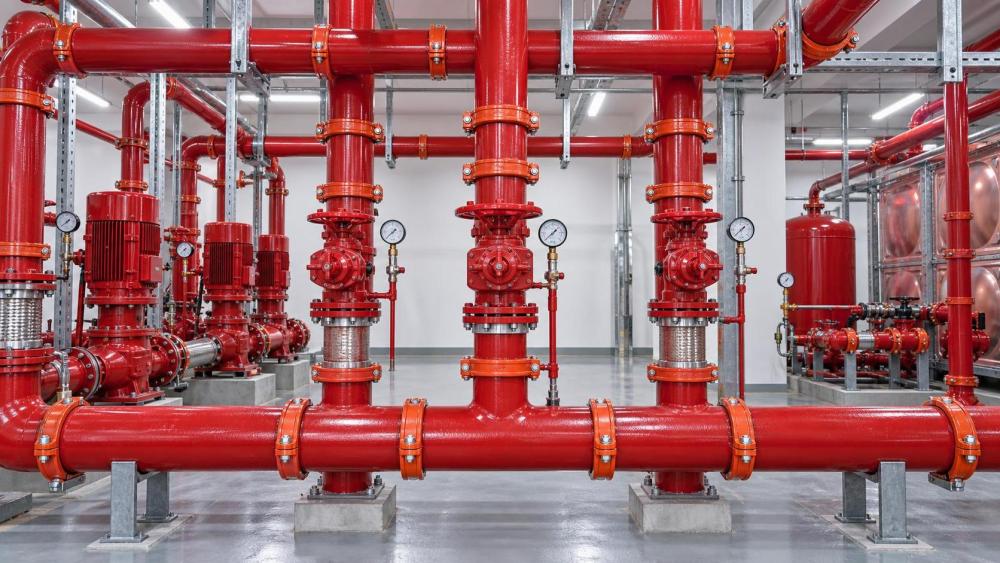
Fire pump rooms, valve rooms, and riser closets are rarely generous spaces. The pipework competes with pumps, controllers, headers, test connections, drains, valves, electrical equipment, structural members, and maintenance clearances. Welding in these locations can be awkward even on a new build. On a renovation, it may be impractical.
Grooved joints are particularly useful where installers need to manage short spool pieces, equipment interfaces, and future access. A removable mechanical joint can make later maintenance less invasive than cutting out a welded section. This is relevant around fire pumps, alarm valves, backflow assemblies, test headers, and other components that may eventually require inspection, replacement, or reconfiguration.
There is, however, a design discipline involved. A coupling is not simply a convenient gap-filler. The selected joint type, gasket grade, pressure capability, restraint characteristics, and permitted movement must match the system’s design. Pipe supports and guides must also reflect the jointing method. If the layout relies on rigid connections to control movement, the support scheme cannot be copied blindly from a different joining approach.
Project managers should ask a direct question during coordination: does the room layout leave enough physical space to assemble and tighten the coupling, inspect the gasket seating, and access fasteners later? A connection that looks fine in a three-dimensional model can still be difficult if a bolt pad ends up against a wall, cable tray, or pump base.
Large Commercial and Industrial Floors Benefit From Repetition
The strongest productivity case on new construction is often found in repetitive installations: large warehouses, distribution centers, manufacturing facilities, data halls, retail complexes, and multi-level parking structures. These projects can involve long runs of mains and branch lines, repeated drops, and numerous fittings installed at elevation. Repetition creates an opportunity to standardize fabrication, labeling, lifting, and installation sequencing.
With a well-organized spool plan, pipe can arrive at the floor or work zone in installation order. Crews do not need to repeatedly measure, cut, and join every length in the air. Instead, they can install pre-prepared sections while another team manages hangers or moves material forward. This helps reduce interruptions caused by missing dimensions, misplaced fittings, or a fabrication station located far from the point of work.
That said, prefabrication only works when drawing control is reliable. Late changes to ceiling elevations, ductwork, cable trays, or structural steel can make an apparently efficient spool package expensive to alter. The project team should avoid releasing large volumes of fabricated pipe before major coordination conflicts are resolved. Grooved systems are forgiving in the sense that sections can be disassembled and adjusted more easily than welded pipe, but “easier to modify” is not the same as “free to modify.”
Where Grooved Joining Does Not Automatically Save Time
It is tempting to specify a grooved system across an entire project and assume the schedule will improve. In practice, several conditions can weaken the advantage. If pipe grooving is performed slowly in the field, if the correct roll-grooving or cut-grooving equipment is unavailable, or if crews have limited experience with the selected coupling system, the savings can disappear. Poorly controlled groove dimensions or damaged pipe ends create inspection failures and rework that are difficult to hide in the schedule.
Material logistics can also become the real bottleneck. A fire protection installation is not made up of pipe alone. Couplings, gaskets, fittings, valves, outlets, reducers, caps, hangers, seismic components where required, and fasteners all need to arrive in the correct quantities and sequence. A project may have hundreds of prepared pipe lengths on site yet lose days because the required fitting configuration or gasket type is missing.
Another issue is mixed-system responsibility. When one team prepares the pipe, another installs it, and a third party supplies fittings, quality ownership can become blurred. The project manager should define who verifies groove condition, who confirms gasket suitability, who records torque or assembly checks where required, and who manages nonconforming material. Mechanical joining is fast when the process is controlled; it is not fast when every issue becomes a debate between suppliers and subcontractors.
A Practical Decision Check Before Release
Before finalizing a grooved fire protection piping approach, the project team should review the system as an installation package rather than a list of components. The following checks tend to expose problems early:
- Confirm that the proposed joining method is accepted for the specific fire protection application, pipe size, pressure condition, and local approval path.
- Verify pipe compatibility, including outside diameter, wall thickness, material condition, coating considerations, and the intended groove preparation method.
- Review coupling type and gasket material against the service environment, including temperature, exposure, and any applicable fluid conditions.
- Coordinate hanger locations, guides, bracing, and movement control with the actual joint characteristics, not a generic piping detail.
- Plan staging so that pipe spools, fittings, couplings, and hardware reach installers together rather than in separate deliveries.
- Use a small first-installation review to confirm crew technique, access, assembly sequence, and inspection expectations before repeating the detail across the project.
The first-installation review is worth emphasizing. A sample run can reveal whether pipe sections are arriving too long for the route, whether coupling bolts are inaccessible, whether lifts can handle spool weight safely, or whether the labeling system makes sense to the field crew. These are modest issues on one riser and major issues across several floors.
Why Procurement Choices Affect the Field Schedule
Fire protection piping is often procured under time pressure, which encourages buyers to compare only unit prices. That can be costly when the project depends on fast mechanical assembly. Couplings and fittings should be evaluated alongside documentation, dimensional consistency, material traceability where required, packaging quality, delivery reliability, technical support, and the supplier’s ability to maintain a complete bill of materials.
This is where a broader industrial sourcing view is useful. Platforms such as Global Industrial Machining & Piping Equipment Network (IMPE) organize the questions that sit behind a catalog description: how materials perform, how fabrication quality affects fit-up, how piping components relate to installation conditions, and what documentation a project team should request before work begins. For procurement teams, the right question is not simply whether a coupling is available. It is whether the supplied system can be installed consistently, inspected confidently, and supported through commissioning.
A low-cost component that arrives without clear technical information, correct accessories, or dependable replenishment can create more risk than it removes. Conversely, a properly coordinated grooved package can simplify field handling and reduce the number of decisions crews must make at elevation or in cramped service areas.
Speed Should Be Designed Into the System
Grooved Pipe Couplings reduce installation time most effectively in retrofit work, confined fire protection rooms, repetitive commercial installations, and projects where prefabrication can be controlled. Their real value is not merely the absence of welding or threading. It is the ability to turn a complex field operation into a more predictable assembly process.
But a fast joint does not compensate for incomplete coordination, unsuitable pipe, weak logistics, or an unapproved design change. The project manager’s job is to make the method part of the construction strategy: verify compatibility early, protect the supply chain, test the installation sequence on a representative area, and keep code compliance and inspection access visible from the first drawing review through final acceptance.
Related News
- Preventing Side Loads and Seal Failures in Tipping-System Telescopic CylindersSep 16, 2026Fluid Power Control Strategist
- What to Audit Before Choosing a Needle Bearing Factory for OEM SupplySep 16, 2026Tribology & Kinematics Expert
- Selecting Machine Vises That Maintain Clamping Accuracy in 5-Axis MachiningSep 16, 2026CNC Kinematics Architect
- How to Specify Rolled Ball Screw Assemblies for Speed, Load, and Positioning AccuracySep 16, 2026Tribology & Kinematics Expert
- Socket Weld Pipe Flanges: When Are They the Right Choice for High-Pressure Lines?Sep 16, 2026Dr. Elias Vance
- What Quality Controls Should a Bearing Retainer Factory Apply Before Shipment?Sep 15, 2026Tribology & Kinematics Expert