
Wear-Resistant Cylinder Seal Kits: Selecting Materials for Abrasive Duty
Abrasive particles can accelerate seal wear, increase leakage, and shorten hydraulic cylinder service life. Yet selecting wear resistant cylinder seal kits is not simply a matter of finding the hardest material. A seal that survives contact with grit may still fail if it is incompatible with the fluid, loses elasticity in the cold, or cannot tolerate pressure peaks. For technical evaluators, the task is to match the entire sealing arrangement to the cylinder’s operating environment and failure history.
The most useful starting question is not “Which material lasts longest?” but “Where are the particles entering, and what are they damaging?” The answer determines whether the priority is a tougher wiper, a different rod seal, better guidance, cleaner hydraulic fluid, or a combination of changes.
Start with the path of contamination
A cylinder on an excavator may carry mud and mineral dust back toward the rod gland on every retracting stroke. A press cylinder, by contrast, may see relatively little external dirt but suffer damage from particles circulating in the hydraulic oil. These are different wear mechanisms, even if both eventually produce leakage.
External contamination typically challenges the wiper first. If dirt remains on the rod, it can enter the gland and abrade the rod seal or score the rod surface. Internal contamination can damage piston seals and cylinder bores, as well as valves and pumps elsewhere in the circuit. Wear particles generated inside the cylinder can add to the problem, creating a cycle in which damaged surfaces produce still more contamination.
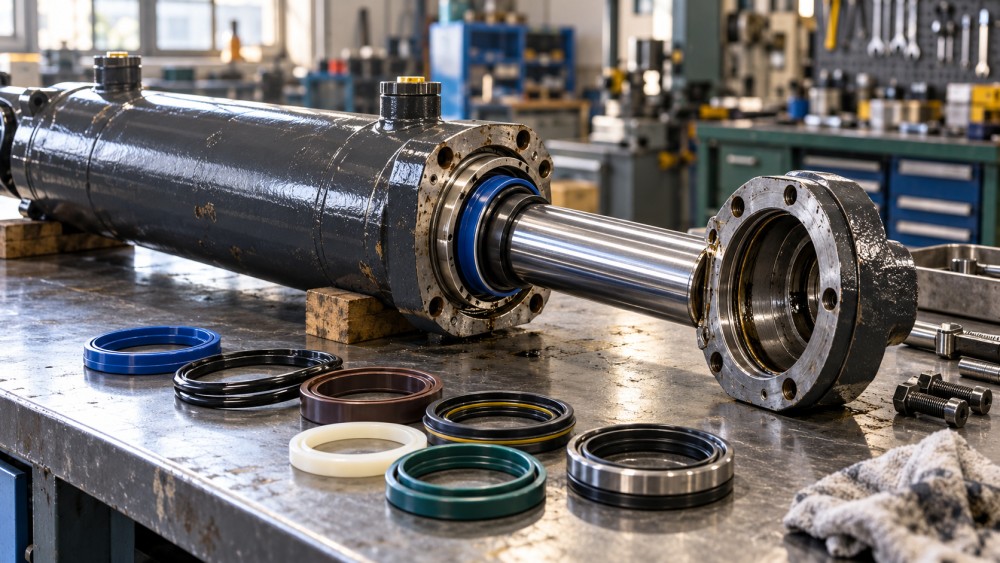
During evaluation, record whether the previous kit showed localized cuts, broad abrasion, extrusion, hardened lips, or uneven wear. Check the rod and bore alongside the seals. A replacement kit installed over a scored rod or in a cylinder with excessive side loading may fail for the same reason as its predecessor.
Comparing seal materials for abrasive duty
Material names are useful screening tools, not performance guarantees. Polyurethane, PTFE and elastomers each cover families of formulations, and their behavior depends on fillers, hardness, geometry and operating conditions. The table below provides a starting point for discussion with a seal supplier.
A polyurethane rod seal can be a practical choice for many mobile hydraulic cylinders exposed to dirt, but the grade must still suit the fluid and ambient conditions. Some polyurethane compounds are more susceptible than others to degradation in hot, wet environments. Ask the supplier about the specific formulation rather than assuming every PU seal behaves alike.
Filled PTFE may be attractive when low friction, chemical exposure or a wider temperature envelope drives the design. However, a PTFE sealing element is frequently part of a composite arrangement, with an elastomeric O-ring or another component supplying energizing force. The energizer must survive the same fluid and temperature conditions as the primary seal. A chemically resistant PTFE ring paired with an unsuitable elastomer is not a chemically resistant assembly.
Elastomers also deserve attention even when they are not the main sliding surface. Static O-rings, secondary seals and energizers can harden, swell or lose resilience, allowing leakage or reducing contact pressure. Review every material in the kit, not just the component advertised as wear resistant.
Evaluate the kit as a system, not a collection of rings
Wipers: the first decision point for dirty rods
A wiper removes contaminants from the rod as it retracts. Its lip profile, material and fit in the gland matter as much as its material family. For wet mud, dry dust or adhesive debris, ask how the proposed profile clears the contaminant without trapping excessive fluid between the wiper and rod seal.
Some wipers provide additional sealing action, but their interaction with the rod seal must be checked. An unsuitable combination can trap pressure between components and contribute to leakage or damage. More aggressive contact is not automatically better if it causes excessive friction or accelerates rod wear.
Rod and piston seals: pressure changes the wear picture
Dynamic seals must maintain contact while sliding against a lubricated surface. Pressure, speed, stroke frequency and dwell time influence that contact. Pressure spikes and larger clearances can also promote extrusion, particularly when temperature softens the material. In those conditions, a suitable anti-extrusion ring or a different seal profile may be necessary.
Check the cylinder’s maximum working pressure and credible transient pressures, not only its normal gauge reading. Confirm the manufacturer’s allowable extrusion gap for the selected seal at the actual temperature and pressure. A kit that fits the groove dimensionally is not necessarily rated for the application.
Wear rings: often overlooked until metal contact appears
Wear rings guide the piston or rod and help manage side loads. If guidance is inadequate, the rod or piston can move off-center, increasing local seal contact and risking metal-to-metal contact. An upgraded seal lip cannot compensate indefinitely for worn bearings, misalignment or structural side loading.
When inspecting an abrasive-duty cylinder, examine guide surfaces, ring thickness and clearance. Also review the source of side loads: attachment geometry, mounting condition and machine operation may matter as much as the ring material.
Operating conditions that can change the material choice
Fluid chemistry. Identify the exact hydraulic fluid and, where relevant, cleaning agents or process media that may reach the seal. Mineral oil, water-containing fluids and synthetic fluids do not have interchangeable compatibility profiles. Obtain compound-specific guidance, including compatibility for energizers and backup rings.
Temperature. Consider cold starts, continuous operating temperature and short-duration peaks. A seal may become too stiff to follow the surface at low temperature, while sustained heat can accelerate aging or change mechanical properties. Temperature at the seal can differ from the reservoir temperature, especially where friction or local heat sources are significant.
Surface finish and condition. Rod and bore surfaces must retain enough lubrication while avoiding damaging roughness or defects. A highly polished surface is not automatically ideal, and a nominal roughness value alone may not reveal scratches, pits or directional machining marks. Use the seal manufacturer’s finish requirements and inspect for damage along the stroke path.
Speed and duty cycle. Long idle periods followed by rapid movement can challenge breakaway behavior; frequent cycling can increase cumulative wear and heat. Share expected speeds, stroke lengths, frequency and dwell periods with the supplier so the proposed profile can be evaluated realistically.
Particle exposure. Describe the contaminant, not just the environment. Fine dust, sharp mineral particles, wet slurry and metallic debris may require different responses. Where practical, inspect used seals and fluid samples to distinguish external dirt ingress from contamination already circulating in the system.
A practical selection workflow for technical teams
- Define the failure mode. Separate visible external leakage from internal bypass, and document the condition of the wiper, rod seal, piston seal and guides. Note whether damage is uniform or concentrated on one side.
- Confirm the hardware. Measure the rod, bore and seal grooves; identify existing profiles and check clearances against the applicable cylinder and seal specifications. Record surface damage before deciding that a material change is sufficient.
- Build the operating envelope. Include fluid identity, operating and peak pressure, temperature range, speed, cycle pattern, side loads and likely contaminants. Identify unusual events such as cold starts or pressure intensification.
- Compare complete configurations. Request the material and profile for each component, including wipers, energizers, backup rings and guides. Ask what changes from the existing kit and which failure mechanism each change addresses.
- Verify installation and validation. Confirm assembly methods, lubrication, tooling and any restrictions on stretching or heating seals. For critical equipment, agree on a trial and inspection plan with the equipment owner and supplier before broad deployment.
A useful trial compares like-for-like duty where possible. Track leakage, rod condition, operating hours or cycles, fluid cleanliness and observations at inspection. Avoid attributing an improvement to seal material alone if the rod was also refinished or filtration was changed. Those interventions may be valuable, but their effects should be recorded.
What to request before approving a wear-resistant seal kit
For procurement and engineering review, a supplier response should make the proposed configuration traceable to the application. The following information is worth requesting:
- Component list, dimensions, profiles and material identification for all dynamic and static seals.
- Operating limits and compatibility guidance for the stated fluid, temperature, pressure, speed and extrusion gap.
- Recommended rod and bore surface conditions, groove tolerances and guidance clearances.
- Installation instructions, storage requirements and any restrictions on lubricants or assembly tools.
- Relevant inspection records, material documentation and test information where required by the project specification.
If the supplier cannot identify the compound beyond a generic label such as “PU” or “PTFE,” ask for enough technical information to assess the operating limits. Proprietary formulations need not be fully disclosed, but the evaluator should be able to determine whether the complete kit is suitable for the stated conditions.
When a material upgrade is not the answer
Repeatedly replacing a damaged rod seal can be frustrating, particularly when each failure brings downtime and another maintenance decision. But if the rod is scored, the gland is misaligned or contaminated oil continues to circulate, a different seal material may only postpone the next repair. Likewise, a strong wiper cannot correct an undersized guide arrangement or remove particles already inside the circuit.
The best choice of wear resistant cylinder seal kits therefore comes from combining material selection with surface inspection, contamination control and sound cylinder geometry. Compare the trade-offs in the context of the whole assembly, document the operating assumptions, and choose a kit whose performance claims can be checked against the actual duty.
Related News
- Why Is Your Heavy-Duty Piston Pump Losing Pressure Under Load?Nov 09, 2026Fluid Power Control Strategist
- Cartridge Valves for Manifold Blocks: Avoiding Cavity Fit ProblemsNov 09, 2026Fluid Power Control Strategist
- Large-Diameter Forged Rings: How Seamless Rolling Affects Grain FlowNov 09, 2026Foundry Phase-Change Fellow
- Sealed Heavy-Duty Roller Bearings: Choosing Seals for Dust and WaterNov 09, 2026Tribology & Kinematics Expert
- Sprockets and Chain Drives: What Determines Replacement Cost?Nov 08, 2026CNC Kinematics Architect
- Monoblock Hydraulic Control Valves: Flow Rating and Spool SelectionNov 08, 2026Fluid Power Control Strategist