
Lead Screw Price Breakdown: What Drives Cost in Precision Motion Systems?
It often starts with a quote that looks simple enough: one lead screw, one nut, one delivery time. Then the questions begin. Why is one supplier’s offer much higher than another when the drawings seem similar? Why does a small change in thread form or straightness suddenly affect the price so much? And why do low-cost options sometimes create more trouble later, especially when the screw is part of a positioning system rather than just a basic linear drive?
In purchasing work, this is a common pain point because lead screw price is rarely just the cost of a metal rod with threads. The quote reflects machining difficulty, tolerance control, material choice, inspection effort, and the level of risk the supplier is taking. If those cost drivers are not clear at the beginning, teams may compare offers that are not truly equivalent. That can lead to delayed approvals, repeated RFQ cycles, unexpected quality discussions, and in some cases a motion system that does not perform as expected after assembly.
A more useful way to review pricing is to stop asking only, “Which quote is cheaper?” and start asking, “What exactly am I paying for, and which of those items matter for this application?” Once that shift happens, supplier comparison becomes much easier and internal discussions usually become more practical as well.
Where quote confusion usually begins
Many buying teams receive lead screw quotations after sharing only a drawing and a target quantity. That sounds reasonable, but the drawing may not fully express the application risk. A screw used in a manual adjustment mechanism is not priced the same way as a screw used in a repeatable precision motion system, even when the outer dimensions are close. If the supplier expects tighter control over backlash, lead accuracy, concentricity, or surface finish, the manufacturing route changes. More process control means more cost.
Another common issue is assuming that every “precision” lead screw is made in the same way. In practice, price can shift depending on whether the screw is rolled or machined, whether the thread profile is standard or custom, whether straightening is simple or demanding, and whether the nut interface requires matching work. The purchase decision becomes difficult when quotations arrive with limited technical detail and internal stakeholders want a fast answer.
The parts of the price that deserve attention
When buyers review a quotation, it helps to separate the number into cost logic rather than treating it as one opaque total. Most lead screw price differences come from a few repeat factors.
Material and base stock condition
Material grade matters not only because of raw metal cost, but because it influences machinability, wear behavior, corrosion resistance, heat treatment response, and long-term dimensional stability. A carbon steel screw for light industrial use will not be priced like a stainless option for a more corrosive environment, and neither will match an alloy steel grade selected for higher load or wear resistance. Some applications also require specific bar straightness or pre-treated stock, which raises starting cost before machining even begins.
Thread manufacturing method
This is one of the biggest drivers. Rolled threads are often more economical for higher volumes and standard forms, especially when the application allows that route. Machined threads may cost more because cycle time is longer and process control can be tighter, particularly for custom geometries or short runs. If a design includes unusual pitch, non-standard starts, special end features, or a requirement for smoother running in a controlled assembly, thread generation becomes a larger part of the quotation.
Tolerance and lead accuracy
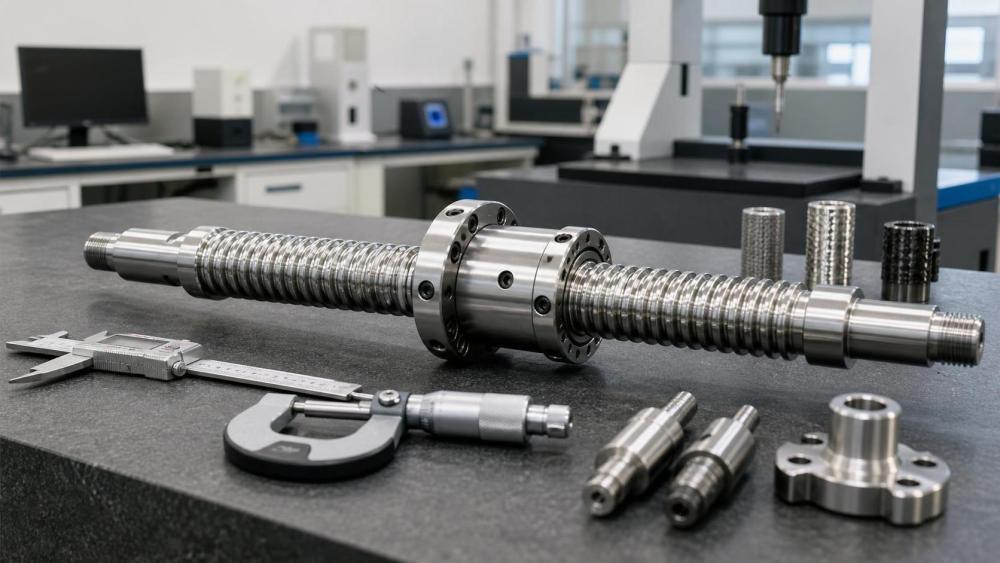
A quote usually climbs when accuracy expectations move from general motion to controlled positioning. That increase does not come from paperwork alone. It can involve more precise setups, slower cutting parameters, additional in-process measurement, straightness correction, and final inspection. The same applies to runout, concentricity between journals and threads, and fit between screw and nut. Small tolerance notes on a drawing can create large pricing changes because they affect the entire production plan.
Surface finish and post-processing
Some buyers focus on dimensions and overlook finishing requirements. But in motion systems, surface roughness can influence wear, friction behavior, lubrication retention, and operating feel. Grinding, polishing, coating, or protective treatment may all add cost. If corrosion protection is needed, that must also be reviewed carefully because some treatments interact with fit, thread geometry, or later assembly operations.
End machining and assembly interfaces
In many projects, the threaded section is only part of the work. Bearing seats, shoulders, keyways, snap ring grooves, coupling ends, locknut threads, and mounting features often require multiple setups. The more interfaces the screw must satisfy, the more chances there are for stack-up issues, scrap risk, and inspection time. This is one reason a lead screw with simple central threading may be easy to price, while a screw with detailed end geometry can vary widely across suppliers.
Nut type and matched performance
The screw alone does not define system behavior. If the quotation includes a matching nut, cost can depend on nut material, anti-backlash features, preload approach, insert design, and fit tuning. A buyer comparing one quote that includes only the screw with another that includes a fitted screw-and-nut pairing may think the price gap is excessive when the scope is actually different.
The mistake of comparing by drawing only
A frequent procurement problem is treating the drawing as the full commercial definition. Drawings matter, of course, but they do not always capture application context. If a lead screw runs at low duty in a guarded enclosure, some features may be acceptable at a lower manufacturing grade. If it sits inside equipment where repeatable positioning, low backlash, and smooth travel matter, the same-looking geometry may need much better process control.
This is why two suppliers can quote very different numbers while both claim compliance. One may be pricing to minimum print interpretation. The other may be pricing to the likely functional requirement behind the print. Neither approach is automatically wrong, but the buyer needs to know which one is being offered.
A more reliable comparison starts by clarifying use conditions: load direction, travel length, duty cycle, speed, lubrication method, operating environment, target life, and whether replacement in service is easy or disruptive. That context helps prevent the low quote from becoming the expensive choice later.
How to read a lead screw quotation without getting lost
If you are trying to make a sourcing decision under time pressure, the easiest way to reduce confusion is to review quotations in layers rather than all at once.
First, identify the non-negotiable functional points. These usually include thread form, pitch, overall dimensions, end interfaces, material family, and the few tolerances that actually affect assembly or motion accuracy. If those are not aligned across suppliers, the numbers are not yet comparable.
Next, look for hidden process assumptions. Is the screw rolled or machined? Is heat treatment included? Is surface treatment included before or after final machining? Is the nut part of the quotation? Is inspection routine or expanded? Has the supplier assumed standard packaging, rust prevention, or any matched-fit work? Small omissions in the commercial scope often explain why one lead screw price looks unusually attractive.
Then review quantity and repeatability. Some suppliers quote aggressively for prototype volume but price differently once repeat orders require more stable process control or dedicated tooling. Others may price a small batch higher because setup time dominates. For procurement teams managing both pilot and ongoing demand, it helps to ask whether the quoted route is suitable for scale or only for the current lot size.
When the lower unit price is not the lower total cost
Industrial buyers already know this in principle, but lead screws are a good example of how the issue appears in practice. A cheaper component can increase the hidden cost of approval, incoming inspection, assembly adjustment, downtime, and replacement planning. That does not mean the highest quote is best. It means the true comparison should include the risk of mismatch between quoted quality and actual application need.
For example, if a screw is part of a system with bearings, couplings, guides, and motor alignment already fixed, variation in journals or lead can create downstream labor even when the part itself technically meets a basic print. The purchasing decision becomes stronger when suppliers are asked not only for price, but for manufacturing assumptions and inspection boundaries. That usually surfaces differences early, before production begins.
Questions that help before approving the order
Not every project needs a long technical review, but a few well-placed questions can change the quality of the decision. Ask how the thread is produced and whether that method is standard for the specified geometry. Ask which dimensions are controlled most tightly during production, not just which ones are listed on the drawing. Ask whether the supplier expects any tolerance interaction between heat treatment, straightening, finishing, and final inspection. If the assembly uses a nut, ask whether fit is supplied as a standard pairing or if tuning is expected during your own assembly stage.
These questions are especially useful when sourcing through industrial information channels or reviewing multiple machining suppliers with different strengths. Some vendors are strong in standard power transmission components. Others are better at precision machining, inspection discipline, custom end features, or low-volume special parts. The right choice depends less on general catalog coverage and more on whether the supplier’s process matches the motion requirement you actually have.
A practical way to balance budget and precision
If internal teams are split between cost pressure and engineering caution, it helps to divide the decision into three bands. One band covers features that protect core performance and cannot be traded away easily. A second band covers enhancements that improve life or assembly convenience but may be negotiable. A third band covers preferences that are nice to have yet not functionally critical.
This approach often reduces debate. Instead of arguing over the whole quote, the team can discuss whether the higher price is tied to a real performance need or to a specification that could be simplified. Sometimes the best savings do not come from pushing a supplier down on unit price. They come from removing unnecessary finishing, relaxing a non-critical tolerance, standardizing an end feature, or aligning the design with a more common thread form.
For buyers working across broader industrial equipment categories, this way of thinking is familiar. Whether the item is a machined shaft, a valve body, a gearbox component, or a lead screw, the same rule applies: cost follows manufacturing difficulty, quality control effort, and the consequences of failure in use.
FAQ
Is a higher lead screw price always a sign of better quality?
No. A higher quote may reflect tighter tolerances, more inspection, different material, or simply a supplier’s cost structure. The important point is whether the extra cost matches your actual motion requirement.
Should I always ask for the lowest possible tolerance?
Only where it matters. Unnecessarily tight tolerances raise machining and inspection cost. If a feature does not affect fit, load transfer, or positioning behavior, it may not need premium control.
Can I compare two quotations if both suppliers say they meet the drawing?
Not safely without checking process assumptions. The same drawing can be interpreted with different manufacturing routes, inspection depth, and scope inclusions.
Does quantity change pricing a lot for these parts?
It can. Setup time, tooling, inspection planning, and whether the thread form is standard all influence how much volume affects the final number.
When a quote seems hard to judge, the problem usually is not the arithmetic. It is the missing context behind the arithmetic. Once material, thread method, tolerance level, end machining, finishing, and supplier capability are made visible, lead screw price becomes easier to evaluate and defend internally. That is the point where procurement moves from chasing a number to making a sound motion-system decision.
Related News
- How to Assess a Rigid Coupling Supplier for Bore Accuracy and Traceable QualityOct 08, 2026Tribology & Kinematics Expert
- Titanium Alloys Compared: Balancing Strength, Corrosion Resistance, and MachinabilityOct 08, 2026CNC Kinematics Architect
- Where Ductile Iron Dismantling Joints Reduce Alignment Risk in Water PipelinesOct 08, 2026Pipeline Metallurgy Scientist
- Selecting a Precision Bearing Sleeve: Fits, Runout, and Material ChoicesOct 08, 2026Tribology & Kinematics Expert
- Face Milling Cutters: How Insert Geometry Affects Finish on Steel and AluminumOct 08, 2026CNC Kinematics Architect
- Single-Acting Cylinders for Clamping: Stroke, Force, and Return Spring ConsiderationsOct 07, 2026Fluid Power Control Strategist