
Why Splined Shafts Fail in Gearboxes and How to Prevent Fretting Wear
Why Splined Shafts Fail in Gearboxes and How to Prevent Fretting Wear
Splined shafts for gearboxes rarely fail without warning. In many cases, the final stripped tooth, cracked hub, or seized connection is only the visible end of a longer process: slight movement between mating surfaces, progressive loss of fit, disrupted lubrication, and repeated torque reversals. By the time a gearbox becomes noisy or develops a pronounced vibration, the spline interface may already have lost much of its effective load-bearing contact.
For maintenance teams, the practical challenge is not simply replacing a worn shaft. It is identifying why the spline moved, why the protective lubricant film broke down, and whether the replacement part will repeat the same failure pattern. A new shaft installed into a worn mating hub, on a misaligned drive, or with an unsuitable grease can return the equipment to service briefly while leaving the original damage mechanism untouched.
This matters in conveyors, pumps, mixers, crushers, mobile equipment, machine tools, process lines, and other applications where a gearbox must transfer fluctuating torque over long operating periods. A splined connection is compact and efficient, but it depends heavily on fit, geometry, material condition, and assembly discipline.
Fretting Wear Begins With Movement Too Small to See
A spline is intended to distribute torque through multiple tooth flanks. In a healthy assembly, contact is reasonably shared across the engaged length and the shaft remains positioned relative to its mating component. Fretting begins when microscopic relative motion develops at the contact faces. That motion may be only a very small oscillation, but under repeated load it removes surface films, disrupts lubricant, and generates fine metallic particles.
Those particles can oxidize into the characteristic red-brown or dark powder often found around a worn spline. This debris is a useful warning sign, but it should not be dismissed as ordinary rust. In an operating connection, it can indicate that the teeth are rubbing under load rather than transmitting torque through stable, properly supported contact.
As wear progresses, backlash increases. The shaft then accelerates through a greater clearance each time torque changes direction or load rises. Impact at the tooth flanks becomes more severe, concentrating stress on fewer teeth and making the connection increasingly vulnerable to pitting, plastic deformation, tooth thinning, and eventual shear. This is why a spline problem often accelerates after an apparently long period of moderate wear.
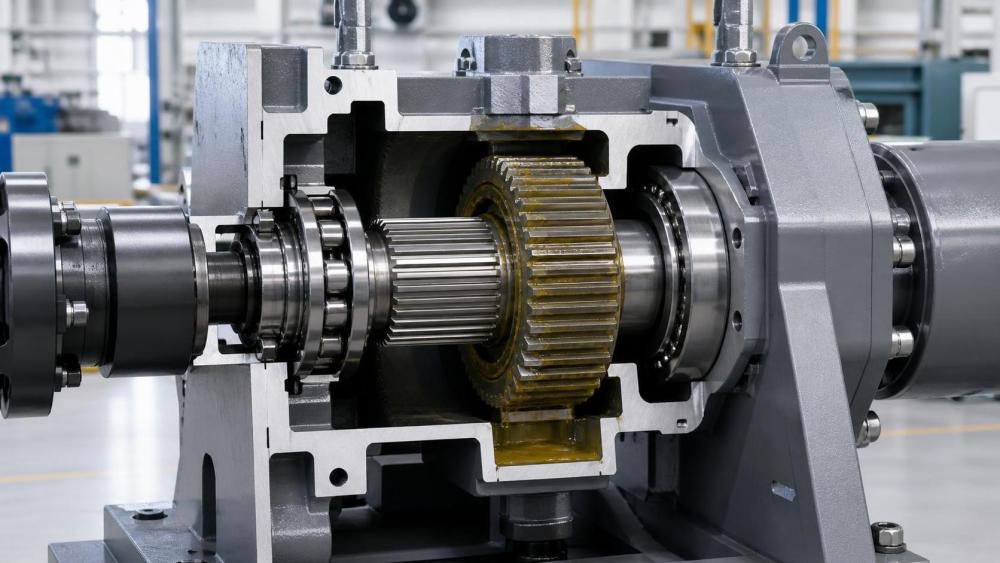
The Main Reasons Gearbox Splines Lose Their Fit
Poor fit is one of the most common contributors. A spline with excessive clearance permits micro-motion from the beginning. This may result from an incorrect shaft specification, machining variation, wear in the internal spline, or a replacement part made to a nominal profile without confirming the actual mating geometry. Tooth count and outside diameter alone are not enough to establish interchangeability. Pressure angle, tooth form, pitch, fit class, engagement length, root geometry, and flank condition all affect how torque is shared.
The opposite problem can also be damaging. An interference condition or burrs on the spline can make assembly difficult and produce high local contact stress. Forcing a shaft into place may score tooth flanks, distort edges, or hide a mismatch that will later create uneven load distribution. A spline should not be treated as a simple sliding fit when its geometry is responsible for transmitting substantial torque.
Misalignment is another frequent root cause. The gearbox may be correctly manufactured, yet a bent driven shaft, worn bearing, soft mounting base, distorted housing, loose coupling, or pipe strain from connected equipment can shift the load path. In hydraulic pump drives, for example, external loading and coupling alignment can affect gearbox bearings and then the spline interface. In conveyor or crusher systems, frame movement and shock loading may have the same effect. The spline is often blamed because it is visibly worn, while the original problem is bearing movement or system alignment.
Lubrication failures deserve equal attention. Some spline couplings are lubricated by gearbox oil, while others need a specified grease applied during assembly or replenished through a dedicated arrangement. A lubricant that is too thin, incompatible with operating temperature, washed out by contamination, or absent from the engaged length cannot maintain separation between moving surfaces. Water ingress, abrasive dust, degraded seals, and poor breather condition make the situation worse. Once debris enters the spline, it can act as an abrasive compound under cyclic load.
Load Conditions That Turn Minor Wear Into a Failure
Not every gearbox runs under smooth, steady torque. Reversing drives, frequent starts and stops, jam-prone conveyors, mixers processing variable material, and mobile machinery exposed to changing traction loads all impose repeated torque changes. These conditions encourage relative movement at any interface that already has clearance. Shock loads can also overload only part of the spline engagement if the shaft is deflecting or the mating hub is not fully supported.
Overhung loads should be reviewed rather than assumed acceptable. A pulley, sprocket, fan, or coupling mounted beyond the bearing support can bend the shaft and alter contact across the spline length. The gearbox may still run, but spline teeth can begin carrying load at one end or along a limited portion of the flank. Uneven contact is especially damaging because it defeats the basic design advantage of a multi-tooth torque connection.
Temperature also changes the operating picture. High temperatures can reduce lubricant viscosity, accelerate grease deterioration, and affect clearances. Low temperatures may make some lubricants too stiff to distribute properly during startup. Where a gearbox operates near furnaces, outdoors, in washdown areas, or on equipment with irregular duty cycles, the lubrication and sealing arrangement should be assessed for the actual environment rather than for a generic indoor condition.
Inspection: What to Look for Before Ordering a Replacement
A visual check is valuable, but it should be systematic. Clean the components enough to distinguish old lubricant from oxide debris and to see the full tooth profile. Look for polished areas on only one side of the teeth, rounded or hooked flanks, corrosion pits, stepped wear at the ends of engagement, cracked tooth roots, raised burrs, and evidence that the hub has been moving axially. Compare the pattern on the external and internal splines; a damaged shaft paired with a seemingly acceptable hub may still indicate a mismatch or partial contact condition.
Backlash should be assessed in the installed position where possible, but it must be interpreted carefully. Excess movement can originate in gears, bearings, couplings, keys, or other driveline elements, not only in the spline. A dial indicator can help quantify relative movement during controlled rotation, while vibration history and operating noise may reveal whether the fault develops under load, during reversals, or at a particular speed.
Before a replacement is specified, record more than the shaft diameter. Useful information includes the number of teeth, spline form, major and minor diameters, engagement length, shaft shoulder locations, bearing journals, retaining features, surface condition, material or hardness information if available, and the type of mating component. Original drawings, gearbox manuals, and previous repair reports can help, but the actual parts should be measured when there is evidence of wear or prior non-original repairs.
Repair or Replace? Avoid the “New Shaft, Old Problem” Cycle
A shaft should not automatically be reused because its teeth are still recognizable. Once the flanks are heavily fretted or deformed, the original contact geometry may no longer be recoverable. Dressing burrs can be appropriate for minor assembly damage, but it does not restore lost tooth thickness or correct a worn fit. Similarly, adding grease to a connection that has already developed substantial backlash may quiet the system temporarily without restoring torque capacity.
When damage is significant, the shaft and internal spline should usually be evaluated as a pair. Replacing only one component can create an unfavorable match between new and worn teeth. The decision depends on the gearbox design, the cost and availability of the mating part, remaining wall thickness, and whether the component can be remachined or replaced without affecting other critical dimensions. Repair methods should be reviewed against the original functional requirements, not merely against the ability to make the parts fit together during assembly.
Material and heat treatment are central to this judgment. Splined shafts for gearboxes are commonly expected to balance core toughness with sufficient surface resistance to wear and fatigue. The appropriate material route depends on shaft size, load spectrum, tooth form, manufacturing process, and the hardness of the mating member. A harder surface is not automatically the better answer: excessive brittleness, poor case-depth control, grinding damage, or an unsuitable hardness relationship between shaft and hub can introduce different problems. Material certificates, heat-treatment records, and dimensional inspection reports are especially useful when sourcing a custom replacement for a heavily loaded drive.
Assembly Practices That Make a Real Difference
Cleanliness matters more than it appears. Before installation, remove old debris, hardened grease, corrosion products, and raised material from both spline members. Inspect the tooth roots and edges under adequate lighting. If the shaft cannot enter smoothly by the intended assembly method, stop and determine why. Driving a component into position with excessive force can damage the very flanks that need to share torque evenly.
Use the lubricant recommended by the equipment manufacturer where that information is available, and confirm whether the spline is intended to receive grease, gearbox oil, or another controlled lubricant arrangement. More lubricant is not always better if it blocks a required seating surface, collects contaminants, or is incompatible with seals. The aim is a stable film at the active contact surfaces and a sealing arrangement that keeps contaminants out.
Alignment checks should include the connected machine, not just the gearbox. Verify bearing condition, coupling position, foundation fasteners, mounting surfaces, and driven equipment runout. On systems with a history of recurring spline wear, it is often worth reviewing operating events as well: repeated jams, abrupt direction changes, incorrect torque-limiter settings, or frequent overload trips can explain why an apparently sound replacement is failing early.
Building a More Useful Maintenance Record
A failed spline provides evidence that should not be discarded with the removed part. Photograph the wear pattern, preserve a sample of debris if contamination is suspected, record the lubricant condition, and note which tooth flanks carried the heaviest damage. These details can help distinguish fretting from corrosion, overload, poor machining, incomplete engagement, or misalignment.
For organizations managing mixed fleets or legacy equipment, structured component information is often the missing link between repair activity and root-cause control. IMPE organizes practical knowledge across gearboxes, forged shafts, bearings, machining processes, lubrication systems, and related power-transmission components. That cross-disciplinary view is useful because spline durability is rarely determined by one part drawing alone; it reflects the interaction of tolerances, metallurgy, bearings, assembly, and the duty imposed by the machine.
The most reliable prevention strategy is therefore straightforward but demanding: confirm the correct spline geometry, inspect both mating members, control alignment and bearing movement, maintain the intended lubricant film, and investigate abnormal torque events before fitting replacement parts. If the original drawing or service history is incomplete, measure the actual assembly and have the replacement specification reviewed against operating load, fit requirements, material condition, and the available inspection evidence. That work is usually far less disruptive than opening the gearbox again after another preventable spline failure.
Related News
- Using Industrial Air Blow Guns to Clear Chips Without Spreading DebrisOct 15, 2026Fluid Power Control Strategist
- Ductile Iron Pipe Valves: Which AWWA Standards Apply to Water Main Projects?Oct 15, 2026Dr. Elias Vance
- Why Vacuum Suction Cups Lose Grip on MDF in Woodworking MachinesOct 15, 2026CNC Kinematics Architect
- Choosing a Variable Displacement Piston Pump Manufacturer: What to VerifyOct 15, 2026Fluid Power Control Strategist
- Parallel vs. Angular Pneumatic Grippers for Confined Assembly StationsOct 15, 2026Fluid Power Control Strategist
- Die Castings vs. Investment Castings: Which Costs Less at Your Production Volume?Oct 14, 2026Foundry Phase-Change Fellow