
Why Gear Motors Overheat: Load, Duty Cycle, and Ventilation Checks
A gear motor that runs hot during a shift is not automatically defective, but it should never be treated as normal without checking the operating conditions. Excess temperature can thin or oxidize gearbox lubricant, shorten winding insulation life, harden seals, and accelerate bearing wear. In a conveyor, pump, mixer, hoist, or packaging machine, the first visible symptom may be a hot housing, but the actual cause is often excessive torque demand, an unsuitable run/rest pattern, or restricted airflow around the motor.
The practical starting point is to separate motor heat from gearbox heat, then compare the temperature condition with load, operating time, and ambient environment. A gear motor may overheat because it is overloaded, because it is correctly loaded but operating beyond its rated duty cycle, or because it cannot release normal internally generated heat. These causes can overlap, so replacing the motor before checking the driven equipment often leaves the original problem in place.
First, determine where the heat is coming from
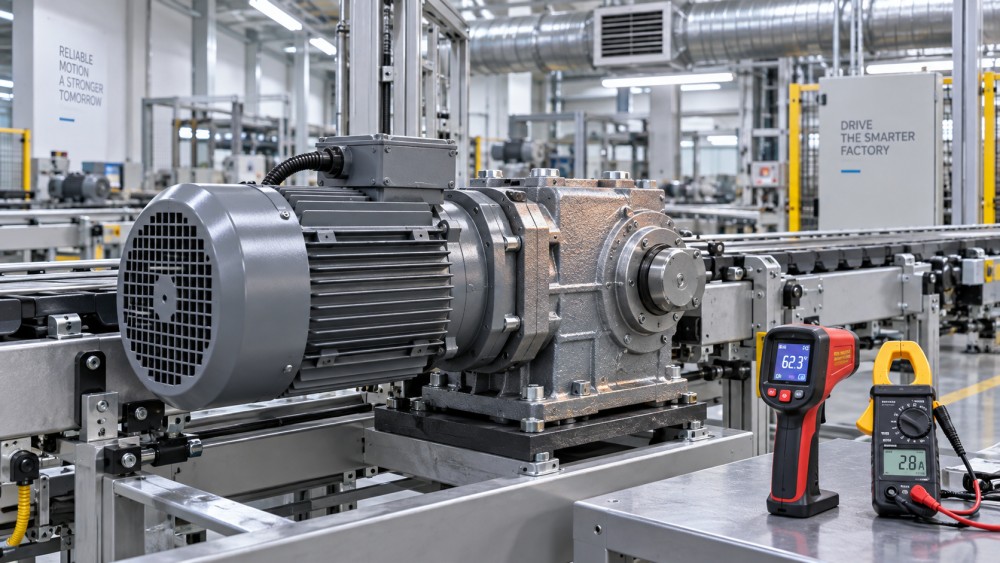
Before making adjustments, inspect the unit after it has operated long enough to reach a stable condition. Use an appropriate contact or infrared temperature measurement method, taking care with reflective surfaces and measuring from comparable points each time. Check the motor frame near the winding area, the end shields near bearings, the gearbox housing, and the lubricant fill area where accessible.
A motor body that is significantly hotter than the gearbox generally points toward electrical loading, poor cooling, voltage issues, or motor bearing drag. A gearbox that is hotter than the motor may indicate high mechanical reduction losses, lubricant problems, gear damage, excess oil, or a load that is forcing torque through the reducer beyond its intended rating. When both are hot, begin with the driven load and operating cycle, because sustained overload can heat the entire assembly.
Do not rely only on whether the housing can be touched. Surface temperature is influenced by paint color, airflow, mounting mass, and measurement location. More useful evidence comes from temperature trend, runtime before heating begins, current draw, noise, vibration, and whether the condition changes when the machine runs unloaded.
Load is the most common place to look
Gear motors convert electrical power into torque and speed reduction. When the machine demands more torque than expected, motor current rises and heat builds rapidly in the windings. The gearbox also sees greater tooth loading and bearing force. A unit may appear properly sized when viewed only by output speed, yet still run hot because the driven equipment requires more starting torque, running torque, or intermittent peak torque than the drive was selected to handle.
Compare actual current with the motor nameplate
Measure current on all phases while the machine is operating under its normal process load. Compare the readings with the motor nameplate full-load current and check whether the three phase currents are reasonably balanced. Current above the rated value is a strong indicator that the motor is being overloaded or supplied incorrectly. A single high phase can suggest voltage imbalance, loose terminals, contactor problems, or a supply issue rather than a mechanical overload.
Current should also be checked during startup, acceleration, reversing, and process peaks. A conveyor may draw acceptable current once it is moving but overheat after repeated starts because each acceleration event produces high current. A mixer can run normally with a thin product but exceed the gear motor’s torque capacity when material viscosity changes. In these situations, a brief measurement during steady running does not show the full thermal load.
Inspect the driven machine before increasing motor size
Mechanical resistance often increases gradually, making an overheating complaint seem like an electrical fault. Isolate the gear motor where safe and practical, then inspect whether the driven shaft, conveyor, pump, or mechanism turns freely. Look for:
- Misaligned couplings, belts, chains, or sprockets that add radial or axial load.
- Conveyor rollers, idlers, guides, or bearings that are seized or contaminated.
- Product buildup, foreign material, or misadjusted guards creating drag.
- Pump blockage, excessive fluid viscosity, closed valves, or operation outside the intended duty point.
- Overtightened belts or chains, which can overload output and input bearings.
- Back-driving, shock loading, or frequent jam-clearing events.
Pay particular attention to changes made around the machine. A different belt tension, heavier product, altered conveyor loading, replacement coupling, or process-speed increase can push a previously stable gear motor beyond its thermal limit. The motor may be healthy; it is simply being asked to deliver more continuous torque than the original condition required.
Duty cycle can overheat a correctly sized unit
Duty cycle describes how long the gear motor runs, how often it starts, whether it reverses, and how much cooling time it receives between loaded periods. A motor selected for intermittent service may operate safely for short runs followed by adequate rest, but it can overheat when production changes to near-continuous operation. The output torque may remain within range, yet the accumulated heat has no opportunity to dissipate.
Start-stop applications deserve careful review. Every start produces elevated current and additional heat in the motor. Plugging, rapid reversing, inching, and high-inertia acceleration create even greater thermal stress. The gearbox is also affected because gear teeth and shafts must repeatedly absorb acceleration torque. A drive that runs cool at constant speed may overheat when an automatic sequence is changed to include more cycles per hour.
When the process cannot be changed, the remedy may involve selecting a motor with a suitable duty rating, using a larger thermal capacity, reducing acceleration demand, adding a correctly configured variable-frequency drive, or revising the gear ratio. A higher reduction ratio can lower motor torque demand for some applications, but it also changes output speed and may affect reflected inertia, so it should not be treated as a universal cure.
Ventilation problems are easy to miss
Even a properly loaded gear motor needs a clear path for heat to leave its frame. Fan-cooled motors depend on moving air across cooling fins and through the fan cover. Dust, fibers, oil mist, plastic film, paint overspray, and accumulated debris can reduce airflow. In washdown or dirty process areas, the fan cover may look unobstructed while the fin passages underneath are packed with material.
Clean the external cooling surfaces with a method suitable for the enclosure rating and site safety procedures. Confirm that the cooling fan rotates correctly, is not damaged, and has adequate clearance from nearby guards or structure. A motor installed close to a wall, inside a tight enclosure, beneath hot process equipment, or beside another heat-producing drive may recirculate hot air rather than draw in cooler ambient air.
Ambient temperature matters because motor ratings assume a defined operating environment. Where air temperature around the unit is already high, the temperature difference available for cooling is reduced. Enclosures containing several drives, steam lines, ovens, hydraulic power units, or poorly ventilated panels can raise local ambient conditions far above the general room temperature. Measure air temperature near the motor air intake rather than relying on a remote building sensor.
Mounting orientation can also affect cooling and lubrication. Some gearboxes have position-specific oil levels, breather locations, or mounting limitations. A unit installed in a different orientation from its intended arrangement may carry too much or too little lubricant at certain bearings and gears. It may also position the motor fan close to a frame member, limiting airflow. Verify the mounting position against the gearbox documentation before changing oil quantity or modifying guards.
Lubrication and gearbox condition need their own review
Lubricant does more than reduce friction: it carries heat away from loaded gear meshes and bearings. Incorrect viscosity, incompatible oil type, degraded lubricant, contamination, or an improper fill level can raise gearbox temperature. Too little oil can starve gears and bearings. Too much can churn the lubricant, increasing internal losses and generating foam and heat.
Inspect for leakage around seals, shaft extensions, plugs, and housing joints. Check the oil level only in the specified mounting position and after observing the manufacturer’s procedure. Darkened oil alone does not prove failure, but burnt odor, visible particles, water contamination, persistent foam, or metallic debris are reasons to investigate further. Do not mix lubricants merely to top up a unit unless compatibility is confirmed; additive packages can be unsuitable together.
Abnormal gearbox noise, rhythmic vibration, rough rotation, or heat concentrated near one bearing area may indicate internal wear or damage. Continuing to operate a hot gearbox under load can transform a manageable lubrication issue into damaged gears, bearings, or seals. Where internal inspection is not practical on site, document temperature locations, lubricant condition, noise characteristics, and load measurements before arranging repair or replacement.
Electrical conditions that resemble an overload
A motor can overheat while the mechanical load is normal. Low supply voltage increases current demand for a given torque, while voltage imbalance causes unequal phase heating. Loose connections, worn contactor contacts, undersized conductors, poor terminations, and faulty overload settings can contribute to abnormal operation. Measure voltage at the motor terminals while the machine is loaded, not only at the incoming supply.
Variable-frequency drives require additional checks. Confirm that motor parameters, base frequency, current limit, acceleration time, and low-speed cooling requirements are set appropriately. A standard fan-cooled motor running slowly for extended periods receives less fan airflow, even though it may still be producing substantial torque. In that case, the motor may need independent forced ventilation, a motor rated for inverter duty, a different gear ratio, or a process change that avoids prolonged low-speed high-torque running.
Thermal overload devices are protective devices, not diagnostic tools. Increasing an overload setting because it trips can expose windings to damage. Verify that the setting matches the motor nameplate and that the device is correctly installed and functioning. Then identify why the current or temperature is elevated.
A practical sequence for restoring normal temperature
- Make the equipment safe, review recent process or mechanical changes, and record the operating symptoms.
- Measure temperature at comparable motor and gearbox points during normal operation.
- Measure current on each phase through startup and a complete work cycle.
- Check voltage at the motor terminals under load and inspect electrical connections.
- Inspect fan operation, cooling fins, guard clearance, enclosure airflow, and local ambient temperature.
- Examine coupling alignment, belt or chain tension, driven-machine drag, and changes in process load.
- Verify gearbox mounting orientation, lubricant type, level, leakage, and signs of internal distress.
- Compare the actual operating cycle with the motor and gearbox duty assumptions before changing components.
When measured current is normal, ventilation is clear, and the temperature remains elevated, look more closely at ambient heat, low-speed operation, lubricant condition, and internal bearing drag. When current exceeds the nameplate value, correct the mechanical or process load first. A replacement gear motor should be selected only after torque, speed, starting conditions, duty cycle, mounting arrangement, and cooling environment have been confirmed. Otherwise, the replacement may overheat in exactly the same way.
Questions that often arise during troubleshooting
Can a gear motor run hot and still be acceptable?
Some temperature rise is expected during operation, especially under continuous load. The important question is whether the temperature stabilizes within the equipment’s permitted limits and whether current, noise, lubrication condition, and insulation protection remain normal. A rising temperature trend, burnt odor, recurring overload trips, or changed noise should be treated as a fault condition.
Should a larger motor be installed to solve overheating?
Not until the cause is known. A larger motor may survive higher loading while transferring greater torque into a gearbox, coupling, chain, or driven machine that was not designed for it. Correcting drag, ventilation, duty cycle, or electrical supply issues is often the safer first step.
Why does the unit overheat only after several hours?
This pattern often indicates thermal accumulation rather than an immediate severe fault. Continuous duty, high ambient temperature, restricted airflow, gradual lubricant degradation, or a recurring process peak can allow heat to build until the assembly reaches an unacceptable temperature.
Related News
- How to Assess a Rigid Coupling Supplier for Bore Accuracy and Traceable QualityOct 08, 2026Tribology & Kinematics Expert
- Titanium Alloys Compared: Balancing Strength, Corrosion Resistance, and MachinabilityOct 08, 2026CNC Kinematics Architect
- Where Ductile Iron Dismantling Joints Reduce Alignment Risk in Water PipelinesOct 08, 2026Pipeline Metallurgy Scientist
- Selecting a Precision Bearing Sleeve: Fits, Runout, and Material ChoicesOct 08, 2026Tribology & Kinematics Expert
- Face Milling Cutters: How Insert Geometry Affects Finish on Steel and AluminumOct 08, 2026CNC Kinematics Architect
- Single-Acting Cylinders for Clamping: Stroke, Force, and Return Spring ConsiderationsOct 07, 2026Fluid Power Control Strategist