
What to Include in an RFQ for Custom Industrial Gearboxes to Avoid Redesigns
A well-prepared RFQ is the first practical safeguard against costly redesigns, production delays, and gearbox performance issues. In custom industrial gearbox sourcing, the quoted unit is only as reliable as the operating information behind it. A supplier cannot make sound decisions on gear geometry, bearing arrangement, housing stiffness, lubrication, sealing, or thermal capacity from a requested ratio and motor power alone.
The expensive failures usually begin with an RFQ that appears complete but leaves critical assumptions unstated. A gearbox may meet its stated nominal torque yet fail under frequent reversals, suffer overheating in a confined enclosure, require an unplanned adapter because the driven shaft details were omitted, or arrive with documentation that does not satisfy the end customer’s quality requirements. These are not merely engineering problems. They become commercial problems through change orders, delayed commissioning, emergency freight, disputed warranty responsibility, and a higher total cost of ownership.
For custom industrial gearboxes, the RFQ should function as a shared definition of duty, interfaces, quality expectations, and commercial boundaries. The objective is not to overload suppliers with unnecessary data. It is to provide enough accurate information for them to identify the real design drivers before production commitments are made.
Begin with the actual machine duty, not the catalog rating
The most common RFQ weakness is treating rated motor power as the gearbox requirement. Power is important, but it does not describe what the transmission will experience in service. A 30 kW gearbox driving a continuously running conveyor has a very different design requirement from a 30 kW gearbox operating a high-inertia mixer, a reversing crane mechanism, or an intermittent press.
An RFQ should state the required output torque, output speed, input speed, target reduction ratio, and direction of rotation. More importantly, it should explain the load profile. Include normal running torque, peak torque, starting torque, transient overloads, shock loads, frequency of starts and stops, reversals, and expected operating hours. Where variable-frequency drives are used, provide the speed range and control method rather than listing only the motor nameplate speed.
Duty cycle should be described in operational terms. For example, “16 hours per day, six days per week, with 20 starts per hour and occasional torque spikes during material discharge” is more useful than a generic statement such as “heavy duty.” If the equipment processes irregular material, handles impact loading, or may jam, say so explicitly. The supplier needs this information to select a suitable service factor and determine whether the gearset, shafts, bearings, and housing need reinforcement.
It is also useful to distinguish between a guaranteed process load and a possible abnormal event. A gearbox designed to survive occasional overload is not necessarily designed to operate continuously at that level. This distinction affects price, efficiency, size, and lead time.
Define the interfaces that create redesign risk
Many gearbox modifications occur after the internal design is approved, when the supplier receives incomplete information about mounting, shafts, motors, couplings, and surrounding equipment. The gearbox may be mechanically sound but impossible to install without new flanges, spacer plates, altered shafts, or field machining.
The RFQ should include a dimensional drawing or interface drawing whenever possible. It should identify:
- Mounting arrangement: foot-mounted, flange-mounted, shaft-mounted, torque-arm-mounted, vertical, horizontal, or another orientation;
- Permitted mounting positions during operation and maintenance;
- Input interface, including motor frame, flange standard, shaft diameter, keyway, spline, coupling type, and motor adapter requirements;
- Output shaft arrangement: solid shaft, hollow shaft, keyed shaft, shrink disc connection, spline, flange output, or custom geometry;
- Output shaft loads, including radial and axial loads, load direction, point of application, and whether forces vary during operation;
- Envelope limits, centerline dimensions, available space for breather, cooling unit, inspection cover, and lubrication access;
- Required location of terminals, sensors, lifting points, drain plugs, fill plugs, and inspection ports.
Radial and axial loading deserves particular attention. A gearbox output shaft connected to a chain drive, belt pulley, pinion, agitator, or screw conveyor can experience significant external loads. If the RFQ gives only torque, the supplier may assume a different bearing duty than the installed arrangement creates. That can lead to premature bearing failure even though the gears themselves are correctly rated.
Where the new gearbox must replace an existing unit, include the old gearbox drawing, photographs, nameplate data, shaft measurements, mounting dimensions, and the reason for replacement. “Like-for-like replacement” should never be treated as a sufficient technical instruction. Legacy units may have been oversized, undersized, modified in the field, or selected for a duty cycle that has since changed.
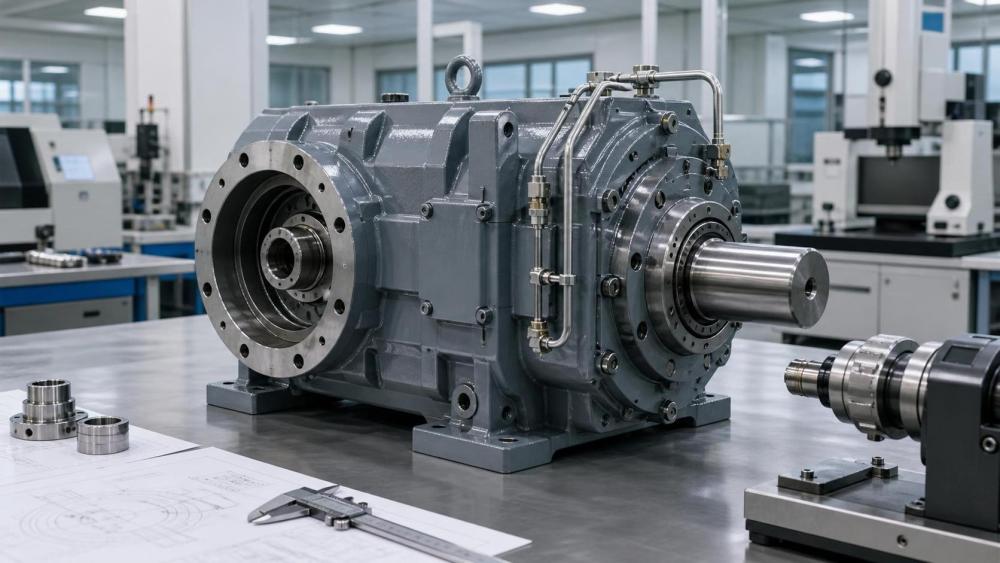
Specify the application environment before selecting materials and protection
Environmental conditions are often left to a short phrase such as “outdoor use” or “corrosive area.” Those descriptions do not enable a supplier to select appropriate seals, coatings, housing materials, bearings, lubricant, or cooling provisions.
State the ambient temperature range, altitude if relevant, humidity, exposure to rain or washdown, dust levels, abrasive particles, chemical vapors, salt spray, and likelihood of water ingress. For food, pharmaceutical, marine, mining, wastewater, steelmaking, port, and offshore applications, the operating environment may drive the design as strongly as the transmitted torque.
Temperature is particularly important. Low ambient temperatures can affect lubricant viscosity and starting torque. High ambient temperatures, poor ventilation, or installation inside a guarded enclosure can reduce thermal capacity. If the unit is located near a furnace, dryer, kiln, or process vessel, identify the expected air temperature around the gearbox rather than the broader site temperature.
The RFQ should also describe cleaning practices. High-pressure washdown, steam cleaning, and chemical cleaning agents may require a different sealing arrangement and surface treatment from ordinary dust protection. If a specific ingress protection level is required for the complete geared motor assembly, clarify whether this applies to the gearbox itself, motor terminal box, sensors, and any external cooling equipment.
Make the performance requirements measurable
“Reliable,” “low noise,” and “high efficiency” are reasonable expectations, but they are not measurable RFQ requirements. If these attributes matter to the application, convert them into conditions that can be reviewed at quotation stage and checked before shipment.
For noise-sensitive installations, specify the measurement condition: distance, operating speed, load condition, mounting arrangement, and ambient setting. Gearbox sound levels vary with actual speed, load, gear type, enclosure, and the connected machine. A no-load factory measurement may not represent installed behavior.
For backlash-sensitive applications such as positioning systems, robotics, indexing equipment, and certain actuator drives, state the maximum allowable backlash at the output, along with the test torque and direction-change condition. Do not assume that a standard industrial reducer will meet precision positioning expectations simply because it has a nominal ratio similar to a planetary or servo gearbox.
Efficiency requirements should be considered in context. Asking for a high-efficiency gearbox may influence gear arrangement, lubricant selection, seal design, and thermal behavior. But the requested efficiency should be linked to an operating point. A transmission’s efficiency under nominal steady load can differ from its efficiency during intermittent low-load operation or frequent acceleration.
If vibration limits, torsional stiffness, runout, shaft deflection, or critical speed are important, these should be identified early. This is especially relevant where the gearbox forms part of a larger rotating system, such as a mixer, extruder, mill, crane, wind-related auxiliary drive, or high-speed pumping package.
State design standards carefully, and identify what must be demonstrated
Standards should reduce ambiguity, not create it. An RFQ may refer to AGMA practices, ISO gear rating methods, IEC motor interfaces, customer specifications, or project-specific engineering rules. The important point is to identify the exact requirement and its purpose.
For gear strength and rating, a buyer may request that the supplier provide a rating calculation based on an agreed method, such as ISO 6336 or an applicable AGMA method. The RFQ should clarify whether the calculation is needed for review, whether a minimum service factor is required, and whether it must cover both gear tooth bending and contact stress. Simply writing “AGMA compliant” can be too broad to resolve design assumptions.
Material requirements should cover more than a general steel grade. If traceability is necessary, request material certificates for gears, shafts, housings, or critical forgings as applicable. If heat treatment is performance-critical, specify the required case hardening, nitriding, through-hardening, or other process requirements through approved drawings or specifications. Avoid imposing a material designation without confirming that it is compatible with the intended manufacturing route and local supply chain.
For hazardous locations, functional safety systems, pressure-related auxiliaries, or sector-specific projects, applicable certification needs to be identified at RFQ stage. These requirements can affect component selection, documentation, inspection, and manufacturing lead time. A late request for certified electrical accessories or special coatings can turn a routine gearbox order into a redesign exercise.
Ask how the supplier will validate the design
Inspection and testing requirements should be proportional to the gearbox’s criticality. A low-risk auxiliary conveyor reducer does not need the same documentation package as a custom transmission for a continuous-process plant where a shutdown has major production consequences. However, even routine custom units need a clear acceptance basis.
The RFQ can request a supplier quality plan or inspection and test plan showing key stages: incoming material control, machining inspection, gear inspection, heat-treatment verification, assembly checks, no-load running test, leak test, vibration or noise checks where relevant, and final dimensional inspection. For critical units, it may be appropriate to request witness or hold points, but these should be defined realistically so they do not create avoidable schedule friction.
Specify whether factory acceptance testing is required and what the test must demonstrate. A no-load run test can confirm rotation, basic lubrication behavior, and obvious assembly issues, but it does not prove full-load thermal performance. If a loaded test is required, the RFQ should define torque, speed, duration, instrumentation, acceptance criteria, and whether the test setup can realistically replicate the application.
Documentation often becomes a late-stage dispute. List required deliverables: certified outline drawing, general arrangement drawing, installation manual, lubrication schedule, spare-parts list, material certificates, heat-treatment records, inspection reports, test reports, coating reports, certificates of conformity, and packing list. Also state the required language, document format, revision-control process, and submission timing. A document package delivered only with the shipment is of limited value when approval is needed before manufacture.
Do not treat lubrication and cooling as minor accessories
Lubrication is integral to gearbox reliability. The RFQ should state whether the gearbox will use splash lubrication, forced lubrication, or an external oil circulation system. Where the supplier is expected to select the arrangement, provide the duty cycle, operating orientation, ambient conditions, and expected maintenance philosophy.
Specify lubricant restrictions where they exist. Certain sites require approved oil brands, food-grade lubricants, biodegradable fluids, or compatibility with existing plant maintenance inventories. These requests can affect seal materials, viscosity selection, temperature behavior, and service intervals.
Cooling requirements should be approached in the same way. If the gearbox is installed in a hot or confined area, ask the supplier to state the calculated thermal rating and any assumptions about ambient temperature, airflow, or cooling water. If an oil cooler, fan, pump, filter, heater, or condition-monitoring device is included, define power supply, instrumentation, connection sizes, control responsibility, and maintenance access.
Separate the quoted scope from the assumptions behind it
A technically detailed RFQ can still produce incomparable quotations if commercial scope is unclear. Custom gearbox pricing varies not only with gears and housing size, but also with engineering hours, pattern equipment, castings or fabrications, special bearings, heat treatment, motor adapters, testing, documentation, preservation, packaging, and service support.
Ask each supplier to identify exclusions, technical assumptions, and deviations in a structured quotation. This is more useful than comparing one total price against another. One supplier may include a motor adapter, oil, commissioning spares, and detailed inspection records; another may price the bare gearbox only. A lower initial quote can become more expensive after accessories, revisions, and freight-related adjustments are added.
The RFQ should state required delivery terms, destination, packaging standard, preservation period, export documentation, labeling, and any site restrictions on wooden packaging or hazardous-material declarations. For large gearboxes, packing design and lifting arrangements matter. Damage to a machined flange, exposed shaft, breather, or cooling circuit during international transit can delay installation just as effectively as a manufacturing defect.
Lead time should be requested in stages: design approval, procurement of long-lead materials, manufacturing, testing, documentation submission, and shipment readiness. This makes schedule risk visible. A supplier that promises an attractive overall lead time but cannot explain the critical path may be relying on assumptions that will change after the order is placed.
Build a review gate before releasing the purchase order
The best RFQs do not eliminate all questions; they ensure that the right questions are raised before metal is cut. Before order release, the buyer should review the supplier’s approved drawing, duty assumptions, torque and load calculations, mounting arrangement, lubrication method, thermal basis, material and heat-treatment proposal, test scope, and document list.
Any mismatch between the RFQ and the supplier’s proposal should be resolved through a controlled clarification, not an informal email exchange. A revised ratio, altered shaft diameter, different mounting orientation, changed motor speed, or substituted bearing arrangement may appear minor but can affect the entire drive system.
Custom industrial gearboxes are rarely purchased as isolated components. They sit between a power source and a process whose uptime, safety, and output depend on predictable torque transmission. The RFQ should therefore capture the application reality, not just the dimensions of the unit being bought. When load conditions, interfaces, environment, validation, documentation, and commercial assumptions are defined early, suppliers can quote on a common basis—and redesigns become the exception rather than the expected cost of doing business.
Related News
- How to Assess a Rigid Coupling Supplier for Bore Accuracy and Traceable QualityOct 08, 2026Tribology & Kinematics Expert
- Titanium Alloys Compared: Balancing Strength, Corrosion Resistance, and MachinabilityOct 08, 2026CNC Kinematics Architect
- Where Ductile Iron Dismantling Joints Reduce Alignment Risk in Water PipelinesOct 08, 2026Pipeline Metallurgy Scientist
- Selecting a Precision Bearing Sleeve: Fits, Runout, and Material ChoicesOct 08, 2026Tribology & Kinematics Expert
- Face Milling Cutters: How Insert Geometry Affects Finish on Steel and AluminumOct 08, 2026CNC Kinematics Architect
- Single-Acting Cylinders for Clamping: Stroke, Force, and Return Spring ConsiderationsOct 07, 2026Fluid Power Control Strategist