
Sizing Gear Motors for Mixers: Startup Torque Matters More Than Rated Power
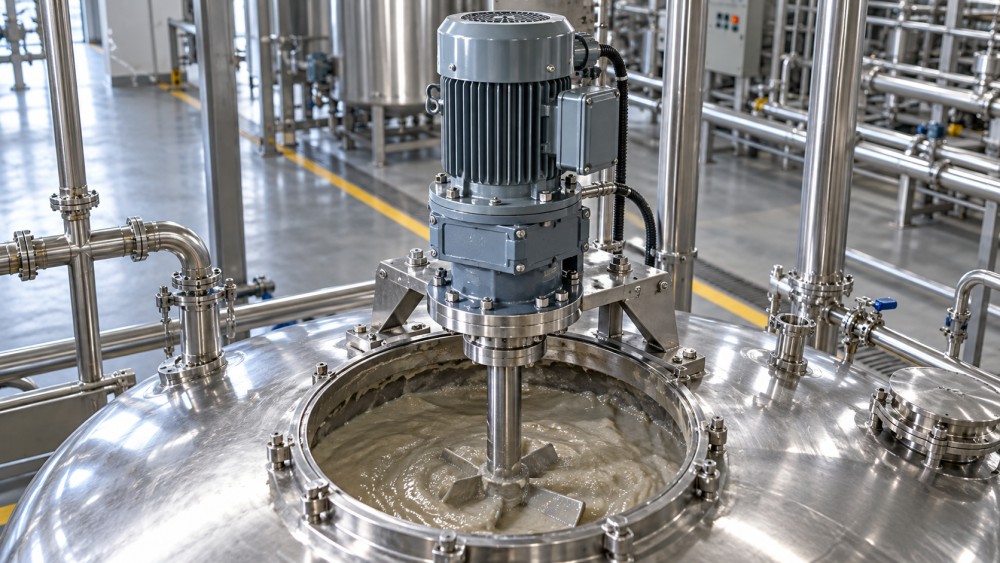
A mixer can operate comfortably at its working speed yet stall when restarted after a shutdown. Settled solids, a colder batch, or a material that thickens at rest can demand more torque than the drive can deliver during startup. When comparing gear motors for mixers, the first question is whether the complete drive can start the worst credible batch and accelerate it without exceeding electrical, thermal, or mechanical limits.
Rated power still matters for continuous operation. However, it does not describe the torque available throughout acceleration or establish what the gearbox can withstand during repeated starts. A sound selection connects process conditions, output torque, gear ratio, motor control, and duty cycle.
Separate breakaway torque from running torque
A mixer drive faces several different demands. Treating them as a single torque figure can hide the condition most likely to cause a failed start.
Breakaway torque is the torque required to initiate movement. Acceleration torque is an additional demand while speed increases. A drive may overcome the initial resistance and still stall later if available motor torque falls below the combined load during acceleration.
A mechanical obstruction belongs in the protection strategy. Increasing motor size until the mixer can force its way through a blockage can transfer the failure to a shaft, coupling, blade, or gearbox.
Define the batch condition that makes starting hardest
The normal production recipe is only part of the sizing basis. Consider the material condition when an operator actually presses Start, including an interrupted batch after a power failure or an overnight shutdown.
For a liquid whose viscosity remains essentially constant with shear rate, colder temperature may create the highest resistance. For a shear-thinning material, apparent viscosity falls as mixing develops, so the initial demand can differ substantially from the established running load. A thixotropic material can rebuild structure while resting, making shutdown duration relevant. A slurry may develop a settled bed around the impeller.
Yield-stress materials require particular care. Flow begins only after sufficient stress develops, and the region moving around the impeller may initially be limited. A single viscosity value measured under unspecified conditions cannot adequately describe that behavior.
Document the conditions that govern these changes:
- Minimum starting temperature and the relevant viscosity or rheological data.
- Solids concentration, particle characteristics, and settling behavior.
- Maximum expected idle time before a loaded restart.
- Fill level, impeller immersion, and ingredient addition sequence.
- Whether the process permits empty starting, preheating, dilution, or another restart procedure.
Process restrictions must be operationally credible. If a drive is sized on the assumption that the vessel starts empty, the control sequence and operating procedure must support that assumption. An emergency stop with a full vessel can otherwise create a restart condition outside the selected drive’s capability.
Build the torque requirement at the mixer shaft
Keep the initial calculation at the gearbox output shaft, where the mixer load acts. At any point during acceleration, required output torque consists of process resistance, mechanical losses, and acceleration torque.
Required output torque = process torque + mechanical resistance + equivalent rotational inertia × angular acceleration.
This is a useful accounting relationship, but it does not make the process load constant. Material resistance can change with speed, temperature, and mixing history. Fluid entrainment also makes the acceleration demand more complex than accelerating a rigid rotor alone.
Useful load evidence includes mixer manufacturer calculations, appropriately scaled trials, and torque measurements from comparable equipment. Comparisons should account for impeller diameter and geometry, vessel arrangement, baffles, clearance, and material behavior. Matching tank volume alone is insufficient.
For geometrically similar impellers operating in a turbulent regime, established mixing correlations relate power to fluid density, rotational speed, and impeller diameter. Viscous and non-Newtonian applications require correlations appropriate to their flow conditions. A running-power estimate for a freely flowing liquid cannot establish breakaway torque in a settled slurry.
Where restart behavior remains uncertain, representative material testing can be more useful than adding an arbitrary margin. The test should reproduce the temperature, rest period, and solids condition responsible for the uncertainty.
Convert motor power into usable output torque
The basic relationship is power = torque × angular speed. At a specified output speed, this converts mechanical output power into continuous torque. It does not establish starting capability: at standstill, a motor can produce torque while mechanical output power is zero.
Gear reduction increases output torque while reducing speed. A preliminary relationship is:
Output torque ≈ motor torque × reduction ratio × gearbox efficiency.
Use efficiency appropriate to the gear design and operating condition. Starting losses, lubricant temperature, and low-speed behavior can differ from catalog nominal conditions, particularly in drives with substantial sliding contact.
A larger ratio may help achieve the required shaft torque, but it also changes the motor speed needed to reach the mixer’s operating speed. Check the full operating range. Running the motor above its base speed may reduce available torque, while prolonged operation at low motor speed can restrict cooling.
The gearbox has its own limits regardless of motor capability. Compare continuous rated output torque, permissible peak torque, and the duration and frequency allowed for overloads. A larger motor or a higher drive current limit can exceed those mechanical limits.
A useful selection diagram plots required torque and available torque against mixer speed, with gearbox limits identified. Available torque must exceed the load sufficiently to accelerate through the full starting range. A catalog point at rated speed shows only one part of that comparison.
Check what the motor and control can actually deliver
For a directly connected induction motor, starting torque and the torque available during acceleration depend on the motor design and supply conditions. Rated running torque alone cannot establish whether the motor will accelerate the mixer. Supply voltage drop during starting can further reduce available torque.
A variable frequency drive provides control over speed and acceleration, but its current capacity and control method determine usable torque. Sensorless vector control can improve low-speed performance compared with basic voltage-frequency control. Applications requiring dependable torque at or near zero speed may need feedback and a motor-drive combination specified for that duty.
Assess the drive’s overload rating together with its permitted duration and recovery conditions. A short overload allowance may be adequate for an occasional start but unsuitable for repeated loaded restarts.
A longer acceleration ramp reduces the torque needed to accelerate inertia. It does not remove breakaway resistance or sustained process torque. Extending the ramp can leave a heavily loaded motor producing high torque at low speed for longer, increasing thermal stress.
A soft starter also needs careful evaluation. Reducing voltage limits starting current, but it reduces induction-motor starting torque as well. It can suit loads that start easily; its current-reduction benefit alone does not establish suitability for a difficult mixer start.
Select the gearbox for repeated duty and mixer loads
Passing a single startup check is insufficient when the mixer starts repeatedly, reverses, or operates through frequent batch changes. The selection must cover both peak loading and accumulated thermal and fatigue effects.
Service factors help manufacturers account for application severity, but their definitions vary. A service factor is not automatically a permissible startup multiplier. Ask how the supplier applies starts per hour, operating time, shock loading, and load variation to its mechanical selection.
Gearbox thermal capacity deserves a separate check. A unit may have adequate mechanical torque capacity while exceeding its acceptable temperature under the specified duty, ambient conditions, mounting arrangement, or cooling configuration. Lubrication requirements also depend on installation orientation and speed.
Mixer shaft loads extend beyond transmitted torque. An overhung impeller can impose bending and radial loads, while some impellers generate substantial axial thrust. Confirm whether the gearbox output bearings can carry these loads or whether a separate bearing arrangement is required. Couplings, keys, and shafts must also withstand the selected peak torque.
These checks help distinguish two apparently similar gearmotors. Equal power and output speed do not establish equal bearing capacity, overload capability, or suitability for a mixer installation.
Compare quotations using one operating specification
Supplier proposals become easier to compare when each uses the same process assumptions. A quotation based on warm, freshly prepared material may look attractive beside one sized for a cold restart after settling, even though the two selections address different duties.
Provide the operating speed range, running torque estimate, startup load basis, acceleration requirement, and duty cycle. Include vessel and impeller details, material behavior, restart conditions, shaft loads, mounting orientation, ambient conditions, and available electrical supply.
Require the proposal to identify:
- Continuous output torque across the required speed range.
- Available startup torque, its duration, and the associated control settings.
- Permissible gearbox peak torque and repeated-start limitations.
- Motor and gearbox thermal suitability for the specified duty.
- Allowable axial and radial loads at the actual load application point.
- Overload protection and the intended response to a stalled or blocked mixer.
Resolve whether quoted values refer to the motor shaft or gearbox output shaft. Likewise, distinguish torque available from the drive from torque permitted by the mechanical transmission. Both must satisfy the application.
Make loaded restart part of acceptance
A no-load rotation check confirms basic operation but provides little evidence of startup capability. Acceptance should include representative loaded starts under the material conditions used for sizing, with a defined acceleration sequence and protection settings.
Record speed response, motor current, drive torque estimates where available, and temperatures over representative duty cycles. Current alone is an imperfect torque measurement, especially when comparing different control methods. Direct shaft-torque measurement provides stronger evidence when startup uncertainty is central to the decision.
If the mixer stalls, identify whether the limiting factor is breakaway resistance, insufficient accelerating torque, a drive current limit, or a protective setting before changing hardware. Raising a limit is appropriate only within the motor, gearbox, and drivetrain ratings.
A defensible purchase decision ties the selected drive to a defined loaded restart condition, demonstrates sufficient torque throughout acceleration, and establishes acceptable continuous duty. That gives the rated power figure the context needed to become a useful selection parameter.
Related News
- Why Is Your Heavy-Duty Piston Pump Losing Pressure Under Load?Nov 09, 2026Fluid Power Control Strategist
- Cartridge Valves for Manifold Blocks: Avoiding Cavity Fit ProblemsNov 09, 2026Fluid Power Control Strategist
- Large-Diameter Forged Rings: How Seamless Rolling Affects Grain FlowNov 09, 2026Foundry Phase-Change Fellow
- Sealed Heavy-Duty Roller Bearings: Choosing Seals for Dust and WaterNov 09, 2026Tribology & Kinematics Expert
- Sprockets and Chain Drives: What Determines Replacement Cost?Nov 08, 2026CNC Kinematics Architect
- Monoblock Hydraulic Control Valves: Flow Rating and Spool SelectionNov 08, 2026Fluid Power Control Strategist