
Planetary Gear Units for Rotary Kilns: Managing Shock Loads and Heat
Planetary gear units for rotary kilns must deliver reliable torque under demanding conditions, from startup shock loads to sustained exposure to heat and dust.
For project managers, selecting the right drive involves more than matching a power rating: load characteristics, thermal limits, lubrication, alignment, and maintenance access affect operational risk and lifecycle costs.
This article examines gearbox selection and protection, helping engineering teams make informed decisions that support kiln availability and project performance.
The central decision is whether the complete drive can handle credible operating and upset conditions while keeping gear and bearing temperatures within the manufacturer's limits.
What Makes a Rotary Kiln Gearbox a High-Risk Purchase?
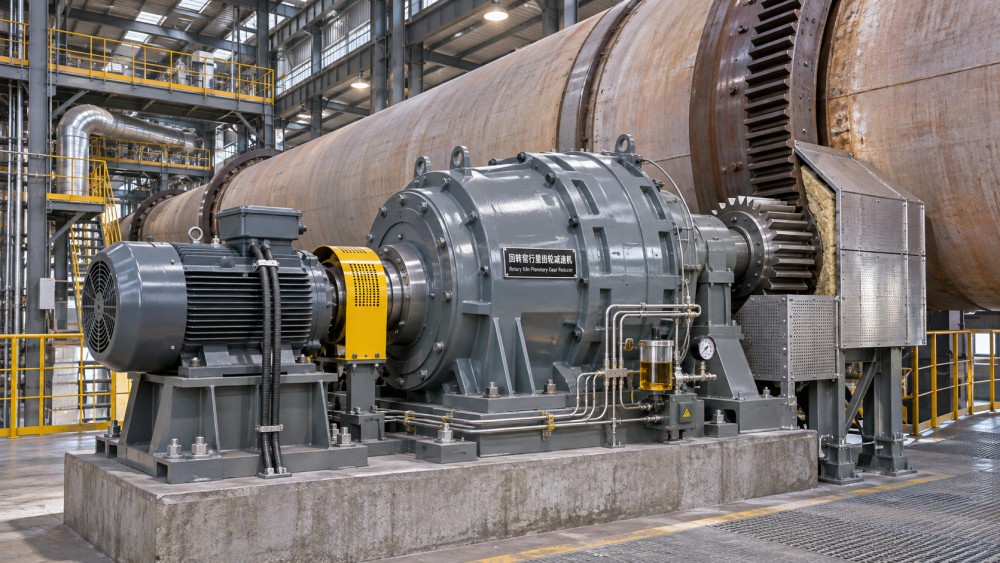
A kiln drive failure can stop an entire production line, disrupt downstream processes, and require a lengthy repair. Gearbox price alone rarely reflects that exposure.
Rotary kilns generally operate at low speeds and high torque, but their loads vary with filling, material distribution, mechanical condition, and the kiln's thermal state.
A planetary gearbox can provide substantial reduction in a relatively compact arrangement. Its suitability still depends on the complete drivetrain, mounting arrangement, and load spectrum.
Project teams should assess the gearbox alongside the motor, coupling, pinion, girth gear, lubrication system, foundation, and controls. Weak interfaces can undermine a well-rated gearbox.
Before requesting quotations, identify the operating cases that could cause lost production or equipment damage. Require suppliers to explain how their proposed drive addresses each case.
How Should Project Teams Define Torque and Shock Loads?
Begin with the kiln supplier's operating data: shell dimensions, inclination, rotational speed range, anticipated filling, material properties, support arrangement, and required production duty.
Request torque estimates for normal running, acceleration, maximum credible loading, and starting after a prolonged stop. State the assumed kiln temperature and material condition for each case.
Restart conditions deserve particular attention. A kiln stopped with material inside may require different starting torque from an empty kiln, especially after cooling or material buildup.
Shock loads can arise from process disturbances, mechanical binding, sudden starts, drive engagement, or faults. Their magnitude depends on the specific equipment and control response.
Do not assume that multiplying motor power by a generic service factor captures these events. Ask for the load spectrum and the supplier's documented rating method.
At the gearbox output, torque depends on power and rotational speed. For a preliminary check, torque in kilonewton-metres equals approximately 9.55 times kilowatts divided by revolutions per minute.
For example, 300 kW delivered at 2 rpm corresponds to approximately 1,433 kN·m. This is steady-state output torque, not a starting or shock-load rating.
Confirm whether quoted power is measured at the motor, gearbox input, or gearbox output. Account for losses and the actual speed at the stated measurement point.
Motor starting capability, variable-frequency drive current limits, acceleration time, and torque control determine what reaches the gearbox. These settings must match the mechanical design assumptions.
Ask the supplier to check gears, bearings, shafts, and housing for the specified loads. A satisfactory gear-tooth rating alone does not establish complete gearbox suitability.
Which Rating and Protection Details Should Appear in the Specification?
Define continuous output torque, speed range, operating hours, duty cycle, start frequency, and credible transient events. Include future capacity increases only where they are technically justified.
Request the applicable rating standards and calculation assumptions, including load distribution, material properties, lubrication, and safety factors. Confirm that the proposed standard covers the components being assessed.
For gear rating, suppliers may reference applicable ISO 6336 or ANSI/AGMA methods. Agreement on the specific parts, editions, duty factors, and acceptance criteria is essential.
Require separate declarations for continuous, starting, and allowable transient torque, including duration and frequency. A maximum torque figure without those conditions is difficult to compare.
Check that the motor and controls can start the loaded kiln without exceeding gearbox, coupling, pinion, or girth gear limits. Review the entire torque path.
Depending on the design, torque-limiting devices, controlled acceleration, overload detection, or protective trips may reduce exposure. Each measure needs a coordinated setpoint and response time.
Protection must not create another hazard. For example, an automatic trip may leave a hot kiln stationary, so operating procedures and auxiliary drive arrangements require review.
How Can Heat Affect Gearbox Reliability?
Heat enters the gearbox through its own mechanical losses and the surrounding environment. Nearby kiln surfaces, hot air, radiant exposure, and restricted ventilation can increase thermal demand.
Elevated oil temperature can reduce lubricant viscosity and weaken the protective film between loaded surfaces. Excessive temperatures can also accelerate oil degradation and affect seals.
A gearbox with adequate mechanical torque capacity may still be thermally unsuitable. The supplier should demonstrate both mechanical and thermal capacity for the proposed installation.
Provide maximum site ambient temperature, altitude, enclosure details, ventilation conditions, nearby heat sources, and expected operating hours. Identify whether temperatures are measured or design assumptions.
Ask the supplier to estimate oil and bearing temperatures at the specified duty, including the worst credible combination of ambient heat, load, and cooling conditions.
Cooling options may include natural convection, fans, oil-to-air coolers, or oil-to-water systems. Selection depends on available utilities, site conditions, maintenance capability, and supplier calculations.
For water-cooled systems, specify inlet water temperature, flow, pressure, water quality, and failure response. For air coolers, allow for dust accumulation and cleaning access.
Thermal shielding or relocation may reduce radiant exposure, but any barrier must preserve necessary airflow and maintenance access. Verify the resulting arrangement with the gearbox supplier.
Set temperature alarms and shutdown limits according to the approved lubricant, gearbox design, and instrument locations. Establish operating procedures for loss of cooling or abnormal readings.
What Lubrication and Dust Controls Protect the Drive?
Specify lubricant grade and viscosity for the actual operating and starting temperatures, following the gearbox manufacturer's recommendations. Cold starts and sustained heat can impose competing requirements.
Confirm whether lubrication is splash-fed or forced, and identify the minimum oil pressure or flow needed before rotation. Consider standby equipment where downtime risk warrants it.
Dust can enter through breathers, seals, filling points, and maintenance activity. Specify appropriate sealing and filtered breathers, while recognizing that no arrangement eliminates contamination risk.
For circulating systems, define filtration requirements, filter condition monitoring, oil sampling points, and access for element replacement. Match cleanliness targets to the manufacturer's recommendations.
Plan oil analysis around operating hours and site conditions. Trend viscosity, water, contamination, and wear metals, then investigate changes against the gearbox's baseline and service history.
Require clear instructions for flushing, initial fill, oil changes, filter replacement, and disposal. Poor commissioning cleanliness can compromise a gearbox before normal production begins.
How Do Alignment and Installation Affect Service Life?
Even a correctly selected unit can suffer bearing overload, seal leakage, vibration, or coupling damage when installation does not match the design assumptions.
Define the gearbox mounting and torque reaction arrangement, foundation stiffness, anchor details, and permitted movement. Responsibilities should be clear between the gearbox, kiln, and civil suppliers.
Kiln components move as temperatures change. Obtain expected cold and hot positions from the kiln designer and check that couplings and connected equipment accommodate that movement.
Where a gearbox drives a pinion and girth gear, verify gear mesh, alignment, and load distribution using the kiln and drive suppliers' installation procedures.
Specify alignment checks during installation and after the equipment reaches stable operating conditions, where safe and practicable. Record measurements so future changes can be compared.
Reserve physical access for oil sampling, filter changes, seal inspection, coupling work, and gearbox removal. Include lifting points and the space needed for replacement equipment.
What Should Be Included in Supplier Comparisons?
Compare proposals against a common duty specification rather than accepting catalog selections at face value. Ask suppliers to identify deviations and assumptions in writing.
The following comparison points help project managers distinguish a complete engineered package from an apparently cheaper gearbox that transfers critical work to the site team.
- Mechanical capacity: Continuous and transient torque limits, operating speeds, bearing checks, rating methods, and documented assumptions.
- Thermal capacity: Calculated operating temperatures, ambient conditions, cooling capacity, utility requirements, and performance limits.
- Package scope: Couplings, torque arms, lubrication equipment, instrumentation, controls, guards, and commissioning support.
- Installation interfaces: Dimensions, loads, mounting requirements, alignment tolerances, foundation details, and maintenance clearances.
- Service support: Spare parts, repair locations, documentation, warranty terms, response commitments, and expected lead times.
Calculate the ownership cost over the project's evaluation period. Include equipment, installation, utilities, planned maintenance, critical spares, and a documented estimate of downtime exposure.
Where failure probabilities are uncertain, compare scenarios instead of presenting a single precise figure. Test how results change with repair duration and production loss assumptions.
A higher initial price may be justified by better cooling, faster replacement, or accessible service. These benefits should be tied to specific site risks and contract commitments.
How Should the Drive Be Commissioned and Monitored?
Before startup, confirm installation records, oil cleanliness, lubrication flow, cooling availability, instrument calibration, protective settings, and the direction of rotation under approved procedures.
Run functional tests for alarms, trips, interlocks, and auxiliary equipment. Agree beforehand on how each test will be performed without exposing personnel or equipment to unnecessary risk.
During initial operation, record oil pressure, temperatures, vibration, motor current, and relevant process conditions. Use these readings to establish a baseline after the system stabilizes.
Investigate trends in context: a temperature increase may reflect ambient conditions, cooling fouling, lubricant issues, or changing load. A single reading rarely identifies the cause.
Assign ownership for inspection routes, oil sampling, alarm response, and spare-parts review. Ensure that operators know when to escalate abnormal conditions and whom to contact.
Conclusion: Select for the Operating Envelope, Not the Nameplate
Planetary gear units for rotary kilns should be selected against documented starting, running, transient, and thermal conditions. Mechanical rating and heat rejection must both be verified.
For project managers, the strongest procurement decision connects technical evidence with installation responsibilities, maintainability, supplier support, and the financial consequences of unplanned downtime.
Before approval, resolve exceptions in the supplier's proposal and confirm that the complete drive can be installed, protected, monitored, and serviced under actual site conditions.
Related News
- Sprockets and Chain Drives: What Determines Replacement Cost?Nov 08, 2026CNC Kinematics Architect
- Monoblock Hydraulic Control Valves: Flow Rating and Spool SelectionNov 08, 2026Fluid Power Control Strategist
- Cement Mortar Linings for Ductile Iron Pipes: Inspection and StandardsNov 08, 2026Pipeline Metallurgy Scientist
- Why Needle Roller Thrust Bearings Fail: Loads, Lubrication and WearNov 08, 2026Tribology & Kinematics Expert
- Selecting Machine Tool Bearings for Machining Center SpindlesNov 08, 2026CNC Kinematics Architect
- Industrial Gearbox Drive Shafts: Torque, Alignment and Fatigue LifeNov 07, 2026Tribology & Kinematics Expert