
How to Qualify a Precision Gearbox Supplier for Repeatable Motion Performance
When a machine must stop at the same position thousands of times, carry a controlled load, or synchronize motion with a robot, encoder, or indexing table, the gearbox is no longer a simple speed reducer. It becomes part of the machine’s accuracy, safety, and uptime strategy. That is why choosing a precision gearbox supplier should be treated as a qualification exercise rather than a catalog comparison.
For quality-control and safety teams, the central question is not merely whether a gearbox can transmit the required torque. The more demanding question is whether units from different production batches will deliver predictable backlash, stiffness, efficiency, temperature behavior, and service life under real operating conditions. A gearbox that performs well in one prototype but varies in serial production can introduce positioning errors, unexpected vibration, overload events, and difficult-to-trace warranty issues.
This guide provides a practical framework for qualifying suppliers of planetary, helical, bevel, worm, and other precision gearbox designs where repeatable motion matters.
Start with the motion risk, not the supplier brochure
A gearbox specification should begin with the consequences of motion variation in the finished machine. In a packaging line, a small positioning drift may cause product misalignment or reject rates. In a robotic welding cell, it may affect path accuracy and create a safety concern near guarded work zones. In lifting, conveying, mixing, or heavy-duty industrial equipment, unstable transmission behavior may increase shock loads and accelerate wear in connected shafts, bearings, couplings, and brakes.
Before inviting quotations, the quality, design, and safety functions should agree on a written application profile. This profile should identify:
- Required output torque, including acceleration, deceleration, shock, and emergency-stop loads;
- Duty cycle, starts per hour, direction reversals, and expected operating hours;
- Allowable backlash or lost motion at the output shaft;
- Required torsional stiffness and positioning repeatability;
- Radial and axial loads applied to the output flange or shaft;
- Ambient temperature, washdown exposure, dust, corrosive media, or explosive-atmosphere requirements;
- Mounting orientation, accessibility for maintenance, and lubrication constraints;
- The safety function affected if gearbox performance degrades.
This exercise prevents a common mistake: selecting a gearbox by nominal torque alone. A unit may meet a static torque number while still being unsuitable for high-frequency reversal, cantilever loading, rapid servo motion, or prolonged operation at elevated temperature.
Translate “precision” into measurable acceptance criteria
The word precision can mean very different things across suppliers. One manufacturer may use it to describe tight gear machining; another may be referring only to a compact product series. A reliable qualification process replaces broad language with controlled, verifiable characteristics.
For repeatable motion applications, inspect the relationship among backlash, torsional stiffness, transmission error, bearing clearance, and gear tooth contact. Low backlash is important, but it is not the whole story. A gearbox with low initial backlash but poor stiffness may still deflect under changing load. Likewise, an overly tight assembly can produce friction, heat, and accelerated wear if preload control is inconsistent.
Ask the supplier to define how backlash is measured: at what torque, at what output location, in which direction, and at what temperature. A single brochure value without a test method provides limited confidence. The same scrutiny applies to efficiency claims, noise levels, permissible overhung loads, and rated life.
Look behind the housing: manufacturing controls determine repeatability
Two gearboxes with similar external dimensions can have very different internal control systems. The supplier’s machining and assembly discipline is often more informative than the product image. For a precision gearbox supplier, the evaluation should cover gear cutting or grinding capability, tooth profile inspection, housing machining, bearing-seat concentricity, shaft runout, heat-treatment control, and final assembly methods.
Gear geometry deserves particular attention. Profile error, lead error, pitch variation, surface finish, and tooth contact pattern affect load distribution and motion smoothness. In planetary gearboxes, consistency among planet gears and accurate carrier geometry are especially important. Small variations can shift the load unevenly among planets, creating local stress and changing backlash behavior over time.
Material and heat treatment must be traceable rather than assumed. Request information on gear steel grade, case hardening or nitriding process where applicable, hardness verification, effective case depth, core properties, and post-treatment distortion control. A supplier does not need to disclose proprietary process settings to demonstrate control; however, it should be able to show how material certificates, heat-treatment lots, and finished components remain linked.
Housing quality also matters. Misalignment between bearing seats can cause uneven gear engagement even when the gears themselves are well made. Ask whether critical housing features are machined in one setup where practical, how concentricity is inspected, and how the supplier manages casting variability if cast housings are used.
Audit the inspection plan, not only the final inspection report
A final test certificate is useful, but it cannot compensate for weak upstream process control. The stronger question is: at which points does the supplier prevent variation from moving forward?
Review the control plan from incoming materials through machining, heat treatment, subassembly, final assembly, and dispatch. Look for defined inspection frequencies, calibrated measurement equipment, traceable gauges, reaction plans for nonconforming parts, and documented handling of rework. In a high-volume OEM program, ask how the supplier distinguishes prototype controls from serial-production controls. The methods used to build a carefully selected sample are not always the methods used to sustain a production run.
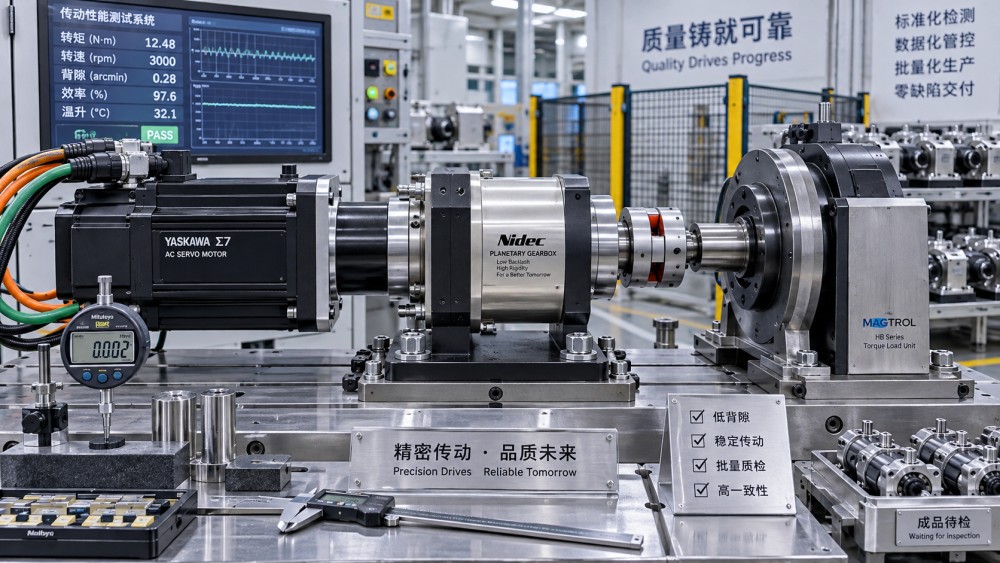
Useful evidence may include first-article inspection records, gear measurement reports, runout data, bearing preload checks, torque-to-rotate measurements, end-play records, leakage tests, and functional run tests. Where a gearbox is safety-relevant, the quality team should also understand the supplier’s escalation path for deviations that may affect field performance.
Do not assume that a tighter nominal tolerance automatically means better reliability. What matters is whether the supplier can repeatedly hold the tolerance while maintaining proper fits, lubrication paths, and assembly preload. A practical supplier can explain which dimensions are critical to function and why.
Verify load testing under conditions that resemble the application
Catalog ratings are normally developed under controlled assumptions. Your machine may not resemble those assumptions. A servo-driven axis, for example, can create repeated acceleration peaks, high reversal frequency, and reflected inertia that are more demanding than a steady conveyor load. A heavy process machine may experience shock torque, vibration, and external shaft loads not represented in a standard rating table.
During supplier qualification, request clarification on the basis for torque and life ratings. Are ratings thermal-limited, gear-strength-limited, bearing-life-limited, or dependent on a specified duty cycle? Is peak torque permitted only for short acceleration events? Does the published value include a service factor? These distinctions change selection decisions.
For critical programs, consider a validation plan using representative motor speeds, inertia, load direction, mounting position, temperature, and cycle profile. The objective is not to force every supplier into an expensive custom test. It is to ensure that the selected gearbox is evaluated against the behavior that creates risk in the actual machine.
Monitor backlash before and after endurance testing, temperature stabilization, vibration signatures, lubricant condition, seal integrity, and output-shaft play. A gearbox may pass a short unloaded run while still showing unacceptable degradation after repeated load reversals.
Lubrication, sealing, and contamination control are quality issues
Many motion problems begin outside the gear mesh. Incorrect lubricant viscosity, poor breather design, seal damage, water ingress, or contamination from a dusty environment can change friction and accelerate bearing or gear wear. In food processing, municipal water systems, mining, fabrication workshops, and outdoor infrastructure equipment, environmental exposure can be as influential as the gearbox ratio.
Ask the supplier to specify lubricant type, fill quantity, orientation limits, relubrication requirements, storage life, and compatibility with local operating temperatures. If the application involves washdown, corrosive vapor, abrasive dust, or irregular storage before installation, confirm the sealing configuration and any protective measures needed during transport and commissioning.
For safety teams, a small lubricant leak should not be treated as a cosmetic issue. It can create slip hazards, contaminate products or processes, reduce lubricant level, and signal a mounting, pressure, or seal problem that deserves investigation.
Assess engineering communication before approving the supplier
A capable precision gearbox supplier should be willing to challenge an incomplete specification. If a supplier accepts a demanding application without asking about load spectra, overhung load, motor interface, ambient conditions, or required service life, that may indicate a transactional quotation process rather than application engineering support.
Evaluate how clearly the supplier responds to technical questions. Are assumptions stated? Are drawings version-controlled? Can the supplier provide dimensional interface data, mounting torque guidance, permissible shaft loads, maintenance instructions, and test documentation in a form that your engineering and quality teams can use?
Communication is also a risk-control tool when failures occur. Define in advance how serial numbers identify production lots, what records are retained, how suspected field failures are analyzed, and how corrective actions are communicated. For machinery builders serving global markets, clear documentation can be as valuable as mechanical performance when dealing with audits, warranty claims, or site safety reviews.
Use a staged approval instead of a one-time pass/fail decision
Supplier qualification is most reliable when it progresses through evidence. Begin with technical document review and a cross-functional risk assessment. Move to sample inspection, interface verification, and representative functional testing. Then evaluate pilot production or first serial batches before approving unrestricted supply.
This staged approach is particularly valuable when switching sources, changing a gearbox ratio, introducing a new housing material, or scaling from low-volume machinery to repeat production. It gives quality teams a chance to detect drift in backlash, noise, temperature, or assembly consistency before the issue becomes embedded in installed equipment.
A practical approval package should include the approved drawing and revision, performance criteria, inspection records, material and traceability requirements, agreed test methods, packaging expectations, nonconformance procedure, and change-notification rules. Suppliers should not alter critical materials, heat treatment, bearing sources, lubricant, sealing arrangement, or manufacturing location without a defined review process when those changes may influence repeatable motion performance.
Questions worth asking before placing the production order
- How is backlash measured, and what variation is allowed across production lots?
- Which gear, bearing, and housing characteristics are controlled during manufacture?
- What traceability exists for material, heat treatment, assembly, and final testing?
- What duty-cycle assumptions support the stated torque and life ratings?
- How are radial load, axial load, shock load, and high-frequency reversal addressed?
- What evidence demonstrates thermal stability and lubricant suitability for the intended environment?
- What final functional tests are performed on every unit, and which are performed by sampling?
- How will engineering changes and quality deviations be communicated to the buyer?
A supplier decision should protect the machine’s future behavior
Qualifying a precision gearbox is ultimately about protecting predictable motion after installation, not just approving a part number. The right supplier provides more than a rated torque figure: it offers evidence that gear geometry, materials, assembly settings, lubrication, testing, and documentation are controlled well enough to support repeatable performance over the equipment’s intended life.
For quality-control and safety professionals, this evidence-based approach creates a stronger connection between procurement and operational risk. It helps prevent the familiar but costly pattern in which a gearbox appears acceptable at incoming inspection, then reveals itself through erratic positioning, rising temperature, noise, leakage, or premature wear after the machine is in service. A disciplined precision gearbox supplier qualification process makes those risks visible early—when there is still time to choose, test, and approve with confidence.
Related News
- How to Assess a Rigid Coupling Supplier for Bore Accuracy and Traceable QualityOct 08, 2026Tribology & Kinematics Expert
- Titanium Alloys Compared: Balancing Strength, Corrosion Resistance, and MachinabilityOct 08, 2026CNC Kinematics Architect
- Where Ductile Iron Dismantling Joints Reduce Alignment Risk in Water PipelinesOct 08, 2026Pipeline Metallurgy Scientist
- Selecting a Precision Bearing Sleeve: Fits, Runout, and Material ChoicesOct 08, 2026Tribology & Kinematics Expert
- Face Milling Cutters: How Insert Geometry Affects Finish on Steel and AluminumOct 08, 2026CNC Kinematics Architect
- Single-Acting Cylinders for Clamping: Stroke, Force, and Return Spring ConsiderationsOct 07, 2026Fluid Power Control Strategist