
Why Heavy-Duty Spherical Roller Bearings Overheat in High-Load Service
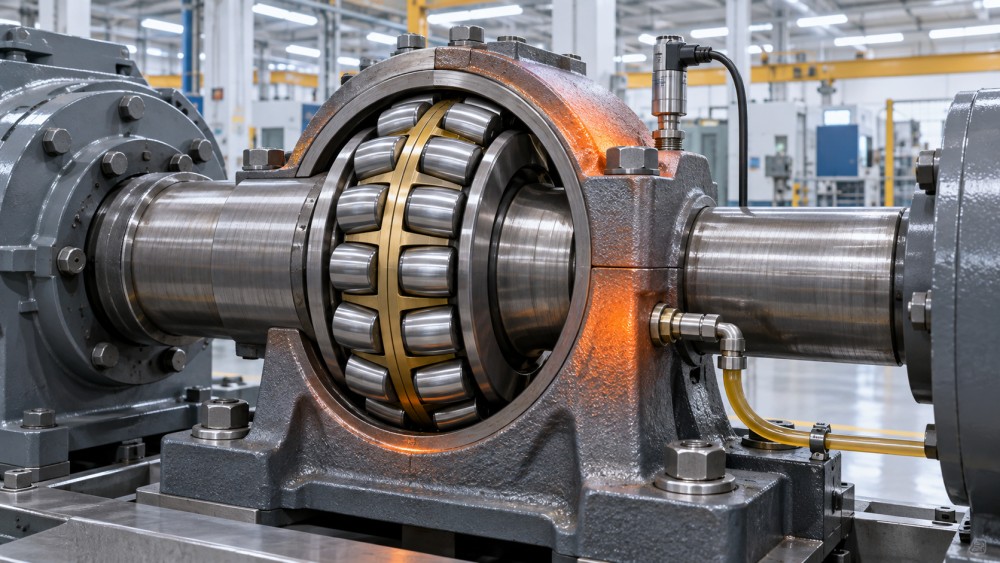
Heat in a heavily loaded spherical roller bearing is not a condition to “watch for a while.” A stable operating temperature may be expected after startup or a lubricant change, but a continuing rise, a sudden step change, or a temperature that exceeds the machine’s established baseline indicates that friction is increasing somewhere in the bearing system. Under high load, that friction can quickly damage the lubricant film, alter internal clearance, score raceways, deform cage pockets, and lead to seizure.
The difficult part is that the bearing housing temperature does not identify the fault by itself. The same hot housing may result from insufficient grease, excessive grease, mounting force transferred through the wrong ring, misalignment, contamination, inadequate operating clearance, or a load condition the bearing arrangement cannot support. Effective troubleshooting depends on separating these causes before the bearing is removed and evidence is lost.
High load magnifies every source of friction
Heavy-duty spherical roller bearings are designed to carry substantial radial loads and accommodate a degree of shaft or housing misalignment. That capability should not be mistaken for unlimited tolerance of poor installation or adverse operating conditions. At high load, roller-to-raceway contact stresses are already significant. If the lubricant film becomes too thin, the rollers begin to experience mixed or boundary lubrication rather than full-film separation. Metal contact rises, heat rises with it, and the lubricant deteriorates faster.
Temperature therefore tends to be both a symptom and an accelerator. Grease that is exposed to excessive heat may soften, bleed oil too rapidly, oxidize, or leave behind a hardened thickener residue. Oil may lose viscosity, reducing film thickness further. Once this cycle begins, a bearing can move from a manageable temperature issue to visible raceway distress in a relatively short operating period.
The first useful distinction is between a gradual temperature increase and an abrupt one. A gradual rise over days or weeks often points to lubrication degradation, progressive contamination, wear, or a changing machine load. A sharp increase following installation, relubrication, a coupling adjustment, or a process change more strongly suggests an installation, grease quantity, alignment, or load-path problem.
Lubrication failures are not limited to “too little grease”
Insufficient lubricant is a direct cause of overheating, particularly where the bearing operates under high radial load, shock load, vibration, or slow oscillating motion. A grease fill that looks adequate at a service port may still fail to lubricate the rolling contacts if old grease has hardened, channels have formed, or the fresh grease follows an easy path out of the housing instead of entering the bearing.
However, overgreasing is just as relevant during maintenance interventions. When a bearing cavity is packed excessively, rolling elements must churn through grease. This creates viscous drag and rapidly raises temperature. The problem is especially severe at higher rotational speeds, but even low-speed heavy-duty machinery can suffer if the grease cannot purge or redistribute. Adding grease in response to a rising temperature, without confirming the existing condition, can worsen the failure mechanism.
Grease compatibility must also be checked. A new grease with a different thickener system may not mix safely with the residue in the housing. The result can be softening, hardening, oil separation, or a change in consistency that affects how lubricant reaches the bearing. Compatibility is not established simply because two products have a similar NLGI grade or are both described as high-temperature greases. Base-oil viscosity, thickener chemistry, additive package, operating temperature, speed, and water exposure all affect suitability.
For oil-lubricated arrangements, the most common errors are incorrect level, blocked return flow, aeration, unsuitable viscosity, and water ingress. An oil level that is too high can generate churning losses; too low a level can starve the contact zone. In circulating systems, a clean reservoir does not prove that oil is reaching the bearing. Restricted lines, plugged filters, failed injectors, incorrect flow division, or a return path that floods the housing can all produce overheating.
- Check the actual lubricant type against the bearing supplier’s and machine builder’s requirements.
- Review the relubrication interval and quantity, not only whether lubrication was performed.
- Inspect purged grease for hard particles, water, discoloration, burnt odor, or unusually separated oil.
- Verify that grease relief paths and oil drains are open and that seals are not trapping excess lubricant.
Internal clearance can disappear after mounting
Improper internal clearance is one of the most consequential causes of overheating in heavy duty spherical roller bearings. These bearings are commonly mounted with an initial radial internal clearance selected to account for interference fit and operating temperature. When a bearing is driven too far up a tapered seat, or when a withdrawal sleeve is tightened beyond the required reduction in clearance, the rings expand relative to one another and the clearance is reduced excessively.
The bearing may then operate with excessive preload. Rollers are forced more tightly into the raceways, friction rises across the rolling contacts, and the bearing runs hot even if lubricant quality and quantity are correct. The condition is frequently misdiagnosed as a grease problem because temperature appears soon after commissioning.
Clearance should be controlled using the mounting method specified for the bearing arrangement. Depending on the design, this may involve measuring radial clearance reduction with feeler gauges, monitoring axial drive-up, or using hydraulic mounting procedures. Axial displacement alone is not universally reliable unless the shaft taper, sleeve, ring geometry, and specified mounting data are known. Reusing a generic drive-up value from another bearing size is a high-risk practice.
Fit selection matters beyond the mounting stage. A tight fit on the rotating ring is usually required to prevent creep under load, but excessive interference can remove too much clearance. Conversely, a loose fit can allow ring creep, fretting corrosion, and local heat generation at the seat. A bearing that has turned blue or brown on the bore or outer diameter may have suffered heat from a loose ring fit rather than from rolling contact friction alone.
Misalignment has limits even in self-aligning bearing designs
Spherical roller bearings can compensate for angular misalignment, but this feature is intended to accommodate realistic shaft deflection, housing distortion, and mounting variation. It does not make severe misalignment harmless. As the angle increases, roller loading becomes less uniform, cage guidance can be disturbed, edge stresses may increase, and friction rises.
A common maintenance error is to focus only on the bearing housing while the source of misalignment lies elsewhere in the drive train. Bent shafts, worn pedestal seats, soft foot conditions, distorted adapter sleeves, misaligned couplings, uneven foundation settlement, or an improperly supported gearbox can force the bearing to operate at an unfavorable angle. Thermal growth also matters. A machine aligned cold may move out of alignment after the shaft, housing, or connected equipment reaches operating temperature.
The wear pattern provides useful clues. A bearing affected by serious misalignment may show uneven roller track contact, localized raceway polishing, edge distress, or nonuniform wear around the circumference. These patterns should be assessed alongside shaft and housing measurements. Replacing the bearing without correcting the geometry can repeat the same overheating event.
Load direction and load magnitude may not match the original arrangement
High load service is not defined only by total load. The direction, duration, shock content, and distribution of load determine what the bearing experiences. A spherical roller bearing can carry combined loads, but an unexpected axial component, belt over-tension, coupling thrust, process upset, or structural distortion may shift the load zone and raise friction beyond the intended duty.
Changes made outside the bearing housing often explain unexplained heat. A larger pulley, altered belt type, increased belt tension, higher process throughput, a modified gearbox ratio, or a new driven component can increase radial or axial load without any visible change to the bearing installation. In vibrating equipment, changes in feed material or unbalanced rotating mass can have a similar effect.
Load also affects lubricant selection. A grease suitable for a moderate-duty conveyor may not maintain sufficient base-oil film in a slow, highly loaded crusher, mill, press, or large fan bearing. The correct choice depends on the contact conditions and operating speed, not solely on ambient temperature. An overly stiff grease can also resist migration into the bearing, particularly at low temperature or during startup.
Contamination creates heat before obvious noise appears
Dust, wear debris, scale, fibers, water, and process fluids alter the contact conditions inside the bearing. Solid particles dent raceways and rollers. Each dent becomes a source of stress concentration and local friction as rolling elements pass over it. Water reduces lubricant film strength, promotes corrosion, and can change grease consistency. Corrosion damage may later appear as roughness, vibration, and heat even after the original water source has disappeared.
High-load bearings are particularly vulnerable because debris is pressed into the contact surfaces rather than being harmlessly displaced. A housing that is repeatedly washed down, exposed to wet process material, or located near dust-generating equipment requires a sealing arrangement matched to the environment. A seal that looks intact from outside may still permit ingress through a worn shaft surface, incorrect lip orientation, blocked labyrinth drain, excessive shaft runout, or pressure changes inside the housing.
During inspection, distinguish contamination from ordinary lubricant aging. Grease with a metallic sheen, gritty texture, or visible particles should prompt examination of the bearing and adjacent components. A magnetic plug or filter debris check in oil systems can help determine whether the particles are ferrous wear material, external contamination, or remnants from a previous failure.
Mounting damage can produce delayed overheating
Installation practices leave signatures that are often missed after the bearing has been removed. Applying mounting force through the rolling elements can create dents in the raceways. Striking a bearing with a hammer, pressing on the wrong ring, or using an improvised sleeve can generate brinelling or false brinelling. The bearing may initially run, but the damaged contact surfaces later produce vibration, noise, and heat.
Induction heating is generally preferable to open-flame heating for interference fits because it provides better control and avoids localized overheating. Excessive heating can affect ring properties, while uneven heating can distort the fit during assembly. Cleanliness is equally important: burrs on a shaft shoulder, damaged threads, poor surface finish, or debris under the bearing ring can prevent correct seating and create an abnormal load path.
For bearings mounted on sleeves, verify locknut security, locking device engagement, sleeve condition, and shaft taper condition. A sleeve that settles after initial operation can change the bearing’s internal clearance. This is one reason temperature and vibration trends immediately after installation should be treated as commissioning data, not ignored as normal break-in behavior.
Use temperature as a diagnostic trend, not an isolated number
An absolute alarm temperature can be useful for protection systems, but it is not a complete diagnosis. The relevant question is whether the bearing housing is stable relative to its normal condition, comparable bearings on the same machine, lubricant specification, ambient conditions, and process load. Sensor placement also changes the reading: a probe near the outer ring, an external housing surface sensor, and an infrared measurement through a contaminated surface will not report the same value.
Temperature should be interpreted with vibration, sound, speed, load, and lubrication history. A hot bearing with low vibration shortly after greasing may indicate churning or excess fill. A rising temperature accompanied by increasing vibration and high-frequency impact signals points more strongly toward raceway damage or contamination. Heat with evidence of bore fretting directs attention to fit and ring creep. Heat that appears only at a particular process load requires investigation of load distribution, shaft deflection, and drive settings.
Before stopping a critical machine, record operating speed, current or power draw, process load, housing temperatures at consistent locations, lubricant condition, and vibration trend where available. This preserves evidence and prevents maintenance action from becoming guesswork. If temperature continues to climb, smoke appears, lubricant discolors rapidly, vibration rises sharply, or abnormal noise develops, controlled shutdown is generally safer than allowing a bearing to progress toward cage failure or seizure.
Inspection after removal should confirm the mechanism
A failed bearing should not be discarded before the condition of the raceways, rollers, cage, seals, shaft seat, housing bore, and retained lubricant has been documented. Blueing can indicate elevated temperature but does not establish the original cause. Smearing may result from inadequate lubrication, excessive preload, or sudden speed changes. Fretting on the bore or outside diameter indicates movement between ring and seat. Indentations suggest contamination or mounting force transmitted through the rolling elements.
The corrective action must match the evidence. Increasing grease volume will not correct preload. Replacing a bearing with a higher load rating will not solve a distorted housing. Installing a premium lubricant cannot compensate for a shaft seat that permits ring creep. Heavy-duty spherical roller bearings provide substantial capacity, but their reliability still depends on the complete system: fit, clearance, alignment, load path, lubricant delivery, sealing, and operating discipline.
Overheating becomes manageable when it is treated as a friction investigation rather than a temperature problem. The most effective response is to identify what changed, preserve operating evidence, verify mounting and clearance, examine lubrication behavior, and inspect the surrounding machine geometry. That approach reduces repeated bearing replacements and addresses the condition that is actually generating the heat.
Related News
- How to Assess a Rigid Coupling Supplier for Bore Accuracy and Traceable QualityOct 08, 2026Tribology & Kinematics Expert
- Titanium Alloys Compared: Balancing Strength, Corrosion Resistance, and MachinabilityOct 08, 2026CNC Kinematics Architect
- Where Ductile Iron Dismantling Joints Reduce Alignment Risk in Water PipelinesOct 08, 2026Pipeline Metallurgy Scientist
- Selecting a Precision Bearing Sleeve: Fits, Runout, and Material ChoicesOct 08, 2026Tribology & Kinematics Expert
- Face Milling Cutters: How Insert Geometry Affects Finish on Steel and AluminumOct 08, 2026CNC Kinematics Architect
- Single-Acting Cylinders for Clamping: Stroke, Force, and Return Spring ConsiderationsOct 07, 2026Fluid Power Control Strategist