
Why Do Double Row Angular Contact Bearings Overheat Under Combined Loads?
Why Do Double Row Angular Contact Bearings Overheat Under Combined Loads?
When a double row angular contact bearing runs hot under combined radial and axial loads, the temperature rise is usually a symptom rather than the root problem. The bearing may be correctly specified on paper, yet still overheat because the mounted system is creating internal friction that the lubrication film cannot control. In pumps, gearboxes, machine-tool assemblies, hydraulic power units, belt drives, and heavy rotating equipment, this is a common maintenance puzzle: the machine has not obviously failed, but one bearing housing is noticeably hotter, grease is discoloured, or vibration begins to climb after a period of normal operation.
For aftermarket maintenance work, the important question is not simply “How hot is too hot?” It is: what is producing the heat, and is that condition stable? A bearing can operate warmer than its surroundings without immediate damage. But a rapid temperature increase, a growing temperature difference between drive and non-drive ends, or repeated grease purge at the seals normally deserves investigation before cage damage, raceway distress, or shaft-seat damage follows.
Why combined loads make this bearing arrangement sensitive
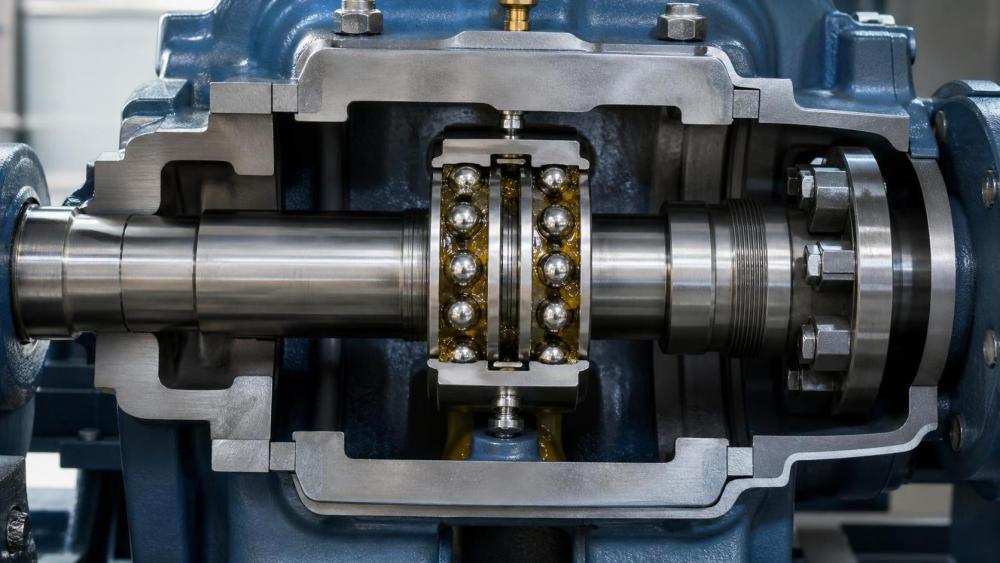
A double row angular contact bearing is designed to carry radial load together with axial load in both directions. Its two rows of balls and angular contact geometry give it useful stiffness and allow it to support moment loads that would be troublesome for a single-row arrangement. That makes it a practical choice in centrifugal pumps, fan shafts, compact gear drives, agricultural equipment, and certain machine spindles.
The same geometry also means that internal load distribution matters greatly. Radial force, thrust force, shaft deflection, fit interference, and mounting accuracy all influence the contact forces between balls and raceways. Under a combined load, the balls do not merely roll; they experience elastic deformation and small amounts of sliding at the contact zones. If preload or alignment is wrong, that sliding increases. Lubricant shear rises with it, and heat appears quickly.
A bearing catalog rating should therefore not be treated as a blanket assurance that the assembly will run cool. Ratings are part of selection, but actual operating behavior depends on speed, load direction, lubrication type, clearance or preload, housing rigidity, shaft geometry, sealing drag, and the ability of the machine to reject heat. A pump bearing near a hot process fluid and a similar bearing in a clean, slow-moving conveyor do not face the same thermal problem.
Excess preload is often the first place to look
Too much preload is one of the most frequent causes of overheating in an angular contact arrangement. It can be introduced during assembly, but it is not always an assembly technician’s mistake. Tight shaft or housing fits can reduce internal clearance. A locknut may be tightened beyond the intended condition. A spacer may be incorrect, damaged, or not seated squarely. Thermal growth can also increase preload after the machine reaches operating temperature.
The practical clue is often timing. A bearing that runs hot almost immediately after replacement may have an installation or fit problem. A bearing that starts at a reasonable temperature, then steadily heats as the shaft and housing expand, points more strongly toward excessive running preload or inadequate allowance for differential thermal expansion.
Do not assume that a “tighter” bearing setting is safer. In applications needing stiffness, some preload may indeed be intentional, especially where positional accuracy matters. But preload must be established according to the bearing manufacturer’s arrangement and the equipment design. Field adjustment by feel, especially on a bearing with an unknown internal configuration, can turn a sound repair into a short-lived one.
Misalignment creates heat even when the load looks acceptable
A double row design can tolerate some real-world imperfection, but it is not a substitute for proper shaft and housing alignment. If the shaft is bent, the bearing seat is tapered, the housing bore is distorted, or the mounting faces are not square, the two rows may not share load as intended. One row can become overloaded while the other contributes less than expected. The result is localized friction, uneven raceway loading, and rising temperature.
This shows up regularly after work on adjacent components. A gearbox cover may be pulled down unevenly. A pump casing may be strained by pipework. A belt drive may be retensioned without checking shaft deflection. A bearing housing may have been repaired, welded, or machined and no longer hold its original form. The bearing is then blamed because it is the part that gets hot, although the underlying fault sits in the structure around it.
Before replacing another bearing, inspect the shaft journal and housing bore for wear, fretting, scoring, out-of-round condition, and evidence of spinning. Check mounting shoulders, fillet clearances, locknut faces, and any spacer surfaces. If the application uses flexible couplings, confirm alignment in the machine’s actual operating condition where possible, not only when the equipment is cold and uncoupled.
Lubrication failures are not limited to “too little grease”
Insufficient lubricant will raise friction, but overgreasing can create the same complaint. When a grease-filled bearing runs at speed, excess grease must be churned and displaced. That churning produces heat. In a tightly sealed housing, it may also raise internal pressure and force grease past seals. The maintenance response is sometimes to add even more grease after seeing purge at the seal, which can make the condition worse.
The right lubricant is equally important. Grease consistency, base-oil viscosity, thickener compatibility, operating temperature, speed factor, water exposure, and load all matter. A grease selected solely because it is available in the workshop may not form an adequate film at the actual contact conditions. Mixing incompatible greases can alter consistency or oil separation behavior, so a relubrication route should be reviewed before introducing a different product.
Oil-lubricated units have their own traps: incorrect level, foaming, blocked return paths, aeration, and contamination from process fluid. In hydraulic equipment, a hot bearing can sometimes be connected to a broader fluid-control issue. A pump operating against abnormal pressure, a restricted suction condition, or an unintended thrust load may stress both the bearing and the lubricant. Treating the bearing alone may only hide the system fault for a while.
What grease and seal evidence can tell you
Grease condition is useful evidence if it is read carefully. Darkened grease near the raceway may suggest prolonged heat exposure, but it does not identify the cause by itself. Metallic particles may indicate advancing bearing damage; hard granular contamination suggests sealing or handling issues; water contamination points to washdown, condensation, or an external ingress route. A damaged seal lip can allow contaminants in while adding friction of its own, particularly if it runs dry or is distorted during installation.
Take samples and photographs before wiping the housing clean. Once the evidence has been removed, teams often lose the only practical clue to whether the failure began with lubricant, contamination, fit, or load.
Combined loading can exceed the real operating envelope
A bearing may overheat because the machine is applying more axial load than expected, or applying it in a different direction from the original design assumption. This is particularly relevant in pumps, helical gear drives, screw mechanisms, and belt-driven equipment. Process changes, impeller wear, pressure changes, altered belt tension, a modified coupling, or replacement of an adjacent component can all shift the load path.
Moment loading deserves attention as well. A pulley positioned too far from the bearing centerline, a heavy overhung coupling, or pipe strain acting through a pump shaft can magnify load on one side of the bearing. The machine may still turn freely by hand, yet generate damaging heat at operating speed because dynamic forces and thermal expansion are absent during a static check.
If an application has changed since the original bearing was installed, review the actual arrangement rather than ordering the same part number automatically. Bearing designation, internal clearance, seal type, cage design, and lubrication recommendation should be checked against the equipment drawing and the bearing manufacturer’s current technical documentation. Equivalent dimensions do not always mean equivalent running behavior.
A disciplined overheating investigation saves repeated replacements
The most efficient troubleshooting sequence begins before dismantling. Record the bearing housing temperature, ambient temperature, running time, speed, load condition, vibration trend, and any unusual noise. Compare like-for-like locations where the machine design permits it. An infrared reading is useful for trending, but surface emissivity and viewing conditions can affect absolute values; a contact measurement at a safe, consistent point can help confirm a suspicious reading.
- Confirm whether the temperature rise began after bearing replacement, lubrication, alignment work, or a process change.
- Check lubricant quantity, type, condition, relubrication practice, and evidence of seal drag or grease churning.
- Inspect driven equipment for abnormal thrust, belt tension, coupling misalignment, pipe strain, or shaft deflection.
- During teardown, preserve the bearing orientation and inspect both rows, raceways, cage, seals, shaft seat, and housing bore.
- Measure fits and geometry against the applicable equipment and bearing documentation before selecting the replacement method.
There is a useful maintenance distinction here: overheating caused by excess grease may improve after correcting fill quantity and running the machine under controlled observation. Overheating caused by incorrect fit, excessive preload, or misalignment usually will not “run in” safely. Continuing operation in the hope that temperatures settle can damage the raceways and create a more expensive repair involving the shaft, housing, seals, coupling, or gearbox.
Installation details that are easy to underestimate
A good replacement bearing can be damaged before startup. Pressing force should be applied only to the ring with the interference fit; transmitting force through the balls creates brinelling risk. Heating methods must be controlled and suitable for the bearing type, especially where seals, grease fill, or special materials are involved. Striking the ring with a hammer is not a precision installation method, even if it has become common practice in urgent repairs.
Cleanliness matters more than many field conditions allow. Fine abrasive dust, machining debris, moisture, and rag fibers can compromise a bearing quickly. This is why bearing reliability connects directly to the broader industrial disciplines of machining quality, shaft-finish control, casting integrity, seal selection, and lubrication management. In power transmission assemblies, the bearing does not operate as an isolated catalog item; it reflects the condition of the entire mechanical system around it.
For maintenance teams working across pumps, gearboxes, hydraulic units, and heavy machinery, the practical rule is simple: do not diagnose a hot double row angular contact bearing by temperature alone. Verify preload and fits, look for misalignment and changing external loads, review the lubricant as a working system, and inspect the surrounding shaft and housing geometry. That approach is slower than swapping a bearing once, but it is usually much faster than replacing the same bearing again after the real cause has been left in place.
Related News
- Using Industrial Air Blow Guns to Clear Chips Without Spreading DebrisOct 15, 2026Fluid Power Control Strategist
- Ductile Iron Pipe Valves: Which AWWA Standards Apply to Water Main Projects?Oct 15, 2026Dr. Elias Vance
- Why Vacuum Suction Cups Lose Grip on MDF in Woodworking MachinesOct 15, 2026CNC Kinematics Architect
- Choosing a Variable Displacement Piston Pump Manufacturer: What to VerifyOct 15, 2026Fluid Power Control Strategist
- Parallel vs. Angular Pneumatic Grippers for Confined Assembly StationsOct 15, 2026Fluid Power Control Strategist
- Die Castings vs. Investment Castings: Which Costs Less at Your Production Volume?Oct 14, 2026Foundry Phase-Change Fellow