
When Do Ceramic Hybrid Machine Tool Bearings Improve Spindle Speed and Tool Life?
A spindle upgrade is often proposed when a machining center begins to show familiar limits: rising bearing temperature during long high-speed cycles, inconsistent finish on tight-tolerance features, tool edges failing earlier than expected, or a speed target that looks achievable on paper but unstable in production. In these situations, ceramic hybrid machine tool bearings may be part of the answer. They can support higher rotational speeds, reduce frictional heat, and improve operating stability—but they are not a universal cure for every spindle problem.
For technical evaluators, the useful question is more specific: under which operating conditions will hybrid bearings create a measurable improvement in spindle speed, tool life, and part quality? The answer depends on the spindle architecture, preload method, load profile, lubrication strategy, machining material, toolholder condition, and the real duty cycle rather than the machine’s catalog speed alone.
Why ceramic hybrid bearings behave differently in a high-speed spindle
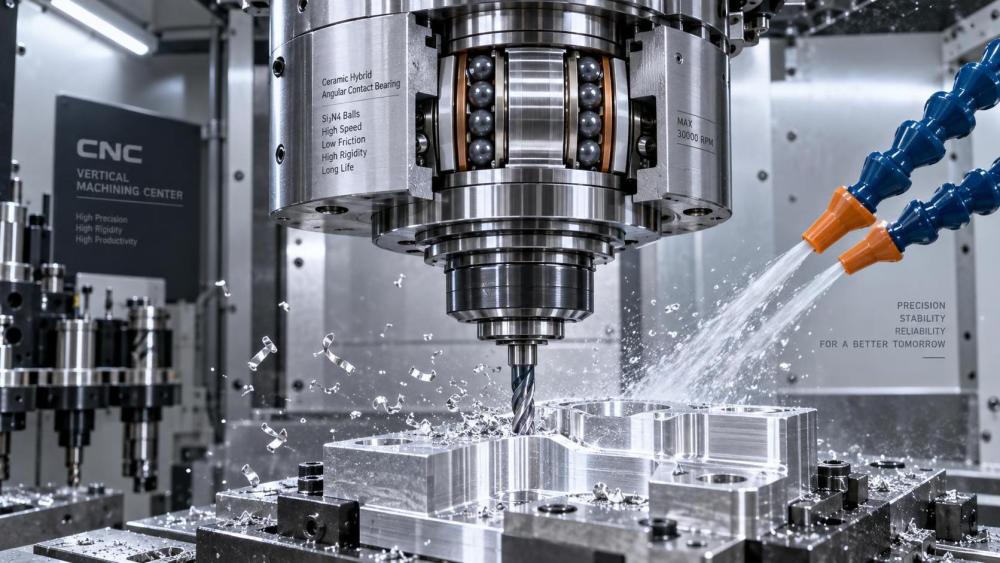
A ceramic hybrid bearing typically combines silicon nitride rolling elements with steel bearing rings. This arrangement changes several characteristics that matter inside a machine tool spindle. Silicon nitride balls are lighter than steel balls, have high hardness, and generally generate less centrifugal force at a given speed. They also have lower thermal expansion and can operate with reduced friction under properly controlled lubrication conditions.
At moderate speed, those differences may be difficult to detect at the workpiece. At high speed, however, centrifugal loading, ball-to-raceway contact stress, lubricant churning, and heat accumulation become much more significant. A conventional steel rolling-element bearing can remain highly reliable within its intended operating range, but a spindle approaching its thermal or speed limit may benefit from the reduced rolling-element mass and lower heat generation of a hybrid design.
That benefit is rarely just “more RPM.” A cooler, more stable bearing system can help the spindle retain preload more consistently, limit thermal growth, reduce vibration sensitivity, and maintain more predictable cutting behavior. These effects are the real link between bearing selection and tool life.
The applications where the upgrade is most likely to pay back
Ceramic hybrid machine tool bearings are most compelling when high spindle speed is not an occasional feature but a sustained production requirement. A shop that runs a short finishing pass at high RPM once per shift has a different case from a production cell operating near the upper speed range for multiple hours each day.
Common high-value applications include:
- High-speed milling of aluminum and nonferrous alloys, where spindle speeds are elevated to maintain productive chip load with small cutters.
- Die and mold finishing, especially with small ball-nose tools, fine step-over strategies, and long periods of high-speed contouring.
- Graphite, composite, and electronics machining, where high RPM, fine surface requirements, and contamination control place unusual demands on spindle systems.
- Precision aerospace and medical components, where surface finish, dimensional stability, and repeatability may matter as much as material removal rate.
- Grinding spindles and high-frequency auxiliary spindles, provided the bearing arrangement, lubrication method, and balance quality are designed for the duty.
In these environments, a hybrid bearing can help extend the practical high-speed operating window. The most important word is practical. A machine may technically reach a stated maximum speed, yet experience heat alarms, premature grease deterioration, unstable finish, or aggressive tool wear long before that speed becomes a reliable production setting. The upgrade is valuable when it turns a marginal operating zone into a repeatable one.
How bearing heat affects tool life—even when the bearing never touches the cut
Tool life is usually discussed in terms of cutting speed, feed, coolant delivery, tool coating, workpiece material, and toolpath strategy. All are important. But spindle bearing behavior can quietly influence each of them through motion quality and temperature control.
As bearing temperature rises, the spindle shaft and housing expand at different rates. This can alter bearing preload and change the tool center position. In severe cases, heat also increases internal friction, causing a self-reinforcing cycle of higher temperature and reduced stability. The resulting variation may appear as changing surface finish, gradual dimensional drift, chatter marks, or unexplained variation between the first and last part of a long run.
A tool subjected to even small levels of radial runout does not share cutting load evenly across its edges. One flute can do more work, experience greater heat, and wear first. With small-diameter end mills, drills, and reamers, this imbalance can sharply reduce usable tool life. If a ceramic hybrid bearing arrangement reduces thermal variation and supports lower vibration at the target speed, it may improve the conditions in which the tool cuts—even though the tool itself has not changed.
This distinction matters during ROI evaluation. The gain may not show up simply as a higher spindle speed. It may show up as fewer finish-pass corrections, longer intervals between tool offsets, more consistent bore quality, or less scrap caused by thermal drift.
Do not confuse a bearing upgrade with a complete spindle solution
A hybrid bearing cannot compensate for an unsuitable spindle design. This is the point where many upgrade discussions become too optimistic. If the motor lacks adequate power or torque at the intended speed, if the toolholder interface has poor runout, if the rotor is inadequately balanced, or if the housing has insufficient thermal control, changing rolling elements alone will not create a stable high-speed machining system.
Before specifying ceramic hybrid bearings, evaluators should examine the entire rotating assembly:
- Spindle shaft geometry, stiffness, and critical speed margin
- Bearing arrangement, contact angle, preload class, and preload mechanism
- Toolholder type, taper condition, clamping force, and measured runout
- Rotor, holder, pull stud, and cutting tool balance at the intended speed
- Lubrication method: grease, oil-air, oil mist, or oil injection
- Cooling jacket performance and temperature-control logic
- Machine foundation, axis acceleration, and the likelihood of interrupted cutting
- Contamination exposure from coolant, abrasive dust, chips, or damaged seals
For example, a grease-lubricated spindle may gain useful speed capability from hybrid bearings, but grease quantity, fill ratio, formulation, and relubrication practice remain critical. Excess grease can create churning losses and heat that erase much of the bearing’s advantage. In an oil-air system, the challenge shifts toward consistent metering, clean air supply, correct oil viscosity, and reliable delivery to each bearing location.
Preload is often the deciding factor
High-speed angular contact spindle bearings require preload to provide stiffness and control the rolling elements. Yet preload also creates friction and heat. Too little preload can allow deflection, runout, and poor cutting stability. Too much can raise temperature rapidly and shorten bearing life, regardless of whether the balls are steel or ceramic.
This is why the most effective hybrid-bearing applications are usually engineered around the correct preload strategy. Fixed preload arrangements may work well where speed and temperature remain within a predictable range. Spring-loaded or constant-pressure systems can be advantageous where thermal expansion and speed variation are substantial. Some spindle designs use different bearing group configurations at the front and rear to balance radial stiffness, axial stiffness, and speed capability.
Technical teams should ask not only, “Can this bearing fit the existing spindle?” but also, “Will the existing preload system produce the right operating preload after warm-up?” A physically interchangeable bearing may still perform poorly if internal clearance, mounting interference, or preload selection does not match the spindle’s thermal behavior.
When tool life gains are realistic—and when they are not
Tool life improvements are realistic when the current limitation is connected to spindle dynamics or thermal instability. Signs include a finish that deteriorates during extended high-speed operation, repeated adjustment of tool offsets after warm-up, premature wear on one cutting edge, unexplained chatter near the top speed range, or bearing temperature that rises sharply during aggressive finishing cycles.
Hybrid bearings are less likely to transform results when the dominant problem lies elsewhere. A dull toolpath, insufficient coolant reach, unstable workholding, poor tool balance, weak machine structure, incorrect cutting parameters, or material inconsistency will still govern tool performance. In fact, installing a more capable bearing system can reveal these weaknesses more clearly because the spindle itself is no longer the first limiting factor.
For hard milling, titanium machining, and other high-load operations, the decision should be particularly careful. Ceramic hybrid bearings can offer advantages in speed and thermal behavior, but heavy radial and axial cutting loads, shock loading, and interrupted cuts must be evaluated against bearing load capacity, contact stress, and required stiffness. The best choice may be a hybrid arrangement, an optimized steel-bearing arrangement, or a broader spindle redesign depending on the process.
A practical evaluation sequence for engineering teams
Rather than approving an upgrade based on maximum RPM claims, document the present production condition. Record spindle temperature from cold start through steady-state operation, vibration trends, actual speed, toolholder runout, surface roughness, dimensional drift, tool wear pattern, and cycle-time losses. If possible, separate roughing, semi-finishing, and finishing data; they impose very different loads on the spindle.
Next, define the production objective in measurable terms. Is the goal to run a 12 mm end mill faster? To improve the life of 2 mm finishing tools? To prevent thermal growth during an unattended shift? To increase speed without reducing finish quality? A clear target makes it easier to select bearing contact angle, precision grade, cage design, lubricant, preload, and cooling requirements.
Then compare the proposed operating point with the spindle’s current thermal and mechanical limits. Bearing manufacturers commonly use speed factors and application-specific calculation methods, but these should be interpreted alongside real installation conditions. The same bearing can perform very differently in a clean, balanced, oil-air-lubricated spindle than in a contaminated, heavily greased unit with poor housing fit.
A controlled trial is preferable to a broad production rollout. Monitor warm-up time, stabilized temperature, vibration, power draw, finish consistency, and tool wear over representative jobs. The decision should be based on the full production outcome, not on a brief no-load speed test.
Installation discipline protects the expected benefit
Hybrid bearings demand careful handling. Silicon nitride balls are extremely hard, but the assembly remains a precision component rather than a rugged commodity. Improper mounting force, damaged raceways, contaminated lubricant, incorrect orientation, or uncontrolled fits can compromise performance before the spindle reaches the machine floor.
Clean assembly conditions, calibrated mounting tools, verified shaft and housing geometry, correct locknut torque, and documented preload procedures are essential. For spindle rebuilders and OEM maintenance teams, it is also wise to inspect related components: spacers, labyrinth seals, springs, drawbar condition, tool taper contact, cooling passages, and lubrication lines. Replacing bearings while leaving a blocked oil-air nozzle or worn toolholder interface untouched often leads to an unfair conclusion that the bearing upgrade “did not work.”
The decision in one sentence
Ceramic hybrid machine tool bearings improve spindle speed and tool life when high rotational speed, heat generation, and dynamic stability are genuine process constraints—and when the spindle’s preload, lubrication, balance, cooling, and tooling system are engineered to use their advantages.
For technical evaluators, this makes hybrid bearings neither an automatic premium option nor a niche luxury. They are a targeted solution for machines where better thermal control and more stable high-speed rotation can translate into real machining value: more reliable finishing, fewer tool-related interruptions, tighter dimensional control, and a spindle that performs consistently through the full production cycle rather than only during a short demonstration run.
Related News
- How to Assess a Rigid Coupling Supplier for Bore Accuracy and Traceable QualityOct 08, 2026Tribology & Kinematics Expert
- Titanium Alloys Compared: Balancing Strength, Corrosion Resistance, and MachinabilityOct 08, 2026CNC Kinematics Architect
- Where Ductile Iron Dismantling Joints Reduce Alignment Risk in Water PipelinesOct 08, 2026Pipeline Metallurgy Scientist
- Selecting a Precision Bearing Sleeve: Fits, Runout, and Material ChoicesOct 08, 2026Tribology & Kinematics Expert
- Face Milling Cutters: How Insert Geometry Affects Finish on Steel and AluminumOct 08, 2026CNC Kinematics Architect
- Single-Acting Cylinders for Clamping: Stroke, Force, and Return Spring ConsiderationsOct 07, 2026Fluid Power Control Strategist