
What to Send a Bearing Housings Supplier for a Drop-In Replacement Quote
A replacement bearing housing can look identical to the old unit and still miss the shaft centerline, interfere with a seal, or require new holes in the mounting base. Those differences usually become expensive when the machine is already stopped. Before requesting a drop-in replacement quote from a bearing housings supplier, procurement teams need more than a part number and a photograph.
A useful RFQ package connects three things: what is installed, what must remain unchanged, and how the equipment operates. Dimensioned drawings, complete bearing designations, mounting details, seal arrangements, and service conditions allow suppliers to assess compatibility rather than simply quote something that looks close.
Define “drop-in” before asking for a price
Suppliers may interpret “replacement” differently. One may offer an interchangeable bare housing; another may quote a complete mounted bearing assembly with a different shaft attachment method. Both offers can sound acceptable until maintenance opens the boxes.
State the supply boundary explicitly: housing only, housing with seals and locating rings, or a complete assembly including the bearing, adapter sleeve, locknut, and other accessories. Identify any components that must be reused, subject to inspection and engineering approval.
Then define the installation restrictions. A practical requirement might read:
The replacement must install on the existing mounting base and shaft without drilling, machining, shimming beyond the approved arrangement, or modifying adjacent guards and lubrication lines. Any deviation requires written approval before order placement.
This is a purchasing requirement, not proof of interchangeability. Ask the supplier to confirm compliance against an approved drawing and identify any conditions that still need verification.
Build the RFQ around the installed assembly
Record identification without treating it as a complete specification
Send the original manufacturer, housing designation, casting marks, equipment model, and available purchase records. Include clear photographs of markings rather than relying solely on a handwritten transcription. Similar-looking characters and missing suffixes can change the proposed replacement.
The bearing designation matters separately from the housing number. Include all readable suffixes and identify whether the bearing has a cylindrical or tapered bore. Where fitted, record the adapter or withdrawal sleeve designation, locknut, locking device, and locating rings.
A shaft diameter alone does not establish the housing requirement. An adapter-mounted bearing may have a bore different from the shaft diameter, while several housing arrangements may accommodate the same bearing series.
Send photographs that answer installation questions
Provide an overall machine view, both shaft-entry sides, the mounting feet, lubrication connections, and nearby obstructions. Add close-ups of seals, end covers, identification marks, and visible damage. A scale in the frame helps establish context, but photographs should not replace dimensional measurements.
For split housings, photograph the internal arrangement only during an authorized shutdown with appropriate isolation procedures. Keep matched cap and base components identified; do not assume caps from apparently identical housings are interchangeable.
The dimensions that decide whether it actually fits
An original approved drawing is the best starting point. If none exists, provide a measured sketch with units, reference surfaces, and measurement uncertainty. Mark dimensions taken from worn or damaged surfaces so the supplier does not mistake deterioration for the intended design.
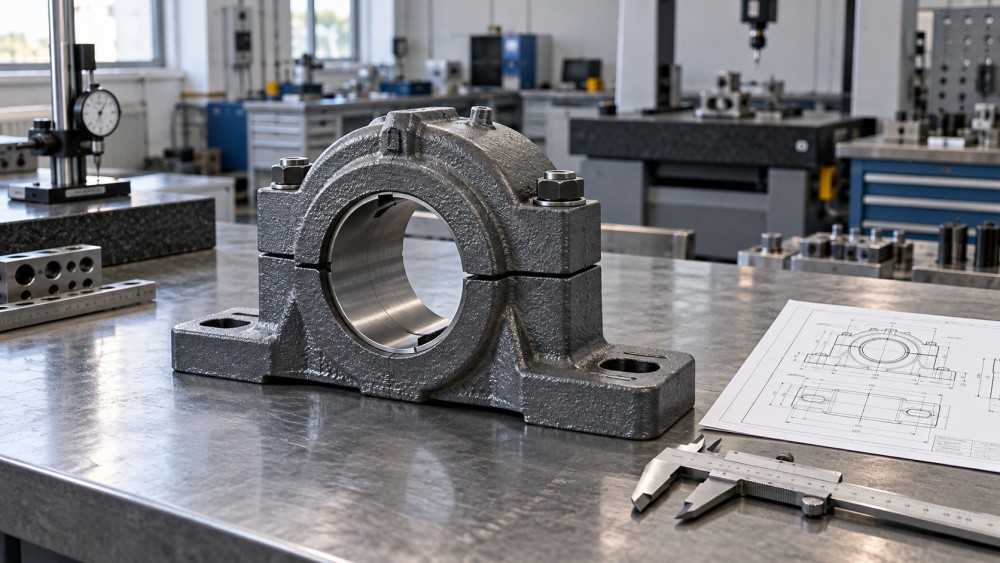
Use the mounting face as a clearly identified reference when documenting center height. If existing shims are present, record them separately rather than incorporating them into the housing measurement. Also note whether mounting slots provide genuine adjustment or merely accommodate installation tolerances.
Do not ask a supplier to copy a worn bearing seat without review. Likewise, mounting bolts should not be used to force a mismatched housing into position. Critical fits and tolerances should come from the applicable design requirements, bearing guidance, and engineering assessment—not an assumption that nominal dimensions are sufficient.
Explain how the bearing is located, sealed, and lubricated
External dimensions can match while the internal arrangement remains wrong. This is particularly important when a shaft uses one locating bearing position and one non-locating position to accommodate thermal expansion.
Identify which position the housing serves. Show the existing locating rings, shoulders, covers, and available axial movement where applicable. Do not confuse a bearing’s internal clearance designation with the assembly’s provision for axial expansion; these are different requirements.
Seal selection deserves similar attention. Specify whether the existing arrangement uses contact seals, labyrinth seals, V-rings, taconite-style assemblies, or another system. Include shaft speed, contamination exposure, washdown practices, and any restrictions on leakage or ingress. A seal that fits the housing may still be unsuitable for the operating speed or environment.
For lubrication, provide the lubricant type, grade, application method, replenishment practice, and connection details. If oil lubrication is used, describe the oil level arrangement, drains, breathers, and any circulation system. If grease is used, identify any purge or relief provisions. Ask the supplier to confirm compatibility rather than silently substituting a different lubrication arrangement.
Give the supplier enough operating context to challenge a poor match
A purchasing team does not need to recreate the entire machine design, but it should supply the operating information available from maintenance and engineering:
- Application and orientation: conveyor pulley, fan, crusher, pump, or other equipment; horizontal, vertical, or inclined shaft.
- Speed and duty: normal and maximum speed, continuous or intermittent operation, frequent starts, and reversing service.
- Loading: known radial and axial loads, load direction, shock, vibration, and belt or chain pull.
- Temperature and exposure: ambient conditions, measured operating temperatures, dust, water, chemicals, or outdoor weather.
- Failure history: cracking, fretting, loose bearing seats, seal damage, overheating, or recurring alignment problems.
Unknown values should be labeled as unknown. Motor power alone is not enough to determine housing loads. Where calculations are needed, ask what additional information the supplier requires and who will take responsibility for the selection.
Failure photographs can be especially valuable. A cracked foot or damaged seat may indicate a problem beyond ordinary wear. Reproducing the same geometry without examining the cause can preserve the original weakness rather than solve the maintenance problem.
Ask your bearing housings supplier to separate price from assumptions
A low quotation is difficult to evaluate when it leaves out seals, inspection, or dimensional confirmation. Request an itemized scope that makes the following visible:
- Housing designation, material grade, and proposed manufacturer.
- Included bearings, seals, sleeves, rings, covers, fasteners, and lubrication fittings.
- Drawing preparation, reverse engineering, tooling, or pattern charges.
- Inspection, material documentation, coating, and any specified testing.
- Packaging, freight basis, delivery terms, and quotation validity.
- Lead time, including the starting point for drawing approval or sample acceptance.
Material descriptions should be specific enough for engineering review. “Cast iron” does not establish equivalence between gray iron and ductile iron, and a material substitution should not be accepted solely because the mounting dimensions match.
For a custom casting or machined replacement, distinguish first-order costs from repeat-order pricing. Pattern ownership, tooling storage, minimum order quantities, and future drawing availability can affect the value of a seemingly inexpensive initial quote.
Request only the documentation the application needs. A dimensional report for critical interfaces and material traceability may be appropriate; additional non-destructive testing should follow a defined requirement rather than a vague request for “full certification.” Unclear documentation demands can add cost without producing useful acceptance evidence.
Use a short RFQ cover note to prevent long clarification chains
Keep the detailed drawings and photographs in attachments, but make the decision-critical information easy to find. A cover note can follow this format:
Request: Quote [quantity] replacement bearing housings for [equipment and installation position]. Supply scope: [housing only / housing with listed accessories / complete assembly].
Existing identification: [manufacturer, housing designation, complete bearing designation, sleeve and seal details]. Attached files include [drawing revision, measured sketch, photographs, and operating data].
Interchangeability requirement: Retain the existing shaft, mounting base, center height, and adjacent equipment. List every dimensional, material, sealing, lubrication, or accessory deviation separately.
Required response: Provide the proposed drawing, itemized price, delivery schedule, documentation scope, exclusions, and any outstanding information needed to confirm suitability.
Add the required delivery location and whether the date is a preferred arrival date or a shutdown-critical deadline. Separate technical approval from commercial award so an urgent purchase does not accidentally bypass compatibility review.
Before issuing the purchase order, close the gaps in writing
Compare quotations against the same attachment revision and supply scope. If one supplier proposes a standard housing and another proposes a custom replacement, check whether the standard option truly preserves the installation interfaces or merely reduces the component price.
Evaluate total installed cost: purchase price, omitted accessories, inspection, transport, installation labor, modifications, and potential downtime. A housing that needs a new baseplate is not commercially equivalent to a confirmed drop-in replacement, even if its quoted unit price is lower.
Before release, obtain an approved drawing, a resolved deviation list, an agreed inspection scope, and clear responsibility for any remaining measurements. If physical verification is still outstanding, identify the offer as conditional rather than treating it as fully interchangeable.
The strongest RFQ does not overwhelm a supplier with unrelated paperwork. It removes uncertainty at the interfaces that matter. For procurement, that means fewer clarification rounds, quotations that can be compared fairly, and a much better chance that the replacement arrives ready for the planned installation—not another round of workshop modifications.
Related News
- Why Is Your Heavy-Duty Piston Pump Losing Pressure Under Load?Nov 09, 2026Fluid Power Control Strategist
- Cartridge Valves for Manifold Blocks: Avoiding Cavity Fit ProblemsNov 09, 2026Fluid Power Control Strategist
- Large-Diameter Forged Rings: How Seamless Rolling Affects Grain FlowNov 09, 2026Foundry Phase-Change Fellow
- Sealed Heavy-Duty Roller Bearings: Choosing Seals for Dust and WaterNov 09, 2026Tribology & Kinematics Expert
- Sprockets and Chain Drives: What Determines Replacement Cost?Nov 08, 2026CNC Kinematics Architect
- Monoblock Hydraulic Control Valves: Flow Rating and Spool SelectionNov 08, 2026Fluid Power Control Strategist