
What to Check When Choosing a Bearing Retainer Factory for OEM Production
What to Check When Choosing a Bearing Retainer Factory for OEM Production
Choosing a bearing retainer factory for OEM production requires more than comparing unit prices. Procurement teams must evaluate material expertise, machining precision, heat treatment, inspection capability, traceability, production capacity, and communication reliability.
A qualified supplier can protect bearing performance, reduce quality risk, and support stable delivery across demanding industrial applications. This guide outlines the key checks buyers should complete before selecting an OEM manufacturing partner.
Start With the Retainer’s Actual Operating Requirements
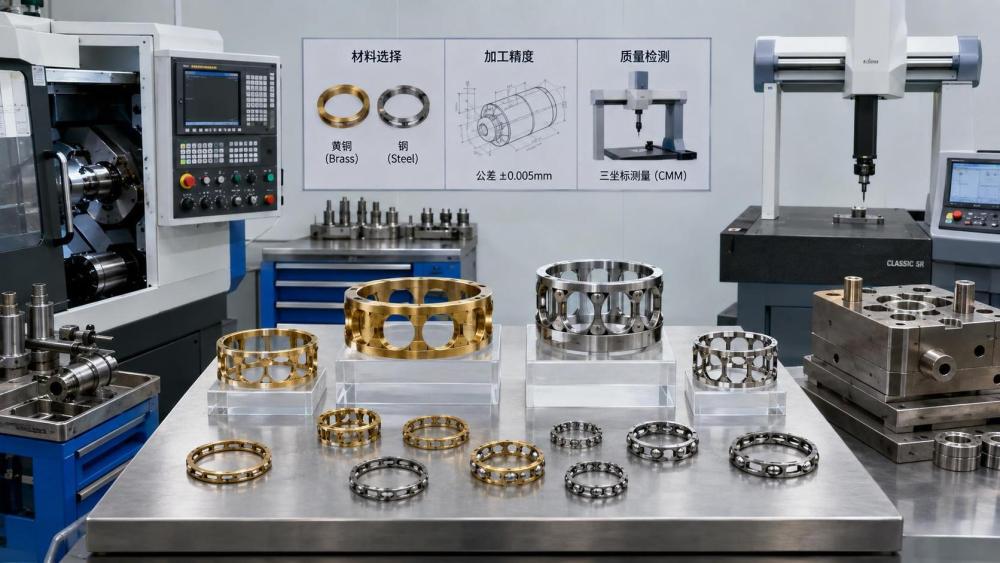
Before contacting any bearing retainer factory, procurement teams should convert the bearing application into a clear technical requirement package. A retainer is not a simple accessory.
It guides rolling elements, maintains spacing, supports lubricant distribution, and influences friction, heat generation, vibration, and high-speed stability. Its design must match the complete bearing system.
Ask engineering teams for the bearing drawing, retainer geometry, operating speed, radial load, axial load, working temperature, lubrication type, contamination exposure, and expected service life.
Retainers used in electric motors, machine tools, pumps, gearboxes, construction equipment, and wind-energy systems may require very different materials and manufacturing controls.
For example, high-speed spindle bearings often need lightweight retainers with accurate pocket geometry and strong dynamic balance. Heavy-duty bearings may prioritize mechanical strength and wear resistance.
A buyer should also identify whether the retainer will be used in deep-groove ball bearings, angular-contact bearings, cylindrical roller bearings, tapered roller bearings, or spherical roller bearings.
These bearing types create different stresses on the cage or retainer. A factory that understands one product category may not automatically be qualified for another.
Include target standards where applicable, such as ISO bearing terminology, customer-specific drawings, material specifications, tolerance tables, inspection plans, and packaging requirements for transport or assembly.
Clear inputs reduce quotation ambiguity. They also make it easier to compare suppliers based on capability, process control, and total production risk instead of headline price.
Verify Material Selection and Metallurgical Competence
Material selection is one of the most important checks when evaluating a bearing retainer factory. Retainer failure can cause rolling-element misalignment, increased friction, accelerated wear, or bearing seizure.
Common retainer materials include stamped steel, machined brass, bronze, polyamide, PEEK, aluminum alloys, and specialty engineering polymers. Each option has operating limits and cost implications.
Stamped steel retainers can provide economical production for high-volume applications. However, corrosion resistance, forming quality, burr removal, coating selection, and dimensional consistency must be controlled carefully.
Machined brass retainers are widely used for demanding industrial bearings because they offer good machinability, strength, dimensional stability, and lubricant compatibility under many operating conditions.
Polyamide retainers can reduce weight and noise, but buyers should confirm temperature resistance, chemical compatibility, moisture absorption behavior, aging performance, and suitability for selected lubricants.
For high-temperature, vacuum, chemical-processing, aerospace, or electrical insulation applications, advanced polymers or special alloys may be necessary. The supplier should explain why the proposed material fits.
Request material certificates for each production lot. These should identify the grade, chemical composition where relevant, mechanical properties, heat number, supplier source, and applicable test standards.
For metal retainers, ask how raw material is stored, identified, and segregated. Mixed materials can create difficult-to-detect failures, especially when similar stock appears visually identical.
A capable supplier should also understand how machining, stamping, heat treatment, surface finishing, and cleaning affect the chosen material’s mechanical behavior and corrosion performance.
Do not accept generic statements such as “premium brass” or “high-quality steel” without a traceable grade. Procurement decisions need measurable specifications, not marketing terminology.
Assess Manufacturing Process Capability, Not Just Equipment Lists
A supplier’s machine list can be useful, but it does not prove repeatable quality. Buyers should focus on whether the production process consistently achieves the required geometry and tolerances.
Depending on the retainer design, production may involve stamping, deep drawing, turning, milling, drilling, broaching, grinding, deburring, riveting, assembly, washing, and final inspection.
Ask the bearing retainer factory to describe the complete route from incoming material to shipment. A process flowchart often reveals missing controls or excessive dependence on manual correction.
For machined retainers, review turning and milling capability, fixture design, tool-change control, spindle condition, coolant management, chip handling, and in-process dimensional measurement.
For stamped retainers, examine die design, press capacity, strip feeding accuracy, die maintenance, forming repeatability, crack prevention, springback control, and edge-quality management.
Complex pocket geometry requires special attention. Pocket dimensions affect rolling-element guidance, clearance, lubricant movement, and bearing torque, particularly at high rotational speeds.
Ask how the supplier controls pocket position, pocket radius, wall thickness, concentricity, roundness, runout, and burr height. These details directly influence assembly quality.
Factories should have documented reaction plans for tool wear, fixture damage, out-of-tolerance measurements, machine stoppages, and abnormal process variation. Corrective action must be practical and timely.
For OEM programs, it is valuable to request sample inspection data from a comparable component. Actual process capability evidence is more meaningful than a broad statement about precision machining.
Where quantities justify it, arrange a technical review of the production route before approving the supplier. Early process discussions prevent expensive redesigns after tooling or mass production begins.
Check Tolerance Control and Measurement Capability
Retainer dimensions must work with raceways, rolling elements, seals, shields, and assembly equipment. Small deviations can create noise, torque variation, interference, or premature bearing failure.
Procurement teams should verify that the factory can measure every critical drawing characteristic. This includes dimensions, geometric tolerances, surface finish, burr condition, and sometimes weight or balance.
Ask what equipment is used for inspection. Relevant tools may include coordinate measuring machines, optical comparators, vision systems, air gauges, micrometers, bore gauges, profilometers, and roundness testers.
The presence of measuring equipment is only the starting point. Confirm calibration status, calibration frequency, measurement instructions, gauge repeatability, reproducibility studies, and operator training records.
For tight-tolerance retainers, in-process measurement is generally more valuable than final inspection alone. It allows the factory to correct drift before a large quantity becomes nonconforming.
Request first-article inspection reports that connect drawing callouts to actual measured values. The report should show revision control, sample identification, measuring method, acceptance criteria, and inspector approval.
Statistical process control can be useful for high-volume production. Buyers should ask which critical dimensions are tracked and how the factory responds when trends approach specification limits.
Surface quality deserves attention because rough edges and machining marks can contaminate bearings, damage rolling elements, or create stress concentrations. Define acceptable burr and finish conditions clearly.
When the component is safety-critical or highly loaded, consider independent dimensional validation. Third-party checks can be appropriate during supplier qualification or after significant process changes.
Review Heat Treatment, Finishing, and Cleanliness Controls
Not every retainer requires heat treatment, but when it does, the process can significantly affect hardness, strength, distortion, residual stress, and fatigue behavior.
Ask whether heat treatment is performed in-house or outsourced. If outsourced, determine how the bearing retainer factory qualifies subcontractors and maintains lot traceability through the process.
Important questions include furnace type, temperature recording, atmosphere control, quenching method, tempering process, hardness testing, distortion checks, and metallographic inspection where required.
Heat-treated retainers may need subsequent grinding or machining to restore critical dimensions. The supplier should explain how it controls dimensional change between pre-treatment and final inspection.
Surface treatments may include phosphating, black oxide, zinc plating, nickel plating, passivation, oiling, or specialized low-friction coatings. Confirm coating thickness, adhesion, corrosion resistance, and compatibility.
For bearing components, cleanliness is not a cosmetic issue. Metal chips, abrasive particles, polishing residue, moisture, or packaging debris can shorten bearing life after assembly.
Ask about washing methods, drying methods, cleaning-fluid management, particle control, rust prevention, clean handling, and final packaging. Sensitive applications may require documented cleanliness targets.
Packaging should protect retainers from corrosion, deformation, contamination, and mixed-lot errors. Bulk packaging may be acceptable for robust parts, while precision retainers may need compartmentalized protection.
Confirm Traceability and Quality-System Discipline
Traceability allows an OEM buyer to identify what material, machine, operator, inspection result, and process condition applied to a specific shipment or production lot.
At a minimum, each lot should be linked to a purchase order, drawing revision, raw material batch, production date, inspection record, quantity, and shipment documentation.
For regulated or high-risk applications, the traceability chain may also need heat-treatment records, coating records, subcontractor certificates, nonconformance reports, and corrective-action documentation.
ISO 9001 certification can indicate that a factory has a documented quality-management framework. However, buyers should examine how the system operates on the production floor.
Ask to review examples of incoming inspection records, process inspection sheets, final inspection reports, calibration labels, nonconformance tags, and corrective-action reports from completed orders.
A reliable supplier can show how it prevents recurrence after a defect. Look for root-cause analysis, containment actions, verified corrective measures, and updates to work instructions or control plans.
Be cautious when a supplier provides certificates but cannot explain its actual control methods. Documentation should support real discipline, not replace it.
Change management is equally important. The factory should notify the OEM before changing material source, tooling, machining parameters, subcontractors, inspection methods, manufacturing location, or packaging design.
Evaluate Capacity, Tooling Ownership, and Delivery Reliability
Even technically capable factories can become unsuitable suppliers if they cannot support required volumes, stable lead times, or urgent recovery needs during OEM production.
Ask for realistic capacity information, including available machines, shift patterns, staffing levels, monthly output, current utilization, bottleneck operations, and contingency plans for equipment failures.
Capacity should be evaluated at the process bottleneck, not by total factory size. A single overloaded stamping press, machining center, or inspection station can delay the entire program.
For custom retainers, tooling ownership requires written agreement. Define who owns dies, fixtures, gauges, programs, spare inserts, design files, maintenance responsibility, and access rights after termination.
Tooling maintenance matters because progressive dies and precision fixtures wear over time. Buyers should understand planned maintenance intervals, spare-part availability, repair lead times, and approval procedures.
Request a production timeline covering sample development, first-article approval, pilot production, mass-production launch, routine replenishment, and logistics transit. Verify assumptions behind every milestone.
Delivery reliability also depends on packaging capacity, export documentation, freight planning, customs experience, and communication during disruptions. These factors are especially important for global OEM supply chains.
Consider whether the supplier can hold agreed safety stock, support scheduled releases, or maintain buffer inventory for critical programs. Inventory arrangements should match demand volatility and storage limitations.
Compare Total Cost, Commercial Terms, and Supplier Communication
The lowest quoted unit price may create the highest total cost when defects, sorting, late delivery, engineering rework, warranty claims, and production interruptions are considered.
Compare quotations using a common scope. Confirm material grade, tooling cost, sampling cost, inspection requirements, packaging, coating, minimum order quantity, payment terms, Incoterms, and freight assumptions.
Ask suppliers to separate one-time costs from recurring costs. This makes it easier to compare tooling investment against unit-price reductions at different forecast volumes.
For long-term programs, review price-adjustment mechanisms for metals, energy, labor, exchange rates, or logistics. A transparent formula is better than unexpected revisions after approval.
Communication quality is a practical risk indicator. A strong factory responds clearly to drawings, identifies missing requirements, asks relevant technical questions, and provides accurate revision-controlled documents.
During qualification, observe how quickly the supplier returns inspection reports, engineering feedback, corrective-action responses, and updated quotations. Slow or vague communication often continues after the purchase order.
Procurement should involve engineering, quality, logistics, and finance in the supplier decision. Cross-functional review helps identify risks that a price comparison alone may overlook.
Before nomination, score each candidate against technical capability, quality systems, delivery reliability, commercial terms, traceability, communication, and long-term improvement potential.
Use a Structured Qualification Process Before Full OEM Approval
A formal qualification process reduces the chance of approving a bearing retainer factory based on incomplete evidence. The process should progress from documentation review to production validation.
First, confirm technical feasibility using drawings, material specifications, operating requirements, and manufacturing-route discussions. Reject suppliers that cannot clearly explain how critical requirements will be controlled.
Second, review samples and first-article reports. Sample approval should verify dimensional compliance, material conformity, finish quality, assembly fit, and performance in the intended bearing design.
Third, conduct a supplier audit when program value, criticality, or volume justifies it. The audit should examine actual production conditions rather than relying only on presentation materials.
Fourth, use pilot production to validate repeatability. A pilot lot can reveal variation between samples, operator dependence, packaging weaknesses, capacity constraints, and hidden tooling problems.
Fifth, establish a supplier quality agreement. Define acceptance criteria, documentation requirements, change-notification rules, warranty responsibilities, response time, and handling of nonconforming products.
For strategic OEM parts, maintain periodic supplier performance reviews. Track on-time delivery, defect rates, responsiveness, corrective-action closure, cost performance, and improvement initiatives over time.
Qualification should not end with the first successful shipment. Ongoing monitoring protects supply continuity as volumes increase, designs change, and manufacturing conditions evolve.
Conclusion: Select the Factory That Reduces OEM Risk
The right bearing retainer factory is not simply the supplier offering the lowest price or the fastest initial quotation. It is the partner that can repeatedly meet technical requirements.
Buyers should prioritize proven material knowledge, controlled manufacturing processes, reliable measurement, lot traceability, stable capacity, disciplined change management, and responsive technical communication.
A structured supplier evaluation creates better purchasing decisions because it links retainer quality to bearing performance, equipment uptime, warranty exposure, and long-term program cost.
When procurement teams evaluate evidence rather than promises, they can choose an OEM manufacturing partner capable of delivering bearing retainers that support dependable industrial operation.
Related News
- Using Industrial Air Blow Guns to Clear Chips Without Spreading DebrisOct 15, 2026Fluid Power Control Strategist
- Ductile Iron Pipe Valves: Which AWWA Standards Apply to Water Main Projects?Oct 15, 2026Dr. Elias Vance
- Why Vacuum Suction Cups Lose Grip on MDF in Woodworking MachinesOct 15, 2026CNC Kinematics Architect
- Choosing a Variable Displacement Piston Pump Manufacturer: What to VerifyOct 15, 2026Fluid Power Control Strategist
- Parallel vs. Angular Pneumatic Grippers for Confined Assembly StationsOct 15, 2026Fluid Power Control Strategist
- Die Castings vs. Investment Castings: Which Costs Less at Your Production Volume?Oct 14, 2026Foundry Phase-Change Fellow