
What Procurement Teams Should Verify Before Choosing a Ball Bearing Manufacturer
A bearing quotation can look acceptable until the first production interruption exposes what was never checked: inconsistent running noise, shortened grease life, an incorrect internal clearance, or a replacement bearing that does not match the approved drawing. In conveyor drives, pumps, gearboxes, electric motors, and machine-tool assemblies, a low unit price can be outweighed quickly by downtime, expedited replacement orders, inspection work, and warranty disputes.
Before choosing a ball bearing manufacturer, procurement teams should verify whether the supplier can repeatedly produce the required bearing design, material condition, dimensional accuracy, load-rating performance, documentation, and delivery support. The central question is not simply whether a supplier can provide a bearing with the right bore and outside diameter. It is whether that bearing will perform predictably in the actual housing, shaft fit, lubrication method, speed range, contamination level, and service cycle of the equipment.
Start with the operating duty, not the catalog reference
A catalog designation is an important starting point, but it does not define the full operating requirement. Two bearings with the same boundary dimensions may differ in internal clearance, cage construction, seal design, grease compatibility, radial play, heat treatment, and vibration level. These differences may have little effect in a lightly loaded hand-operated mechanism but become critical in a continuously running motor or a high-speed pump.
Before requesting quotations, collect the information that affects bearing selection and supplier qualification:
- Bearing type and boundary dimensions, including bore, outer diameter, width, and any snap-ring groove or flange requirement.
- Radial and axial load direction, expected load variation, shock loading, and whether the load is constant or intermittent.
- Operating speed, start-stop frequency, temperature range, and allowable noise or vibration level.
- Shaft and housing fit requirements, including whether the inner or outer ring rotates relative to its load.
- Lubrication method, relubrication interval, grease type, and possible exposure to water, dust, chemicals, or process debris.
- Special requirements such as electric-current insulation, food-contact suitability, corrosion resistance, high-temperature operation, or low-torque sealing.
- Drawing revision, packaging rules, labeling needs, batch identification, and incoming-inspection expectations.
This preparation prevents a frequent sourcing failure: comparing prices for products that are described by the same part number but are not built to the same technical condition. A supplier may quote an open bearing while the application needs a contact seal, or quote normal internal clearance where elevated temperature and interference fits require a different clearance class.
Confirm that the manufacturer controls the critical production stages
Procurement should distinguish between a producer, an assembler, a distributor, and a trading company. Each may be a suitable commercial partner in the right situation, but the level of manufacturing control affects traceability, technical response, lead-time reliability, and responsibility when a quality issue occurs.
A manufacturer should be able to explain how it controls the main stages that determine bearing performance. For standard steel ball bearings, these usually include ring material preparation, forging or forming, turning, heat treatment, grinding, superfinishing, raceway geometry inspection, ball grading, assembly, lubrication where applicable, sealing, noise and vibration testing, preservation, and packaging.
Do not treat a long equipment list as proof of capability. Ask which processes are performed in-house, which are subcontracted, and how outsourced processes are approved and monitored. Heat treatment and precision grinding deserve particular attention because they influence hardness, residual stress, dimensional stability, raceway finish, and contact geometry. A supplier that cannot clearly identify its control points may struggle to investigate a premature-failure claim later.
Questions that reveal useful capability information
Rather than asking only whether a factory has “advanced equipment,” request answers tied to the bearing being purchased. Useful questions include:
- What bearing steel grade or material specification is used for the rings and rolling elements?
- How are lot numbers maintained from raw material through final packing?
- Which measurements are taken after heat treatment and after final grinding?
- How are bore, outside diameter, width, radial clearance, runout, and raceway form checked?
- What inspection method is used for bearing noise or vibration where low-noise operation is required?
- Can the manufacturer control special features such as polymer cages, stainless components, non-contact shields, contact seals, or custom grease fills?
- What is the process for managing drawing changes and preventing mixed revisions in production?
The answers should be consistent with the intended use. A general-purpose bearing supplier may be appropriate for noncritical replacement stock, while an OEM application with tight noise limits or a difficult contamination environment requires deeper process evidence.
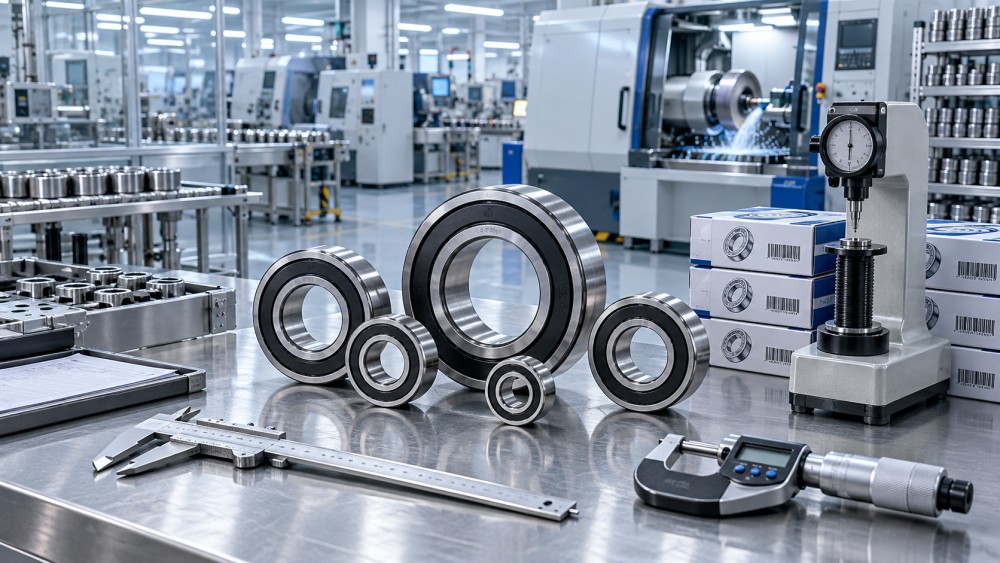
Verify material traceability and heat-treatment discipline
Material traceability is not paperwork for its own sake. It gives the buyer a way to connect an installed bearing to the material and process records used to make it. When bearings are used in pumps, power transmission assemblies, machine spindles, or safety-relevant mechanisms, this connection can determine whether a suspected defect can be isolated to a production lot.
Request the level of traceability needed for the purchase. This may include material certificates, heat or melt references, production batch numbers, inspection records, and final packing identification. The expected document set should be defined before the purchase order is released. Asking for certificates only after a shipment has arrived often creates delays and confusion, especially when batches have been consolidated in a warehouse.
Heat treatment requires careful review because bearing rings need an appropriate balance of hardness, wear resistance, fatigue performance, and dimensional stability. A supplier does not need to disclose proprietary process settings, but it should be able to show that heat-treatment parameters are controlled, loads are identified, and hardness or other relevant properties are verified. For corrosion-resistant, high-temperature, or specialty materials, confirm that the material condition matches the application rather than assuming that a stainless designation alone provides adequate load capacity or service life.
Compare load ratings with the actual application assumptions
Load ratings are often copied directly into purchasing specifications without checking how they were established. Dynamic and static load ratings are valuable selection inputs, but they must be interpreted with the bearing type, operating speed, required life, load direction, and mounting arrangement in mind. A rating from one supplier should not automatically be assumed equivalent to the same nominal rating from another supplier without understanding the applicable standard and calculation basis.
Ask the supplier to identify the published load-rating method and provide technical data for the exact bearing configuration offered. This is particularly important when the bearing includes seals, special grease, a nonstandard cage, altered clearance, or a modified raceway. Those features can affect speed capability, friction, allowable temperature, and usable life.
For a critical assembly, provide the manufacturer with the load and speed envelope instead of asking it to validate a single maximum value. Bearings often fail during transient conditions: a belt tensioning event, a pump startup, a reversing cycle, or a temporary misalignment caused by housing distortion. A technically capable supplier should be able to identify which assumptions need confirmation rather than offering unconditional approval based only on dimensions.
Inspect the quality system through evidence, not logo claims
Quality certifications can be useful screening tools, but they do not replace part-specific verification. Procurement should confirm the scope and validity of any certification that is relevant to the order, then look for evidence that the supplier’s system is applied to bearing production. Inspection plans, calibration records, nonconformance handling, lot segregation, and corrective-action procedures are more informative than a certificate displayed in a sales presentation.
Incoming inspection can also be aligned with supplier controls. For high-volume standard bearings, buyers may inspect identification, packaging condition, dimensions, rotation feel, radial clearance where practical, and sample noise or vibration according to internal requirements. For engineered or high-risk parts, the inspection plan may also require material documentation, dimensional reports, grease confirmation, seal verification, or retained samples.
It is important to agree on acceptance criteria before ordering. Terms such as “low noise,” “premium quality,” or “industrial grade” are too vague to resolve a dispute. Define measurable requirements where possible: tolerance class, clearance class, vibration category, allowable runout, surface condition, packaging cleanliness, marking format, and documents required with shipment. Where a requirement cannot be expressed by a simple number, describe the application and request a documented technical agreement.
Review samples as part of a controlled approval path
Samples are useful only when they represent the intended serial-production condition. A hand-picked sample from an unrelated batch may confirm dimensions but reveal little about production consistency. The sample request should identify the exact part number, revision, material, seals or shields, cage, grease, clearance, packaging, and inspection records expected for regular supply.
Testing should reflect the most relevant risk. A machinery builder concerned about audible motor noise may prioritize vibration and running-noise evaluation. A conveyor system operating outdoors may focus on seal retention, grease behavior, corrosion protection, and contamination resistance. A bearing installed with a tight interference fit may require fit and clearance confirmation after mounting, not just measurement in its unpacked state.
Where field testing is not practical, establish a staged approval. This can include drawing review, document review, sample inspection, pilot-lot approval, and then monitored production release. The purpose is not to burden a supplier with unnecessary administration; it is to find mismatches before they become a large inventory problem.
Look beyond unit price when comparing commercial offers
A low quoted price can conceal costs that appear later in the supply chain. Compare offers using the same technical baseline and commercial assumptions. Confirm whether pricing includes the specified seals, grease, packaging, inspection documents, export packing, labeling, and any testing requested. Clarify minimum order quantities, lot-size flexibility, tooling charges for custom designs, lead-time definition, payment terms, and responsibilities for nonconforming goods.
Delivery performance matters because bearings are often small components with an outsized effect on assembly schedules. Review how the supplier plans material availability, production scheduling, safety stock, and shipment consolidation. Ask what happens when a forecast changes, a quality hold is issued, or a shipment must be split. A supplier does not need to guarantee every future disruption can be avoided, but it should have a credible escalation and communication process.
For multi-source purchasing, ensure that part numbers do not mask uncontrolled substitutions. Different sources should be qualified separately unless technical equivalence has been verified. Mixing bearings with different grease, clearance, vibration level, or sealing characteristics within the same assembly can create inconsistent equipment behavior and complicate warranty analysis.
Assess engineering support before a problem occurs
Technical support becomes most visible when a bearing runs hot, produces noise, shows ring creep, or fails sooner than expected. At that point, procurement needs a supplier that can ask the right questions: actual load, speed, housing material, shaft tolerance, mounting method, lubricant, contamination source, ambient temperature, and failure appearance. A response limited to “replace the bearing” does not address the root cause.
During supplier evaluation, ask how nonconforming parts and field complaints are handled. Verify who receives the claim, what evidence is needed, whether the supplier can review returned samples, and how corrective actions are documented. Clear responsibilities for containment, lot tracing, replacement, and technical analysis reduce conflict when equipment availability is under pressure.
Questions procurement teams often raise
Is a lower-cost bearing acceptable for a noncritical application?
Possibly, provided that the lower-cost product still meets the defined operating and quality requirements. The decision should be based on application duty, replacement accessibility, downtime impact, inspection confidence, and lot consistency—not on the assumption that all dimensionally similar bearings are interchangeable.
Should procurement require material certificates for every bearing order?
The requirement should match the risk of the application and the buyer’s traceability rules. For critical equipment, regulated projects, or custom bearings, batch-linked documentation may be necessary. For routine standard stock, a defined certificate frequency or retained supplier records may be sufficient if the supplier has been properly qualified.
What is the most useful first step when evaluating a new manufacturer?
Send a complete technical requirement, including the real operating conditions, and evaluate the response. A reliable supplier will identify missing information, confirm the offered configuration, state relevant limitations, and provide documentation that matches the requested part. That early exchange often reveals more than a price comparison alone.
Related News
- Using Industrial Air Blow Guns to Clear Chips Without Spreading DebrisOct 15, 2026Fluid Power Control Strategist
- Ductile Iron Pipe Valves: Which AWWA Standards Apply to Water Main Projects?Oct 15, 2026Dr. Elias Vance
- Why Vacuum Suction Cups Lose Grip on MDF in Woodworking MachinesOct 15, 2026CNC Kinematics Architect
- Choosing a Variable Displacement Piston Pump Manufacturer: What to VerifyOct 15, 2026Fluid Power Control Strategist
- Parallel vs. Angular Pneumatic Grippers for Confined Assembly StationsOct 15, 2026Fluid Power Control Strategist
- Die Castings vs. Investment Castings: Which Costs Less at Your Production Volume?Oct 14, 2026Foundry Phase-Change Fellow