
What Determines Tapered Roller Bearing Prices in Industrial Procurement?
What Determines Tapered Roller Bearing Prices in Industrial Procurement?
A tapered roller bearing can look like a relatively simple line item on a bill of materials: cone, cup, rollers, cage, dimensions, quantity. Yet a quotation comparison often reveals substantial differences between apparently interchangeable parts. The tapered roller bearings price is shaped by far more than outside diameter or a catalog reference. Material cleanliness, internal geometry, heat treatment discipline, precision level, inspection scope, packaging, order volume, and the commercial risk carried by the supplier all influence the number on the purchase order.
For procurement teams buying bearings for gearboxes, wheel hubs, conveyors, pumps, agricultural equipment, mining machinery, industrial drives, or heavy-duty assemblies, the central question is not simply which offer is lowest. It is whether each offer represents the same operating capability and the same level of supply-chain certainty. A lower unit price can be rational for a low-speed, lightly loaded, serviceable application. It can become expensive when the bearing supports a critical shaft, operates under shock load, or requires a shutdown to replace.
Good purchasing decisions begin by separating the bearing’s visible specification from the manufacturing and validation work behind it.
The Basic Size Is Only the Starting Point
Tapered roller bearings are designed to carry combined radial and axial loads. Their conical rollers and raceways create a contact geometry that can manage thrust in one direction; many assemblies use paired or opposed arrangements when axial load reverses or shaft stiffness matters. That functional advantage also makes setup and consistency important. The bearing’s clearance, contact angle, mounting arrangement, preload or endplay target, lubricant condition, and housing rigidity can all affect its actual service life.
Two bearings with matching bore, outside diameter, and width may not have the same dynamic load rating, limiting speed, dimensional precision, running accuracy, cage design, or tolerance for contamination. A quote based solely on a part number is therefore incomplete when the application is demanding. Procurement should ask engineering to confirm whether the reference is an exact approved design, an acceptable equivalent, or merely a dimensional substitute.
This distinction matters especially in replacement markets. A distributor may offer a familiar designation at a lower price, but the proposed bearing may differ in internal design, country of origin, seal arrangement, grease fill, or declared performance data. None of these differences automatically makes the product unsuitable. They do mean that “same size” should not be treated as “same value.”
Steel Quality, Heat Treatment, and Manufacturing Control
Bearing steel is a major cost driver because the rolling contact surfaces operate under repeated high contact stress. Buyers may see descriptions such as chrome bearing steel, but a material label alone does not establish equivalent quality. Steelmaking route, inclusion control, chemical consistency, forging or forming practice, and heat-treatment capability influence fatigue resistance and dimensional stability. For high-load machinery, a supplier’s ability to maintain consistent metallurgy across batches can matter more than a favorable first quotation.
Heat treatment deserves particular attention. Raceways and rollers need hardness, microstructure, and depth characteristics suitable for their intended duty. Poor process control may not be visible at incoming inspection, yet it can contribute to premature surface distress, cracking, excessive wear, or unstable clearance after operating temperature changes. Higher-priced bearings may reflect more controlled furnace processing, traceability, metallurgical verification, and batch-level quality records. Whether that premium is justified depends on the consequences of failure in the specific machine.
Grinding and superfinishing also affect cost. Accurate raceway profiles, roller consistency, surface finish, and controlled roller sorting support more uniform load distribution. In a low-risk application, the difference may not be commercially meaningful. In a gearbox, precision spindle support, or heavy wheel-end assembly, uneven load sharing can turn a modest bearing cost difference into a maintenance problem.
Load Rating and Precision Class Change the Quote
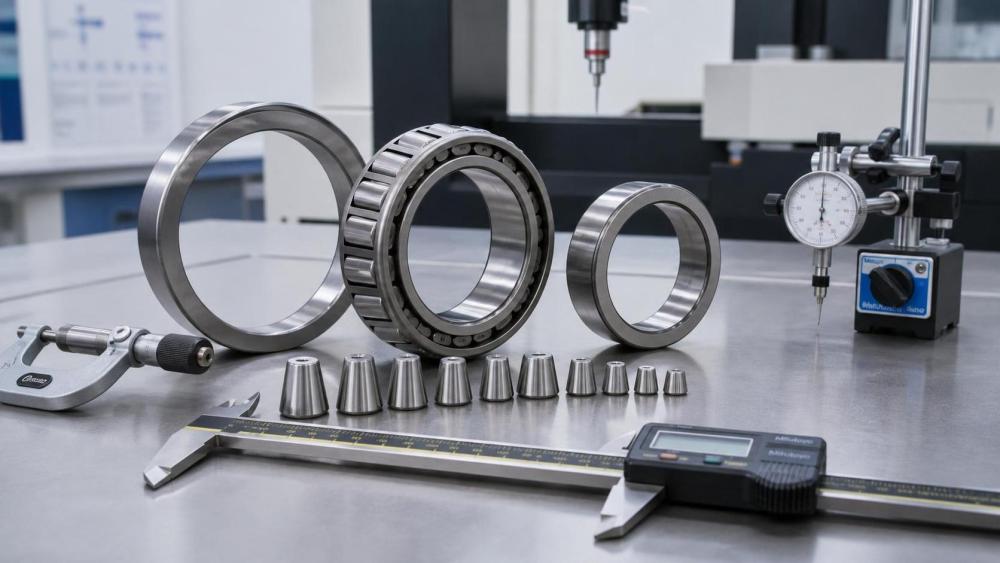
A practical way to read a bearing quotation is to connect price with the required duty rather than with the catalog family alone. Load capacity is affected by roller length and diameter, roller count, contact angle, raceway geometry, and material and heat-treatment quality. A compact bearing engineered for a high load may be materially different from a standard series bearing with similar envelope dimensions.
Precision requirements add another layer. Standard industrial tolerance may be sufficient for many conveyors, reduction drives, and general machinery. Tighter dimensional and running-accuracy requirements can be necessary where shaft runout, vibration, positioning accuracy, or noise are controlled closely. Such requirements usually mean more restrictive production control, additional measurement, selective assembly, and potentially lower yield. The resulting cost should not be viewed as a brand surcharge by default; it can be a direct consequence of the specification.
Sealing, Lubrication, and the Operating Environment
The surrounding environment often explains price differences that are not obvious in a dimensional comparison. Open tapered roller bearings may be appropriate inside a clean, well-lubricated gearbox. The same design can fail early in a dusty quarry, a wet wheel-end, or equipment exposed to washdown if the sealing system and lubricant strategy are inadequate.
Where seals are integrated or supplied as part of an assembly, the quote may include specialized elastomers, contact-lip geometry, grease compatibility work, or corrosion-protection measures. These details affect running torque and heat generation as well as contamination resistance. For an application operating at speed, adding sealing without checking thermal behavior is not a complete solution.
Procurement should also avoid treating corrosion protection as a cosmetic option. Storage in humid conditions, long ocean transit, outdoor equipment exposure, and water ingress can change the requirement. A more robust preservative, coating, or packaging method may increase the delivered bearing cost while reducing the risk of receiving corroded inventory or installing compromised parts.
Brand, Source, and Documentation Have Commercial Value
Brand reputation affects tapered roller bearings price because established manufacturers and authorized channels may provide controlled product identity, published technical data, application support, warranty processes, and broader stock availability. In critical equipment, these services can be part of the value being purchased. They can also help maintenance teams avoid a costly mismatch when a bearing must be replaced quickly.
That said, buying by brand name alone is not a complete procurement method. A competent manufacturer with clear process controls may be suitable for many OEM or aftermarket programs, particularly when the buyer has verified samples, production capability, inspection practices, and traceability. The key is to evaluate the source against the duty and failure consequence, not to assume that the highest-priced offer is automatically the technical answer.
Documentation requirements can materially alter a quote. A standard commercial order may need only a certificate of conformity and basic packing identification. A project involving regulated equipment, contractual quality plans, or a tightly controlled OEM supply chain may require material information, dimensional inspection records, batch traceability, first-article approval, or specific marking and packaging instructions. These should be stated at the request-for-quotation stage. Asking for them after price award can create avoidable disputes over cost and lead time.
Volume, Lead Time, and the Hidden Cost of Small Orders
Volume changes the economics of bearing procurement. Larger and more predictable schedules can spread setup, inspection, packing, and logistics costs across more units. They may also allow suppliers to plan raw material and production capacity with less uncertainty. Small quantities, mixed references, emergency orders, or unusual designs tend to carry a higher unit cost because the same commercial and quality work is applied to fewer parts.
Lead time is not simply a logistics issue. It can reveal whether the supplier is quoting from inventory, allocating a production slot, sourcing through another channel, or proposing a substitute. Buyers should request a clear statement of stock status, manufacturing lead time, shipment terms, and validity of the quoted price. In industrial maintenance, an inexpensive bearing that arrives after the shutdown window may have little practical value.
Freight, export packaging, customs exposure, and destination handling should also be separated from ex-works price where possible. Comparing only the unit price can hide a meaningful landed-cost difference, particularly for low-volume replenishment orders or bearings requiring corrosion protection for long transport.
A Better Way to Compare Supplier Offers
A useful comparison sheet should force like-for-like answers. Start with the exact bearing designation and dimensions, then add the information that determines real interchangeability: load ratings, tolerance or precision requirement, clearance class if applicable, cage material, seal condition, lubrication condition, origin, brand status, inspection documents, batch traceability, packaging, quantity breaks, lead time, and Incoterms. If a supplier cannot confirm a technical point, record it as unconfirmed rather than assuming compliance.
For new sources, sample evaluation can be more informative than a price negotiation alone. Incoming checks may include identification, dimensions, visible workmanship, radial or axial behavior as relevant to the assembly, and review of supporting documents. More demanding validation should be defined by engineering and quality teams, particularly if the bearing is used in a safety-sensitive or high-consequence machine.
It is equally important to examine the mating components. A correctly specified bearing cannot compensate for a shaft or housing with poor geometry, damaged shoulders, inadequate fits, contamination, misalignment, or an unsuitable lubrication regime. When recurring bearing cost becomes a concern, the root cause may lie in the assembly rather than in the bearing purchase price.
Think in Lifecycle Cost, Not Just Purchase Cost
The most economical bearing is the one that meets the required operating life and reliability at the lowest justified total cost. That calculation includes purchase price, installation labor, lubricant, spares holding, downtime exposure, damage to adjacent shafts or gears, and the practical ability to source replacements. A low-cost option may be appropriate where replacement is easy and operational risk is limited. A more controlled, documented bearing is often easier to justify where access is difficult, downtime is expensive, or failure can affect a larger mechanical system.
This is the perspective behind IMPE’s coverage of bearings and wider power-transmission systems. Bearings do not operate in isolation; their performance is connected to shafts, gearboxes, seals, lubrication, machining tolerances, cast or forged housings, and maintenance practice. Bringing those factors into a procurement review makes price comparisons more honest and more useful.
Before awarding an order, confirm the application loads, mounting arrangement, environmental exposure, required documentation, delivery window, and acceptable source qualification level. Once those conditions are visible, the tapered roller bearings price becomes easier to interpret—not as a standalone number, but as the commercial expression of a defined level of performance and risk.
Related News
- How to Assess a Rigid Coupling Supplier for Bore Accuracy and Traceable QualityOct 08, 2026Tribology & Kinematics Expert
- Titanium Alloys Compared: Balancing Strength, Corrosion Resistance, and MachinabilityOct 08, 2026CNC Kinematics Architect
- Where Ductile Iron Dismantling Joints Reduce Alignment Risk in Water PipelinesOct 08, 2026Pipeline Metallurgy Scientist
- Selecting a Precision Bearing Sleeve: Fits, Runout, and Material ChoicesOct 08, 2026Tribology & Kinematics Expert
- Face Milling Cutters: How Insert Geometry Affects Finish on Steel and AluminumOct 08, 2026CNC Kinematics Architect
- Single-Acting Cylinders for Clamping: Stroke, Force, and Return Spring ConsiderationsOct 07, 2026Fluid Power Control Strategist