
What Determines Bearing Retainer Prices Across Materials, Sizes, and Order Volumes?
What Determines Bearing Retainer Prices Across Materials, Sizes, and Order Volumes?
A bearing retainer, often called a cage, looks like a relatively small part in a bearing assembly. That can make it tempting to treat it as a simple commodity line item. In practice, bearing retainer price is influenced by a combination of material behavior, geometry, manufacturing method, inspection requirements, and purchasing conditions. Two retainers with similar outside dimensions may receive very different quotations because one is intended for a low-speed conveyor bearing while the other must control rolling elements in a high-speed spindle, gearbox, pump, or heavy-duty drive system.
For procurement teams, the useful question is not simply “Which supplier has the lowest price?” It is “What is included in this price, and does that retainer match the actual duty of the bearing?” A lower-cost cage can be perfectly appropriate when loads, speed, temperature, and lubrication are stable. It becomes expensive when it contributes to roller skewing, poor lubricant circulation, excess heat, vibration, or an unplanned bearing replacement.
This matters across industrial equipment markets. Bearings support gearboxes, pumps, motors, machine tools, hydraulic power units, construction machinery, agricultural equipment, material-handling systems, and process equipment. In each of these applications, the retainer is one component in a larger mechanical system. Its price should be reviewed in that context rather than isolated from the bearing design, shaft condition, housing accuracy, lubricant, sealing arrangement, and expected maintenance cycle.
Material Is Usually the First Major Cost Driver
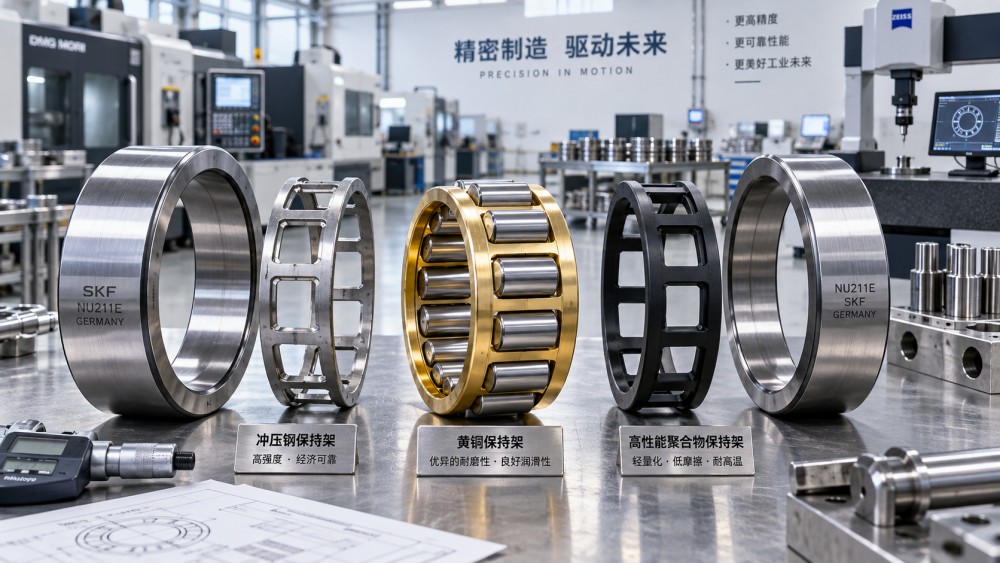
The most visible reason for a price difference is retainer material. Common options include stamped steel, machined brass, polymer cages, and, for specific environments, stainless steel or other specialized alloys. None is universally “best.” The material choice follows the bearing type and operating conditions.
Stamped steel retainers are often cost-effective for established, high-volume bearing designs. Sheet material can be formed efficiently once tooling is available, and the resulting cage can provide good strength for many standard applications. The economics change quickly for unusual shapes, limited production quantities, thicker sections, or designs requiring several forming and joining operations. A buyer comparing a stamped steel quote with a machined option should confirm whether both designs offer the same pocket geometry, guidance method, surface condition, and dimensional control.
Machined brass retainers commonly appear in larger bearings, demanding rolling mills, marine equipment, industrial gearboxes, and applications where cage strength, sliding behavior, or operating stability justify a more substantial component. Brass stock and machining time generally increase unit cost, particularly when the retainer has complex pockets or requires close concentricity. However, it can be a rational lifecycle choice where a weak or poorly controlled cage would risk costly equipment downtime.
Polymer retainers may offer low mass, quieter operation, and favorable behavior in certain high-speed bearing arrangements. Their price is not determined by resin alone. Mold design, production quantity, fiber reinforcement, moisture sensitivity, temperature limits, chemical exposure, and the buyer’s required validation all affect the commercial picture. A cage suitable for a clean, lubricated electric motor may not be suitable for a hot hydraulic pump environment or a system exposed to aggressive cleaning media.
Special corrosion-resistant materials can add cost for obvious reasons, but purchasers should avoid specifying them by default. If corrosion comes from ingress, failed seals, unsuitable grease, or poor storage, changing cage material alone may not solve the root problem. In those cases, the better procurement decision may involve packaging, preservation, sealing, or lubrication controls rather than an unnecessarily expensive retainer grade.
Size Changes More Than Raw-Material Consumption
Larger retainers use more material, but their price does not rise in a straight line with diameter. As bearing size increases, cages can become harder to form, machine, handle, inspect, and package without distortion. Larger rolling elements also require pockets that maintain consistent spacing under load. For a supplier, this may mean heavier fixtures, longer cycle times, more rigid tooling, or more careful handling between operations.
Very small retainers have a different cost problem. Material usage is low, but precision demands can be high. Thin cage sections, fine features, burr control, and pocket accuracy are difficult to manage at small scale. A tiny component may require precise stamping dies, fine blanking, automated inspection, or carefully controlled molding. That is why a small bearing retainer should not automatically be expected to have a negligible unit price.
Geometry matters as much as size. Ball-bearing cages, cylindrical roller cages, tapered roller cages, and spherical roller bearing retainers all have different structural demands. A cage guided by the inner ring has different critical dimensions from one guided by the outer ring or rolling elements. Features such as tabs, rivets, crossbars, lubrication windows, and assembly slots can increase process complexity even when the overall diameter looks ordinary.
When asking for quotations, provide the bearing designation where available, but do not stop there. A supplier may need a drawing, material specification, cage type, guidance arrangement, operating speed, temperature range, lubrication method, and expected application. This information narrows the risk that a quote is based on an assumed standard part while the actual requirement is a custom design.
Manufacturing Route Often Explains the Quotation Gap
A bearing retainer can be stamped, injection molded, machined from bar or tube stock, fabricated from formed sections, or produced through a hybrid process. The manufacturing route is often the hidden reason why apparently comparable offers differ.
Stamping can deliver a favorable unit price at repeat volume, but the initial tooling investment may be significant. If the order is for a discontinued bearing, a prototype, or a small maintenance batch, a supplier may reasonably recommend machining instead. The machined part may cost more per piece but avoid a tooling charge and a long development period. This is not a contradiction; it is a volume decision.
Machined retainers are also sensitive to material form and machine access. A cage that requires multiple setups, internal pocket machining, deburring, and final balancing will cost more than a simple turned ring. Where close tolerances are specified, suppliers may need dedicated fixtures, in-process measurement, or final inspection on calibrated equipment. The quote should distinguish whether these controls are included or merely assumed.
For polymer designs, injection molding may look inexpensive after a tool is proven. Before that point, mold engineering, sample iterations, and material trials can represent meaningful non-recurring cost. Buyers should clarify ownership of the mold, maintenance responsibility, expected tool life, and whether the quoted price assumes a forecast quantity. These details become particularly important when sourcing parts for long-life infrastructure equipment, where replacements may be required years after the initial machine build.
Tolerance, Surface Finish, and Heat Treatment Are Not Cosmetic Details
Cage pockets must hold rolling elements at the intended spacing while allowing appropriate movement and lubricant flow. If pocket dimensions, concentricity, wall thickness, or burr condition are poorly controlled, the bearing may experience abnormal friction or cage contact. The cage itself may not carry the primary radial load, but it strongly influences how rolling elements circulate through the bearing.
That is why a quotation based on “same size” is often incomplete. One supplier may include ordinary production checks; another may include material traceability, dimensional reports, surface-finish requirements, hardness verification, or additional inspection for a critical application. The second offer can look high until the buyer recognizes that it contains work not included in the first offer.
Heat treatment deserves the same scrutiny. Some retainers require no special treatment, while others rely on controlled hardness, stress relief, or material conditioning to maintain shape and wear resistance. The correct requirement depends on material and design. Specifying heat treatment without a clear engineering need can add cost and introduce distortion risk. Omitting it where required can create an even larger problem. Procurement should request that suppliers state the proposed process rather than leaving this point vague.
Order Volume Changes Unit Price, but Not in the Same Way for Every Design
Order volume affects bearing retainer price through setup recovery, tooling utilization, purchasing efficiency, inspection effort, and packaging. For a standard stamped or molded cage, a larger release may lower the per-piece cost because fixed expenses are spread across more units. For a custom machined retainer, the savings may come from reduced setup frequency, batch programming, and more efficient material purchasing.
Still, buyers should be cautious with an attractive annual-volume price that is tied to one large release. Carrying excessive inventory can erase the unit-price saving through storage, preservation, obsolescence, and cash tied up in stock. This is especially relevant when bearing designs are being updated or when an OEM has uncertain demand for a machine platform.
A practical arrangement is often a framework price with scheduled releases, provided the supplier’s material and tooling assumptions are transparent. It can balance unit-cost control with lower inventory exposure. The right structure depends on lead time, part criticality, forecast confidence, and whether the design is stable.
Documentation and Supplier Capability Have a Real Cost
Industrial buyers increasingly need more than parts in a box. They may require material certificates, inspection records, lot identification, dimensional reports, packaging instructions, or documented control of engineering revisions. For machinery producers and contractors working on demanding systems, this paperwork is not administrative decoration. It helps maintain traceability when a bearing assembly is investigated months or years later.
However, documentation should be proportionate. Requiring extensive reporting for a non-critical standard cage can add administration without improving machine reliability. Conversely, accepting a low quote without confirming material identity or inspection capability is risky when the retainer is used in a high-load gearbox, a pump that is difficult to access, or equipment where downtime has operational consequences.
Supplier capability is also broader than the cage-making machine. A capable producer should be able to discuss the drawing revision, intended material, manufacturing route, critical dimensions, inspection approach, protective packaging, and realistic lead time. If the supplier cannot explain why a particular retainer design is suitable, the quotation may be based on visual similarity rather than engineering equivalence.
How to Compare Bearing Retainer Quotes Without Missing Risk
The cleanest comparison is a line-by-line technical and commercial review. Check whether each quotation covers the same material grade, manufacturing method, dimensions, tolerance expectations, finishing, heat treatment where applicable, inspection level, documentation, packaging, and delivery basis. If a supplier proposes an alternative material or cage construction, ask for the engineering rationale and confirm whether the bearing manufacturer or responsible design authority must approve it.
Do not overlook the interface with the rest of the bearing. A retainer may fail because of misalignment, contaminated lubricant, incorrect preload, damaged rolling elements, poor shaft or housing tolerances, or inadequate clearance. Replacing the cage with a more expensive version will not correct those system-level conditions. For repair work, photographs and failed-part analysis can be useful, but they should not substitute for checking the bearing arrangement and operating history.
Platforms covering machining, castings, forgings, power transmission, and fluid-power equipment can help procurement teams frame these questions before approaching suppliers. The central lesson remains practical: the lowest bearing retainer price is meaningful only when the quoted part has the right material, geometry, process control, and delivery support for its operating duty. A sound purchase order defines those essentials clearly, then lets suppliers compete on a genuinely comparable basis.
Related News
- How to Assess a Rigid Coupling Supplier for Bore Accuracy and Traceable QualityOct 08, 2026Tribology & Kinematics Expert
- Titanium Alloys Compared: Balancing Strength, Corrosion Resistance, and MachinabilityOct 08, 2026CNC Kinematics Architect
- Where Ductile Iron Dismantling Joints Reduce Alignment Risk in Water PipelinesOct 08, 2026Pipeline Metallurgy Scientist
- Selecting a Precision Bearing Sleeve: Fits, Runout, and Material ChoicesOct 08, 2026Tribology & Kinematics Expert
- Face Milling Cutters: How Insert Geometry Affects Finish on Steel and AluminumOct 08, 2026CNC Kinematics Architect
- Single-Acting Cylinders for Clamping: Stroke, Force, and Return Spring ConsiderationsOct 07, 2026Fluid Power Control Strategist