
Selecting Stainless Steel Ball Bearings for Washdown and Corrosive Service
In washdown rooms, coastal plants, chemical skids, and wet-process equipment, bearing failure rarely begins as a dramatic event. It often starts with a faint roughness during rotation, discoloration around the seal, grease that has been washed away, or a motor that suddenly requires more torque than usual. By the time the bearing is noisy, corrosion, contamination, or lubricant breakdown may already have damaged the raceways.
For that reason, selecting stainless steel ball bearings for corrosive service is not simply a matter of replacing carbon steel with stainless steel. Technical evaluators need to match the bearing’s alloy, heat treatment, seal arrangement, lubricant, internal clearance, load condition, and cleaning environment to the actual duty cycle. A bearing that survives occasional water exposure may still fail quickly under daily alkaline foam cleaning, chlorine-based sanitizers, hot steam, or salt-laden air.
The right specification begins with a practical question: what reaches the bearing, how often, and what happens after exposure? The answer determines whether a standard stainless insert bearing is sufficient or whether the application needs a more carefully engineered corrosion-resistant bearing assembly.
Start with the service environment, not the catalog material name
“Washdown” covers a wide range of conditions. A packaging conveyor cleaned with low-pressure water is very different from a food-processing machine exposed to high-pressure spray, detergents, thermal cycling, and intermittent product contact. Likewise, a bearing near a marine hatch may experience salt mist for years, while a bearing on a chemical transfer unit may face concentrated splashes from a specific process fluid.
Before comparing stainless steel ball bearings, document the exposure profile in a form that engineering, maintenance, and procurement teams can all review:
- Liquid type: potable water, process water, seawater, food residue, acidic fluid, alkaline cleaner, solvent, disinfectant, or slurry.
- Exposure mechanism: splash, immersion, high-pressure washdown, vapor, condensation, or airborne salt and chemical mist.
- Cleaning regime: frequency, pressure, temperature, dwell time, and the chemistry of detergents and sanitizers.
- Operating temperature: including hot wash cycles, cold storage, steam exposure, and temperature swings.
- Contamination risk: fines, fibers, product particles, grit, metal dust, or abrasive slurry.
- Access for maintenance: whether the bearing can be inspected and relubricated without disrupting production.
This exercise prevents a common purchasing mistake: specifying “stainless” as a broad corrosion requirement without identifying the corrosive agents. Stainless alloys resist rust differently depending on chloride concentration, acidity, temperature, oxygen availability, and crevice conditions. A bearing can look clean externally while corrosion progresses underneath a damaged seal or within a moisture-retaining housing fit.
Choose the alloy with hardness and corrosion resistance in balance
Most rolling bearings require hard, fatigue-resistant raceways. That requirement limits material choice, because the stainless alloys with the highest corrosion resistance are not always the easiest to harden for demanding rolling-contact duty.
Martensitic stainless bearing steels
Grades commonly associated with bearing rings and balls, such as AISI 440C, are widely used where a combination of hardness, load capacity, and moderate corrosion resistance is needed. Proper heat treatment enables high hardness and good rolling-contact fatigue performance. In many wet industrial applications, 440C stainless steel ball bearings offer a meaningful improvement over conventional chrome steel bearings.
However, “corrosion resistant” does not mean immune to chlorides or aggressive cleaning compounds. In saltwater exposure, chlorine-containing cleaners, or stagnant moisture trapped around seals and housings, martensitic stainless may pit. Pitting is especially damaging in bearings because even small surface defects can disturb the rolling path and accelerate fatigue.
Austenitic stainless components
Austenitic grades such as 304 and 316 are valued for corrosion resistance, particularly in general wet and marine environments. Yet they are generally not suitable as high-hardness bearing raceway materials in the same way as 440C. They may be used for bearing housings, shields, external hardware, or specialized components, while the rolling elements and rings use a hardenable bearing-grade alloy.
For an evaluator, this distinction matters. A stainless housing does not guarantee that the internal rolling elements have equivalent resistance to the process environment. Ask suppliers to identify the material of rings, balls, cages, shields, and housing separately.
When standard stainless is not enough
If the application includes concentrated chlorides, strong acids, oxidizing sanitizers, continuous immersion, or prolonged marine exposure, a conventional stainless rolling bearing may not be the final answer. The solution may involve polymer housings, specialty coatings, ceramic rolling elements, isolation from the wet zone, improved drainage, or a bearing design that allows scheduled replacement. Material selection must remain connected to the whole assembly rather than being treated as a single-component decision.
Seals often determine real washdown life
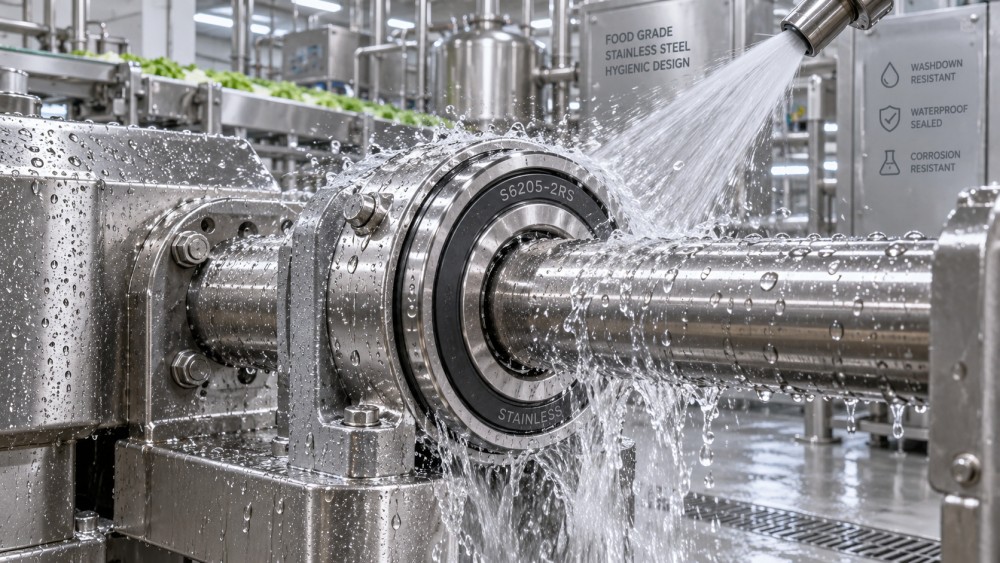
In corrosive service, the seal is not a minor accessory. It is the bearing’s first line of defense against water ingress and the last barrier keeping lubricant where it belongs. A high-quality stainless bearing with an inadequate seal can fail sooner than a less expensive material properly protected by the right sealing arrangement.
Open bearings should generally be avoided where spray, debris, or cleaning fluid can reach the raceways. Metal shields offer some protection against large particles but are not intended to provide a fluid-tight barrier. For repeated washdown, contact seals are usually the more appropriate starting point because they create a more effective exclusion path. Their trade-off is higher friction, greater heat generation, and a lower permissible speed than an open or shielded bearing.
Seal material also deserves review. Nitrile rubber is common and works well in many general industrial conditions, but it may not tolerate every chemical, temperature, or sanitizer. Fluoroelastomer options can improve resistance to certain chemicals and elevated temperatures, while other elastomers may be selected for low-temperature flexibility or food-contact considerations. Compatibility should be verified against the actual cleaner and process media, not assumed from a broad “chemical resistant” label.
For mounted units, inspect the interfaces around the insert bearing, housing bore, shaft, locking device, and end cover. Water can enter through routes that are not obvious on a catalog cross-section. A seal facing outward is of limited value if wash fluid tracks down the shaft and enters from the opposite side.
Lubrication must survive both the process and the cleaning routine
Lubricant selection is closely tied to bearing protection. Grease lubricates rolling contacts, reduces wear, helps prevent corrosion, and can support the sealing system. But washdown chemicals and high-pressure water can emulsify, dilute, or physically displace grease. Once the lubricant film is compromised, corrosion and metal-to-metal contact gain a path into the bearing.
For food and beverage equipment, the lubricant may need to meet the facility’s incidental food-contact requirements. In chemical or industrial fluid-handling systems, chemical compatibility and water resistance may be the more important considerations. Grease thickener type, base-oil viscosity, corrosion inhibitors, load-carrying additives, and operating-temperature range all affect performance.
A practical specification should state whether the bearing is factory-lubricated and sealed for life, or designed for periodic relubrication. Sealed-for-life bearings reduce the risk of overgreasing and simplify access in compact machinery, but they cannot recover from severe water ingress. Relubricable units can offer a longer service strategy, provided the grease point is accessible, purge paths are managed, and technicians use the correct lubricant in the correct quantity.
Do not overlook grease compatibility during replacement. Mixing greases with incompatible thickeners can soften or harden the lubricant structure, reduce water resistance, and create a maintenance problem that appears unrelated to bearing selection.
Check load, speed, and alignment after the environmental choice
Corrosion resistance is only one part of bearing suitability. Stainless steel ball bearings still need to carry the applied radial and axial loads, handle shaft speed, accommodate misalignment where present, and maintain sufficient fatigue life. An over-specified material paired with an under-sized bearing remains an underperforming solution.
Ball bearings are often suitable for moderate radial loads and limited axial loads, especially where low friction and compact dimensions are useful. However, a conveyor pulley, belt drive, mixer, or pump shaft may introduce combined loading, vibration, shock, or shaft deflection that changes the selection. Mounted bearing units can simplify installation, but their locking method and housing geometry must suit the shaft tolerance and operational forces.
Speed deserves special attention when using contact seals and heavier grease fills. Increased seal drag and lubricant churning raise operating temperature. In a hot environment, that heat can shorten grease life and accelerate seal aging. Ask for limiting speed information based on the actual sealing and lubrication configuration, rather than relying on an open-bearing reference value.
Misalignment is another quiet failure mechanism. Corrosion can make it more consequential by damaging sealing lips and retaining moisture at one side of the bearing. If the frame is flexible, the shaft is long, or installation tolerances are difficult to control, consider a housed unit or bearing arrangement designed to accommodate the expected angular misalignment.
A selection matrix for technical review
Installation details can undermine an otherwise sound bearing choice
Many corrosion-related failures originate at installation. A shaft with scoring, poor surface finish, or incorrect tolerance can damage the seal during assembly. A loose fit can allow fretting and moisture entry; an excessively tight fit can reduce internal clearance and raise operating temperature. Improper mounting force applied through the rolling elements can introduce brinelling before the machine even enters service.
For washdown applications, equipment layout matters as much as bearing catalog data. Avoid horizontal ledges where water pools around the housing. Provide drainage, orient grease fittings away from direct spray where possible, and prevent cleaning jets from being aimed directly at seal interfaces unless the bearing arrangement was designed for that exposure. After cleaning, warm-up operation may help drive off residual moisture in some systems, but it is not a substitute for suitable seals and drainage.
During commissioning, establish a baseline for vibration, temperature, sound, and motor current. These readings give maintenance teams a reference point. In wet service, visual inspection should include seal condition, corrosion staining, grease leakage, and the condition of adjacent shafts, fasteners, and housings—not only the bearing itself.
Common specification errors to avoid
One frequent error is treating stainless steel ball bearings as a universal answer to corrosion. Stainless improves resistance, but it does not eliminate the effects of unsuitable cleaners, water trapped in crevices, abrasive contamination, or inadequate lubrication. Another is selecting by outside dimensions alone. A dimensionally interchangeable bearing may have different seals, grease, internal clearance, cage material, and speed capability.
Technical teams should also avoid specifying a bearing without reviewing the cleaning chemical safety data and concentration used on site. A mild detergent in a laboratory test may bear little resemblance to the heated alkaline solution used during an actual sanitation cycle. Finally, do not assume that a “maintenance-free” label removes the need for inspection. It changes the maintenance task from relubrication to condition monitoring and planned replacement.
Make the purchasing specification specific enough to be useful
A reliable RFQ or internal specification for corrosive service should identify the bearing type and dimensions, ring and ball material, seal arrangement and elastomer, lubricant requirement, load and speed conditions, temperature range, shaft and housing fits, corrosion media, washdown method, and any required documentation. Where application risk is high, request confirmation of chemical compatibility and ask the supplier to state the assumptions used for life and speed limits.
For OEMs, municipal fluid systems, food-process machinery builders, marine equipment suppliers, and industrial maintenance teams, the strongest choice is usually not the bearing with the most impressive material description. It is the one whose complete design matches the real operating environment. When stainless steel ball bearings are evaluated as part of a system—bearing, seal, lubricant, housing, shaft, cleaning practice, and maintenance plan—they become a far more dependable foundation for uptime in wet and corrosive service.
Related News
- Why Is Your Heavy-Duty Piston Pump Losing Pressure Under Load?Nov 09, 2026Fluid Power Control Strategist
- Cartridge Valves for Manifold Blocks: Avoiding Cavity Fit ProblemsNov 09, 2026Fluid Power Control Strategist
- Large-Diameter Forged Rings: How Seamless Rolling Affects Grain FlowNov 09, 2026Foundry Phase-Change Fellow
- Sealed Heavy-Duty Roller Bearings: Choosing Seals for Dust and WaterNov 09, 2026Tribology & Kinematics Expert
- Sprockets and Chain Drives: What Determines Replacement Cost?Nov 08, 2026CNC Kinematics Architect
- Monoblock Hydraulic Control Valves: Flow Rating and Spool SelectionNov 08, 2026Fluid Power Control Strategist