
Selecting Mounted Bearings for Agricultural Equipment in Dusty, High-Shock Fields
Mounted bearing selection for agricultural machinery should begin with the failure mechanism, not the shaft diameter. In dusty, high-shock field service, a bearing unit can have adequate catalog load capacity and still fail early because abrasive contamination reaches the raceway, the housing shifts under impact, the shaft creeps in the bore, or repeated shock loads damage the rolling contacts.
The most suitable mounted bearings for agricultural equipment are therefore those that match the complete operating system: the rotating element, transmitted load path, expected impacts, shaft condition, sealing arrangement, lubrication access, housing attachment, and maintenance reality. A heavy disc harrow, feed conveyor, grain auger, mower conditioner, planter drive, or fertilizer applicator can place very different demands on what may appear to be the same pillow block or flange bearing unit.
Start with the machine location, not the bearing catalog
A mounted bearing is an assembly consisting of an insert bearing and a housing. The insert commonly has a spherical outside diameter that permits limited self-alignment within the housing. This construction is useful in agricultural frames that are welded rather than precision-machined, but it should not be interpreted as unlimited tolerance for bent shafts, distorted brackets, or poor installation.
The working position of the unit usually reveals more than its nominal speed. A bearing mounted close to soil-engaging tools faces direct dust exposure, vibration, intermittent impact, crop residue, washdown, and possible fertilizer contact. A bearing inside a guarded grain-handling assembly may operate with less direct impact but can be exposed continuously to fine abrasive dust. A mower or forage-processing rotor can create high cyclic loads and imbalance, while a slow-speed pivot or packer roller may experience severe shock loads at low rotational speed.
These conditions change the selection priority:
- Soil-contact and tillage assemblies place strong emphasis on housing rigidity, shock resistance, sealing, and resistance to loosening.
- Augers, conveyors, and elevators require attention to radial load, belt or chain pull, contamination from grain dust, and shaft retention under reversing or fluctuating torque.
- High-speed cutting and conditioning equipment require balance, permissible speed, vibration control, temperature management, and reliable relubrication.
- Fertilizer and slurry-related equipment adds corrosion and chemical compatibility to the usual dust and shock concerns.
A housing style selected only because it fits an existing bolt pattern can be the wrong choice if the surrounding structure cannot hold alignment or withstand the reaction loads created by the driven component.
Load rating is necessary, but the applied load must be understood correctly
Catalog dynamic and static load ratings are essential inputs, but they are not direct statements of field life. They must be compared with the actual radial, axial, and moment loads at the bearing position. Agricultural equipment often produces load combinations that are underestimated during initial selection.
Radial load may come from the weight of a roller, belt tension, chain tension, crop force, or an offset-mounted tool. Axial load can arise from helical conveyors, misaligned belt drives, side thrust from rotating assemblies, or movement caused by uneven ground contact. Where a pulley, sprocket, or disc is mounted outside the bearing centerline, the overhang creates a moment load. That moment can concentrate load on one side of the bearing and housing even when the calculated radial load appears moderate.
Shock loading deserves separate treatment. Striking stones, entering compacted soil, abrupt clutch engagement, reversing an auger, or transport vibration can generate transient loads substantially different from steady-state running loads. A unit with a generous basic dynamic rating may still suffer brinelling, raceway indentation, or cage damage if the static capacity and housing support are insufficient for these events.
Basic rating-life methods, including approaches associated with ISO 281, are useful for comparing bearing capacity under defined conditions. They do not by themselves account for contamination level, installation error, lubrication condition, shock severity, or corrosion. In field equipment, those factors can dominate the service result. The evaluation should therefore combine calculated loads with a realistic description of duty cycle: operating speed, loaded hours, transport time, engagement frequency, impacts, and whether the machine runs continuously or intermittently.
For applications with uncertain loads, a practical design review should identify the worst credible event rather than relying solely on an average load. This is particularly important where the bearing supports a driven ground-contact component or a long shaft that can deflect between supports.
Sealing is often the decisive feature in dusty fields
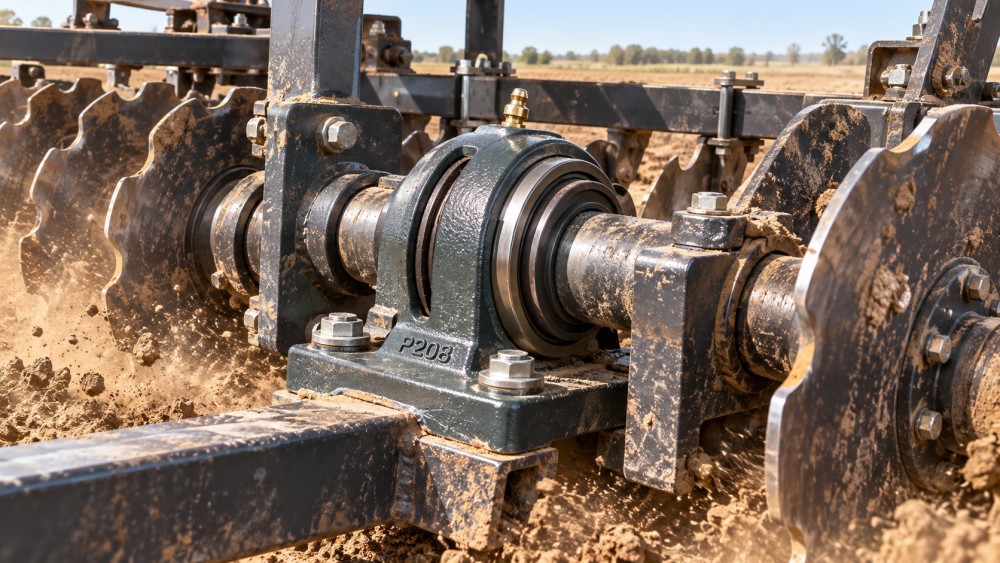
Agricultural dust is not a single contaminant. Fine dry soil, sand, plant fibers, fertilizer particles, chaff, moisture, and abrasive mud behave differently at the seal. Dry fine particles can pass through small sealing gaps; wet contamination can carry grit into the seal contact zone; stringy crop residue can wrap around exposed rotating surfaces and damage external seal elements.
For exposed positions, a single-contact seal may not provide adequate exclusion capability. Multi-stage arrangements are generally more appropriate: an internal contact seal supported by an external flinger, slinger, labyrinth, or shield. The external feature should reduce the amount of contamination that reaches the primary seal, rather than serving only as a cosmetic cover.
Seal selection must also consider friction and temperature. More aggressive contact sealing can improve exclusion but may generate additional torque and heat, particularly at higher speed. The correct decision is not simply “maximum sealing.” It is the sealing arrangement that provides enough contamination control without exceeding the speed, temperature, and torque limits of the application.
Seal performance also depends on the surrounding geometry. A bearing placed where a rotating disc, pulley hub, or adjacent bracket directs mud toward the seal needs more protection than the same bearing installed behind a guard. If a bearing is exposed to pressure washing, direct high-pressure spray should not be assumed harmless. Water can be forced past seals that perform well against ordinary splashing and dust. A machine cleaning procedure can therefore affect bearing reliability as much as the nominal IP-style expectations sometimes applied to other equipment categories.
Relubrication is valuable only when it can be performed properly
Relubricatable mounted units are often appropriate for severe agricultural duty because fresh grease can replenish the lubrication film and help purge contaminants from the seal area. However, a grease fitting alone is not a maintenance strategy.
The fitting must be accessible when the machine is assembled, preferably without removing guards or reaching around hazardous moving parts. There must be a clear purge path, since adding grease without allowing old grease and contamination to escape can increase pressure at the seals. The specified grease must remain suitable for the temperature range, speed, water exposure, and load condition. Mixing incompatible grease types can impair consistency and oil separation behavior.
In remote bearing positions, extended grease lines may improve access, but they introduce their own issues: line damage, blocked outlets, uncertain grease delivery, and the possibility that one central point supplies different bearings with different needs. A centralized lubrication arrangement should be evaluated as a system, including metering, line routing, and verification of delivery at each bearing.
Sealed-for-life units can be sensible where relubrication is impractical and the environment is reasonably controlled. They are less forgiving in highly contaminated, wet, or shock-loaded locations. Selection should reflect the actual service interval expected from the machine, not merely the convenience of eliminating grease points.
Housing material and mounting geometry determine whether alignment is retained
Mounted bearing housings are commonly available in cast iron, ductile iron, pressed steel, thermoplastic materials, and corrosion-resistant variants. The material choice should follow structural demand and environment rather than a generic preference.
Cast iron housings provide a familiar balance of rigidity and cost for many agricultural machines. Ductile iron can offer improved toughness where impact resistance and structural robustness are more demanding. Pressed-steel housings can suit lighter-duty or space-constrained equipment but require careful assessment of stiffness and fastening support. Polymer housings may offer corrosion resistance and lower mass in appropriate conditions, but their temperature limits, stiffness, creep behavior, chemical resistance, and impact suitability must be checked against the specific installation.
The housing cannot compensate for a weak support frame. A pillow block bolted to thin plate may move under cyclic loading, gradually fretting the mounting surface or loosening fasteners. A two-bolt flange mounted on a distorted vertical plate may carry unintended misalignment from the start. In both cases, the bearing insert may articulate within the housing, but that movement is limited and can create edge loading when the shaft line is materially incorrect.
Mounting bolt grade, tightening method, joint stiffness, and locating features deserve as much attention as the housing itself. In high-vibration positions, bolt preload loss is a common pathway to bearing movement. Where possible, the structure should positively locate the housing with shoulders, machined seats, dowels, or other features that do not rely entirely on friction from the mounting bolts. This is especially relevant for bearing stations exposed to repeated lateral impacts.
Shaft locking should match torque, vibration, and serviceability
The inner ring must remain secure on the shaft under transmitted torque, vibration, and thermal cycling. Common mounted-bearing locking methods include set screws, eccentric locking collars, and adapter-sleeve arrangements. Each has limits.
Set-screw locking is compact and widely used, but it can mark the shaft and may be less desirable where frequent repositioning or reuse of the shaft is expected. It also requires correct orientation and tightening. Eccentric collar systems can provide practical locking for many normal-duty arrangements, but the direction of shaft rotation and vibration environment should be considered. Adapter sleeves may provide strong, concentric clamping for suitable bearing designs, though they require compatible shaft geometry and more disciplined installation.
For any locking method, the shaft surface condition matters. Rust, paint, burrs, weld spatter, and undersize shaft sections can prevent full contact and lead to creep. Shaft creep can polish or wear the bore, create fretting debris, generate heat, and eventually make removal difficult. A nominal shaft diameter is therefore not enough; roundness, surface finish, tolerance, hardness where relevant, and the presence of shoulder transitions should be reviewed.
Do not use self-alignment as a substitute for shaft design
Spherical insert bearings can accommodate modest angular misalignment between shaft and housing. This helps absorb assembly variation in fabricated agricultural frames. It does not solve excessive shaft deflection, bent shafts, nonparallel bearing supports, or a pulley position that applies a large overturning moment.
Misalignment has several consequences beyond reduced bearing life. It can accelerate seal wear, raise operating temperature, increase vibration, and transfer unintended loads to belts, chains, couplings, and gearboxes. On long shafts, the location and number of bearing supports should be assessed together with shaft diameter and driven-element placement. Adding a bearing support without considering thermal expansion or assembly tolerance can create its own constraints, particularly when the shaft is fixed axially at more than one location.
A useful distinction is between a bearing that guides the shaft axially and a bearing intended mainly to float or accommodate movement. Agricultural assemblies that experience temperature variation, frame flexing, or long shaft spans need an axial-location strategy. If every mounted unit is tightened and trapped against shoulders without clearance planning, the arrangement can impose axial preload that was never included in the load calculation.
Corrosion protection must address both the housing and the bearing interior
Outdoor equipment can experience long idle periods after exposure to rain, crop chemicals, fertilizer dust, slurry residues, or washdown. Housing coatings are helpful, but exterior paint alone does not protect raceways, rolling elements, grease, seals, or the shaft-to-bore interface.
Where chemical exposure is credible, the review should include the housing coating system, fastener finish, grease compatibility, seal elastomer compatibility, and corrosion protection of the insert bearing. Fertilizer-containing environments are particularly demanding because deposits can attract moisture and create persistent corrosive conditions. Design features that prevent material accumulation around the seal and allow cleaning and drainage can be as important as selecting a more corrosion-resistant finish.
Specify the unit as an engineered assembly
A robust purchase specification for mounted bearings for agricultural equipment should state more than bore diameter and housing type. It should identify the machine position, shaft size and tolerance, locking method, radial and axial load assumptions, maximum and normal speed, expected shock exposure, operating temperature, contamination type, water or chemical exposure, lubrication method, housing material, mounting arrangement, and any required dimensional interchangeability.
It is also useful to require supplier documentation that connects the offered unit to the stated application conditions: dimensional drawing, load ratings, speed limits for the sealing configuration, relubrication provisions, grease recommendations where supplied, material description, corrosion treatment, and installation torque guidance. When interchangeability with an existing unit is required, verify bolt centers, base height, overall envelope, shaft-center position, locking direction, grease-port location, and clearance for tools and guards. A part that cross-references by bore size may not be mechanically interchangeable.
The best mounted bearing selection is rarely the unit with the highest listed capacity or the lowest acquisition cost. It is the one whose sealing, structure, shaft retention, lubrication plan, and mounting stability are consistent with the machine’s actual field exposure. In dusty, high-shock agricultural service, that systems view is what separates a bearing that fits from one that remains reliable through the operating season.
Related News
- How to Assess a Rigid Coupling Supplier for Bore Accuracy and Traceable QualityOct 08, 2026Tribology & Kinematics Expert
- Titanium Alloys Compared: Balancing Strength, Corrosion Resistance, and MachinabilityOct 08, 2026CNC Kinematics Architect
- Where Ductile Iron Dismantling Joints Reduce Alignment Risk in Water PipelinesOct 08, 2026Pipeline Metallurgy Scientist
- Selecting a Precision Bearing Sleeve: Fits, Runout, and Material ChoicesOct 08, 2026Tribology & Kinematics Expert
- Face Milling Cutters: How Insert Geometry Affects Finish on Steel and AluminumOct 08, 2026CNC Kinematics Architect
- Single-Acting Cylinders for Clamping: Stroke, Force, and Return Spring ConsiderationsOct 07, 2026Fluid Power Control Strategist