
Precision Bearings Price: How Accuracy Grade, Material, and Preload Affect Cost
A bearing quotation can look deceptively simple: part number, quantity, unit price, lead time. Yet the real precision bearings price is rarely determined by diameter alone. Two angular contact bearings with the same basic dimensions may differ sharply in cost because one is built for ordinary rotational support while the other is manufactured, measured, assembled, and documented for a high-speed spindle, a robotic axis, or a positioning system where microns matter.
For procurement teams, the challenge is not merely finding the lowest quoted price. It is identifying which specifications genuinely protect machine performance and which ones add cost without improving the application. Accuracy grade, material, preload, cage design, sealing, lubrication, inspection scope, and supplier traceability all affect the number on the quotation—and, more importantly, the cost of downtime, replacement, rejected parts, and field service later.
This guide breaks down the major cost drivers behind precision bearings and offers a practical way to compare suppliers without reducing a technical purchasing decision to a unit-price exercise.
Why “same size” does not mean “same cost”
Precision bearings are used where motion quality matters as much as load capacity. Common examples include machine tool spindles, grinding equipment, measuring machines, semiconductor handling equipment, industrial robots, medical equipment, servo-driven assemblies, gearboxes, pumps, and high-speed automation systems.
In these applications, a bearing is not simply a rolling component. It contributes to radial and axial stiffness, runout control, temperature behavior, vibration level, positioning repeatability, and surface finish of the final machined part. A small difference in raceway geometry or preload can be visible in a grinding result, audible in a high-speed spindle, or costly in a production line that cannot hold tolerance.
That is why a buyer comparing precision bearings should begin by separating interchangeable catalog dimensions from interchangeable functional performance. Bore, outside diameter, and width are only the starting point. A lower-cost bearing may fit the housing perfectly but fail to provide the required rotational accuracy, speed margin, or fatigue life.
Accuracy grade: the most visible driver of precision bearings price
Accuracy grade is often the first specification that changes a bearing quotation. It controls permissible variation in bore diameter, outside diameter, width, radial runout, axial runout, and raceway geometry. The naming system varies by standard and manufacturer, but buyers commonly encounter classes such as P0/P6/P5/P4/P2 under ISO terminology, or ABEC classes in certain markets.
Higher accuracy does not mean that every dimension is “smaller.” It means that dimensional and rotational deviations are held within tighter limits. Achieving those limits requires more precise grinding, superfinishing, controlled assembly, additional measurement, and more rigorous sorting of rings and rolling elements. Each stage increases manufacturing time and reduces the share of production that qualifies for the top grade.
One common purchasing mistake is requesting the highest available accuracy grade “to be safe.” For a machine tool spindle, this may be necessary. For a moderate-speed shaft in a fabricated industrial machine, it can turn a sensible bill of materials into an expensive one without delivering measurable value. The right question is not “What is the best grade?” but “What degree of runout and repeatability does the system actually need?”
Material selection changes both the invoice and the operating envelope
Most rolling bearings use high-carbon chromium bearing steel because it offers a practical balance of hardness, rolling-contact fatigue resistance, machinability, and cost. However, demanding environments often require alternatives, and these choices affect precision bearings price substantially.
Through-hardened bearing steel remains the usual economic choice for many industrial assemblies. Its cost is comparatively stable, and it is widely available in standard configurations. Where corrosion, electrical erosion, vacuum compatibility, or extreme speed enters the design brief, more specialized materials may become relevant.
Stainless bearing steel can be selected for humid, washdown, food-processing, chemical, or marine-adjacent environments. It may reduce corrosion-related failure risk, but it should not be treated as a universal upgrade. Corrosion resistance depends on the complete system: lubricant, seals, housing design, cleaning chemicals, and contamination exposure all matter.
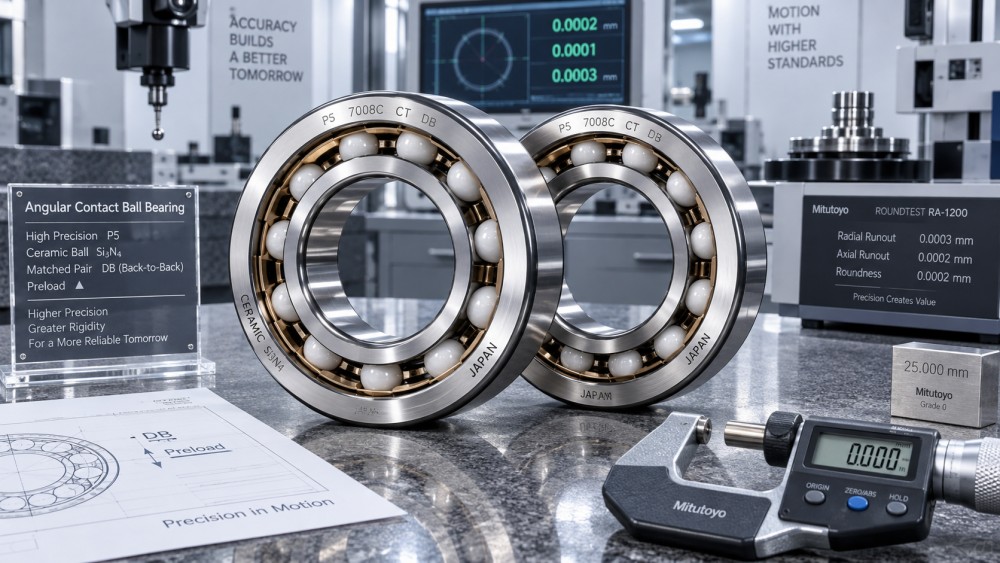
Hybrid bearings, typically combining steel rings with ceramic rolling elements, are more expensive because ceramic balls require specialized production and stringent quality control. They can offer benefits in high-speed operation, reduced centrifugal force, electrical insulation behavior, and certain lubrication-limited conditions. But the premium should be tied to a defined engineering need—not a general belief that ceramic always lasts longer.
For procurement review, ask the supplier to identify the ring material, rolling-element material, heat treatment condition, and any coating. A vague description such as “premium steel” is not enough for a high-consequence application. Material certificates and traceability may add administrative cost, but they are valuable when the bearing supports regulated equipment, critical rotating assets, or a production process with expensive stoppage risk.
Preload is not an accessory; it is a performance specification
Preload is especially important for angular contact ball bearings, spindle bearings, and matched bearing sets. It is an internal force applied when bearings are mounted or supplied as a set. Proper preload removes internal clearance, raises stiffness, and can improve axial and radial positioning. Too little preload may allow vibration or deflection. Too much can increase friction, heat generation, and premature fatigue.
The effect on price comes from more than the preload label itself. Preloaded bearings require controlled geometry, careful matching, and often set assembly procedures. Universal-matched or factory-matched duplex, triplex, and quadruplex arrangements may cost more than buying individual bearings, but they reduce uncertainty during installation. This is particularly valuable when an OEM or maintenance team needs consistent spindle behavior across multiple machines.
Buyers should avoid comparing a single open bearing with a matched set as if they were equivalent products. The quotation should state whether the bearing is supplied as an individual unit, universally matchable unit, or fixed matched set; it should also indicate the arrangement—back-to-back, face-to-face, or tandem—when relevant.
Preload selection should be reviewed together with speed. A heavy preload may create desirable stiffness at low to moderate speed, while a high-speed spindle may need a lighter preload or a carefully managed variable-preload design to avoid excessive thermal growth. When the application data are incomplete, a supplier’s technical recommendation can be useful, but procurement should ask what operating assumptions were used.
The features that quietly raise the quote
Many cost differences sit in the details that are easy to miss in a short RFQ. These details can be entirely justified, yet they should be visible in the comparison.
- Cage design: Phenolic, polyamide, brass, steel, and machined cages behave differently at speed, temperature, and under lubrication conditions. High-speed cage designs commonly command a premium.
- Contact angle: Angular contact bearings with different contact angles are not direct substitutes. The angle affects axial load capacity, stiffness, and speed behavior.
- Seals and shields: Contact seals improve contamination protection but can add friction and limit speed. Non-contact seals, shields, and open designs each serve different operating environments.
- Lubricant fill: Standard grease, high-speed grease, food-grade lubricant, low-noise grease, or special oil compatibility can change both price and lead time.
- Noise and vibration grading: Controlled vibration performance matters in electric motors, medical systems, precision instruments, and quiet automation equipment.
- Special tolerances: Non-standard bore, width, radial clearance, surface finish, or runout requirements may move a bearing from catalog supply to a semi-custom product.
- Packaging and preservation: Export packaging, corrosion protection, individual labeling, and long-term storage requirements add modest cost but can prevent expensive receiving and inventory problems.
A low quote may omit these features rather than offer them more efficiently. The best comparison is therefore a line-by-line technical alignment, not a spreadsheet sorted only by unit price.
Inspection, documentation, and traceability: costs that often prevent larger losses
In ordinary replacement purchases, standard manufacturer inspection may be sufficient. In aerospace support equipment, precision machining centers, energy systems, or OEM assemblies shipped globally, buyers may require much more: material certificates, dimensional reports, runout measurements, noise and vibration records, batch traceability, packing lists by serial or lot number, and third-party inspection coordination.
These services increase the delivered cost because they require testing time, controlled records, and quality personnel. They also reduce ambiguity. If a bearing issue appears after installation, a traceable lot and documented inspection history make root-cause analysis far more practical than a generic carton with no production reference.
This is where procurement teams should distinguish between “documentation requested” and “documentation needed.” Requiring a full inspection report for every low-risk maintenance bearing can create avoidable expense and longer lead times. On the other hand, skipping traceability for a critical spindle or a safety-sensitive actuator can leave the organization exposed to far greater cost later.
How to compare quotations without overlooking lifecycle cost
A practical buying decision combines initial price with the expected consequences of failure, replacement, and lost production. This does not require a complicated financial model for every purchase. It requires asking a few disciplined questions.
- What function does the bearing perform? Identify whether it supports general rotation, accurate positioning, high-speed motion, heavy axial load, or a contamination-prone environment.
- Which requirements are mandatory? Confirm dimensions, bearing type, accuracy grade, preload, clearance, contact angle, material, cage, sealing, lubrication, and matched-set arrangement.
- What is the consequence of premature failure? Consider labor access, unplanned shutdown, scrap, collateral damage, safety exposure, and customer delivery impact.
- Can the supplier prove equivalence? A cross-reference alone is not proof. Request the relevant technical datasheet and clarify any differences in tolerance, speed limit, load rating, and configuration.
- What is the real delivered cost? Include freight, duties, packaging, testing, documentation, minimum order quantity, lead time, and the cost of holding safety stock.
For maintenance buyers, a dual-source strategy can be sensible: retain an approved premium source for critical positions while qualifying a technically verified alternative for less demanding applications. The important point is to classify bearings by application risk rather than applying one sourcing rule across every item.
Questions worth adding to a precision bearing RFQ
A well-written RFQ reduces back-and-forth and makes supplier quotations easier to compare. Along with quantity and delivery destination, include the original part number or drawing, machine application, operating speed, radial and axial loads if available, temperature range, lubrication method, contamination exposure, mounting arrangement, and required documents.
For high-precision uses, add the requested accuracy class, preload class, contact angle, cage type, matching requirement, and acceptable brands or equivalent criteria. If the bearing will be installed in a CNC spindle, grinding head, robotic joint, or inspection device, state that context. It tells the supplier that performance consistency—not merely fitment—is part of the purchase decision.
When reviewing a quote, look for unanswered assumptions. Does the offer specify open or sealed construction? Is the preload actual or merely “standard”? Are bearings supplied individually or as a marked set? Is the quoted brand the manufacturer, an authorized channel product, or an unspecified equivalent? These details frequently explain why one precision bearings price is materially lower than another.
A balanced purchasing decision protects both budget and machine performance
Precision bearing procurement is often a negotiation between engineering confidence and cost pressure. Neither side should be ignored. Paying for ultra-precision geometry, hybrid rolling elements, special grease, and full traceability makes sense when those features protect a critical process. It makes less sense when the application cannot use the additional capability.
The strongest purchase decision is usually the one with the clearest specification. Define the accuracy needed, select material for the actual environment, set preload according to stiffness and speed requirements, and request inspection evidence in proportion to operational risk. With that foundation, procurement teams can compare suppliers on a fair basis and turn the precision bearings price from a confusing number into a defensible investment decision.
Related News
- How to Assess a Rigid Coupling Supplier for Bore Accuracy and Traceable QualityOct 08, 2026Tribology & Kinematics Expert
- Titanium Alloys Compared: Balancing Strength, Corrosion Resistance, and MachinabilityOct 08, 2026CNC Kinematics Architect
- Where Ductile Iron Dismantling Joints Reduce Alignment Risk in Water PipelinesOct 08, 2026Pipeline Metallurgy Scientist
- Selecting a Precision Bearing Sleeve: Fits, Runout, and Material ChoicesOct 08, 2026Tribology & Kinematics Expert
- Face Milling Cutters: How Insert Geometry Affects Finish on Steel and AluminumOct 08, 2026CNC Kinematics Architect
- Single-Acting Cylinders for Clamping: Stroke, Force, and Return Spring ConsiderationsOct 07, 2026Fluid Power Control Strategist