
At high rotational speeds, a precision bearing retainer does more than separate rolling elements: its material influences cage deformation, friction, heat generation, and dynamic stability.
For technical evaluators comparing steel, brass, and engineering polymers, the challenge is balancing stiffness, mass, thermal behavior, and lubricant compatibility under actual operating conditions.
This article examines how these material properties affect bearing performance, why cage design and guidance matter, and which application factors deserve attention during technical evaluation.
The practical conclusion is straightforward: select the complete bearing configuration against its operating envelope. No retainer material delivers superior stability across every high-speed application.
What Actually Makes a Bearing Retainer Stable at High Speed?
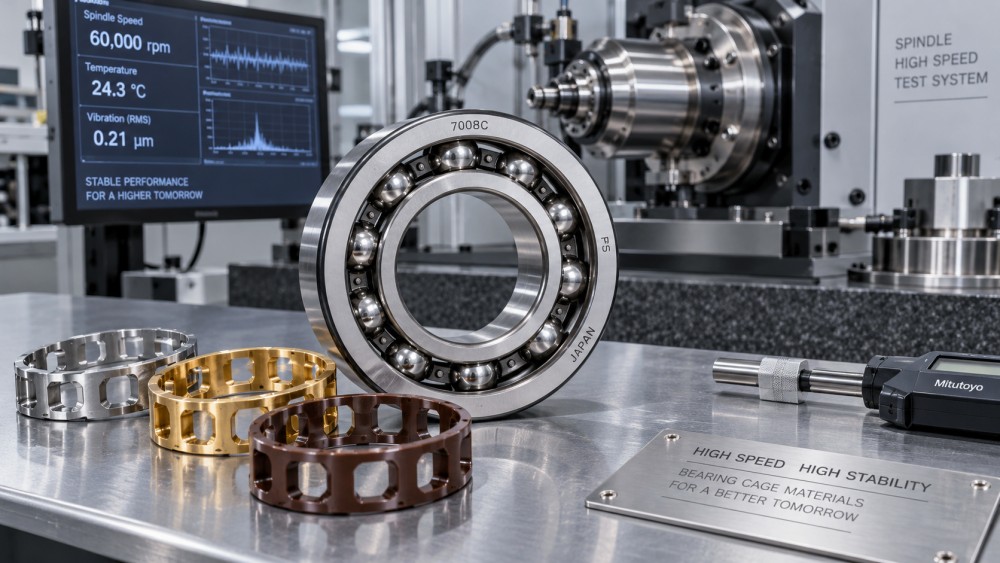
A retainer, also called a cage, maintains rolling-element spacing and guides their movement. It generally carries secondary contact forces rather than the bearing’s primary load.
High-speed stability means maintaining controlled cage motion, acceptable contact forces, and predictable clearances throughout operation. Low mass helps, but it cannot compensate for unsuitable geometry.
Instability may involve cage whirl, repeated pocket impacts, or excessive contact with guiding surfaces. These behaviors can increase noise, wear, friction, and operating temperature.
Material affects these behaviors through density, stiffness, damping, friction, and thermal expansion. However, pocket geometry, guidance, lubrication, and rolling-element motion determine how those properties interact.
For an unchanged geometry, cage rotational inertia increases with mass. Lower inertia can reduce acceleration-related forces, particularly during frequent starts, stops, and rapid speed changes.
Centrifugal loading also increases strongly with rotational speed. Resulting deformation depends on material properties and cage geometry, potentially changing pocket clearance or guide contact conditions.
Evaluators should therefore request evidence for the exact bearing designation, cage construction, preload, and lubrication arrangement. A generic material comparison cannot establish a permissible speed.
Steel, Brass, or Polymer: Which Tradeoffs Matter Most?
Material families provide a useful starting point, but individual grades differ substantially. Reinforcement, manufacturing method, heat treatment, and surface condition can change the practical ranking.
Steel: Stiffness and Dimensional Control
Steel cages offer high stiffness and useful strength at elevated temperatures. They can support dimensional control where pocket geometry must remain consistent under mechanical loading.
Pressed steel construction can be relatively light because sections are thin. Consequently, comparing density alone can misrepresent the mass difference between finished cage designs.
Steel cages require suitable lubrication at their contact surfaces. Lubrication failure can produce wear or scuffing, depending on the contact conditions and bearing configuration.
Steel remains a credible option where temperature capability and structural rigidity matter, provided the manufacturer validates the particular cage geometry for the required operating speed.
Brass: Robustness with a Mass Penalty
Machined brass cages offer robust construction and favorable sliding behavior in many bearing arrangements. Their usefulness depends on adequate lubrication, pocket geometry, and guidance selection.
Brass is denser than steel and common engineering polymers. A substantial machined cage can therefore impose higher inertial and centrifugal loads than lighter alternatives.
Its thermal expansion also differs from steel bearing rings. Evaluators should check how operating temperatures affect guidance clearances rather than assuming room-temperature dimensions remain representative.
Brass may suit demanding industrial service, but robustness does not automatically establish suitability for extreme spindle speeds. Application-specific validation remains necessary before approving a substitution.
Engineering Polymers: Low Mass with Grade-Specific Limits
Polyamide and PEEK cages can reduce mass and provide useful damping. These properties may help control impact severity and friction in suitably designed high-speed bearings.
Polymer stiffness generally falls as temperature rises, while sustained loading can cause creep. Reinforcement improves some properties but also introduces direction-dependent behavior and manufacturing considerations.
Polyamide can absorb moisture, affecting dimensions and mechanical properties. Lubricant chemistry, additives, and operating temperature also influence durability, so the exact grade must be identified.
PEEK often provides greater temperature capability than conventional polyamide grades, but its suitability still depends on reinforcement, stress, exposure duration, and the complete bearing design.
Why Temperature and Lubrication Can Reverse the Material Choice
The relevant temperature is the cage’s operating exposure, including local heating near sliding contacts. Housing temperature alone may underestimate conditions inside a heavily loaded bearing.
Thermal expansion changes pocket and guide clearances. Unequal heating among cages, rings, and rolling elements can alter contact conditions even when each component remains intact.
For polymers, evaluate allowable temperature together with exposure duration and mechanical stress. A short-term thermal limit does not establish acceptable performance over continuous operating hours.
Lubrication affects both rolling contacts and cage contacts. Too little supply can increase friction, while excessive lubricant can increase churning losses and heat generation.
Grease formulation, fill quantity, and redistribution during operation influence temperature and drag. Oil-air systems require suitable delivery conditions to provide lubrication without unnecessary fluid resistance.
Compatibility assessment should cover the complete lubricant formulation, including additives. A broad statement that a polymer resists oil does not establish compatibility with every product.
Request manufacturer guidance for the intended lubricant, cage grade, operating temperature, and relubrication method. Treat a lubricant change as an engineering change requiring technical review.
How Cage Guidance and Clearances Affect the Result
Cages may be guided by rolling elements, the inner ring, or the outer ring. Each arrangement creates different contact speeds, lubrication requirements, and dynamic behavior.
Ring-guided designs can provide controlled cage guidance in appropriate applications. Their performance depends on guide geometry, lubricant access, clearance, and relative motion at the interface.
Rolling-element guidance places greater emphasis on pocket interactions and rolling-element motion. The resulting behavior depends on load distribution, acceleration, and the bearing’s internal design.
Pocket clearance must accommodate lubrication, thermal changes, and manufacturing variation. Excessive clearance can increase impacts, while insufficient clearance may promote rubbing or restrict motion.
These relationships explain why two cages made from the same material can behave differently. Geometry and guidance may outweigh the material advantage suggested by density.
Surface finish, pocket accuracy, molding quality, and machining consistency also matter. Manufacturing defects or dimensional variation can undermine an otherwise appropriate material and cage design.
When comparing suppliers, ask whether published performance applies to the proposed guidance arrangement. Similar dimensions and identical material names do not establish equivalent dynamic behavior.
Which Operating Conditions Should Drive Your Selection?
Begin with bearing type, dimensions, load direction, preload, and speed profile. Include acceleration, operating duration, ambient conditions, and expected contamination before comparing retainer options.
For precision spindles, assess thermal growth, vibration, runout, and preload behavior together. Cage friction contributes to heating, but other bearing and spindle losses also matter.
Lightly loaded high-speed bearings can experience rolling-element skidding and unstable motion. Confirm minimum-load requirements and preload recommendations instead of assuming low load always improves reliability.
In power transmission equipment, transient loads, misalignment, contamination, and lubrication interruptions may dominate selection. A cage optimized for clean spindle service may require different validation.
Speed factors such as n × dm help compare operating severity, where n is rotational speed and dm is mean bearing diameter. They remain screening tools.
Confirm the manufacturer’s definitions of reference speed and limiting speed. Neither value should be treated as an unconditional operating guarantee across different lubrication or preload conditions.
Hybrid bearings with ceramic rolling elements may alter centrifugal loading and thermal behavior. Their cage requirements still need validation for the complete assembly and operating envelope.
What Evidence Should Technical Evaluators Request?
A useful supplier submission identifies the cage material grade, construction method, guidance arrangement, and applicable bearing designation. Generic descriptions such as “engineering plastic” are insufficient.
Request permissible operating conditions alongside the assumptions behind them. Relevant details include lubricant, preload, load range, temperature, mounting arrangement, and whether operation is continuous or intermittent.
Ask for material traceability and manufacturing controls appropriate to the application. For polymers, reinforcement content and conditioning can matter; for metals, composition and processing deserve attention.
Review endurance or application-test evidence against your actual duty cycle. A brief run at maximum speed demonstrates different capabilities from repeated acceleration over extended service.
Compare suppliers using the same operating specification and acceptance criteria. Otherwise, apparent performance differences may reflect different test temperatures, lubrication quantities, loads, or measurement locations.
Retain the complete bearing designation in purchasing documents. Cage suffixes and internal-design identifiers can distinguish configurations that look interchangeable but have different operating limitations.
For replacement decisions, require confirmation of functional interchangeability. Matching bore, outside diameter, and width establishes mounting compatibility but does not establish equivalent high-speed performance.
How to Validate Stability Before Production Approval
Validate the bearing in a representative assembly whenever practical. Shaft fits, housing alignment, preload, cooling, and lubrication delivery can substantially influence the measured operating behavior.
Establish baseline vibration, temperature, torque or power consumption, and spindle accuracy where relevant. Use consistent measurement locations and operating conditions so candidate comparisons remain meaningful.
Increase speed through planned operating stages while recording temperature stabilization and vibration changes. Include realistic acceleration and deceleration because transient behavior may expose cage-related weaknesses.
Define acceptance criteria before testing, using equipment requirements and manufacturer guidance. Temperature rise, vibration trends, accuracy drift, and inspection findings should support the approval decision.
A sudden vibration increase does not prove a cage material problem. Imbalance, resonance, preload changes, lubrication disturbances, and other bearing defects require investigation as well.
After representative endurance testing, inspect for pocket wear, guide-surface damage, cracking, discoloration, and permanent deformation. Connect physical findings with recorded operating conditions before assigning causes.
Document the approved configuration and its operating limits. Subsequent changes to cage grade, lubricant, preload, or cooling should receive review proportional to their likely performance impact.
Choosing a Retainer You Can Defend Technically
The best precision bearing retainer is the one whose material, geometry, guidance, and lubrication remain compatible throughout the intended operating cycle, including thermal and transient conditions.
Steel offers stiffness, brass offers robust construction, and polymers offer low mass with grade-dependent capabilities. These advantages become valuable only when the complete design supports them.
Approve a configuration using documented operating limits, relevant supplier evidence, and representative validation. This approach provides a stronger basis than choosing by material reputation alone.