
Needle Roller Bearings: When to Source Custom Sizes for OEMs
Standard needle roller bearings can simplify sourcing, but they do not fit every OEM application. When space constraints, unusual shaft dimensions, load requirements, or operating conditions exceed catalog options, a custom size may offer a better fit.
For procurement teams, the decision also involves tooling costs, minimum order quantities, lead times, and quality documentation. This guide explains when to consider custom bearings and what to discuss with a needle roller bearings supplier before requesting a quotation.
When Does a Custom Needle Roller Bearing Make Sense?
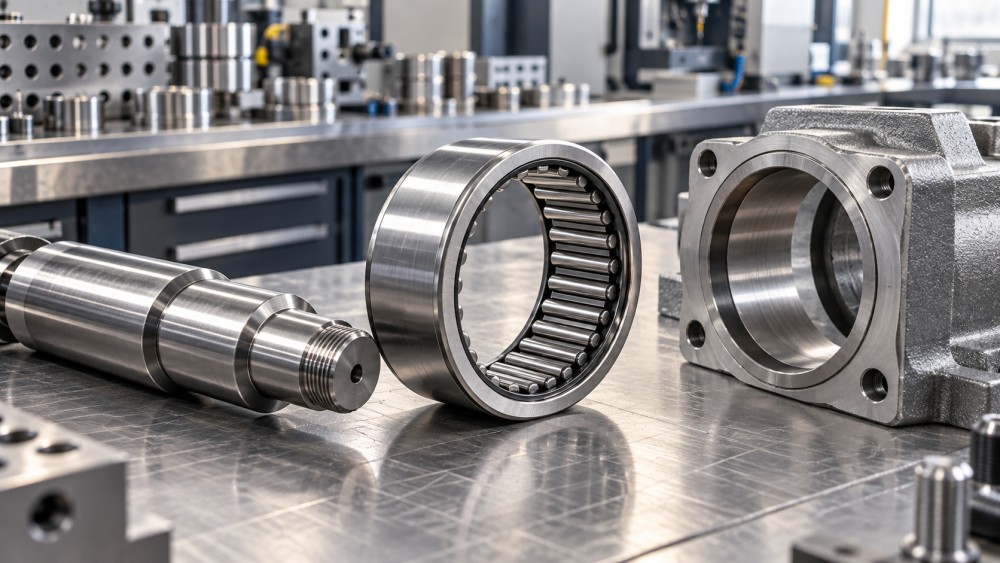
Consider a custom bearing when a verified application requirement cannot be met economically with an available standard bearing and reasonable changes to adjacent components.
Typical triggers include a fixed shaft diameter, a restricted housing envelope, a required bearing width unavailable in catalogs, or an existing machine design that cannot change.
Customization becomes more compelling when changing the bearing avoids expensive redesigns to the shaft, housing, seals, or assembly process across a meaningful production volume.
However, an unusual dimension alone is not enough. Ask suppliers to check alternative bearing series, manufacturers, inner rings, and housing arrangements before commissioning special tooling.
The purchasing decision should compare the complete installed cost and supply risk over the program’s expected life, not just the quoted bearing price.
Check Standard Options Before Paying for Custom Tooling
Needle roller bearings are available in several configurations, including drawn cup, machined ring, and needle roller and cage assemblies. Their dimensions and installation requirements differ.
Give the supplier the actual available envelope, rather than only a preferred part number. A different configuration may satisfy the same functional requirement without customization.
For example, a suitable assembly without an inner ring may reduce radial space, provided the shaft surface can function reliably as a bearing raceway.
That substitution is not automatically cheaper. Additional shaft hardening, grinding, inspection, and replacement costs can outweigh savings on the bearing itself.
A standard bearing with an inner ring may be preferable when the shaft material or heat treatment cannot support direct rolling contact, subject to available space.
Also check whether changing a housing bore or using a standard inner ring preserves interchangeability without creating unacceptable tolerance, stiffness, or assembly problems.
Ask engineering and the supplier to document why each viable standard alternative fails or costs more. This creates a defensible basis for the custom request.
Five Situations That Justify a Custom Size
1. The Available Space Is Fixed
Compact gearboxes, actuators, and transmission assemblies may have tightly constrained shaft diameters, housing bores, and widths. A catalog bearing may satisfy two dimensions but miss the third.
A custom outside diameter, bore, or width can resolve the packaging conflict. The supplier must still confirm that the resulting bearing has adequate strength and capacity.
2. Redesigning Adjacent Parts Costs More
An established OEM platform may share shafts or housings across several models. Altering those parts can trigger new tooling, validation, inventory changes, and service documentation.
Compare those program-wide costs with the custom bearing’s tooling, qualification, and unit-price premium. Include the cost of obsolete inventory and any production interruption.
3. The Bearing Is No Longer Available
Legacy equipment may require a replacement for an obsolete bearing or a size tied to an older design. A custom part can support ongoing production or service.
Before ordering, verify the original component’s dimensions, load case, materials, and mating surfaces. Matching external dimensions alone does not establish equivalent performance.
Where drawings are incomplete, arrange a technical review of samples and the assembly. Reverse engineering may require functional testing and approval from the design authority.
4. Duty Requirements Change the Geometry
Higher loads, oscillating motion, shock, or limited lubrication may make a catalog geometry unsuitable within the available envelope. A supplier can assess feasible modifications.
A wider bearing or different roller arrangement may help in some designs, but added width or roller count does not guarantee the required life.
Confirm the actual load distribution, speed, alignment, lubrication, and mounting conditions through engineering analysis and representative testing before approving a custom design.
5. Production Volume Supports the Investment
Recurring demand can spread engineering and tooling costs across more units. For low-volume projects, a standard bearing plus a controlled component modification may cost less.
Include service demand and realistic production forecasts, but avoid assuming every projected unit will be ordered. Contract terms should address what happens if volumes change.
What Procurement Should Include in the RFQ
A useful request for quotation describes the bearing’s function and operating conditions as well as its dimensions. Incomplete inputs invite assumptions and noncomparable quotes.
Coordinate with engineering before contacting a needle roller bearings supplier. Identify which dimensions are fixed, which can change, and who owns the final technical approval.
Provide a controlled drawing where available, including revision, tolerances, applicable specifications, and inspection requirements. Clearly identify any information that remains preliminary.
- Envelope: Required bore, outside diameter, width, allowable deviations, and available axial and radial space.
- Loads and motion: Radial and axial loads, load direction, speed, duty cycle, shock, oscillation, and expected service life.
- Mating parts: Shaft and housing materials, dimensions, fits, hardness, surface finish, and any intended direct raceway surfaces.
- Environment: Operating temperature, lubricant, contamination exposure, sealing arrangement, and cleaning or storage conditions.
- Commercial demand: Prototype quantity, annual volume, forecast duration, delivery locations, packaging needs, and target production date.
- Quality: Required inspection records, material traceability, test plans, change notification, and customer-specific approval procedures.
Where possible, share load spectra rather than a single maximum load. A supplier needs to understand how frequently different loads and speeds occur.
Ask every bidder to list assumptions and exclusions separately. This makes it easier to identify whether a low quotation omits testing, tooling, or required documentation.
How to Compare Custom Bearing Costs
A custom bearing quotation should separate one-time charges from recurring costs. This distinction matters when suppliers offer different tooling arrangements or volume commitments.
Request separate prices for design work, prototypes, tooling, validation, production parts, special inspection, packaging, freight, and any agreed inventory or storage services.
For an initial comparison, divide one-time costs by the expected purchased quantity, then add recurring delivered costs. Use several volume scenarios, not only the forecast.
For example, $12,000 in one-time charges spread over 60,000 bearings adds $0.20 per bearing. At 20,000 bearings, the same charges add $0.60.
This simple allocation excludes financing, scrap, inventory carrying costs, and qualification risk. Add those items where they could change the sourcing decision.
Compare the result against the total cost of the best standard alternative, including any shaft or housing changes, rather than against a catalog price alone.
Review minimum order quantities and release schedules carefully. A low unit price may require a purchase commitment that exceeds realistic demand or shelf-life limits.
Clarify ownership of drawings and tooling, maintenance responsibility, storage fees, and whether tooling can be transferred. Ownership alone does not guarantee practical transferability.
For multi-year programs, negotiate how material prices, forecast changes, and engineering revisions affect pricing. Define the circumstances under which either party can revise commitments.
Which Technical Risks Need Supplier Evidence?
Load Capacity and Service Life
Ask the supplier to explain its capacity and life assessment using the agreed load, speed, lubrication, and alignment inputs. Identify assumptions that need validation.
Calculated bearing life is an engineering estimate, not a guarantee of field life. Contamination, shock, poor lubrication, and assembly damage can cause earlier failure.
Needle roller bearings primarily support radial loads. Confirm separately how the assembly handles axial loads and shaft location rather than assuming the bearing provides both.
Shaft and Housing Compatibility
If rollers run directly on the shaft or in the housing, those surfaces become functional raceways. Their hardness, case depth, finish, geometry, and material matter.
Obtain supplier-approved raceway requirements and verify manufacturing capability before committing to the design. A custom bearing cannot compensate for an unsuitable mating surface.
Installation fits also affect bearing behavior. Confirm the required shaft and housing tolerances, internal clearance after mounting, and inspection method for the selected configuration.
Lubrication, Contamination, and Testing
Share the actual lubrication method and maintenance interval, including startup and low-speed conditions. Confirm lubricant compatibility with cage materials, seals, and operating temperatures.
Define the contamination environment and sealing responsibilities at assembly level. A bearing supplier may not control the full sealing system, even when supplying integral seals.
Agree on a validation plan appropriate to the application, such as dimensional inspection, material verification, endurance testing, or representative assembly trials.
Specify acceptance criteria, sample quantities, test ownership, reporting format, and the process for handling failures. Resolve these points before placing a production order.
How to Evaluate a Needle Roller Bearings Supplier
Assess whether the supplier can produce and inspect the proposed geometry consistently, not simply whether it can provide a sample bearing that fits.
Ask which operations are performed internally and which are subcontracted. Identify the organizations responsible for heat treatment, precision grinding, cage manufacture, and final inspection.
Request evidence of relevant manufacturing controls, calibrated measurement equipment, material traceability, and production experience. Check that any claimed certification is current and applicable.
For critical applications, review capability data or an agreed production control plan where available. A single first article does not demonstrate long-term process stability.
Confirm the documentation package before ordering. Depending on the application, it may include dimensional reports, material certificates, heat-treatment records, and agreed test results.
Ask how the supplier controls changes to materials, manufacturing sites, subcontractors, tooling, and processes. Define which changes require advance notification or customer approval.
Where continuity is important, discuss capacity, alternative production arrangements, safety stock, and recovery plans. Verify that proposed safeguards are included in the contract.
Plan Lead Times and Qualification Before Committing
Custom bearing lead time can include engineering review, tooling, sample production, testing, drawing changes, and production ramp-up. A quoted manufacturing lead time may exclude several stages.
Request a milestone schedule with dependencies and decision owners. Identify when the OEM must approve drawings, provide mating parts, complete testing, and release production orders.
Allow time for at least one iteration where the design is new or operating conditions are demanding. Agree in advance how redesign and retesting will be priced.
For a production launch, define the qualification route and release criteria. Use customer-required processes, such as a production part approval procedure, where applicable.
Clarify who pays for rejected samples, replacement tooling, expedited freight, or delays caused by changed requirements. These commercial details affect the real project risk.
For ongoing supply, consider forecast sharing and scheduled releases, but match commitments to actual demand. Excess custom inventory may have limited use elsewhere.
Make the Sourcing Decision
Choose a custom size when the application requirement is verified, standard alternatives have been evaluated, and the complete business case supports the additional commitment.
Before approval, procurement should have a comparable cost model, a feasible qualification schedule, documented technical assumptions, and clear agreements on tooling and supply continuity.
The strongest outcome is not necessarily the cheapest bearing. It is a bearing and supply arrangement that meet the OEM’s performance, production, and service requirements.
Related News
- Sprockets and Chain Drives: What Determines Replacement Cost?Nov 08, 2026CNC Kinematics Architect
- Monoblock Hydraulic Control Valves: Flow Rating and Spool SelectionNov 08, 2026Fluid Power Control Strategist
- Cement Mortar Linings for Ductile Iron Pipes: Inspection and StandardsNov 08, 2026Pipeline Metallurgy Scientist
- Why Needle Roller Thrust Bearings Fail: Loads, Lubrication and WearNov 08, 2026Tribology & Kinematics Expert
- Selecting Machine Tool Bearings for Machining Center SpindlesNov 08, 2026CNC Kinematics Architect
- Industrial Gearbox Drive Shafts: Torque, Alignment and Fatigue LifeNov 07, 2026Tribology & Kinematics Expert