
Needle Bearing Supplier Criteria for High-Load, Space-Limited Machinery Designs
Selecting a needle bearing supplier is a design-risk decision, not a catalog exercise. For compact, heavily loaded mechanisms, bearing geometry alone rarely determines reliable service life.
Technical evaluators need evidence that a supplier can control material quality, raceway hardness, lubrication behavior, dimensional consistency, and traceability across production batches and operating conditions.
The central question is straightforward: can the supplier repeatedly deliver a bearing system that survives the actual load spectrum, installation tolerances, contamination exposure, and maintenance reality?
This guide explains how to evaluate a needle bearing supplier for demanding OEM machinery, industrial transmissions, hydraulic equipment, construction machines, and other high-load, space-limited applications.
Start With the Actual Duty Cycle, Not the Catalog Load Rating
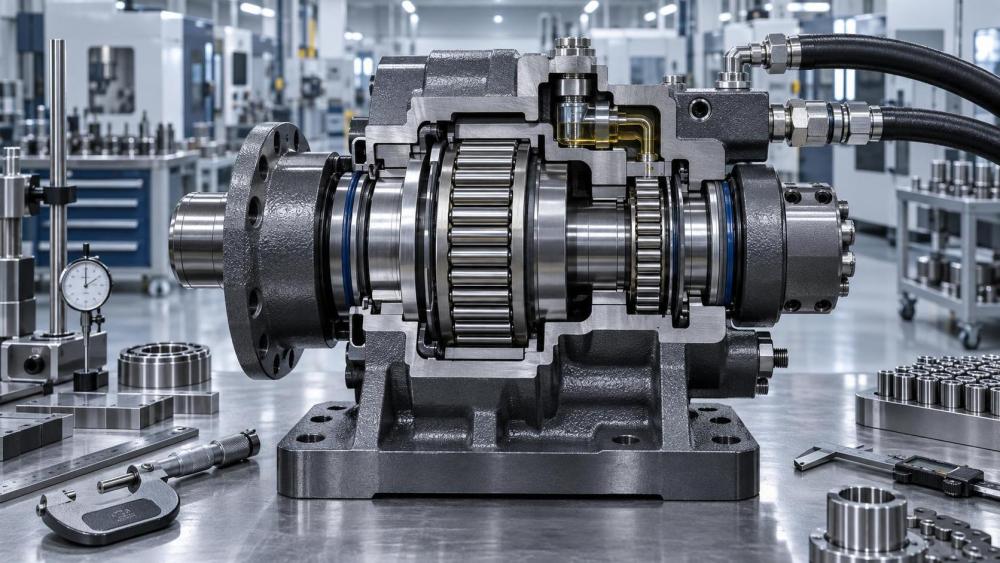
A needle bearing supplier should first understand the mechanism’s operating duty. Static load, radial load, shock events, speed, oscillation angle, temperature, and operating hours all affect bearing selection.
Catalog dynamic load ratings are useful comparison values, but they do not automatically predict field performance. Ratings depend on defined calculation methods and assumed operating conditions.
Technical evaluators should provide the supplier with a realistic load spectrum rather than one maximum value. Repeated high-load peaks can be more damaging than steady nominal loading.
Ask whether the supplier can calculate basic rating life, modified rating life, contact stress, and safety factors using the intended mounting arrangement and application environment.
For oscillating applications, such as articulated linkages, hydraulic cylinder pivots, or steering joints, limited rotation can prevent lubricant redistribution and concentrate wear in one raceway zone.
A capable supplier should identify when a full-complement needle bearing, caged assembly, drawn-cup bearing, or custom roller arrangement is more appropriate for the duty cycle.
High radial capacity is the primary attraction of needle bearings, yet axial loads, moments, housing deflection, and shaft bending can still create damaging edge loading.
Request an application review that includes shaft diameter, housing wall thickness, support geometry, adjacent components, and any expected misalignment. Bearing performance cannot be assessed in isolation.
When loads are uncertain, require the supplier to document assumptions clearly. An optimistic calculation based on incomplete data can create false confidence during prototype approval.
The strongest supplier relationship begins with a shared definition of operating conditions. This allows engineering teams to compare alternatives based on risk, rather than nominal capacity alone.
Verify Capacity Through the Complete Bearing System
A needle bearing may use a hardened inner ring, a hardened shaft raceway, an outer ring, or a thin drawn cup. Each configuration changes capacity, cost, and failure exposure.
Using the shaft directly as the inner raceway can save radial space and components. However, it transfers critical hardness, finish, geometry, and heat-treatment responsibility to the OEM.
Ask the needle bearing supplier for required raceway hardness, effective hardened depth, surface roughness, roundness, taper, and permissible waviness for shaft and housing interfaces.
These limits should be tied to the selected bearing series, roller diameter, roller length, load zone, and lubrication regime. Generic shaft specifications are insufficient for critical assemblies.
In high-load designs, the housing must resist ovalization. A thin, flexible housing can distort the outer raceway and reduce the practical load-carrying capability of an otherwise suitable bearing.
Evaluate whether the supplier specifies interference fits, housing bore tolerances, shoulder dimensions, and installation tools. Poor fit design can cause creep, cracking, or local contact overload.
For drawn-cup needle bearings, housing material and bore finish deserve particular attention. Excessive bore roughness or incorrect lead-in geometry can damage the cup during pressing.
Where a separate inner ring is used, confirm its width, axial location, chamfers, and runout requirements. A properly hardened ring may be preferable when shaft treatment is difficult to control.
Suppliers should also address retention and axial guidance. Needle rollers carry radial loads efficiently, but many assemblies need separate thrust washers, collars, or adjacent surfaces for axial control.
A useful supplier review identifies system-level constraints early. It should show which dimensions are functionally critical, which are manufacturing-sensitive, and where the design has limited tolerance margin.
Assess Raceway Materials, Heat Treatment, and Surface Integrity
Material and heat treatment determine whether a compact bearing can withstand repeated Hertzian contact stress. This is especially important when machinery experiences shock loading or poor lubrication.
Ask what steel grades are used for needles, cages, inner rings, and outer rings. The supplier should explain material selection instead of providing only a commercial grade designation.
Through-hardened bearing steels are common for rings and rollers, while carburized materials may improve core toughness in parts exposed to impact or bending loads.
Hardness values alone do not tell the full story. Effective case depth, retained austenite, microstructure, grinding damage, and residual stress can influence rolling contact fatigue resistance.
Technical evaluators should request heat-treatment process control records for critical applications. These may include furnace control, hardness inspection, metallographic verification, and case-depth measurement results.
Grinding and superfinishing quality also matter. Surface burns, tensile residual stresses, grinding cracks, and excessive roughness can shorten bearing life before visible damage appears.
A qualified supplier should define surface-finish requirements for bearing raceways and explain how it verifies them. Ra alone may not reveal harmful peaks, directional texture, or waviness.
For corrosive environments, discuss material alternatives, coatings, and lubricant compatibility early. Stainless bearing materials may improve corrosion resistance but can involve different load and fatigue limitations.
Do not assume black oxide, phosphate treatment, or a light preservative oil provides long-term corrosion protection. Storage, washdown, humidity, and chemical exposure must be evaluated separately.
Material traceability becomes essential when bearing failure could halt production, damage costly equipment, or create safety concerns. The supplier should connect material certificates to finished product batches.
Examine Lubrication, Sealing, and Contamination Control
Many needle bearing failures begin with lubricant starvation, contamination, or unsuitable grease selection. Compact designs often have little internal volume for lubricant storage or heat dissipation.
Ask whether the proposed bearing is grease-lubricated, oil-lubricated, or intended for initial lubrication only. The answer affects cage selection, clearances, seals, and maintenance planning.
A needle bearing supplier should recommend lubricant viscosity based on speed, temperature, load, and contact geometry. General-purpose grease recommendations are not enough for severe service.
In slow oscillating joints, grease must resist displacement from the loaded zone. In high-speed applications, excessive grease can generate heat, churning losses, and roller skid.
Confirm compatibility between bearing grease, adjacent seals, hydraulic fluids, cleaning agents, and corrosion inhibitors. Chemical incompatibility can harden seals, dilute lubricants, or reduce additive performance.
Contamination tolerance should be evaluated realistically. Dust, metal particles, water, abrasive slurry, and process debris can indent raceways and initiate rolling contact fatigue.
Where sealing is outside the bearing itself, ask the supplier to review the full sealing arrangement. A high-quality bearing cannot compensate for an ineffective housing seal.
For equipment with inaccessible bearing locations, define relubrication intervals, grease path design, purge capability, and expected lubricant consumption before finalizing the supplier specification.
Temperature limits should be supported by evidence. Polymer cages, seals, grease thickeners, and heat-treatment stability may impose lower limits than the bearing steel itself.
A supplier that discusses lubrication as a system variable is generally more valuable than one that treats it as an afterthought. Reliable compact designs depend on this discipline.
Audit Manufacturing Consistency and Dimensional Control
Prototype samples can perform well while serial production varies. Technical evaluators should therefore assess how the needle bearing supplier controls consistency across materials, machines, shifts, and lots.
Review the supplier’s process flow from incoming steel inspection through forming, heat treatment, grinding, assembly, preservation, packaging, and final inspection. Critical controls should be identifiable.
Key dimensional characteristics commonly include roller diameter variation, roller length, ring bore, outside diameter, wall thickness, roundness, raceway profile, and assembled radial clearance.
For high-load machinery, ask which measurements are inspected at what frequency. A final random check alone may not detect process drift created during heat treatment or grinding.
Statistical process control is useful when it is connected to meaningful characteristics. Request capability data for dimensions that affect fit, load distribution, and running clearance.
Clarify whether the supplier sorts rollers into size grades and how those grades are managed during assembly. Mixed roller populations can alter clearance and load sharing.
Automation can improve repeatability, but process capability depends on maintenance, tooling condition, calibration, and operator response plans. Equipment lists alone do not prove production control.
Supplier quality systems should include nonconformance containment, root-cause analysis, corrective action verification, and communication procedures for affected shipments or production batches.
When evaluating a new source, inspect sample-to-sample variation, not only average dimensions. Tight average results can conceal an unacceptably wide manufacturing distribution.
For critical components, consider a pilot run that represents normal production conditions. This provides more useful evidence than hand-selected engineering samples or unusually small trial quantities.
Require Traceability, Test Evidence, and Clear Documentation
Documentation is not administrative overhead in industrial bearing procurement. It provides the evidence needed to connect design requirements, supplied components, inspection results, and future failure investigations.
A reliable needle bearing supplier should identify part numbers, revision levels, production dates, batch or lot numbers, and packaging labels in a consistent, usable format.
Confirm that certificates of conformity refer to the actual delivered lot. Generic statements of compliance do not demonstrate that specific products met agreed requirements.
For controlled applications, request material certificates, hardness reports, dimensional inspection records, and relevant test reports. The document package should match the application’s risk level.
Drawing control is equally important. Suppliers must use the current approved revision, understand critical dimensions, and notify customers before changing materials, processes, tooling, or production locations.
Change-control discipline protects validated machinery designs. An unannounced cage material substitution or heat-treatment adjustment can alter performance even when external dimensions remain unchanged.
Ask how long records are retained and whether lot traceability extends to heat-treatment batches and steel melts. Retention requirements should reflect equipment service life and contractual obligations.
For international sourcing, clarify standards and terminology before purchase orders are issued. Differences in tolerance classes, load-rating methods, or inspection conventions can create avoidable disputes.
Documentation should support acceptance, not merely satisfy a template. The best records make it easier for engineering, quality, procurement, and field-service teams to reach the same conclusion.
Suppliers that communicate limitations transparently are often lower-risk partners. A documented application boundary is more valuable than a broad claim that every bearing can suit every environment.
Evaluate Engineering Support During Design and Failure Analysis
Technical support is a major differentiator when machinery has restricted space, variable loads, or difficult operating conditions. The supplier should help resolve design questions before tooling is released.
Assess response quality by submitting a realistic application case. Useful answers include calculations, assumptions, fit recommendations, lubricant guidance, and clearly stated information gaps.
Generic catalog excerpts are insufficient for complex equipment. A capable engineering team can explain why a bearing configuration is suitable, where it is sensitive, and what verification remains necessary.
Ask whether the supplier can support tolerance stack analysis involving the shaft, housing, bearing, retention features, and nearby seals. This prevents assembly problems from appearing late.
Failure-analysis capability is equally important. When damage occurs, the supplier should be able to inspect raceways, rollers, cages, lubricant condition, fits, and surrounding components systematically.
Look for a structured investigation method that distinguishes overload, misalignment, contamination, inadequate hardness, installation damage, corrosion, lubrication failure, and electrical erosion where relevant.
A supplier should not assign blame before evidence is collected. Productive investigations compare failed parts with unaffected samples, operating records, installation data, and documented design requirements.
For OEM programs, discuss support during validation testing, early production, warranty review, and design changes. Engineering availability after order placement matters as much as pre-sale responsiveness.
Regional warehousing and local technical contacts can reduce downtime, but they do not replace manufacturing expertise. Evaluate both service accessibility and the authority behind technical recommendations.
Strong application support reduces the cost of late redesign. It also helps procurement teams avoid selecting a lower-priced bearing that introduces expensive field reliability exposure.
Balance Commercial Terms Against Lifecycle Risk
Unit price should be evaluated alongside service life, reject rate, delivery reliability, inventory exposure, and failure consequences. The lowest-priced needle bearing supplier is rarely automatically the lowest-cost option.
Calculate the cost of a bearing-related failure in the actual machine. Include labor, access difficulty, lost production, equipment damage, warranty claims, spare-part logistics, and customer reputation.
For high-volume products, consider total quality cost. Small dimensional shifts can create assembly delays, increased inspection effort, scrap, noise complaints, or inconsistent machine performance.
Supply continuity matters when bearings are customized or application-specific. Ask about manufacturing capacity, approved subcontractors, tooling ownership, lead times, safety stock, and dual-source feasibility.
Packaging should protect bearings through the real logistics chain. Moisture barriers, corrosion protection, labeling, handling methods, and storage life deserve review for export or long warehouse cycles.
Define incoming inspection requirements proportionately. Excessive inspection increases cost, while inadequate inspection shifts supplier-control risk into assembly operations and final equipment testing.
Commercial agreements should state quality requirements, notification procedures, warranty responsibilities, return-material analysis steps, and response times for urgent production disruptions.
Technical evaluators should create a weighted scorecard rather than relying on informal impressions. Weight application engineering, process capability, documentation, delivery performance, and commercial terms according to risk.
Field trials can be useful, but they should include defined acceptance criteria. Monitor temperature, vibration, noise, torque, wear, lubricant condition, and teardown evidence where practical.
The final decision should identify residual risks openly. A supplier can be approved with controls, validation tests, or design changes, provided those actions are owned and measurable.
Build a Supplier Approval Decision That Engineers Can Defend
A defensible approval decision combines bearing calculations, material evidence, manufacturing capability, lubrication planning, dimensional requirements, documentation, and commercial resilience into one review process.
Start by defining the application’s non-negotiable conditions. These usually include load spectrum, envelope dimensions, target life, temperature, contamination level, speed, oscillation, and maintenance access.
Then compare each needle bearing supplier against the same technical data package. Consistent questions reveal whether differences reflect genuine capability or simply differences in sales presentation.
Prioritize suppliers that identify constraints early and provide evidence for their recommendations. This behavior is particularly valuable when a compact bearing arrangement leaves little margin for error.
Do not approve a supplier solely because its bearing matches a familiar part number. Equivalent dimensions do not guarantee equivalent steel cleanliness, heat treatment, roller quality, or process control.
For high-load machinery, require a documented validation path before full release. It should cover prototype inspection, installation verification, endurance testing, production qualification, and change-control expectations.
The right supplier becomes an engineering resource, not only a component source. That relationship improves motion reliability, reduces rework, and supports more confident compact-machine design decisions.
Ultimately, the best needle bearing supplier is the one that can demonstrate repeatable performance in your actual operating environment, while maintaining traceability, responsiveness, and disciplined production control.
Related News
- How to Assess a Rigid Coupling Supplier for Bore Accuracy and Traceable QualityOct 08, 2026Tribology & Kinematics Expert
- Titanium Alloys Compared: Balancing Strength, Corrosion Resistance, and MachinabilityOct 08, 2026CNC Kinematics Architect
- Where Ductile Iron Dismantling Joints Reduce Alignment Risk in Water PipelinesOct 08, 2026Pipeline Metallurgy Scientist
- Selecting a Precision Bearing Sleeve: Fits, Runout, and Material ChoicesOct 08, 2026Tribology & Kinematics Expert
- Face Milling Cutters: How Insert Geometry Affects Finish on Steel and AluminumOct 08, 2026CNC Kinematics Architect
- Single-Acting Cylinders for Clamping: Stroke, Force, and Return Spring ConsiderationsOct 07, 2026Fluid Power Control Strategist