
Low-Friction Rolling Bearings: Which Design Features Reduce Energy Loss and Heat?
Low-Friction Rolling Bearings: Which Design Features Reduce Energy Loss and Heat?
A rolling bearing is often treated as a catalog item: select the bore, outside diameter, load rating, and speed limit, then move on. That approach can work for lightly loaded equipment with forgiving duty cycles. It is less reliable in pumps, gearboxes, high-speed spindles, hydraulic power units, conveyor drives, electric motors, and heavy machinery where a few extra watts of friction can become a persistent temperature problem.
A low friction rolling bearing is not simply a bearing advertised with a lower torque value. Its real performance comes from a combination of internal geometry, surface quality, lubricant behavior, cage design, sealing arrangement, mounting accuracy, and operating load. The same bearing can run cool in one assembly and run hot in another if preload, contamination, shaft fit, or lubricant quantity is wrong.
For technical evaluation, the practical question is not “which bearing has the lowest friction?” It is “which bearing design and support system will maintain low friction at the actual speed, load, temperature, and contamination level of this machine?” That distinction matters when assessing power-transmission components, machined bearing housings, forged shafts, gearbox assemblies, and fluid-power equipment.
Where bearing heat actually comes from
Rolling contact reduces sliding compared with plain bearings, but it does not eliminate energy loss. Frictional torque in a rolling bearing is usually influenced by several overlapping sources: rolling resistance at the raceway contacts, sliding between rolling elements and cage pockets, lubricant churning, seal drag, microslip under load, and deformation caused by excessive interference or preload.
At lower speeds and higher loads, contact conditions and internal clearance tend to dominate. At high speed, lubricant drag, cage motion, seal friction, and inadequate heat removal can become more important. This is why a bearing that appears suitable from a basic load-life calculation may still be a poor choice for a high-speed electric motor or a compact gearbox.
Heat is also cumulative. Friction raises bearing temperature; higher temperature changes lubricant viscosity; lower viscosity may reduce film thickness; thinner films can increase surface interaction and accelerate wear. In a sealed unit, heat may have fewer paths to escape. Once this cycle starts, the problem is rarely solved by replacing the bearing with an identical part.
Raceway geometry and rolling-element quality set the foundation
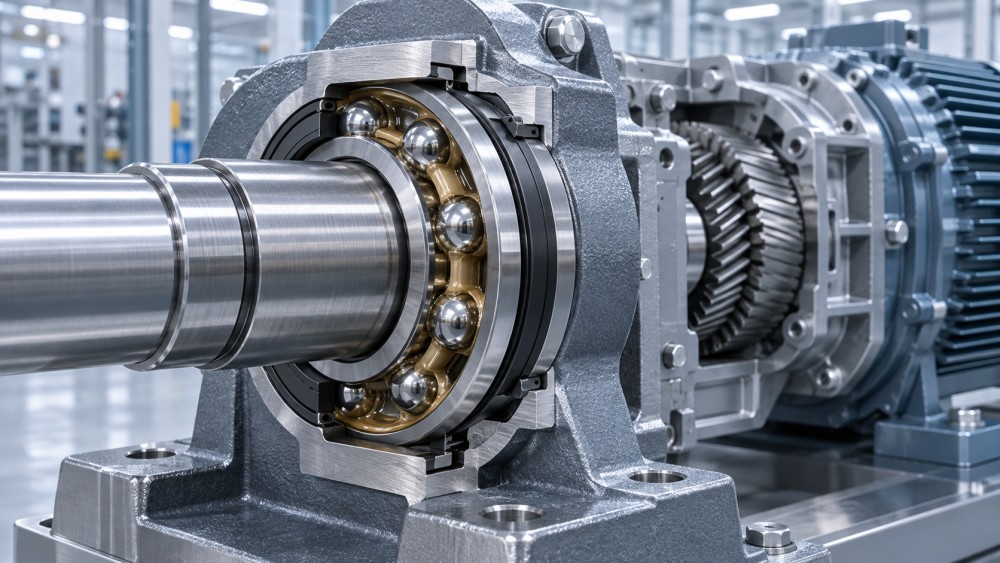
Raceway geometry determines how loads are distributed through the rolling elements. Proper curvature, contact angle, raceway conformity, and internal clearance help the bearing carry load without unnecessary sliding or stress concentration. These features are controlled during grinding, superfinishing, heat treatment, and final inspection, so low-friction performance begins well before assembly.
Surface finish deserves more attention than it usually receives during procurement. Smooth raceways and rolling elements support a more stable lubricant film and reduce asperity interaction. The goal is not merely a visually polished surface; it is controlled roughness, waviness, roundness, and form accuracy. A ring with poor waviness can generate vibration and local load variation even when its nominal dimensions are correct.
Rolling-element grade and consistency also affect torque variation. In applications such as servo drives, machine-tool spindles, precision pumps, or instrumentation, stable rotational behavior can matter as much as average friction. A bearing with uneven ball or roller geometry may not fail immediately, but it can contribute to noise, temperature scatter, and inconsistent machine response.
For this reason, a technical review should look beyond basic envelope dimensions. Ask whether the supplier can provide information on internal design, tolerance class, radial internal clearance or preload condition, material traceability, and inspection capability. Standards such as ISO 492 cover many dimensional and running-accuracy requirements for radial bearings, but the application may require tighter conditions than a general-purpose bearing standard alone implies.
Internal clearance and preload: the most common place to lose efficiency
Clearance and preload are often discussed as positioning or stiffness issues. They are also direct heat-generation issues. Too much internal clearance can permit skidding, vibration, poor load sharing, and unstable rolling-element motion. Too little clearance can create high contact stress and excessive friction, particularly after the inner ring expands on a warm shaft.
Preload is necessary in many angular-contact ball bearing arrangements, spindle systems, paired bearings, and applications requiring shaft location. Yet preload should not be treated as a generic quality upgrade. It needs to match speed, thermal gradient, mounting arrangement, and external loads. A preload suitable for a rigid, temperature-controlled spindle can be excessive in a gearbox where the shaft and housing expand at different rates.
The assembly sequence matters as well. Tight shaft fits, out-of-round housings, shoulder runout, locknut force, and improper spacer dimensions can alter the operating clearance after installation. In field investigations, bearing overheating is frequently blamed on lubricant quality when the more basic cause is an incorrect fit or a housing bore that distorts the outer ring.
Cage design is not a minor detail at speed
The cage separates rolling elements and guides their motion. In ordinary service, it can seem secondary to rings and rolling elements. At higher speeds, however, cage mass, pocket geometry, guidance method, and material can noticeably affect friction and heat.
A well-designed cage minimizes unnecessary sliding and maintains reliable rolling-element spacing. Depending on the bearing type and operating environment, cages may be made from steel, brass, or engineering polymer materials. There is no universally superior cage material. Polymer cages can reduce mass and may suit certain high-speed applications, while metal cages can be preferred where temperature, load, chemical exposure, or shock conditions are more severe.
The evaluator should check compatibility rather than rely on a broad claim such as “high-speed cage.” Lubricant additives, elevated temperature, washdown chemicals, and transient overloads can change the suitability of cage materials. For industrial pumps and hydraulic equipment, fluid ingress or incompatible process media can be as relevant as rotational speed.
Lubrication reduces friction only when the supply is controlled
Lubrication is where many technically sound bearing selections lose their advantage. The lubricant must form an adequate film at the rolling contacts, protect surfaces from corrosion and wear, and carry some heat away. But excessive grease fill, oil levels that are too high, or uncontrolled oil splash can create churning losses. The bearing may be well made and correctly mounted, yet still run hot because it is working through too much lubricant.
Grease selection should consider base-oil viscosity, thickener type, operating temperature, speed factor, relubrication interval, water resistance, and compatibility with seals. More grease is not automatically safer. In high-speed arrangements, over-greasing can cause a sharp temperature rise during run-in. Controlled quantities and a proper stabilization period are often more useful than frequent, large grease additions.
Oil-air, oil-mist, circulating-oil, jet, or bath lubrication may be selected for demanding applications, but each system brings its own design burden. Circulating oil can assist cooling and contamination removal, while jet lubrication can support certain high-speed duties. Neither arrangement compensates for poor alignment, unsuitable preload, or an undersized housing with inadequate heat dissipation.
A useful procurement question is whether the manufacturer’s speed capability assumes grease or oil, open or sealed construction, and a particular mounting orientation. Published limiting speeds are generally conditional values, not permission to operate at the edge of the range under every load and temperature condition.
Seal drag must be balanced against contamination risk
Non-contact shields and contact seals have very different friction implications. A shield generally creates little running torque but offers limited protection against fine dust, washdown, or pressure-driven moisture. A contact seal improves retention of grease and exclusion of contaminants, but its lip contact adds drag and can contribute to heat, especially at higher shaft speeds.
The lowest-friction solution is not always the most energy-efficient system over its service life. In a clean, enclosed electric motor, a low-drag shielded arrangement may be reasonable. In aggregate handling, mining, wastewater equipment, agricultural machinery, or exposed outdoor drives, stronger sealing may prevent contamination damage that would create much larger losses than seal friction ever could.
This is one of the more important trade-offs in bearing design. Technical teams should evaluate the actual contamination path: airborne dust, wash water, process fluid, pressure pulses, shaft deflection, and thermal cycling. A seal is part of the entire protection system, alongside labyrinths, housing design, grease selection, breather condition, and maintenance practice.
Alignment, shaft quality, and housing machining can erase bearing improvements
A low-friction bearing cannot correct a bent shaft, a misaligned gearbox, or a bearing seat with poor roundness. Misalignment shifts load toward one side of the raceway, raises local contact stress, and can increase sliding. In spherical roller bearing applications, self-aligning capability helps accommodate some shaft or housing deflection, but it should not be used as a substitute for sound machine geometry.
Machining quality has a direct connection to bearing temperature. Shaft journal finish, shoulder squareness, bore geometry, fit tolerance, and housing rigidity all influence ring distortion and load distribution. This link is particularly relevant in industrial equipment supply chains where bearings may be purchased separately from shafts, cast housings, gearbox cases, or machined end covers.
For OEMs and project teams comparing component suppliers, bearing performance should therefore be reviewed alongside machining and assembly capability. A precise bearing installed in a poorly controlled cast or machined seat will not deliver its intended torque or life performance. The same principle applies to forged shafts: material integrity and fatigue strength matter, but concentricity, bearing-seat finish, and installation handling are equally consequential.
A practical evaluation checklist for low-friction bearing selection
- Define the actual load spectrum, including radial load, axial load, shock events, and periods of low load that may encourage skidding.
- Confirm operating speed, start-stop frequency, ambient temperature, housing temperature, and available heat dissipation.
- Review internal clearance or preload after mounting, not only the bearing’s unmounted catalog condition.
- Match seal type to contamination exposure instead of selecting the lowest-drag option by default.
- Specify lubrication method, lubricant type, quantity, relubrication practice, and acceptable cleanliness level.
- Check shaft and housing tolerances, runout, surface condition, and stiffness as part of the bearing specification.
- Request relevant drawings, material documentation, inspection records, and application guidance where the duty is critical.
Bearing life calculations remain necessary, commonly using methods associated with ISO 281, but life rating alone does not predict frictional torque, thermal behavior, or contamination resistance. A complete assessment should combine load-life analysis with a thermal review and realistic installation assumptions. Where failure diagnosis is needed, the damage terminology and investigation approach in ISO 15243 can help teams separate lubrication, fatigue, electrical erosion, handling, and contamination-related patterns.
The better bearing is usually the better-matched bearing
In power transmission and heavy industrial equipment, reducing energy loss is rarely about one premium feature. It is the result of controlled raceway geometry, appropriate rolling elements and cage, stable lubrication, sensible sealing, correct preload, and accurate surrounding parts. The machine has to support the bearing design rather than work against it.
For technical evaluators working across bearings, gearboxes, hydraulic units, pumps, machined housings, and shaft assemblies, the most useful approach is to treat friction as a system-level issue. A bearing that runs cooler in a test condition may not remain cooler after it is installed on a distorted shaft, over-greased, exposed to water ingress, or forced to absorb misalignment from an adjacent coupling.
That is why structured technical information matters in industrial sourcing. Before selecting a low friction rolling bearing, compare not just nominal capacity and price, but the internal design assumptions, mounting requirements, lubrication window, sealing trade-offs, and manufacturing controls of the complete assembly. Those details are usually where energy efficiency and long-term reliability are decided.
Related News
- How to Assess a Rigid Coupling Supplier for Bore Accuracy and Traceable QualityOct 08, 2026Tribology & Kinematics Expert
- Titanium Alloys Compared: Balancing Strength, Corrosion Resistance, and MachinabilityOct 08, 2026CNC Kinematics Architect
- Where Ductile Iron Dismantling Joints Reduce Alignment Risk in Water PipelinesOct 08, 2026Pipeline Metallurgy Scientist
- Selecting a Precision Bearing Sleeve: Fits, Runout, and Material ChoicesOct 08, 2026Tribology & Kinematics Expert
- Face Milling Cutters: How Insert Geometry Affects Finish on Steel and AluminumOct 08, 2026CNC Kinematics Architect
- Single-Acting Cylinders for Clamping: Stroke, Force, and Return Spring ConsiderationsOct 07, 2026Fluid Power Control Strategist