
How to Qualify a Rolling Bearing Supplier for Traceability and Consistent Lead Times
A rolling bearing supplier should be qualified as a controlled source of product and information, not merely as a seller of dimensionally correct parts. A bearing can match the requested designation, fit on a shaft, and still create avoidable risk if its steel heat, manufacturing batch, inspection status, or storage history cannot be traced. The same is true of delivery: a supplier’s quoted lead time has little value if it does not distinguish between stocked standard items, finished goods awaiting inspection, and bearings that still require production.
The central procurement question is therefore not “Can this supplier provide the bearing?” It is “Can this supplier repeatedly provide the specified bearing, with verifiable origin and a delivery promise that reflects actual control of inventory, production, and logistics?” That distinction matters most where bearings affect safety, costly downtime, warranty exposure, regulated equipment, or planned maintenance windows.
Start with the bearing’s risk profile, not the supplier’s catalogue
Qualification requirements should reflect the consequence of failure and the degree of interchangeability. A deep-groove ball bearing used in a non-critical auxiliary fan does not require the same supplier controls as a spherical roller bearing in a conveyor drive, a tapered roller bearing in heavy mobile equipment, or a precision angular-contact bearing for a machine-tool spindle.
Before requesting supplier documentation, define the purchase requirement with enough precision to prevent substitution by appearance. The required specification may include:
- bearing type, ISO designation, dimensions, and internal clearance or preload;
- accuracy class, where relevant, such as Normal, P6, P5, or an equivalent defined by the applicable standard;
- cage material, seal or shield arrangement, lubrication condition, and corrosion protection;
- load, speed, temperature, vibration, contamination, or misalignment conditions that affect suitability;
- approved manufacturer, approved manufacturing location, or permitted alternatives;
- documentation required with each shipment; and
- rules for changes in source, design, material, process, or packaging.
Many procurement failures begin when the specification relies only on a generic part number. Identical basic dimensions do not establish equal internal geometry, steel cleanliness, heat treatment, surface finish, grease compatibility, sealing performance, or noise and vibration grade. The supplier must be able to confirm exactly what is being supplied and whether it is interchangeable with the approved design.
Traceability must connect documents to physical product
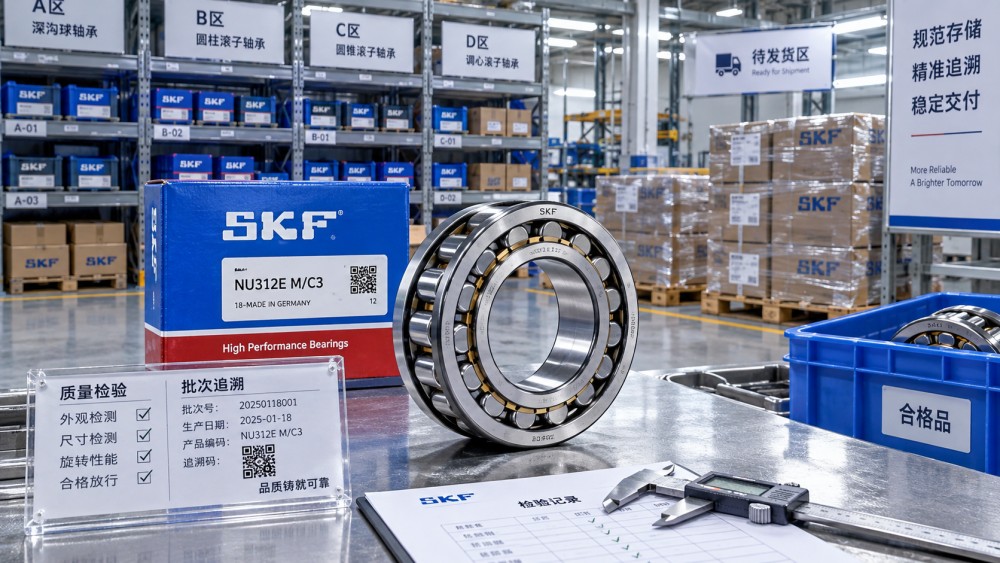
A certificate by itself is not traceability. Traceability exists only when a purchaser can link a delivered bearing to a specific identifiable lot and then follow that lot through the relevant records. For rolling bearings, the appropriate depth of traceability depends on application risk, but the chain should be explicit.
At a minimum, the supplier should be able to identify the manufacturer, factory or production source when required, product designation, lot or batch reference, quantity, and shipment date. The physical link may be established through manufacturer markings, label data, sealed packaging, barcodes, lot labels, or a supplier-controlled relabelling process that preserves the original reference.
For critical or controlled applications, qualification should examine whether records can extend beyond the distributor’s receipt transaction. Useful evidence may include the original manufacturer’s certificate of conformity, batch-specific inspection records where available, material or heat documentation when contractually required, and records of any repacking, preservation, inspection, or special handling performed after the bearing left the factory.
The important point is proportionality. Requiring mill certificates for every standard bearing can create paperwork without improving control if the bearing manufacturer does not normally release heat-level records to the distribution channel. Conversely, accepting a generic statement of conformity for a high-consequence application may leave a serious gap. The required traceability level should be agreed before ordering and written into the supplier quality agreement or purchase order conditions.
A practical test is to select one past delivery during the qualification review and ask the supplier to reconstruct its path. The supplier should be able to show the purchase order, receipt record, original label or lot reference, storage location, sales order, packing record, and the documents sent with shipment. If a quality concern is raised, the supplier should also be able to identify remaining stock from the same lot and customers who received it. Delays or ambiguity in this exercise indicate that the traceability system is administrative rather than operational.
Separate authorised supply from open-market availability
The source of supply is one of the most important controls for bearings because counterfeiting, unauthorised distribution, mixed inventory, and obsolete stock can be difficult to detect through visual inspection. Packaging, labels, and even etched markings can be imitated. Dimensional checks alone will not confirm original manufacture or expected fatigue life.
A rolling bearing supplier should disclose whether it is an authorised distributor, a direct manufacturer, an independent distributor, or a trader sourcing through multiple channels. None of these categories automatically determines acceptability, but each requires a different level of scrutiny.
An authorised channel may offer a clearer route to manufacturer support, current technical notices, warranty handling, and product-origin records. It does not remove the need to verify the supplier’s own storage, picking, and order-control practices. An independent source may be commercially useful for obsolete references, emergency requirements, or difficult-to-find stock, but the buyer should define enhanced controls: source disclosure, original packaging evidence, lot segregation, independent inspection where justified, and written prohibition on substitution.
Particular caution is warranted when a supplier offers unusually broad brand availability, prices materially below established channels, or immediate stock for a part that is otherwise subject to extended production lead times. These circumstances do not prove nonconformity, but they should trigger questions about provenance, age, storage conditions, and chain of custody.
Evaluate process discipline, not only quality certificates
ISO 9001 certification can be relevant evidence that a supplier operates a documented quality management system, but it is not proof that the company can manage bearing-specific risks. A certification scope should be reviewed rather than assumed. A trading company may have a valid certificate while relying on external warehouses, third-party inspection, or uncontrolled sourcing that is not fully covered by its documented processes.
The qualification review should focus on the controls that affect the delivered bearing:
- Receiving verification: How are incoming bearings checked against the purchase order, manufacturer label, lot information, and packaging condition?
- Segregation: Can the supplier prevent mixing between brands, lots, grades, new stock, returns, and customer-owned material?
- Nonconforming product control: Are damaged, suspect, returned, or incorrectly labelled bearings physically and electronically blocked from resale?
- Repacking control: If original packages are opened or units are split, how are lot identity, preservation, and original manufacturer references retained?
- Inspection capability: What checks can the supplier perform, and what can those checks not establish? Dimensional measurement cannot validate internal metallurgy or fatigue performance.
- Change notification: Will the supplier notify the buyer before changing manufacturer, origin, bearing variant, grease, seal design, packaging format, or inspection method?
For bearings requiring matched sets, special clearance, precision class, or controlled lubrication, ordinary warehouse practices are often inadequate. The supplier must demonstrate that matching codes, orientation requirements, set quantity, and assembly instructions remain intact from receipt through dispatch. Breaking a matched set to fill separate orders can create a nonconforming condition even when each individual bearing is genuine.
Lead-time reliability is a planning-control issue
Consistent lead times depend on more than factory capacity. They depend on whether the supplier has a reliable view of supply status and controls the handoffs between demand confirmation, allocation, inspection, packing, export documentation, and transport booking.
A quoted lead time should be decomposed into identifiable stages. “Four weeks” may mean four weeks to dispatch from a regional warehouse, four weeks to receive from a manufacturer, or four weeks of production before international freight begins. These are different commitments with different risks. The purchase order should state the relevant delivery point, such as ex-works dispatch, handover to carrier, arrival at a named destination, or delivery to the buyer’s facility.
For recurring demand, ask the supplier how it distinguishes among on-hand inventory, allocated inventory, inbound confirmed stock, planned production, and unverified availability. A stock report that does not show these distinctions can lead to double-selling or late discovery that inventory is committed elsewhere.
Meaningful delivery performance should be measured against the supplier’s original confirmed date, not a date repeatedly revised after the order is accepted. Buyers should also track line-item completeness. A shipment that arrives on time but excludes a critical bearing reference may still stop maintenance or assembly work.
Assess inventory and preservation where lead times matter
Bearings are not maintenance-free inventory. Storage temperature, humidity, vibration, handling, package integrity, corrosion protection, and grease ageing can affect condition before installation. A supplier holding stock for long periods should have defined rules for first-in, first-out or first-expired, first-out management where shelf-life-controlled materials are involved, as well as periodic checks of packaging condition.
This is especially relevant for grease-filled bearings, sealed units, bearings intended for clean environments, and large bearings that may be stored for extended periods. The qualification discussion should establish whether the supplier records receipt date, original production date when available, preservation condition, and any rework or relubrication performed. If relubrication, washing, or repacking is permitted, the process must be authorised and traceable; otherwise it can obscure the original condition of the product.
For strategically important references, a managed inventory arrangement can improve continuity, but only if ownership, minimum and maximum levels, replenishment triggers, stock rotation, and lot segregation are clear. A local stock promise without an agreed replenishment mechanism merely moves uncertainty from the buyer’s storeroom to the supplier’s warehouse.
Use a qualification sample that exposes real operating behaviour
A document review is necessary but incomplete. Supplier performance becomes visible during quotation, order acknowledgement, document submission, handling of exceptions, and response to changes. A trial order should therefore test the points that matter in the intended relationship: accurate identification of the requested bearing, confirmation of source, lot documentation, packing quality, delivery-date discipline, and responsiveness when an inconsistency is identified.
Qualification should also include an agreed escalation route. If a batch is suspected, who can authorise containment? How quickly can the supplier trace affected stock? Can it stop a shipment before dispatch? Is there a defined corrective-action process with root-cause analysis rather than a simple credit note? These questions are more revealing than broad assurances about service quality.
Supplier approval need not be permanent or uniform. A supplier may be approved for standard catalogue bearings from named manufacturers while being restricted from special clearances, precision grades, safety-critical applications, or substitutions. This controlled approval model is often more useful than a single approved/unapproved label because it reflects the actual strength of the supply arrangement.
Make total supply cost visible before choosing the lowest quote
The purchase price of a bearing is only one part of procurement cost. A lower-priced offer can be expensive if it requires additional incoming inspection, creates documentation gaps, increases expediting activity, causes line stoppages, or exposes the business to counterfeit and warranty risk. Conversely, paying for documented provenance, stable inventory visibility, and disciplined delivery may be justified for bearings whose absence interrupts high-value equipment.
The cost comparison should distinguish between standard demand and urgent demand. A supplier with a competitive unit price but unreliable confirmations can create repeated premium freight and emergency sourcing. For planned maintenance, the relevant comparison is often the cost of having the correct bearing available at the scheduled shutdown date, not the cost per unit on the quotation.
Clear commercial terms support this discipline: agreed documentation, notification requirements, permitted substitutions, acceptance criteria, packaging standards, Incoterms where cross-border supply is involved, and remedies for nonconforming deliveries. These terms convert the qualification findings into enforceable purchasing controls.
A capable rolling bearing supplier can explain its source, preserve lot identity, disclose the limits of its inspection, and commit to dates supported by actual inventory or production information. When those controls are verified before routine purchasing begins, traceability and lead-time consistency become measurable supply attributes rather than assurances made at quotation stage.
Related News
- Why Is Your Heavy-Duty Piston Pump Losing Pressure Under Load?Nov 09, 2026Fluid Power Control Strategist
- Cartridge Valves for Manifold Blocks: Avoiding Cavity Fit ProblemsNov 09, 2026Fluid Power Control Strategist
- Large-Diameter Forged Rings: How Seamless Rolling Affects Grain FlowNov 09, 2026Foundry Phase-Change Fellow
- Sealed Heavy-Duty Roller Bearings: Choosing Seals for Dust and WaterNov 09, 2026Tribology & Kinematics Expert
- Sprockets and Chain Drives: What Determines Replacement Cost?Nov 08, 2026CNC Kinematics Architect
- Monoblock Hydraulic Control Valves: Flow Rating and Spool SelectionNov 08, 2026Fluid Power Control Strategist