
How to Evaluate a Cylindrical Roller Bearings Manufacturer for Quality and Supply Risk
The lowest quotation for a cylindrical roller bearing can become the highest-cost option if it introduces premature wear, unplanned machine downtime, claim disputes, or emergency sourcing. The central procurement question is not whether a manufacturer can supply a bearing matching a catalogue designation. It is whether that supplier can repeatedly deliver the required internal geometry, material condition, cleanliness, documentation, and lead time for the actual operating duty.
Cylindrical roller bearings are especially sensitive to production consistency because their line contact geometry supports high radial loads but depends on accurate roller profiles, raceway finish, cage performance, clearance control, and alignment conditions. A bearing that appears interchangeable by dimensions may behave very differently in a gearbox, electric motor, rolling mill, pump, machine-tool spindle, conveyor drive, or heavy industrial transmission.
Begin with the operating requirement, not the manufacturer’s catalogue
A supplier assessment cannot be separated from the bearing’s application. Before comparing manufacturers, the buying specification should establish the actual conditions the bearing must withstand: radial load, axial displacement requirement, speed range, temperature, lubrication type and viscosity, contamination exposure, mounting fit, housing rigidity, expected service interval, and consequences of failure.
For example, an NU-type cylindrical roller bearing permits axial displacement between the shaft and housing, while an NJ or NUP arrangement can provide axial location in one or both directions depending on the design. A manufacturer may offer all of these configurations, but the commercial quotation is not comparable unless the required design function is fixed. The same applies to cage material. A stamped steel cage, machined brass cage, and polymer cage are not automatically substitutes; their suitability depends on speed, shock loading, lubricant, operating temperature, and cage guidance arrangement.
The purchase specification should also identify whether the bearing is a standard replacement part or a critical OEM component. For an MRO purchase with a known cross-reference and controlled service conditions, qualification can be proportionate. For a bearing incorporated into a new gearbox, traction system, process line, or safety-critical asset, reliance on nominal dimensions and a basic test certificate is inadequate.
A useful discipline is to distinguish between fit and function. Bore, outside diameter, and width confirm fit. Load capability, heat generation, vibration behavior, axial movement, reliability, and life under the intended conditions determine function.
Assess manufacturing capability through evidence that relates to bearing failure modes
Many supplier reviews focus on whether the factory has CNC machines, grinders, and an inspection room. These are relevant, but they do not by themselves demonstrate controlled bearing production. Cylindrical roller bearing quality depends on linked processes: steel selection, ring forging or tube preparation, heat treatment, rough and finish grinding, superfinishing, roller manufacture, cage production, assembly, cleaning, preservation, and final inspection.
The key is to ask how the manufacturer controls the characteristics that cause common bearing failures.
- Premature fatigue or spalling: Review bearing steel grade, supplier control, inclusion cleanliness requirements, heat-treatment process control, hardness verification, and metallographic capability where required by the application.
- Excessive heat or rapid wear: Examine control of internal radial clearance, roller diameter variation, roller profile, raceway geometry, surface finish, and assembly consistency.
- Skewing, cage damage, or smearing: Confirm the bearing design, cage material and guidance, roller end-face geometry, lubricant assumptions, and limits on acceleration or low-load operation.
- Noise and vibration: Request the manufacturer’s measurement method, acceptance grades where applicable, test conditions, sampling plan, and traceability of results to production lots.
- Corrosion during storage or transport: Evaluate cleaning, rust-preventive treatment, packaging barrier quality, desiccant practice where necessary, and stated shelf-life conditions.
Questions should be specific enough that the response can be checked. “Do you control heat treatment?” invites a generic assurance. “Which parameters are recorded for the relevant ring heat-treatment batch, how are hardness and effective hardening condition verified, and how is the batch linked to finished bearing lots?” produces evidence that can be evaluated.
For standard bearings, the manufacturer may not disclose every proprietary process detail. That is not necessarily a concern. What matters is whether it can provide credible process descriptions, controlled documentation, lot identification, inspection records, and a clear response when a nonconformance occurs.
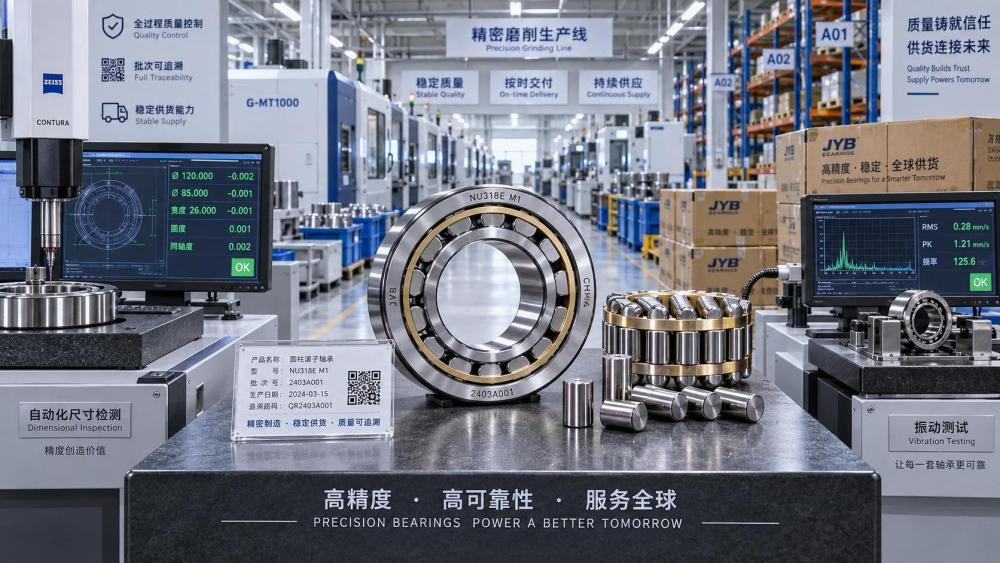
Material traceability is more than a mill certificate
Material certificates are often requested and often misunderstood. A steel mill certificate may confirm the chemistry and properties of incoming steel, but it does not prove that a particular finished bearing contains material from that certificate unless traceability is maintained through subsequent manufacturing stages.
For higher-risk applications, the traceability chain should connect raw material or ring blanks to heat-treatment batches, grinding or assembly lots, final inspection records, and shipment labels. The required depth depends on the cost of failure. A routine distributor stock item may be managed by batch-level documentation. An OEM bearing for regulated, high-load, or difficult-to-access equipment may require a more explicit manufacturing route and retention of quality records.
Traceability also needs to remain usable after delivery. Lot codes should be legible, consistently applied, and linked to packing lists and certificates. If a quality issue emerges months later, a buyer must be able to determine the affected inventory, shipments, and equipment population without quarantining every bearing purchased under the same part number.
Documentation should not be treated as a substitute for quality. A complete certificate package cannot correct poor raceway geometry or uncontrolled clearance. Its value is in enabling verification, containment, root-cause investigation, and commercially defensible claims.
Standards matter, but a standard number is not a qualification decision
Manufacturers commonly reference ISO, DIN, ABMA, or customer-specific requirements. These references need to be interpreted carefully. Dimensional interchangeability, tolerance classes, radial internal clearance groups, load ratings, and vibration criteria are separate matters. A bearing may comply with basic boundary dimensions while not meeting the application’s requested precision, clearance, or performance expectations.
For cylindrical roller bearings, procurement documents should clearly state the relevant designation and any required suffixes rather than relying on a shortened base number. Details such as clearance class, tolerance class, cage execution, lubrication feature, ring modification, and special inspection requirement can materially change the product supplied.
ISO 9001 certification is useful as evidence that a manufacturer operates a documented quality-management system. It should not be interpreted as proof that every bearing design is technically suitable or that process capability is sufficient for a demanding application. Where an application requires sector-specific approval, customer qualification, or a special test regime, those requirements need separate confirmation.
It is also worth checking how the manufacturer handles equivalency claims. A statement that its part is “equivalent to” a named brand should lead to technical comparison, not automatic acceptance. Compare the complete designation, internal design, limiting speed, load ratings under the stated calculation method, clearance, cage type, lubrication constraints, and applicable dimensional and precision specifications. If the bearing is replacing an established component, a controlled trial may be more appropriate than a fleet-wide substitution.
Test capability should be aligned with acceptance risk
Final inspection data has value only when the measurement method is suitable and repeatable. A serious review examines both what is tested and how results are controlled. Typical checks may include dimensional accuracy, radial internal clearance, rotation quality, noise or vibration, hardness, surface condition, marking, preservation, and packaging integrity. The relevant mix varies by product and duty.
Ask whether testing is performed on every unit, by sampling plan, or only at first-article stage. There is no universal correct answer: 100 percent verification may be justified for selected critical attributes, while statistically controlled sampling may be reasonable for stable high-volume production. The concern arises when the supplier cannot define the inspection frequency, acceptance criteria, calibration status of measuring equipment, or disposition process for failed parts.
For a newly qualified source, pre-shipment inspection can reduce uncertainty, particularly where the order combines several part numbers, custom markings, or special packaging. However, a third-party dimensional check should not be mistaken for validation of bearing life. Functional reliability comes primarily from controlled design and production, not from a final visual inspection.
Evaluate consistency across lots, not only the sample sent for approval
Sample approval is one of the weakest indicators of long-term supply performance when it is disconnected from serial production. A sample may be produced with unusual attention, while later lots are made on different equipment, with a changed cage source, another heat-treatment line, or substitute raw material. The supplier should be able to explain what controls prevent such changes from altering the approved product.
Change management deserves explicit attention in the supply agreement. Changes to bearing steel source, heat-treatment route, cage design or material, roller supplier, lubricant or preservative, factory location, inspection method, and packing configuration can affect performance or downstream assembly. Define which changes require prior notification and whether written approval, requalification, or updated documentation is required.
Production capacity should be assessed in the same way. A stated monthly output figure is not enough. Determine how much capacity is allocated to the bearing family and size range being purchased, whether grinding and assembly are performed in-house, what bottlenecks arise during peak demand, and how priority is decided when several customers require the same line. A factory with large overall output may still have limited capability for a particular large-diameter, precision, or customized cylindrical roller bearing.
Delivery reliability is a technical risk as well as a logistics risk
Lead time is often quoted as a single number, but it contains several different risks: raw-material availability, production queue, heat-treatment cycle time, inspection release, export packing, booking capacity, customs clearance, and inland delivery. A supplier that can ship standard stock quickly may still require a much longer cycle for non-standard clearance, special cage, matched sets, or customer-specific marking.
For repeat demand, the most useful discussion concerns the replenishment model rather than an isolated quoted lead time. Consider agreed forecast visibility, minimum order quantities, buffer-stock ownership, safety-stock location, order-freeze periods, and the supplier’s response to demand spikes. These arrangements should be matched to the cost of line stoppage and the bearing’s storage characteristics.
Packaging deserves practical scrutiny. Bearings must arrive protected from moisture, particulate contamination, impact, and mix-up. Individual packing, labeling, carton strength, pallet stability, and export corrosion protection matter more for long transit routes and warehouse storage. Packaging errors can also create traceability failures when labels are separated from the product or mixed lots are packed together.
Compare total acquisition cost, not unit price alone
A lower unit price may be commercially sound when the application is non-critical, technical requirements are standard, and incoming controls are efficient. It becomes misleading when it transfers cost into inspection, sorting, qualification, excess inventory, warranty exposure, or downtime.
A disciplined comparison should include the delivered bearing price, freight and duties, payment terms, qualification cost, incoming inspection burden, expected reject handling, inventory carrying cost, documentation requirements, and the financial impact of a supply interruption. For critical equipment, the cost of a single failure can outweigh the saving on a large number of bearings. That does not automatically justify selecting the highest-priced manufacturer; it means the price premium must be evaluated against demonstrable reduction in operational risk.
Quotations should also be normalized before comparison. Confirm currency, Incoterms, validity period, quantity breakpoints, tooling or development charges, test-report charges, packaging specification, certificate scope, warranty terms, and responsibility for defective-product return. A quotation with a low ex-works price may exclude the controls and logistics terms included by another source.
Use supplier qualification as a staged commercial decision
Qualification need not be an all-or-nothing approval. A practical approach is to assign the supplier to an appropriate supply category based on bearing criticality and available evidence. A source may be accepted for standard MRO bearings while remaining unapproved for high-speed drives, heavy-load gearboxes, or equipment where bearing replacement requires extended shutdown.
Before placing significant volume, require a technically complete quotation, representative samples where appropriate, traceable inspection documentation, and confirmation of production location. For applications with meaningful failure consequences, establish acceptance criteria for pilot lots and define the escalation route for nonconformities. The supplier’s response during this stage is informative: prompt technical clarification, disciplined document control, and transparent handling of limitations are stronger indicators than broad performance claims.
The most reliable cylindrical roller bearings manufacturer is not simply the one with the widest catalogue, the lowest offer, or the most certificates displayed. It is the one whose product design fits the duty, whose manufacturing controls can be verified, whose records support containment when problems occur, and whose supply model remains credible when demand or logistics conditions become less predictable. That combination turns bearing procurement from a part-number transaction into a controlled decision on equipment reliability and supply exposure.
Related News
- How to Assess a Rigid Coupling Supplier for Bore Accuracy and Traceable QualityOct 08, 2026Tribology & Kinematics Expert
- Titanium Alloys Compared: Balancing Strength, Corrosion Resistance, and MachinabilityOct 08, 2026CNC Kinematics Architect
- Where Ductile Iron Dismantling Joints Reduce Alignment Risk in Water PipelinesOct 08, 2026Pipeline Metallurgy Scientist
- Selecting a Precision Bearing Sleeve: Fits, Runout, and Material ChoicesOct 08, 2026Tribology & Kinematics Expert
- Face Milling Cutters: How Insert Geometry Affects Finish on Steel and AluminumOct 08, 2026CNC Kinematics Architect
- Single-Acting Cylinders for Clamping: Stroke, Force, and Return Spring ConsiderationsOct 07, 2026Fluid Power Control Strategist