
How to Evaluate a Bearing Ring Supplier for Tolerance, Heat Treatment, and Lead Time
Price is easy to compare. Bearing ring risk is not.
Choosing a bearing ring supplier looks simple when the RFQ sheet only shows material, dimensions, and annual volume. In practice, most sourcing problems appear later: rings that pass incoming inspection but create noise in assembly, heat-treated parts that distort after grinding, or deliveries that arrive on time once and slip the next three times. For procurement and supplier evaluation teams, this is why tolerance, heat treatment, and lead time have to be reviewed together rather than as separate checklist items.
A bearing ring is not just a turned steel component. It sits inside a power transmission system where geometry, hardness profile, cleanliness, and timing all affect downstream cost. If the ring goes into automotive components, gearboxes, pumps, motors, industrial automation equipment, or heavy machinery, a small deviation can become assembly scrap, excess noise, reduced bearing life, or field reliability concerns. The supplier that quotes lowest may still be the most expensive once line stoppage, sorting, and expedited freight are added.
That is why experienced buyers usually evaluate a bearing ring supplier the same way they would assess other precision industrial sources: by looking at machining capability, process discipline, metallurgical control, inspection method, and delivery behavior under real production conditions. Platforms such as IMPE are useful in this context because they frame bearings, forgings, machining, and heat treatment as connected manufacturing decisions rather than isolated catalog items.
Tolerance capability is more than the drawing number
When buyers ask whether a supplier can hold tolerance, the answer is almost always yes. The more useful question is: on which features, by which process route, at what batch size, and with what inspection repeatability?
For bearing rings, dimensional capability usually needs to be reviewed feature by feature. OD and ID may be stable on a modern CNC turning line, but roundness, raceway profile, concentricity, face runout, and post-heat-treatment size stability are often where differences show up. A supplier may machine soft rings comfortably, then struggle to control deformation after quenching or induction hardening. Another may depend heavily on final grinding to “correct” upstream variation, which works until volume increases or wheel condition changes.
A practical evaluation starts with the process flow. Ask to see how the ring moves from raw material or forging to turning, heat treatment, grinding, superfinishing if applicable, and final inspection. If a supplier cannot clearly explain where key tolerances are created and where they are only verified, that is a warning sign. Good suppliers know which dimensions are process-capable, which are risk points, and what controls they use when tool wear or thermal drift begins to affect results.
It is also worth checking whether the tolerance requirement is realistic for the proposed manufacturing route. Some buyers issue a print with tight limits copied from a legacy source without reviewing whether the feature truly drives bearing performance. A capable supplier will challenge unnecessary tightness, not because they want lower quality, but because they understand where tolerance matters and where it only adds cost and lead time.
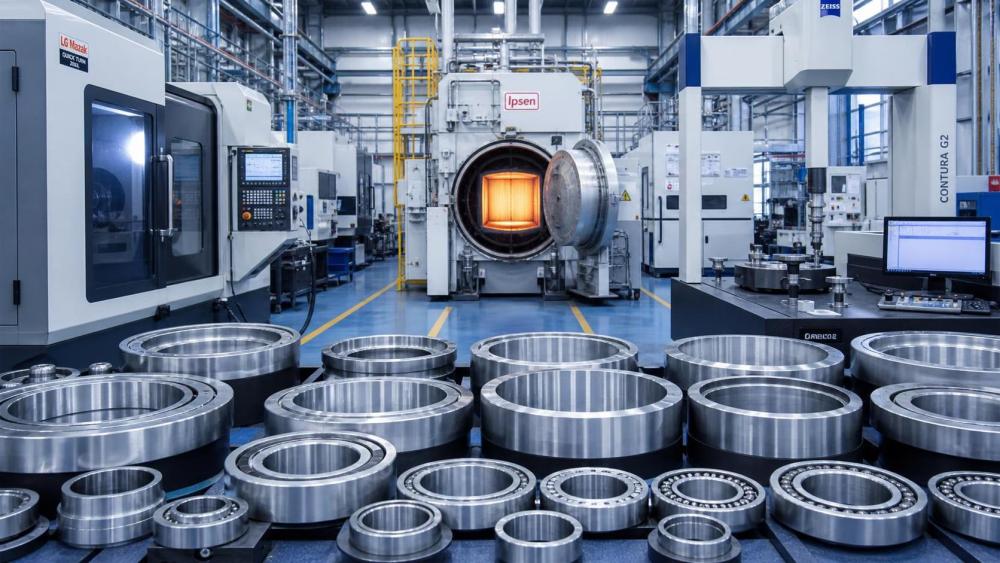
In supplier audits, three details often separate a dependable source from a merely responsive one:
- Whether they use in-process gauging or rely mainly on end-of-line inspection
- Whether they can discuss gauge R&R, calibration discipline, and traceability of measuring equipment
- Whether they can show consistency across batches, not only a favorable first article
If the application is sensitive to vibration, preload, or rotational accuracy, this conversation matters even more. A ring that is technically “within tolerance” can still create performance issues if the tolerance stack, surface condition, and form error are not controlled in a balanced way.
Heat treatment is where many supplier evaluations stay too shallow
Buyers often verify hardness and move on. That is not enough. Heat treatment affects wear resistance, fatigue life, residual stress, dimensional change, and grindability. For bearing rings, the real concern is not only whether the target hardness is reached, but whether the microstructure and case condition are appropriate for the application and stable from batch to batch.
The first thing to clarify is the heat treatment route: through hardening, case hardening, induction hardening, or another specified process tied to the material and design. Each route changes both performance and manufacturing risk. For example, a supplier may outsource heat treatment to a nearby partner. Outsourcing is not automatically a problem, but it changes how you should evaluate control. Who owns the process specification? Who reviews furnace records? Who manages distortion feedback into pre-heat-treatment machining allowance?
Ask for the actual quality documents that support heat treatment, not just a statement that the parts are hardened. Depending on the project, that may include hardness reports, material certificates, metallographic verification, case depth checks where relevant, and traceability linking each batch to furnace load or treatment lot. Not every order needs the same documentation package, but a supplier serving serious OEM or industrial accounts should be prepared for that level of review.
A useful conversation here is about distortion management. Experienced bearing ring manufacturers usually talk openly about quench movement, stock allowance before grinding, fixturing, loading pattern, and how they prevent hardness variation at the ring cross-section. If the supplier only says “we inspect after heat treatment,” they may be reacting to problems rather than controlling them.
This is where IMPE’s broader coverage of machining, forgings, and metallurgical control reflects real buyer needs. In bearings and other power transmission parts, heat treatment quality cannot be separated from upstream material selection and downstream finishing. Procurement teams that treat these as disconnected steps often miss the root cause of repeat defects.
Lead time should be tested for stability, not just speed
Lead time is one of the most misunderstood parts of supplier selection. A fast quotation lead time does not mean reliable production lead time. A supplier can promise four weeks and still depend on unstable forging supply, overloaded heat treatment capacity, or one grinding bottleneck that affects every urgent order.
What buyers really need to know is whether the quoted lead time is backed by capacity planning and supplier discipline. Start by breaking the timeline into stages: raw material or ring forging procurement, rough machining, heat treatment, finish grinding, inspection, packaging, and export or domestic shipping. A supplier that can explain where the schedule is tight is usually more trustworthy than one that gives a blanket promise with no detail.
There are also hidden lead time risks that do not appear in a quotation:
- Special steel grades or custom forgings with long upstream cycles
- Heavy dependence on subcontracted heat treatment or grinding
- Limited inspection capacity for dimensional or metallurgical reports
- Packaging standards that are not ready for export, moisture protection, or mixed SKU handling
For repeat business, ask how the supplier handles forecasted demand versus spot orders. Some shops perform very well on prototypes and small lots but become erratic once a blanket order turns into monthly releases. Others are built for schedule discipline but not for engineering changes. The right choice depends on your program, but you need to know which model you are buying into.
A short supplier review matrix helps avoid one-dimensional decisions
What experienced buyers usually ask before approval
The best supplier reviews are not built around generic capability slides. They are built around a specific part family and a few hard questions.
Can the supplier explain the most difficult feature on the ring without looking back at the drawing for five minutes? Do they understand how material condition affects machining and heat treatment response? Can they show what happens when a lot drifts out of control and how they contain it? If delivery slips, who communicates, and how early?
Another useful check is whether the supplier understands the downstream system. A bearing ring used in a gearbox, hydraulic pump, motor, or conveyor assembly is not judged only by dimensions on paper. Surface finish, residual burrs, edge condition, cleanliness, rust protection, and packaging orientation can all matter in real production. Suppliers with broader exposure to power transmission and heavy industrial applications tend to discuss these points earlier, which usually makes qualification smoother.
Do not separate commercial review from technical review
One common procurement mistake is to complete technical approval first and commercial comparison later, as if they are independent. They are not. A low-cost source that uses external heat treatment, has limited grinding redundancy, and requires extended payment terms may still be viable, but only if the supply chain risk is visible and acceptable.
The opposite can also happen. A technically strong supplier may quote higher because they include better process control, more documentation, and realistic lead times. That should not automatically disqualify them. In many industrial programs, especially where uptime and warranty exposure matter, paying for control is cheaper than paying for recovery.
For that reason, the most practical way to evaluate a bearing ring supplier is to compare total sourcing reliability: process capability, metallurgical discipline, responsiveness to engineering changes, and ability to deliver repeat orders without drama. If two suppliers look similar on paper, the one that can openly discuss tolerance stack, heat treatment distortion, and scheduling constraints is usually the safer long-term partner.
Before placing a production order, it is worth aligning the drawing, inspection plan, documentation package, and release schedule in one conversation. That step sounds basic, but it prevents many of the problems buyers later blame on the supplier alone.
Related News
- How to Assess a Rigid Coupling Supplier for Bore Accuracy and Traceable QualityOct 08, 2026Tribology & Kinematics Expert
- Titanium Alloys Compared: Balancing Strength, Corrosion Resistance, and MachinabilityOct 08, 2026CNC Kinematics Architect
- Where Ductile Iron Dismantling Joints Reduce Alignment Risk in Water PipelinesOct 08, 2026Pipeline Metallurgy Scientist
- Selecting a Precision Bearing Sleeve: Fits, Runout, and Material ChoicesOct 08, 2026Tribology & Kinematics Expert
- Face Milling Cutters: How Insert Geometry Affects Finish on Steel and AluminumOct 08, 2026CNC Kinematics Architect
- Single-Acting Cylinders for Clamping: Stroke, Force, and Return Spring ConsiderationsOct 07, 2026Fluid Power Control Strategist