
How to Evaluate a Ball Bearing Manufacturer for Load Capacity and Quality Consistency
Selecting a ball bearing manufacturer is rarely just a sourcing exercise. For technical evaluators, it is a decision about operating risk: whether the bearing will carry the real load seen in service, whether dimensional and metallurgical quality will remain stable across batches, and whether future replacements will behave like the samples that passed initial validation. In practice, that means moving beyond catalog values and asking a harder question: which manufacturer can repeatedly produce bearings that survive your application, not just meet a drawing.
This matters more now than it did a decade ago. Across industrial equipment, the tolerance for unplanned downtime is shrinking while operating conditions are becoming less forgiving. Higher shaft speeds, compact gearbox designs, electrified drivetrains, variable loads, and aggressive duty cycles all push bearings closer to their limits. At the same time, global sourcing has widened the field of potential suppliers. That creates opportunity, but it also creates a familiar evaluation trap: many manufacturers can present acceptable documents, but far fewer can demonstrate process control strong enough to deliver load capacity and quality consistency at scale.
What technical evaluators are really trying to confirm
Most buyers searching for guidance on bearing manufacturers are not looking for a definition of ball bearings. They are trying to reduce uncertainty in four areas.
- Whether the manufacturer’s stated load ratings reflect robust engineering and manufacturing discipline, or only a commercial baseline.
- Whether quality is stable from lot to lot, especially after qualification samples.
- Whether the supplier understands the actual application, including combined loads, lubrication conditions, contamination, misalignment, and temperature.
- Whether the organization can support traceability, root-cause analysis, and corrective action when field issues emerge.
That is the right framing. A bearing failure is seldom caused by a single number in a catalog being “wrong.” More often, failure comes from the gap between rated performance and actual delivered consistency.
Load capacity is not just a catalog figure
Catalog dynamic and static load ratings are necessary, but they are not enough to compare manufacturers on their own. In a technical review, the key issue is how those numbers were achieved and how reliably the same conditions can be reproduced in production.
For ball bearings, practical load capacity depends on several factors working together: steel cleanliness, ball roundness, raceway geometry, heat treatment depth and uniformity, internal clearance control, surface finish, cage stability, and lubrication behavior under operating temperature. A supplier may quote acceptable ratings while still having weak process capability in one of those areas. When that happens, the result is usually not immediate failure in every unit. The more common pattern is uneven service life, vibration variation, noise issues, or premature fatigue under specific duty cycles.
Technical evaluators should therefore treat published load ratings as an entry point, not the conclusion. Ask how the manufacturer validates those ratings. Are they based on recognized standards and repeatable endurance testing? Are results tied to specific production routes and material specifications? Can the supplier explain the relationship between design rating and actual failure modes seen in the field?
A manufacturer that can only restate the catalog usually does not give you enough confidence for critical applications.
Material integrity is where consistency often begins or fails
In bearing production, consistency starts upstream. Bearing rings and balls can look identical on a drawing while performing very differently depending on steel quality, inclusion control, and heat treatment response. For demanding industrial applications, the issue is not merely whether the steel grade matches a nominal specification, but whether the supplier has stable control over source material and can verify cleanliness and microstructural outcomes.
Non-metallic inclusions, segregation, decarburization, and inconsistent hardening are all familiar pathways to reduced fatigue life. These are not always visible in routine incoming inspection by the buyer. That is why manufacturer evaluation should include questions about approved steel mills, incoming material verification, retained heat numbers, and metallurgical inspection practices. Where the application is safety-critical or high-duty, it is reasonable to request deeper evidence, such as hardness mapping, microstructure records, or cleanliness controls, subject to what the supplier is willing to disclose.
The point is simple: if the manufacturer cannot demonstrate discipline in the first stages of the process, downstream precision does not fully solve the problem.
Heat treatment control separates serious manufacturers from capable machinists
Many companies can machine bearing components to an acceptable shape. Fewer can maintain heat treatment consistency tightly enough to support reliable bearing life. For ball bearings, heat treatment affects hardness, retained austenite balance, dimensional stability, residual stress, and resistance to rolling contact fatigue. Small variation here can translate into large variation in performance over time.
When evaluating a manufacturer, ask less about whether heat treatment exists and more about how it is controlled. Is it performed in-house or outsourced? If outsourced, how is process qualification managed? What atmosphere control, quench discipline, tempering control, and distortion management are in place? How does the manufacturer verify hardness not just as a single pass/fail number, but as a consistent output across production lots?
Suppliers with stronger bearing programs usually have a clearer answer to these questions, along with documented reaction plans when results drift. That matters because heat treatment problems are rarely isolated; they tend to appear as recurring variation, warranty disputes, and unexplained service-life spread.
Dimensional accuracy matters, but geometry matters more than buyers sometimes assume
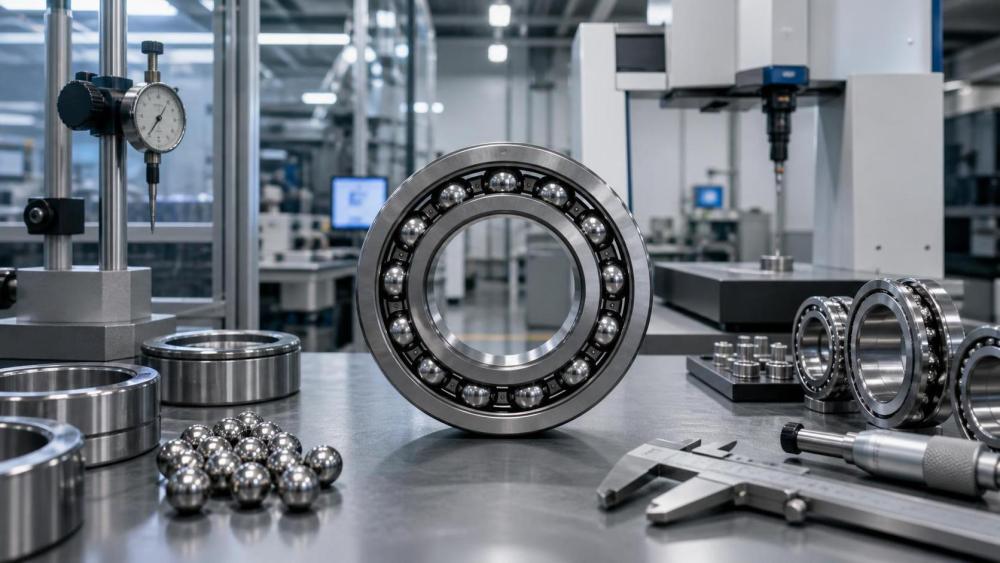
It is easy to focus on bore, outside diameter, and width because they are visible and easy to measure. But in actual bearing performance, raceway profile, waviness, roundness, ball grading, and internal geometry control can matter just as much. These features influence load distribution, friction, noise, heat generation, and vibration behavior.
A manufacturer may meet nominal dimensions while still producing bearings that run less smoothly under speed or fatigue early under real load. That is especially relevant in electric motors, pumps, gearboxes, conveyors, and precision transmission systems where noise, vibration, and thermal behavior are monitored closely.
For technical evaluation, it helps to ask what the manufacturer controls beyond basic dimensions. Can they discuss raceway finishing, superfinishing where applicable, internal clearance classes, and process capability on geometric parameters? If the answer remains general, you may be looking at a supplier that can produce standard commercial-grade bearings but may struggle with applications where repeatability matters.
Quality consistency is a systems question, not an inspection question
One of the most common mistakes in supplier qualification is overvaluing final inspection. End-of-line checks are important, but they do not create consistency; they only detect part of its absence. A manufacturer with weak process discipline can still ship some acceptable lots, especially during early qualification or under close commercial pressure.
What technical evaluators should really look for is evidence of process stability. That includes documented control plans, gauge calibration, lot traceability, nonconformance handling, operator discipline, maintenance of grinding and finishing equipment, and statistical process monitoring where appropriate. Formal certifications can be useful signals, but they are not proof by themselves. A certificate without process maturity often produces a false sense of security.
In practice, a more reliable indicator is how the supplier responds to detailed questions. Mature manufacturers usually explain their controls in operational terms. Weak suppliers tend to answer with broad statements about quality commitment, advanced equipment, or 100% inspection.
The right questions during qualification
For a technical evaluator, the supplier meeting should reveal whether the manufacturer understands bearings as a fatigue-critical product or treats them as a commodity. The best questions are the ones that connect manufacturing detail to service risk.
- How are dynamic and static load ratings established and validated?
- What are the approved raw material sources, and how is incoming material verified?
- Which heat treatment steps are controlled in-house, and what records are retained by lot?
- How are internal clearance, roundness, waviness, and surface finish monitored?
- What failure modes are most commonly seen in customer returns, and how were corrective actions closed?
- Can the supplier provide batch traceability from steel to finished bearing?
- How is equivalence maintained when production volume increases or a sub-supplier changes?
These questions do more than gather data. They test whether the manufacturer has an engineering-based control model or mainly a commercial one.
Application fit is where many comparisons go wrong
Not every good manufacturer is right for every application. A supplier may perform well in standard electric motor bearings yet be a poor fit for shock-loaded agricultural equipment, high-speed machine tool auxiliaries, or contamination-prone conveyor systems. Technical evaluation should therefore begin with the operating context, not the supplier shortlist.
At minimum, define the real load case: radial load, axial load, combined load, peak events, speed range, duty cycle, lubrication method, ambient conditions, contamination risk, sealing requirements, expected maintenance intervals, and acceptable failure consequences. If these conditions are not clear internally, even a disciplined manufacturer cannot be evaluated properly.
This is also where common assumptions should be challenged. A higher-rated bearing is not automatically the better choice if mounting conditions, lubrication, or housing rigidity are poor. Likewise, a lower-priced source is not truly lower-cost if inconsistency forces incoming inspection expansion, line stoppages, or early replacement campaigns.
Documentation matters most when problems begin
Many supplier reviews place too much emphasis on pre-sales responsiveness and too little on post-failure discipline. Yet for technical buyers, the manufacturer’s documentation system becomes most valuable after an issue appears in operation. If field noise rises, temperature drifts, or premature spalling occurs, can the supplier isolate the affected lots, review heat and grinding records, and perform a credible root-cause analysis?
That capability often determines whether a problem is contained in days or spreads into a prolonged warranty and production crisis. For this reason, traceability, complaint handling, and corrective-action rigor should be weighted heavily in evaluation, especially for OEM and infrastructure-linked equipment where replacement cost is much larger than bearing piece price.
How to read claims about certifications and standards
Standards and certifications are useful screening tools, but they should be read carefully. Compliance with common quality management frameworks may indicate organizational discipline, yet it does not automatically confirm bearing-specific process strength. Likewise, references to dimensional standards or material standards are important, but they do not tell you enough about endurance under your duty cycle.
Where a manufacturer cites laboratory testing, life testing, or third-party verification, ask what exactly was tested, under which conditions, and how recently. If figures are presented without context, they should be treated cautiously. The same applies to blanket claims about service life extension or zero-defect output. In industrial component sourcing, such statements are usually too broad to support a decision without qualification.
If regulatory or sector-specific requirements apply in your market, those should be checked directly against current standards and customer requirements, especially where export applications are involved. Any specific compliance claim should be treated as 【待核实】 until documents and scope are reviewed.
A practical comparison framework
For many teams, a weighted comparison works better than a simple approved/not-approved judgment. The manufacturer that wins should not be the one with the best brochure, but the one with the strongest fit across technical risk, operational support, and total cost.
This type of framework is useful because it keeps the discussion anchored in operating reality. A bearing manufacturer should be evaluated as a production system, not just a unit-price source.
What usually deserves extra scrutiny
Some warning signs are common enough to justify immediate follow-up. One is excessive dependence on generic test certificates without supporting process detail. Another is reluctance to discuss returns data or corrective actions. A third is pricing that is materially below market without a clear explanation in scale, scope, or design standard. Low cost can be legitimate, but when it is paired with vague technical answers, the risk usually sits somewhere in material control, process stability, or documentation discipline.
Another point worth watching is substitution risk. In some supply chains, a qualified sample and a routine production lot may not be fully equivalent over time if upstream sources, grinding parameters, or heat treatment routes change without robust control. For long-life industrial equipment, change management is not administrative overhead; it is part of technical quality.
The decision is less about promises than about repeatability
For technical evaluators, the best bearing manufacturer is usually not the one making the broadest performance claims. It is the one that can connect design, metallurgy, process control, inspection, and field feedback into a repeatable system. That is what supports real load capacity and consistent quality over years of supply, not just over the first approved batch.
In other words, the decision should come down to evidence of control. If a supplier can explain how bearing life is built into the process, how variation is monitored, and how problems are traced and corrected, you are closer to a dependable source. If the discussion stays at the level of catalogs, certificates, and price, the technical risk is still largely yours.
Related News
- How to Assess a Rigid Coupling Supplier for Bore Accuracy and Traceable QualityOct 08, 2026Tribology & Kinematics Expert
- Titanium Alloys Compared: Balancing Strength, Corrosion Resistance, and MachinabilityOct 08, 2026CNC Kinematics Architect
- Where Ductile Iron Dismantling Joints Reduce Alignment Risk in Water PipelinesOct 08, 2026Pipeline Metallurgy Scientist
- Selecting a Precision Bearing Sleeve: Fits, Runout, and Material ChoicesOct 08, 2026Tribology & Kinematics Expert
- Face Milling Cutters: How Insert Geometry Affects Finish on Steel and AluminumOct 08, 2026CNC Kinematics Architect
- Single-Acting Cylinders for Clamping: Stroke, Force, and Return Spring ConsiderationsOct 07, 2026Fluid Power Control Strategist