
How to Evaluate Precision Bearings for Machine Tools by Speed, Rigidity, and Runout
Choosing precision bearings for machine tools is not only about brand or price. For procurement teams, speed capability, rigidity, and runout directly affect machining accuracy, spindle stability, service life, and total operating cost. The real question behind most purchase inquiries is simpler: which bearing specification is genuinely necessary for the machine, and which one only adds cost without reducing risk?
That matters because machine tool bearings sit at the point where cutting performance, thermal behavior, maintenance intervals, and scrap risk meet. If the bearing is underspecified, the spindle may struggle with speed, lose stiffness under load, or introduce runout that shows up on the finished part. If it is overspecified, the buyer may pay for tolerance classes or preload arrangements that the actual application will never convert into business value.
What procurement teams are really evaluating
When buyers search for precision bearings for machine tools, they are usually not trying to learn what an angular contact bearing is. They are trying to answer four practical questions:
- Will this bearing support the actual spindle duty cycle, not just the catalog speed?
- Will it hold enough rigidity for the material, tooling, and surface finish requirement?
- Will the runout level be low and stable enough for the target machining tolerance?
- Can the supplier prove consistency through manufacturing control, inspection, and traceability?
Those questions should be evaluated together. A spindle bearing package that performs well on speed but loses stiffness at load is not a good choice for heavier cutting. A very rigid setup that runs hot at higher RPM may also be the wrong commercial decision if uptime and bearing life matter more than peak cutting force.
Speed capability is more than a maximum RPM number
Speed is often the first filter in supplier quotations, but catalog RPM values can mislead buyers if they are treated as absolute selection criteria. Machine tool spindle performance depends on bearing type, cage design, preload, lubrication method, thermal control, and assembly quality. In practice, the usable speed window may be narrower than the headline number suggests.
For procurement, the right question is not “Which bearing has the highest speed rating?” but “Which bearing can run at our operating speed range with acceptable temperature rise, lubrication stability, and life expectancy?” A spindle used for high-speed finishing in aluminum or small-part milling has a very different bearing demand than one used for harder materials, interrupted cuts, or mixed-duty production.
Typical checks during sourcing should include whether the quoted speed rating assumes grease or oil-air lubrication, what preload condition was used in testing, and whether the machine builder’s spindle housing and cooling system can support that operating envelope. If these conditions are not aligned, the bearing may technically meet catalog limits while performing poorly in the actual spindle.
A common sourcing mistake is to select a bearing for future flexibility rather than present production reality. Unless there is a clear roadmap toward higher-speed machining, paying a premium for an ultra-high-speed configuration may not produce a measurable return. The cost may be better spent on better balancing, cleaner assembly conditions, or stronger inspection control.
Rigidity determines whether machining stability is predictable
Rigidity is where many bearing decisions become application-specific. In machine tools, rigidity is not just about resisting load. It affects chatter behavior, dimensional repeatability, tool life, and the machine’s ability to hold process stability over longer runs.
For buyers, this means a spindle bearing should be matched to the cutting profile of the machine. A high-speed machining center focused on light cuts and fine finishing may prioritize lower friction and thermal stability. A machine handling heavier radial and axial loads may require a more rigid bearing arrangement, a different contact angle, or a preload level that supports cut stability even at the cost of some speed.
The tradeoff is straightforward: more rigidity often means more preload, and more preload can increase heat generation and reduce top-end speed if the system is not designed carefully. This is why bearing selection should be tied to the spindle design, not treated as a stand-alone commodity.
Procurement teams should ask suppliers and machine builders for application reasoning, not only part numbers. If a supplier cannot explain why a certain preload class, bearing arrangement, or contact angle suits the intended machining profile, the quotation is incomplete even if the price looks attractive.
Runout is where bearing quality becomes visible on the part
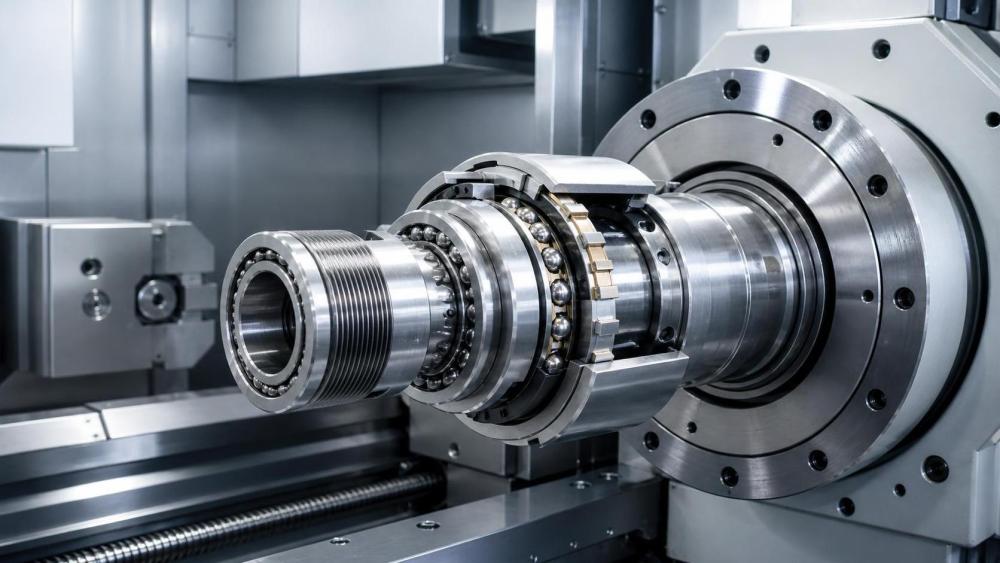
Runout is one of the clearest links between bearing quality and machining output. Excessive or unstable runout affects surface finish, roundness, geometric tolerance, tool wear, vibration, and spindle noise. In high-precision machining, even small deviations can turn into visible quality problems downstream.
Procurement teams should be careful here: low runout on a bearing inspection report does not automatically guarantee low runout in spindle operation. Final performance depends on shaft and housing accuracy, fitting practice, cleanliness during assembly, preload control, and thermal growth during operation.
That is why bearing runout should be evaluated as part of a system. When comparing suppliers, ask not only for bearing accuracy class, but also for what is measured, under what conditions, and how consistency is maintained between batches. A one-time test report is less useful than evidence of process capability and repeatability.
In procurement terms, runout risk is expensive because it often appears indirectly. It may show up as higher scrap rates, more frequent tool replacement, unexpected spindle vibration, or difficulty holding tolerance on finishing operations. By the time it becomes visible in production, the cost is usually much higher than the original bearing price difference.
How to compare options without relying on brand alone
Brand reputation matters in spindle bearings, but relying on brand alone is not enough for a serious sourcing decision. The same brand can have multiple bearing classes, internal designs, and manufacturing origins. For buyers managing cost pressure, the task is to compare technical fitness and supply reliability together.
In many cases, a lower-cost option can be acceptable if the application is less demanding and the supplier can provide stable quality documentation. But for high-speed spindles, tight-tolerance machining, aerospace-related work, mold finishing, or precision grinding, the cost of a bearing issue typically outweighs the unit price savings.
Where common purchasing assumptions go wrong
Several ideas often circulate in sourcing discussions that deserve closer scrutiny.
“Higher precision grade is always better.” Not necessarily. If the spindle system, machine structure, and process control cannot fully use the additional precision, the buyer may simply be paying for theoretical capability. The better decision is to match accuracy to the process requirement and risk level.
“Maximum speed means production speed.” It usually does not. Real operating speed depends on lubrication, preload, thermal management, and load condition. The catalog value is only part of the picture.
“Bearings from any approved supplier are interchangeable.” Not always. Internal geometry, preload behavior, cage design, and manufacturing consistency can differ enough to affect spindle performance and assembly outcomes.
“Bearing failure is mainly a maintenance issue.” In machine tools, failure often starts earlier, at selection, handling, mounting, lubrication setup, or contamination control. Procurement decisions influence all of these indirectly through supplier choice and specification clarity.
Questions that should appear in every RFQ or technical review
For procurement teams, a bearing RFQ should do more than request dimensions and price. It should force alignment between machine duty, quality expectations, and supplier capability. Useful questions include:
- What spindle application is this bearing intended for: milling, turning, grinding, drilling, or mixed duty?
- What are the continuous and peak operating speeds?
- What load pattern is expected: primarily radial, axial, or combined?
- What preload class and arrangement are being quoted?
- What lubrication method is assumed in the performance rating?
- What runout or accuracy data can be supplied per batch?
- What traceability is available for material, heat treatment, and inspection?
- What is the lead time for production lots and replacement demand?
- How is packaging designed to control contamination and handling damage?
- What technical support is available if spindle testing shows abnormal heat or vibration?
These questions do two things. First, they improve technical fit. Second, they expose whether a supplier understands machine tool applications or is only reselling standard catalog parts with limited application support.
Total cost is driven by stability, not purchase price alone
In procurement discussions, bearing price is visible immediately, while the cost of instability appears later through downtime, spindle rebuild frequency, scrap, and missed delivery schedules. For that reason, the commercial comparison should include operating consequences, not just unit cost.
If a lower-price bearing introduces more variation in runout or thermal behavior, the result may be more inspection burden, slower production ramp-up, and higher maintenance uncertainty. If a premium bearing extends spindle life and reduces process drift in a high-value machining line, the higher initial cost may be justified. The answer depends on production value, tolerance sensitivity, maintenance capacity, and replacement difficulty.
For buyers managing multiple machine categories, it can be useful to separate bearings into risk tiers. High-speed and high-accuracy spindles deserve tighter supplier qualification and stronger documentation requirements. More standard machine applications may allow broader sourcing options if quality consistency is demonstrated.
Supplier evaluation should include process discipline
Because precision bearings for machine tools affect the final spindle system more than many buyers initially assume, supplier assessment should go beyond datasheets. A capable supplier should be able to discuss grinding accuracy, raceway finishing, cleanliness standards, preload matching, storage conditions, and inspection methods in practical terms.
Where possible, buyers should also confirm whether bearings are supplied as universally matchable units, specifically matched sets, or configurations requiring controlled mounting procedure. Misunderstanding that detail can create assembly variation even when the bearing itself is made correctly.
Documentation expectations may vary by industry and region, and some requirements around quality certification or test records should be treated as application-specific and verified case by case【待核实】. Still, the direction is clear across industrial sourcing: traceability, test visibility, and response quality increasingly matter alongside price.
A practical decision rule
If the spindle application is fast, thermally sensitive, and tied to tight finish or tolerance requirements, speed capability and runout stability deserve the most weight, with rigidity tuned to the actual cutting profile. If the application is load-heavy, less speed-intensive, and vulnerable to chatter or deflection, rigidity becomes the dominant filter, while speed margin remains necessary but secondary. In both cases, the final decision should only be made after confirming how the bearing will perform in the real spindle arrangement, not in isolation.
That is usually the difference between buying a bearing and buying spindle performance. Procurement teams that make that distinction early tend to see fewer surprises later, especially when production volumes rise and small variations stop being small.
Related News
- How to Assess a Rigid Coupling Supplier for Bore Accuracy and Traceable QualityOct 08, 2026Tribology & Kinematics Expert
- Titanium Alloys Compared: Balancing Strength, Corrosion Resistance, and MachinabilityOct 08, 2026CNC Kinematics Architect
- Where Ductile Iron Dismantling Joints Reduce Alignment Risk in Water PipelinesOct 08, 2026Pipeline Metallurgy Scientist
- Selecting a Precision Bearing Sleeve: Fits, Runout, and Material ChoicesOct 08, 2026Tribology & Kinematics Expert
- Face Milling Cutters: How Insert Geometry Affects Finish on Steel and AluminumOct 08, 2026CNC Kinematics Architect
- Single-Acting Cylinders for Clamping: Stroke, Force, and Return Spring ConsiderationsOct 07, 2026Fluid Power Control Strategist