
How Take-Up Mounted Bearings Maintain Belt Tension in Conveyor Systems
Conveyor reliability is rarely decided by one major component. More often, it is lost through small mechanical changes that accumulate over time: a belt elongates after installation, a pulley moves slightly out of square, material buildup alters tracking, or a maintenance adjustment is made unevenly on one side. When tension is no longer stable, the consequences can spread quickly—belt slip at the drive pulley, poor tracking, premature bearing wear, spillage, reduced throughput, and unplanned shutdowns.
A take up mounted bearing is part of the practical answer to that problem. It supports the shaft of a movable pulley while allowing the pulley assembly to travel in a controlled direction. This movement gives the conveyor a way to absorb belt stretch and maintain the tension needed for reliable power transmission. It sounds straightforward, but the bearing arrangement, frame geometry, adjustment method, sealing, and maintenance access all affect whether the take-up system works as intended in the field.
For project managers, the key point is that belt tensioning is not a one-time commissioning task. It is an operating condition that must remain manageable throughout the conveyor’s service life. A well-selected take-up arrangement makes that management easier. A poorly considered one can turn routine belt adjustment into a recurring source of production risk.
Why conveyor belts need a controlled tension reserve
Every belt conveyor needs sufficient tension to create friction between the drive pulley and the belt. Without that friction, torque from the motor and gearbox cannot be transferred consistently. The belt may slip, especially during loaded starts, wet operating conditions, or periods of higher-than-normal material loading. Yet excessive tension is not a solution either. Over-tensioning can place unnecessary load on bearings, shafts, pulleys, belt carcasses, splice areas, and supporting structure.
The difficulty is that a conveyor belt does not remain dimensionally fixed. It may elongate during early operation, change with temperature, settle around splices, or respond differently as loading patterns change. Long conveyors, heavy-duty aggregate lines, bulk material handling systems, and inclined conveyors are especially sensitive because the belt path and operating loads create more opportunities for tension variation.
A take-up pulley provides a reserve of travel. Instead of treating belt stretch as a failure that requires immediate belt shortening or major rework, the system allows the pulley to move and recover the required tension. The mounted bearings at each end of that pulley shaft are what make the movement mechanically possible while still carrying radial loads and maintaining shaft support.
How a take-up mounted bearing arrangement works
In a typical arrangement, the take-up pulley shaft is supported by two mounted bearing units. These may be housed bearings installed in sliding frames, take-up frames, or fabricated guide structures. The bearing housings are designed to move along a defined path—usually parallel to the return run of the belt—while adjustment screws, gravity weights, hydraulic devices, or other tensioning mechanisms shift the pulley position.
When the belt length effectively increases, the take-up pulley moves away from the belt path to remove slack. When the system is adjusted correctly, both sides of the pulley move by the same amount and remain square to the conveyor centerline. That last condition matters more than it may appear. If one bearing housing advances farther than the other, the pulley can skew. A skewed pulley may influence belt tracking and introduce uneven loading across the belt and bearings.
The mounted bearing is therefore not simply a support component. It is part of a moving assembly that must resist shaft load, tolerate vibration, remain aligned during travel, and survive the local environment. In dusty quarry service, fertilizer handling, grain processing, recycling, ports, and wastewater facilities, contamination and corrosion can be as consequential as the nominal load rating.
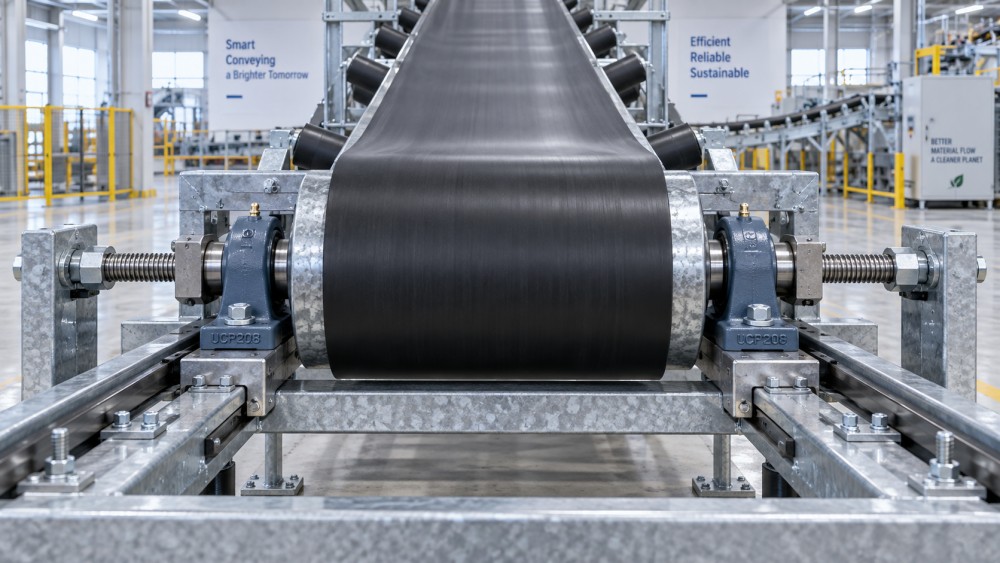
The design is commonly seen in screw take-up systems, where threaded rods move the bearing housings manually or through mechanical adjustment. Gravity take-ups use a counterweight to maintain tension automatically as conditions change. Hydraulic take-ups can provide controlled force and may be appropriate where loading is variable or where remote monitoring is required. Each approach relies on the pulley bearings and guides being able to move without binding.
The difference between tension adjustment and belt tracking
These two issues are often discussed together, and on site they are sometimes adjusted together. They are not the same thing. Tension is the force condition needed for traction and belt stability. Tracking is the belt’s tendency to run centrally on the pulleys and idlers. A take-up pulley can influence tracking because its alignment affects the belt path, but it should not be used as the main cure for a persistent tracking problem.
When a belt consistently drifts to one side, the inspection should extend beyond the take-up mounted bearing assembly. Check whether the conveyor structure is square, whether loading is centered, whether return idlers are level, whether the belt splice is straight, and whether material has accumulated on pulleys or rollers. A maintenance crew that repeatedly adjusts one take-up screw to force the belt back toward center may temporarily reduce the symptom while creating pulley misalignment.
A practical rule is simple: use the take-up to establish even, specified tension and maintain pulley squareness. Use proper tracking measures to solve tracking. The correct sequence avoids loading the bearing units unevenly and prevents the take-up from becoming a workaround for deeper installation issues.
What project teams should evaluate before selecting the bearing arrangement
A catalog description alone does not provide enough information for a conveyor take-up design. The bearing unit must be considered with the pulley shaft, housing, guide frame, tensioning method, belt specification, and actual duty cycle. In many projects, the bearing is selected correctly in isolation but performs poorly because the movable frame is too flexible, the adjustment screws are difficult to access, or the guides are not protected from debris.
Several questions are worth resolving during design review and procurement:
- What radial load will each bearing carry from belt tension, pulley weight, and operating conditions?
- How much take-up travel is needed for installation, expected belt stretch, splice work, and future adjustment?
- Will the bearing housings move smoothly under load, or can corrosion, dirt, frame distortion, or poor guide alignment cause binding?
- Is the shaft mounting method suitable for the shaft finish, torque, vibration, and expected maintenance practice?
- What sealing and lubrication approach matches the environment: dry dust, moisture, washdown exposure, abrasive fines, or chemical contamination?
- Can technicians inspect and adjust both sides safely without entering a pinch point or working around an energized conveyor?
The housing material and corrosion protection also deserve attention. Painted cast housings may be suitable for many indoor or moderately exposed applications, but aggressive outdoor, coastal, washdown, or chemical environments may require a different protection strategy. The right choice depends on the surrounding process, cleaning regime, temperature, and maintenance capability—not merely on whether the conveyor is technically indoors or outdoors.
Common failure patterns seen around take-up pulleys
Bearing failure at the take-up is often blamed on the bearing itself, but the root cause may be elsewhere. One common issue is uneven screw adjustment. If the two bearing housings are moved by different amounts, the pulley shaft no longer sits perpendicular to the belt centerline. This can increase side loading, worsen belt wandering, and leave the bearing units carrying loads in a condition the original arrangement did not intend.
Another frequent problem is seized or contaminated sliding hardware. A screw take-up may be mechanically sound when installed, then become difficult to adjust after months of exposure to fines, rust, or hardened material buildup. The result is predictable: maintenance staff adjust only the accessible side, use excessive force, or postpone the work until belt slip becomes severe. A protected thread, lubricated sliding interface, drainage, and clear access are modest design details with outsized operational consequences.
Misalignment can also begin upstream. A bent pulley shaft, insufficiently rigid support frame, worn pulley lagging, or a poorly positioned drive may transfer abnormal forces to the take-up bearings. Replacing a failed unit without checking shaft condition and housing alignment risks repeating the same failure cycle.
Lubrication practices need judgment as well. Some housed bearing configurations are designed for relubrication, while others are supplied with lifetime grease for defined operating conditions. Adding grease indiscriminately can damage seals or attract contamination around the housing. On the other hand, treating a relubricatable bearing as permanently sealed can shorten service life in demanding duty. The bearing manufacturer’s instructions, lubricant compatibility, and site contamination level should guide the maintenance plan.
Choosing between screw, gravity, and hydraulic take-up systems
The take-up mounted bearing concept appears in several system types, but the operational behavior differs.
There is no universally superior option. A manually adjusted screw take-up can be dependable and economical where belt conditions are stable and maintenance access is good. A gravity system can better accommodate ongoing belt elongation, but it requires proper guarding and adequate vertical or horizontal travel. Hydraulic systems offer control, yet they introduce another subsystem that must be maintained with the same seriousness as pumps, valves, cylinders, and fluid cleanliness controls.
Installation details that prevent later tension problems
The most useful checks occur before the conveyor is handed over. Verify that the take-up guides are parallel, that both bearing housings begin from a measured and comparable position, and that the pulley is square to the conveyor centerline. Confirm that the planned travel remains available after initial tensioning; it is unwise to commission a new belt with the take-up already close to the end of its adjustment range.
The take-up pulley should also be checked under realistic operating conditions. An unloaded belt can appear well behaved while a loaded belt exposes drive slip, tracking drift, or structural movement. During commissioning, teams should observe belt behavior at start-up, normal load, and shutdown where safe procedures permit. This is when unusual noise, pulley movement, frame deflection, or uneven bearing temperatures are most likely to be noticed before they become production failures.
For engineered equipment packages, documentation should connect the bearing arrangement to the larger power transmission assembly. Drawings, shaft details, pulley information, bearing identification, lubrication instructions, adjustment procedure, and replacement access should be available together. Industrial procurement often separates these items into different packages, but the conveyor does not operate in separate packages. Its reliability depends on how the parts interact.
A maintenance plan should monitor movement, not just bearing condition
A useful inspection routine records take-up position over time. This simple observation can reveal whether the belt is gradually stretching, whether an adjustment has been made unevenly, or whether the conveyor is approaching the limit of available travel. Waiting until visible belt slip occurs is late-stage maintenance; by then, pulley lagging, belt surfaces, and drive components may already have been affected.
Technicians should inspect housing fasteners, locking devices, seals, guide surfaces, adjustment threads or cylinders, and signs of shaft movement. They should also look for evidence that the pulley is not running square: asymmetric belt wear, repeated edge contact, uneven material accumulation, or different conditions at the two bearing locations. Vibration and temperature checks can be useful, but they should be interpreted alongside alignment and belt behavior rather than treated as isolated readings.
This systems view aligns with the broader approach used in industrial power transmission work. Bearings, gearboxes, shafts, couplings, pulleys, seals, and lubrication practices must be reviewed as connected elements. Platforms such as Global Industrial Machining & Piping Equipment Network (IMPE) help project teams organize those connections when comparing component categories, evaluating machining and casting quality, or reviewing long-term maintenance implications across an equipment package.
The practical decision: design for adjustment that people can actually perform
The best take-up mounted bearing arrangement is not necessarily the most complex one. It is the one that maintains pulley support and belt tension under the real conditions of the conveyor, while allowing safe and repeatable inspection. In a clean, accessible plant, a basic screw take-up may be entirely appropriate. In a long bulk-handling conveyor exposed to fluctuating loads, a gravity or controlled hydraulic arrangement may justify its added complexity.
Before finalizing the design, ask one field-oriented question: when the belt needs adjustment after months of operation, can the maintenance team move both bearing housings evenly, verify pulley squareness, and do the work without improvisation? If the answer is uncertain, the conveyor tensioning system needs more attention now—not after the first belt slip or bearing replacement.
Related News
- How to Assess a Rigid Coupling Supplier for Bore Accuracy and Traceable QualityOct 08, 2026Tribology & Kinematics Expert
- Titanium Alloys Compared: Balancing Strength, Corrosion Resistance, and MachinabilityOct 08, 2026CNC Kinematics Architect
- Where Ductile Iron Dismantling Joints Reduce Alignment Risk in Water PipelinesOct 08, 2026Pipeline Metallurgy Scientist
- Selecting a Precision Bearing Sleeve: Fits, Runout, and Material ChoicesOct 08, 2026Tribology & Kinematics Expert
- Face Milling Cutters: How Insert Geometry Affects Finish on Steel and AluminumOct 08, 2026CNC Kinematics Architect
- Single-Acting Cylinders for Clamping: Stroke, Force, and Return Spring ConsiderationsOct 07, 2026Fluid Power Control Strategist