
High-Speed Machine Tool Bearings: Balancing Preload, Heat, and Rigidity
High speed machine tool bearings must retain enough operating preload to control tool displacement without generating more heat than the spindle can remove. The relevant condition is the preload reached during rotation, cutting, and thermal stabilization. A catalog preload class describes a defined bearing condition; it does not establish the stiffness or temperature of the assembled spindle across its duty cycle.
A sound specification therefore connects bearing arrangement, fits, lubrication, cooling, and preload strategy to measurable spindle behavior. Maximum speed and load ratings remain necessary screening parameters, but acceptance also requires limits for tool-point displacement, temperature rise, thermal drift, vibration, and warm-up time under representative operating conditions.
Preload changes both stiffness and the heat balance
Preload creates internal contact forces before an external cutting load is applied. In an opposed angular-contact bearing arrangement, this removes clearance and establishes contact stiffness. Increasing preload generally increases stiffness, although the gain is nonlinear and progressively smaller relative to the additional contact force. The accompanying friction and contact stress make maximum preload an unsuitable design objective.
Under an external axial load, one bearing or bearing group becomes more heavily loaded while the opposing group unloads. If unloading becomes excessive, the spindle loses its intended stiffness characteristics, and rolling-element motion can become unstable. Minimum-load requirements therefore matter during high-speed, lightly loaded operation as well as during cutting. Heavy cutting presents a different constraint: combined external load and preload must remain compatible with contact stress, lubrication, and fatigue requirements.
Static bearing stiffness also differs from stiffness at the tool tip. Shaft bending, bearing span, housing deformation, toolholder compliance, and bearing-seat interfaces all contribute to displacement. Increasing preload produces limited benefit when another part of this structural path dominates. Chatter resistance further depends on dynamic stiffness and damping, so a static deflection result alone cannot establish machining stability.
Fixed-position and constant-force preload respond differently
With fixed-position preload, the relative positions of opposing bearing rings are constrained through shoulders, spacers, and clamping components. Matched bearing face offsets or controlled spacer dimensions establish the initial preload. This arrangement supports high stiffness, but changes in ring temperature, shaft expansion, and housing geometry alter the operating contact forces.
Constant-force preload uses a compliant element, commonly a spring, to maintain a more consistent axial force as dimensions change. The moving ring must slide reliably through its intended travel. Tight fits, distorted seats, seal drag, or contamination can restrict that movement and defeat the preload mechanism.
Constant-force preload does not make high-speed behavior thermally independent. Centrifugal effects, contact-angle changes, lubricant behavior, and radial temperature differences still influence bearing contacts. Likewise, a variable-preload system needs a defined operating envelope: increasing preload for a heavy cut is useful only if the transition does not create excessive contact loading or destabilize the spindle.
Thermal growth must be traced through the assembly
A hotter inner ring generally expands relative to a cooler outer ring, changing internal geometry and potentially increasing contact loading. Axial growth introduces another effect through the shaft, housing, and spacers. Whether these changes increase or reduce preload depends on bearing orientation, constraint locations, material expansion, and the temperature distribution. A rule such as “shaft heating always increases preload” is too broad to support a design decision.
Back-to-back arrangements provide a wide effective support spread and good moment stiffness. Face-to-face arrangements have different effective load-line geometry and accommodation of angular displacement. Neither arrangement guarantees thermal stability by itself. Tandem bearings increase load capacity in one axial direction, but require an opposing arrangement to support reverse thrust and establish preload.
Spacer materials and lengths influence the relative positions of the rings. Matching coefficients of thermal expansion is insufficient when inner and outer spacers operate at different temperatures. The useful calculation follows the actual thermal paths and constraints, including the rear support. A rear bearing intended to float must retain enough freedom to accommodate shaft growth; otherwise, the spindle acquires an unintended axial constraint.
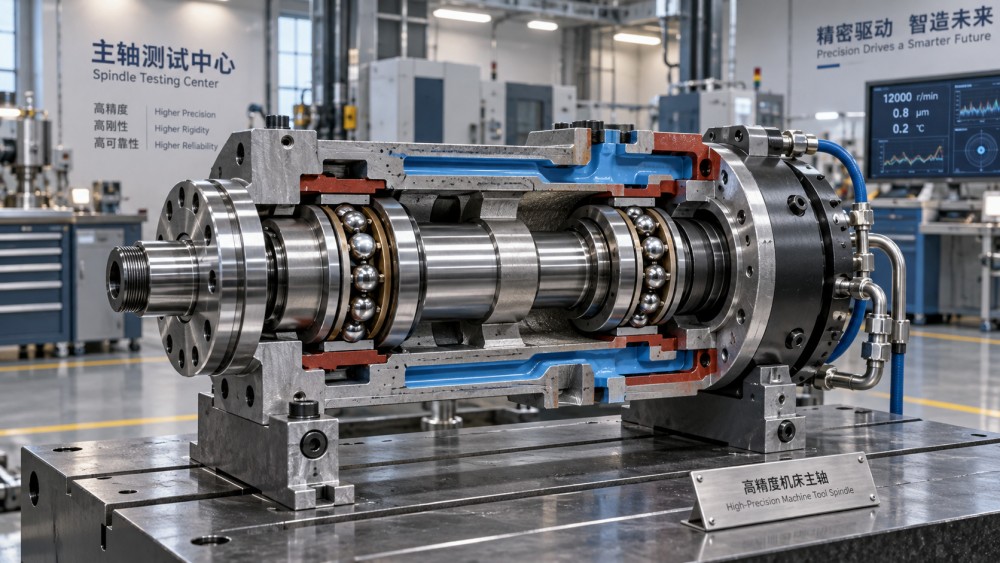
Housing temperature is only a partial indicator. An outer-ring sensor can show a stable reading while the inner ring and shaft continue heating. During development, temperature measurements at several housing locations, coolant measurements, and axial displacement data provide a stronger picture of stabilization than one temperature reading.
Speed capability belongs to the complete bearing system
Angular-contact ball bearings are widely used in high-speed spindles because they support combined loads and permit controlled preload. Smaller contact angles generally favor speed, while larger angles support greater axial stiffness and thrust capacity. The selection still requires the actual load direction and magnitude: a speed-oriented contact angle may be unsuitable for a process with substantial axial cutting force.
Hybrid bearings with silicon nitride rolling elements reduce rolling-element mass relative to all-steel bearings. This reduces centrifugal loading and changes high-speed contact behavior. It does not remove restrictions associated with the steel rings, cage, lubricant, fits, or thermal expansion. Substituting hybrid bearings into an existing assembly requires renewed assessment of preload and operating conditions.
The speed factor, often expressed as rotational speed multiplied by mean bearing diameter, helps compare operating severity. It is a screening tool rather than a universal acceptance limit. Manufacturer speed values depend on stated assumptions about lubrication, preload, mounting, and cooling. A grease speed limit and an oil-air speed limit are not interchangeable, and published values require adjustment where the actual arrangement differs from the reference conditions.
Cage design also affects permissible operation. Guidance method, material, lubricant compatibility, and acceleration influence cage stability. Frequent speed changes and reversals deserve explicit evaluation because steady operation at maximum speed does not reproduce those conditions.
Lubrication and cooling must avoid adding their own losses
The lubricant must separate loaded surfaces while limiting drag. Excess grease creates churning and heat, particularly during initial running. Insufficient lubricant supply or unsuitable viscosity reduces film protection. Grease quantity should follow the bearing and spindle specification, with a controlled running-in procedure that redistributes grease and reveals abnormal temperature behavior.
Oil-air lubrication supplies small, metered oil quantities through an air stream. Its performance depends on delivery reaching the intended bearing location, suitable oil viscosity, clean air, and reliable metering. Air pressure at the supply unit does not prove that each bearing receives oil. Delivery-line layout, nozzle position, and interruption detection require attention, especially after maintenance.
Oil viscosity must be evaluated at operating temperature. Higher viscosity supports film formation under some load conditions but increases viscous losses. Lower viscosity reduces drag while reducing film thickness. Surface finish, contact loading, speed, and contamination determine whether the resulting lubrication condition is adequate.
Cooling should control temperature gradients as well as remove heat. Aggressive housing cooling around a hotter shaft can increase the temperature difference between bearing rings and change preload. Coolant temperature also affects spindle growth relative to the machine structure. Stable coolant regulation tied to an appropriate machine reference generally gives more predictable displacement than simply selecting the lowest available coolant temperature.
Assembly details can overwhelm the selected preload class
Interference fits change ring geometry and internal bearing conditions. Shaft and housing tolerances therefore belong in the preload assessment, together with roundness, cylindricity, shoulder squareness, and surface finish. A nominally correct diameter does not compensate for a distorted bearing seat.
Clamping deserves equal attention. A locknut retains the bearing stack and applies the specified clamping force; its tightening torque does not directly measure bearing preload because thread and face friction influence the result. Burrs, trapped debris, uneven spacer faces, or excessive clamping deformation can alter alignment and contact loading.
Matched bearings must retain their specified pairing and orientation. Replacing one bearing without confirming compatibility with the remaining set risks changing preload and load sharing. Installation forces should follow the bearing manufacturer's mounting method and should not pass through rolling contacts when pressing a ring onto its seat.
These effects explain why a replacement spindle can run hotter despite using the same bearing designation. Before changing the preload class, the investigation should establish whether fits, spacer geometry, lubricant quantity, clamping, or cooling conditions changed during assembly.
Validation needs transient behavior and meaningful acceptance criteria
A useful test cycle includes cold start, controlled speed steps, sustained high-speed operation, representative cutting loads, deceleration, and restart after heat soak. Temperature, vibration, spindle power or drive current, and axial displacement should be recorded against time. No-load drive current is useful for comparisons under equivalent conditions, although motor and drive losses prevent treating it as a direct bearing-friction measurement.
The shape of the response helps distinguish causes. A temperature rise that settles after grease redistribution has a different implication from a rise that continues with increasing power consumption. A rapid response to a speed increase suggests speed-related losses; drift that persists after speed falls points toward stored heat and slower structural expansion. Neither pattern identifies a fault alone, but both help focus inspection and additional measurements.
Acceptance criteria should define:
- The operating cycle, including acceleration, dwell duration, cutting-load direction, and coolant conditions.
- Temperature measurement locations and permissible behavior. Absolute temperature, rise above the reference condition, and stabilization trend answer different questions.
- Tool-point displacement and repeatability after warm-up, with a defined measurement setup.
- Vibration limits linked to sensor position and analysis method, plus stop conditions for abnormal temperature or vibration growth.
Precision classification standards describe characteristics such as dimensional tolerances and running accuracy. They do not certify the thermal stability of an assembled spindle. Likewise, bearing rating-life calculations depend on load and lubrication assumptions and do not establish acceptable tool-point drift, grease life, or resistance to contamination. Any specified standard needs its applicable edition, bearing category, and acceptance characteristics stated clearly.
A spindle suitable for sustained high-speed finishing can behave differently during repeated heavy cuts and short idle periods, even when both cycles remain below the same maximum speed. Approval should therefore rest on demonstrated preload stability and tool-point behavior over the intended cycle, with the mounting and lubrication conditions recorded so that subsequent assemblies can reproduce the result.
Related News
- Why Is Your Heavy-Duty Piston Pump Losing Pressure Under Load?Nov 09, 2026Fluid Power Control Strategist
- Cartridge Valves for Manifold Blocks: Avoiding Cavity Fit ProblemsNov 09, 2026Fluid Power Control Strategist
- Large-Diameter Forged Rings: How Seamless Rolling Affects Grain FlowNov 09, 2026Foundry Phase-Change Fellow
- Sealed Heavy-Duty Roller Bearings: Choosing Seals for Dust and WaterNov 09, 2026Tribology & Kinematics Expert
- Sprockets and Chain Drives: What Determines Replacement Cost?Nov 08, 2026CNC Kinematics Architect
- Monoblock Hydraulic Control Valves: Flow Rating and Spool SelectionNov 08, 2026Fluid Power Control Strategist