
Bearing Lock Washer Selection: Tab Design, Shaft Threads, and Load Risk
A bearing lock washer may look like a low-cost accessory, but a mismatch between the washer, locknut, shaft thread, and bearing arrangement can turn into a costly maintenance issue. The usual warning signs are a locknut that cannot be fully secured, a tab that does not align with a nut slot, fretting around the inner tab, rising vibration, or repeated loss of internal clearance after adjustment. In a gearbox, pump, conveyor drive, or pulley assembly, these problems can lead to bearing creep, preload changes, shaft damage, and an unplanned shutdown.
The practical purchasing rule is simple: select the bearing lock washer as part of a matched locking system, not as a generic stamped ring. Confirm the locknut series and thread designation first, then verify the shaft or sleeve arrangement, tab geometry, material condition, available space, and the actual load and vibration risk. A washer with the right outside diameter but the wrong inner-tab fit or nut-slot relationship is not a safe substitute.
Start with the locking arrangement, not the washer diameter
Most bearing lock washer problems begin when a buyer starts with the visible dimensions of an old component. Outside diameter, inside diameter, and thickness are useful checks, but they do not identify the locking arrangement by themselves. The washer must prevent relative rotation between the shaft or sleeve and the locknut. It does this through an inner locating feature and one or more bendable outer tabs.
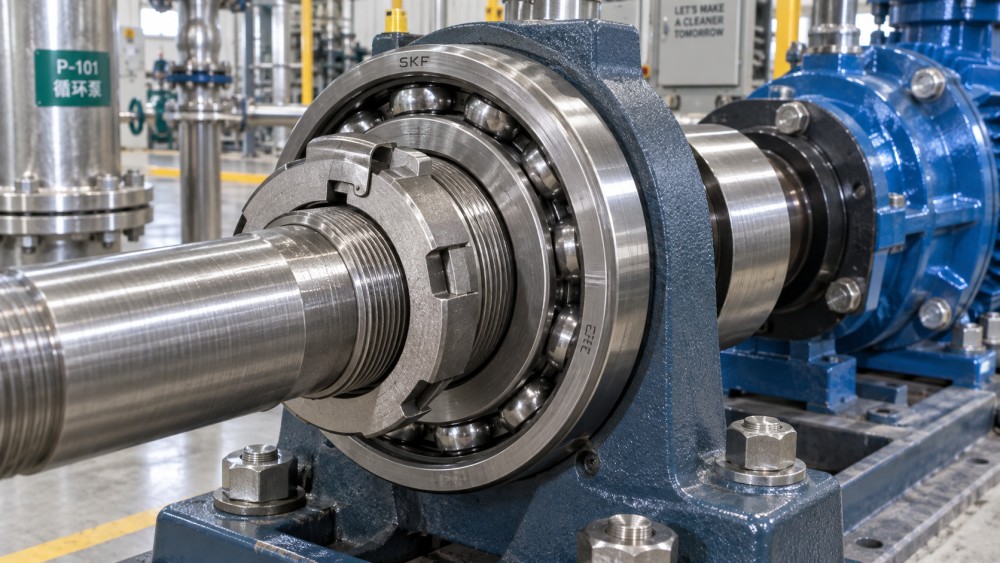
In a common bearing mounting arrangement, a tab washer is fitted over a threaded adapter sleeve, withdrawal sleeve, or threaded shaft section. Its inner tab engages with a keyway, slot, or flat feature on the mounting component. A compatible locknut is tightened against the bearing or associated spacer. After the nut reaches the required position, one outer washer tab is bent into a slot on the locknut.
That sequence explains why parts cannot be selected independently. The washer must match:
- the locknut’s thread size and locknut series;
- the number, width, and position of the locknut slots;
- the shaft, sleeve, or journal feature that receives the inner tab;
- the bearing arrangement, including any spacer, seal carrier, or locating ring;
- the installation method and available access for bending the tab correctly.
A lock washer is not intended to compensate for a loose nut, damaged thread, incorrect bearing fit, or missing shoulder. It is a positive anti-rotation device after the joint has been assembled and adjusted correctly.
Tab design determines whether the washer can actually lock
Tab design deserves more attention than it usually receives in purchasing descriptions. The inner tab anchors the washer, while the outer tabs provide the mechanical connection to the locknut. Both features must function without excessive distortion.
Inner tab engagement
The inner tab should enter its mating keyway or slot without being forced. A tab that is too narrow can move back and forth under vibration, wearing both the tab and the mating groove. A tab that is too wide may not seat fully, may buckle during nut tightening, or may be filed down during installation. Modifying the tab in the field is sometimes treated as a quick repair, but it changes the contact condition and can remove the clearance needed for reliable seating.
Check whether the washer is intended for a shaft thread, an adapter sleeve, or a withdrawal sleeve. Components can share similar thread designations while using different groove details or different assembly geometry. The inner tab must also have adequate engagement depth. If the washer sits proud because the groove is shallow, the locknut may clamp against the washer unevenly rather than against the intended bearing or spacer face.
Outer tab location and bend condition
Outer tabs are designed to align with the locknut slots after tightening. Buyers sometimes assume that more tabs automatically create a stronger lock. In practice, the important point is whether at least one tab can be bent cleanly into an available slot without loosening or overtightening the nut to chase alignment.
The selected tab should sit fully in the nut slot and should not be bent across a rounded corner where it can spring back. The tab should be bent once with a suitable tool rather than repeatedly worked back and forth. Re-bending can crack the material, especially when a washer has already been used or has been exposed to corrosion. Used tab washers should generally not be treated as reusable maintenance stock.
Where access is restricted by a housing, seal, coupling hub, or pulley, verify that technicians can reach the tab after tightening the nut. A technically compatible washer is of little value if the assembly leaves no room for correct locking or later inspection.
Thread designation is necessary, but it is not the full compatibility check
Thread mismatch is one of the most direct ways to damage an expensive shaft or sleeve. Bearing locknuts often use metric fine threads associated with standard locknut families, but a nominal diameter alone does not confirm compatibility. Thread pitch, thread form, tolerance, handedness where applicable, and the nut series must all be checked against the drawing or existing component marking.
Procurement records should capture the complete identification rather than a description such as “lock washer for 60 mm shaft.” A 60 mm journal may have no thread, a different thread pitch, an adapter sleeve thread, or a proprietary retention arrangement. The correct description should connect the washer to the associated locknut designation and the relevant shaft or sleeve configuration.
Thread condition also matters. Burrs, corrosion, plating build-up, impact damage, or prior galling can make a correct locknut feel tight before it reaches its intended axial position. Installing a new washer will not solve that problem. The thread should be cleaned and inspected before the locknut is fitted. If the nut binds, forcing it with a spanner can damage the thread flanks and make future removal more difficult.
Match the washer choice to the load risk, not just the maintenance history
Lightly loaded equipment running at steady speed may show no visible problem for a long period even with marginal retention hardware. That does not mean the selection is correct. Risk increases when the bearing arrangement is exposed to shock, frequent starts and stops, reversing rotation, high vibration, belt tension changes, thermal cycling, or cyclic axial loading.
These conditions can create small relative movements at the locknut interface. Once a nut begins to lose its position, the effect depends on the bearing type and mounting method. A tapered-bore bearing on an adapter sleeve can experience a change in internal clearance. A locating bearing may lose axial control. A spacer stack may become loose. In some assemblies, the bearing may begin to creep on the seat, producing wear that cannot be corrected by simply replacing the washer.
Higher-risk applications therefore require a more disciplined review of the full retention system:
- Confirm that the locknut and washer are designed as a compatible pair rather than sourced from unrelated ranges.
- Check that shaft shoulders, spacers, and bearing faces are clean, square, and undamaged.
- Use the specified tightening procedure for the bearing arrangement instead of relying only on “tight by feel.”
- Verify that the selected tab can engage a locknut slot at the final tightened position.
- Include replacement tab washers in planned maintenance kits where bearing removal is expected.
There is an important distinction between preventing nut rotation and carrying axial load. The bearing, locknut, shaft shoulder, sleeve, and spacer arrangement carry the assembly load. The lock washer keeps the nut from backing off. Selecting an unusually thick or harder washer does not automatically improve load capacity and can interfere with axial positioning if it differs from the intended design.
Material, finish, and reuse policy affect lifecycle cost
Most tab washers are produced from steel suitable for forming the tabs without immediate cracking. Material and surface condition should be appropriate for the operating environment, but the washer must still remain formable. A corrosion-resistant finish can be useful in damp or contaminated environments; however, coating thickness and surface treatment should not obstruct the inner tab, alter fit in the nut slot, or create flaking debris near the bearing.
For washdown areas, outdoor machinery, marine-adjacent service, or equipment exposed to aggressive process fluids, procurement should not assume that a standard washer will have the same service life as the bearing. Inspect the entire retention area: locknut, shaft thread, seal performance, exposed sleeve surfaces, and water ingress path. A corroded locknut slot can prevent full tab engagement even when the washer itself is new.
Tab washers are generally inexpensive compared with bearing replacement labor, shaft repair, or production interruption. The sensible cost decision is usually to replace the washer whenever the locknut is removed, particularly when a tab has already been bent. Reuse creates several uncertainties: reduced bend strength, hidden cracking at the tab root, flattened inner-tab contact surfaces, and distortion from prior tightening. Keeping a used washer because it “still looks flat” is not a reliable acceptance criterion.
Questions to resolve before issuing a purchase order
A well-prepared purchase request reduces the risk of receiving an interchangeable-looking but unsuitable part. The request should identify the mating locknut and the mechanical arrangement, not only the washer part number copied from a storeroom label. Labels can be incomplete, and legacy equipment may contain substitutions from earlier repairs.
Before ordering a bearing lock washer, obtain the following information from the equipment drawing, maintenance manual, or physical inspection:
- Locknut marking and complete thread designation.
- Washer designation, if visible, and a dimensional confirmation where markings are absent.
- Shaft, adapter sleeve, or withdrawal sleeve part reference.
- Location of the inner keyway or locating groove.
- Number and condition of locknut slots.
- Whether the bearing is mounted on a tapered seat, cylindrical seat, or sleeve.
- Operating factors such as vibration, reversing duty, shock load, heat, moisture, and contamination.
- Whether the order is for routine replacement, a planned overhaul, or correction of a recurring loosening problem.
The final point changes the buying approach. For routine replacement, a confirmed like-for-like matched washer may be appropriate. For recurring loosening, ordering the same component without investigating thread damage, bearing fit, nut seating, lubrication contamination, or installation practice may repeat the failure. The washer should not be blamed before the rest of the assembly is checked.
When a standard tab washer is not the answer
A tab washer is effective when it belongs to the intended locknut system and is installed correctly. It is not a universal remedy for every rotating-shaft retention problem. Equipment with severe vibration, limited access, unusual shaft geometry, very high axial forces, or nonstandard bearing housings may use other locking methods specified by the machine designer, such as locking plates, clamping devices, hydraulic locking arrangements, or purpose-designed retaining hardware.
Do not replace a specified retention method with a generic bearing lock washer simply because the thread diameter appears similar. Also avoid adding adhesives, extra washers, or improvised shims to make a tab align. Those changes can alter bearing setting, reduce thread engagement, or conceal a more serious fit problem. Where the locknut repeatedly loses position despite a correctly matched new washer, the assembly should be reviewed for damaged threads, worn keyways, incorrect bearing mounting, inadequate shoulder support, or operating loads beyond the original arrangement.
The lowest-cost purchase is rarely the washer with the lowest unit price. The better decision is the washer that matches the locknut, seats correctly on the shaft or sleeve, can be bent into a secure tab position, and supports the maintenance interval expected from the bearing assembly.
Related News
- How to Assess a Rigid Coupling Supplier for Bore Accuracy and Traceable QualityOct 08, 2026Tribology & Kinematics Expert
- Titanium Alloys Compared: Balancing Strength, Corrosion Resistance, and MachinabilityOct 08, 2026CNC Kinematics Architect
- Where Ductile Iron Dismantling Joints Reduce Alignment Risk in Water PipelinesOct 08, 2026Pipeline Metallurgy Scientist
- Selecting a Precision Bearing Sleeve: Fits, Runout, and Material ChoicesOct 08, 2026Tribology & Kinematics Expert
- Face Milling Cutters: How Insert Geometry Affects Finish on Steel and AluminumOct 08, 2026CNC Kinematics Architect
- Single-Acting Cylinders for Clamping: Stroke, Force, and Return Spring ConsiderationsOct 07, 2026Fluid Power Control Strategist