
Why Low Noise Linear Guides Get Louder: Lubrication, Alignment, and Preload
Low noise linear guides become louder when rolling contact, ball or roller recirculation, or the surrounding machine structure no longer behaves as intended. Lubrication is an important suspect, but extra grease will not correct a twisted rail, an incompatible replacement block, or excessive internal loading. Noise can increase before positioning accuracy changes enough to trigger an alarm.
The most useful distinction is whether the sound follows travel position, operating temperature, speed, or a recent maintenance event. Noise concentrated in one travel zone points toward local contamination, damage, or mounting geometry. Noise across the stroke after lubrication or component replacement shifts attention toward lubricant delivery, compatibility, preload, and assembly conditions. These patterns guide inspection; they do not establish a diagnosis by themselves.
Establish what changed before adjusting anything
A guide that has always produced a steady recirculation sound presents a different problem from one that suddenly develops scraping, clicking, or rough vibration. Compare operation under the same payload, speed, acceleration, stroke, and temperature. A recording made beside an open enclosure cannot be compared meaningfully with one made outside a closed machine.
Record when the change appeared: after a shutdown, washdown, lubrication service, collision, rail replacement, or payload change. Also note whether it occurs during steady travel, at reversal, or only during acceleration. Reversal noise can originate in the drive coupling, ball screw support, brake, or cable carrier rather than the guide.
Before close inspection, isolate hazardous energy and secure gravity-loaded axes. Any powered diagnostic movement must follow the machine’s approved service procedure with guards and protective measures maintained. Stop operation if there is binding, severe grinding, abnormal heating, visible metallic debris, or suspected structural damage.
Lubrication: verify delivery before adding more
A full reservoir or visible grease at a fitting does not prove that lubricant reaches every loaded raceway. Blocked lines, failed metering elements, unsuitable fittings, and incorrect port configurations can leave a carriage under-lubricated while the lubrication system appears functional.
Check the guide manufacturer’s specified lubricant, initial fill, replenishment quantity, and interval. Confirm that the installed block’s lubrication ports and internal passages match the machine’s supply arrangement. In centralized systems, verify delivery at the relevant outlets using the approved procedure rather than relying only on pump pressure or a controller indication.
Lubricant selection involves more than grease consistency
Greases with the same NLGI grade can have different base-oil viscosities, thickeners, additives, and material compatibility. Base-oil viscosity affects film formation and running resistance; consistency describes the grease’s physical firmness. Neither property substitutes for the other.
A lubricant unsuitable for operating speed, load, or temperature can produce inadequate separation or excessive drag. Cold-start noise that decreases as the axis warms may justify checking lubricant suitability, but temperature-dependent seal friction and mounting distortion must also be considered.
Do not mix lubricants simply because their colors or consistency grades match. Incompatible mixtures can alter consistency, oil release, or lubrication performance. If the installed lubricant is unknown, obtain an approved changeover procedure. Introducing a solvent through an assembled block is not a universal cleaning method and can affect seals or leave the rolling contacts insufficiently protected.
Fresh grease can conceal damage without resolving it
A controlled replenishment followed by approved low-speed distribution travel can help assess lubrication condition. A reduction in noise supports further investigation of lubricant supply or interval, but it does not demonstrate that the guide is healthy. Fresh lubricant may damp impacts from an already damaged raceway.
Excess lubricant can also increase resistance and temperature, particularly before redistribution. Use the specified quantity rather than injecting grease until the sound disappears. Where purging is permitted, inspect the discharged material for contamination or metallic particles; neither grease color alone nor the amount expelled is a reliable wear measurement.
Short-stroke applications need particular attention. Lubricant distribution may remain uneven when the rolling elements repeatedly work over a limited region. Any redistribution stroke, revised interval, or alternative lubricant should be approved for the guide and machine rather than introduced as a generic maintenance adjustment.
Alignment: mounting geometry can create internal loading
A linear guide rail follows its mounting surface within the limits of its stiffness and fastening arrangement. Debris beneath a rail, a raised burr, uneven support, or an incorrect shoulder contact can distort the assembled rail. Tightening bolts does not remove these errors; it can clamp them into the installation.
On a two-rail axis, the blocks are connected through the carriage structure. If rail parallelism, mounting heights, or carriage interfaces are outside the permitted limits, the assembly forces the blocks to accommodate the mismatch. The result can be increased rolling resistance, vibration, and heat even when each component is individually serviceable.
This mounting-induced loading is easily confused with excessive factory preload. The distinction matters: replacing a block with a lighter-preload version may reduce symptoms while leaving the installation error unresolved.
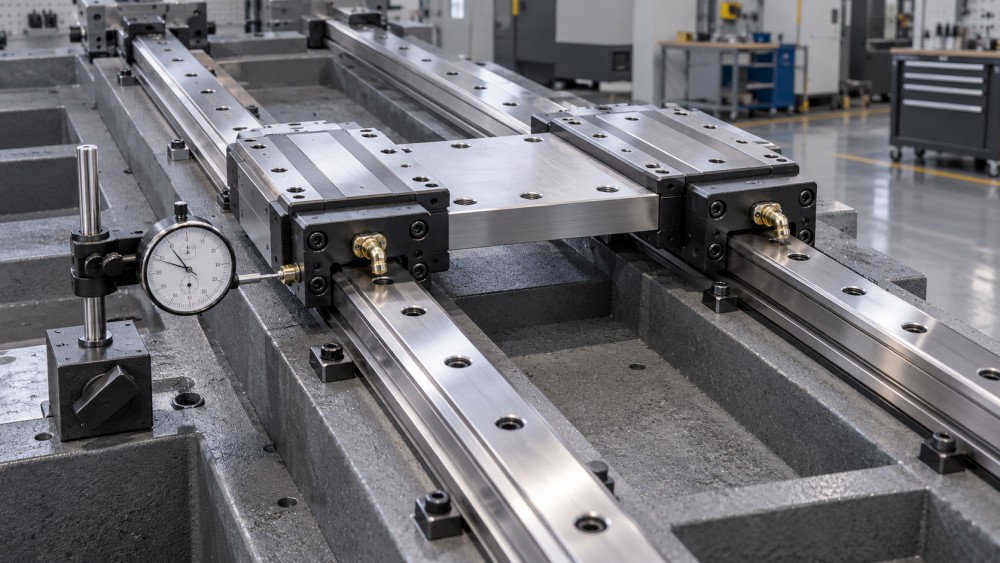
Inspect mounting surfaces, locating shoulders, fastener condition, and the documented tightening sequence before interpreting alignment measurements. Measure the required geometry using suitable references and instruments, such as indicators or an appropriate alignment system. Acceptable parallelism and height variation depend on guide size, accuracy class, preload, spacing, and assembly design; a tolerance borrowed from another machine is not a valid acceptance criterion.
A carriage that appears smooth near one end but becomes resistant elsewhere warrants a position-based check. If resistance changes after the carriage plate is installed, that suggests interaction between the mounting interfaces, but the comparison must be made under a controlled assembly procedure.
Do not loosen rail or carriage fasteners during powered operation to see whether the noise improves. Any staged fastening or isolated-component test requires the axis to be supported, the drive safely controlled or disconnected as specified, and the manufacturer’s assembly method followed.
Thermal conditions also matter. Rails, frames, and carriage structures do not necessarily expand equally. An assembly that moves freely when cold can develop additional constraint at operating temperature. Compare cold and stabilized conditions before accepting a cold-only alignment check as conclusive.
Preload: distinguish the selected specification from installation stress
Preload creates internal contact loading to reduce clearance and increase stiffness. It is part of the guide’s design specification, not a setting that should be adjusted by feel. Greater preload can improve rigidity, but it also increases sensitivity to mounting errors and can increase running resistance and heat.
On many profile rail guides, preload is established through selected rolling-element dimensions and internal geometry. Mounting-bolt torque secures the components; it is not a valid means of adjusting internal preload. Reducing bolt torque to make an axis quieter can compromise joint integrity without correcting the cause.
When noise starts after replacement, check the complete rail and block identification against the original assembly documentation. Relevant details include:
- Preload and accuracy designations, including manufacturer-specific suffixes.
- Whether the series permits interchangeability or requires matched components.
- Block dimensions, mounting interfaces, and seal configuration.
- Caged or uncaged rolling-element construction and lubrication arrangement.
Components that fit physically are not necessarily equivalent. A replacement can introduce a different preload, seal drag, or recirculation characteristic. Mixing blocks with different specifications on the same carriage can also change load sharing.
Noise alone cannot quantify preload. A steady increase in running force, temperature, and vibration after replacement is stronger evidence of excess loading than sound by itself, but these observations still require comparison with the specified assembly. Measure running resistance using an approved method and account for drive, seal, cable, and payload contributions.
Do not replace rolling elements with another size, remove elements, or modify a recirculation path as a field correction. Where internal preload is incorrect, the remedy is a correctly specified component or an authorized rebuild.
Rule out damage and nearby sources before replacing the guide
Lubrication and alignment corrections cannot restore a pitted or indented raceway. Contamination can mark rolling contacts, while impact loading or a collision can leave localized damage that produces repeated noise. Damaged wipers, displaced seals, and broken recirculation parts can create scraping or clicking without a simple lubrication remedy.
Inspect accessible rail surfaces and external block components without dismantling protected internal parts unnecessarily. Look for corrosion, scoring, embedded debris, damaged seals, and metallic contamination. Visible evidence supports diagnosis, but a clean exposed rail does not rule out damage inside the block.
Low noise linear guides also transmit vibration into the carriage, frame, and covers. A loose panel can amplify a modest excitation into a prominent sound. If the noise peaks within a narrow speed range, structural resonance deserves investigation alongside guide condition. Correcting a loose cover is appropriate; adding damping to conceal rough rolling contact is not.
Return to service only after the change is verified
Make one controlled correction at a time where practicable. Changing lubricant, tightening sequence, and block specification together may reduce noise, but it removes the evidence needed to identify the cause and prevent recurrence.
After corrective work, verify mounting integrity, lubrication delivery, free travel, and protective devices before powered testing. Increase operating demand in controlled stages under the machine’s service procedure. Check the complete working stroke, reversals, representative payload, and stabilized operating temperature.
Acceptance should include running resistance or drive-current trends, temperature behavior, vibration, and the required positioning performance—not sound alone. Acoustic comparisons need consistent microphone location, machine enclosure state, speed, and load. A general decibel limit cannot replace application-specific criteria.
Record the lubricant used, replenishment quantity, component identification, alignment results, and test conditions. If roughness, heating, metallic debris, or localized noise remains after verified lubrication and installation checks, escalate for internal inspection or replacement. A quieter axis is encouraging; stable mechanical behavior under representative operating conditions is the stronger basis for returning it to service.
Related News
- Why Is Your Heavy-Duty Piston Pump Losing Pressure Under Load?Nov 09, 2026Fluid Power Control Strategist
- Cartridge Valves for Manifold Blocks: Avoiding Cavity Fit ProblemsNov 09, 2026Fluid Power Control Strategist
- Large-Diameter Forged Rings: How Seamless Rolling Affects Grain FlowNov 09, 2026Foundry Phase-Change Fellow
- Sealed Heavy-Duty Roller Bearings: Choosing Seals for Dust and WaterNov 09, 2026Tribology & Kinematics Expert
- Sprockets and Chain Drives: What Determines Replacement Cost?Nov 08, 2026CNC Kinematics Architect
- Monoblock Hydraulic Control Valves: Flow Rating and Spool SelectionNov 08, 2026Fluid Power Control Strategist