
Why Linear Guide Rail Prices Differ: Load Ratings, Accuracy, and Service Life
A linear guide rail that looks similar in catalog photographs can carry a very different price because its real value is defined by the conditions it can survive while maintaining motion quality. Rail width and block length are visible, but they do not reveal raceway geometry, hardness depth, ball circulation quality, preload consistency, accuracy grade, sealing resistance, or inspection discipline. Those less visible features determine whether a machine axis remains stable after long travel cycles, repeated reversals, vibration, contamination exposure, and changing loads.
The useful comparison starts with the required motion rather than the nominal rail size. A lower-priced assembly may be suitable for a guarded light-duty slide with short strokes and modest accuracy demands. The same assembly may become a costly choice on a vertical machining axis, a gantry carrying an off-center load, a welding fixture exposed to abrasive debris, or an automated station that runs continuously. Linear guide rail price should therefore be assessed against load distribution, mounting structure, operating environment, and the acceptable level of positional drift over the equipment life.
Load rating is a design limit, not a simple strength label
Catalogs commonly state dynamic load rating and static load rating. Both matter, but they answer different questions. Dynamic rating relates to fatigue life under repeated rolling contact. Static rating indicates resistance to permanent indentation or damaging deformation under a high stationary or shock load. Treating either value as the complete selection basis can produce a misleading comparison.
A rail block is rarely loaded in a clean, centered, steady direction. The table mass, workpiece, fixture, cutting force, cable drag, acceleration, and gravity all act through different points. When the resultant force is offset from the block center, it creates pitch, roll, or yaw moments. A system with four blocks does not automatically divide that moment equally. Mounting flatness, preload variation, frame stiffness, and small differences in rail height alter the actual share carried by each block.
Higher-priced guide assemblies often provide stronger moment capacity through a larger ball circle, a longer block body, additional load-bearing raceway geometry, or a rail and block combination designed for more rigid engagement. This is especially relevant where the moving member is wide relative to rail spacing. Increasing rail separation may reduce moment load per block more effectively than simply selecting a heavier block, provided the supporting structure is rigid enough to preserve that spacing under load.
Load calculations also need the real duty cycle. A carriage that sees a light average load but experiences a sharp impact during part transfer, tool engagement, emergency stopping, or cylinder end-of-stroke contact needs static margin as well as fatigue-life capacity. Conversely, selecting a large static rating for a high-frequency positioning axis does not establish adequate running life. The rolling contacts still accumulate fatigue damage through each loaded travel cycle.
Accuracy grade affects more than positioning accuracy
Accuracy grades are often compared only through a single straightness or height tolerance. That misses the practical effect of accumulated variation. A rail system includes rail straightness, block height, block-to-block height variation, rail-to-rail parallelism, and the consistency of the mounting reference surfaces. When two rails support one table, minor differences can force the blocks to run under internal stress. The axis may still move when assembled, yet exhibit higher friction, inconsistent drive current, noise, or premature wear.
Tighter accuracy grades require more controlled grinding, measurement, sorting, and matching. They also require care in handling because a rail with a finely controlled reference edge can lose its benefit when mounted against burrs, paint buildup, weld distortion, or a poorly machined shoulder. The resulting price difference reflects both the precision created at the factory and the additional controls needed to demonstrate it consistently.
For a machine tool axis, inspection fixture, optical handling stage, or synchronized dual-drive gantry, rail accuracy can directly influence geometric performance. In a material-handling shuttle, broad assembly tolerances may be acceptable if the work location is established by a separate stop or locating device. Paying for the highest rail grade in that second situation may not improve the final process. The rail should be accurate enough that its contribution to error remains below the usable tolerance budget after base machining, structural deflection, thermal movement, and drive error are considered.
Preload is closely tied to this issue. Light preload can reduce clearance and improve repeatability without creating excessive rolling resistance. Medium or heavy preload increases stiffness, but it also raises friction, heat generation, and sensitivity to mounting error. A guide intended for high preload requires close control of ball size, raceway form, and block geometry. It also requires a mounting system capable of holding the rails within the supplier's installation tolerances. A low-cost rail assembled with an aggressive preload claim may feel stiff by hand but still produce uneven motion once installed over a long travel.
Material and heat treatment determine the quality beneath the surface
Rolling contact is highly sensitive to surface integrity. The rail and block raceways must resist repeated Hertzian contact stress while maintaining a fine surface finish. Common guide materials are alloy steels selected for hardening response and dimensional stability. The important distinction is not merely whether the component is described as hardened, but how the hardened layer, core toughness, grinding quality, and residual stress work together.
Insufficient hardness or shallow effective hardening can allow indentations, surface distress, or faster wear under repeated concentrated load. Excessive brittleness or poor heat-treatment control creates another failure path, especially where shock, mounting stress, or impact is present. Distortion during heat treatment must also be corrected by precision grinding. That sequence consumes production time and demands inspection, which is part of the price gap between rails that retain geometry and those with greater variation from batch to batch.
Corrosion protection creates a separate tradeoff. A basic oil film is adequate only where storage and operation remain dry and lubrication is maintained. Humid washdown zones, coolant mist, chemically active air, and intermittent outdoor exposure demand a more deliberate corrosion strategy. Surface treatments and stainless or corrosion-resistant constructions may increase initial cost, but a rusted raceway does not recover its original smoothness through relubrication. Before comparing finishes, the full environment matters: coolant chemistry, cleaning agents, condensation during shutdown, airborne salt, and the time equipment may sit idle.
Seals, wipers, and lubrication shape service life in the real environment
Published fatigue life assumes suitable lubrication and a contamination level compatible with rolling contact. Fine particles entering a block behave differently from visible debris. A small hard contaminant can mark the raceway and become a repeating source of vibration as balls pass over the damaged zone. Chips, grinding dust, weld spatter, molding powder, and dried coolant all require different protection approaches.
A basic end seal may suit a clean enclosed machine. Additional lip seals, scrapers, metal wipers, side seals, or bellows become justified when debris reaches the rail directly. These additions are not interchangeable. A hard scraper effective against chips can add drag and may not seal fine abrasive dust. A flexible lip seal can exclude fluid and small particles but will wear faster if it continuously contacts sharp swarf. The rail price rises with the complexity of the sealing package, but the correct package is defined by the contaminant, travel speed, and cleaning method.
Lubrication provisions deserve the same scrutiny. A block with accessible grease ports, internal distribution passages, and suitable compatibility with centralized lubrication is easier to maintain consistently than one that receives lubricant only at an awkward interval. Over-greasing can increase drag and attract debris; under-lubrication promotes metal contact and corrosion. For long rails, the location of ports, access after guarding is installed, and the ability to confirm lubricant delivery should be settled before the machine layout is frozen.
Rail length, joining, and mounting work can reverse an apparent saving
Long travel introduces costs that do not appear in a short sample quotation. A long rail needs careful straightness control, protective packaging, and transport support so it is not bent or damaged before installation. When shipping constraints require joined rails, the joint quality, reference-edge continuity, pitch matching, and installation procedure become part of the axis performance. A joint placed where the carriage reverses under load can expose any discontinuity more severely than one located in a low-duty travel zone.
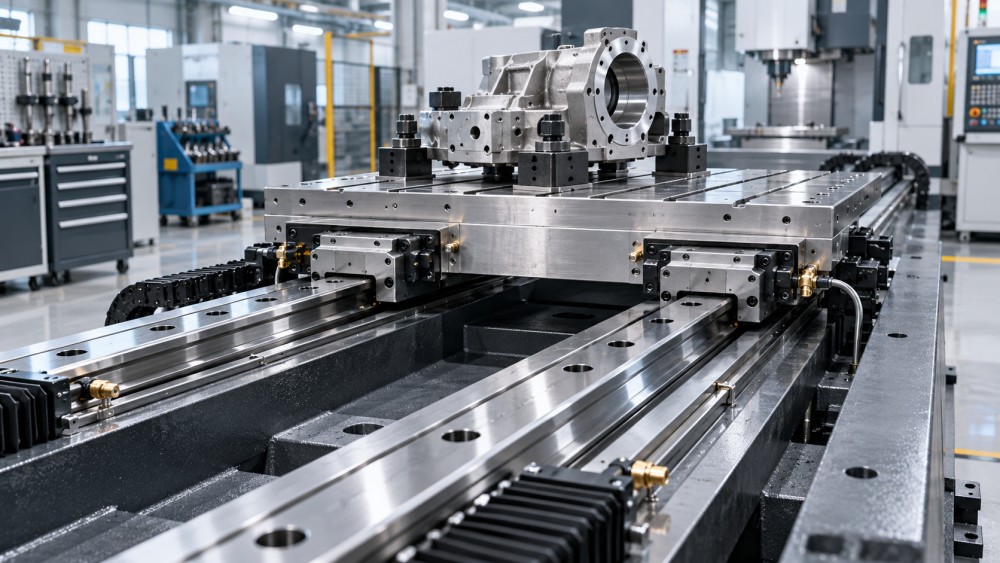
Mounting surfaces often decide whether a premium guide delivers premium behavior. The rail seat needs appropriate flatness and straightness, while the shoulder must provide a clean reference without forcing the rail sideways through uneven contact. Threaded holes, clamping sequence, torque consistency, and base distortion all matter. On a welded frame or large fabricated machine bed, machining the rail pads after stress relief is often more consequential than moving from one nominal rail size to the next.
During assembly, a useful diagnostic is to move the carriage slowly through the entire stroke before the drive is coupled. Changes in resistance, stick-slip, localized noise, or a distinct tight position indicate a geometry or cleanliness problem. Increasing motor force may hide the symptom while imposing extra rolling load. The underlying cause should be investigated through rail alignment, block arrangement, mounting contamination, and structure deflection.
Comparing quotations without comparing unlike assemblies
A meaningful quotation comparison should identify the exact rail profile, block series, number of blocks, accuracy grade, preload class, material or corrosion treatment, sealing configuration, lubrication fittings, rail length, and whether rails are supplied as matched or paired sets. “Equivalent” descriptions are unreliable when they omit these features. A lower figure may refer to a single loose block, while another quotation includes matched rails, preload selection, end machining, protective packaging, and a seal configuration appropriate for the machine.
- Trace the load path: include the center of gravity, external process force, acceleration, rail spacing, block spacing, and all relevant moments rather than comparing only vertical load.
- Separate positional needs from structural needs: a rail may satisfy travel accuracy yet lack the stiffness required to resist cutting force or a cantilevered fixture.
- Match protection to the contaminant: coolant mist, abrasive dust, metal chips, and outdoor moisture place different demands on seals and surface treatment.
- Review the installed condition: rail grade, preload, and block capacity have limited value when the machine base cannot hold alignment under temperature change or operating load.
- Include replacement consequences: access constraints, re-alignment time, damage to adjacent components, and production interruption often outweigh the original component difference.
The lowest rail price is defensible when the applied load, moment, environment, and required motion quality genuinely fit that rail's construction. The more expensive option becomes justified when it avoids a specific failure mechanism: raceway indentation from shock, accuracy loss from variable preload, corrosion under intermittent exposure, contamination-driven roughness, or fatigue wear under sustained cycling. A precise comparison connects each additional feature to an identifiable operating condition, rather than treating price as a proxy for quality on its own.
Related News
- How to Assess a Rigid Coupling Supplier for Bore Accuracy and Traceable QualityOct 08, 2026Tribology & Kinematics Expert
- Titanium Alloys Compared: Balancing Strength, Corrosion Resistance, and MachinabilityOct 08, 2026CNC Kinematics Architect
- Where Ductile Iron Dismantling Joints Reduce Alignment Risk in Water PipelinesOct 08, 2026Pipeline Metallurgy Scientist
- Selecting a Precision Bearing Sleeve: Fits, Runout, and Material ChoicesOct 08, 2026Tribology & Kinematics Expert
- Face Milling Cutters: How Insert Geometry Affects Finish on Steel and AluminumOct 08, 2026CNC Kinematics Architect
- Single-Acting Cylinders for Clamping: Stroke, Force, and Return Spring ConsiderationsOct 07, 2026Fluid Power Control Strategist