
What Determines Linear Motion System Price in High-Precision Automation Projects?
Linear motion system price in a high-precision automation project is determined by the performance envelope that must be maintained over the full stroke, duty cycle, and service life. A compact guide rail and carriage assembly for light, intermittent positioning has a very different cost basis from a multi-axis system expected to hold repeatability while accelerating a heavy tool plate, resisting an offset load, and operating beside coolant, abrasive dust, or process heat.
The quoted rail length is visible, but it rarely explains the final amount. The expensive elements are often hidden in the required accuracy grade, preload, machining quality of the mounting structure, drive selection, feedback arrangement, environmental protection, and validation work. Comparing offers only by nominal rail size or carriage count can therefore produce a low initial figure that shifts cost into alignment work, reduced throughput, premature replacement, or machine rework.
Accuracy Class Changes Both Component and Assembly Cost
Higher accuracy rail systems require tighter control of rail straightness, parallelism, running-height variation, and carriage-to-carriage consistency. These characteristics affect how smoothly an axis moves and how closely a mounted table follows its intended path. The cost increase is not simply a premium label: it reflects more selective manufacturing, measurement, sorting, and documentation.
Accuracy needs should be derived from the finished process, not from the smallest tolerance printed on an individual component catalog. A dispensing head, inspection camera, laser process head, or precision milling fixture may need tight path accuracy. A transfer shuttle may only need repeatable end positions. Specifying the highest available grade for every axis can consume budget without improving the output that matters.
Preload is closely connected to this decision. Increased preload reduces internal clearance and improves stiffness, which can limit deflection and vibration under changing loads. It also increases rolling resistance, heat generation, and sensitivity to rail parallelism. A high-preload carriage mounted on a frame with poor flatness can bind or exhibit uneven running force. The linear motion system price may rise twice: first for the preload grade, then for more demanding machining and inspection of the mounting surfaces.
Load Rating Must Be Read as a Moment Problem
Static and dynamic load ratings are useful starting points, but a centered vertical load is rarely the whole application. A cantilevered end effector, long workholding plate, cable carrier, or offset center of gravity applies pitching, rolling, and yawing moments. These moments may govern carriage size and spacing even when the total mass appears modest.
Rail separation and the distance between carriages have a strong influence on axis stiffness. A design with widely spaced rails and carriages can sometimes use smaller components while controlling angular deflection. A narrow package may need larger carriages, a stiffer base, or additional support. The lower-cost rail layout is therefore not always the one with fewer parts. Envelope constraints, moving mass, and allowable angular error must be reviewed together.
Load calculations should also distinguish between a rare emergency condition and the load spectrum that occurs thousands of times in normal production. A system designed around a brief peak may be unnecessarily costly if the event can be controlled by motion programming or a mechanical stop. Conversely, sizing from average load while ignoring rapid reversals or an eccentric payload creates a misleadingly low quotation.
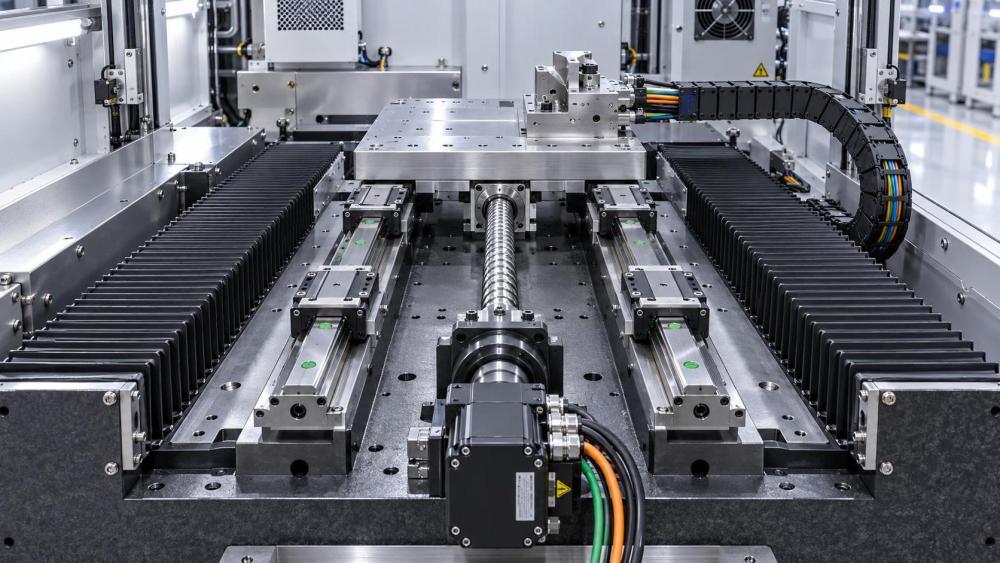
The Drive Architecture Often Dominates the Axis Cost
A linear guide system supports and constrains motion; it does not define the complete axis price by itself. The drive method changes force capability, speed range, position resolution, backlash behavior, heat management, and integration effort. Belt-driven axes can offer economical long travel and high speed where positioning demands are moderate. Ball screw systems are frequently selected for thrust, controlled positioning, and vertical motion. Linear motors remove mechanical transmission contact and can support demanding dynamic performance, but they introduce requirements for magnetic protection, feedback, thermal control, and a suitable machine structure.
Ball screw selection involves more than screw diameter and lead. The nut preload, support-bearing arrangement, critical speed, buckling risk on vertical axes, and lubricant delivery all affect cost and performance. A large lead improves travel speed at a given motor speed, yet increases reflected inertia and may change the torque requirement. A lower-lead screw can improve mechanical advantage but may restrict cycle time. These choices should be resolved against the motion profile rather than selected from a general-purpose size chart.
Drive integration also includes couplings, motor mounts, bearing blocks, limit devices, cable management, and guards. A component quote that excludes these parts cannot be compared directly with an assembled actuator quote. The same issue applies to servo motors, gear reducers, encoders, drives, and controller interfaces. An offer should clearly state where the mechanical scope ends and where electrical integration begins.
Material, Surface Treatment, and Contamination Protection
Most precision linear rails use hardened steel raceways because rolling contact demands high surface hardness and controlled finish. The surrounding structure may be aluminum, fabricated steel, cast iron, or a mineral-filled composite. Material choice affects the price of the complete moving system through stiffness, damping, thermal expansion, machining time, and mass.
An aluminum extrusion can be economical and light, particularly for pick-and-place or inspection equipment. Its mounting faces still need adequate flatness and rigidity. A heavy steel weldment may appear economical at the fabrication stage, but distortion relief, machining, and corrosion treatment must be included when precision alignment is required. Cast structures offer useful damping and stability, although pattern, casting, stress-relief, and finish-machining costs are relevant at lower production volumes. The rail is only as stable as the surface supporting it.
Seals, wipers, bellows, telescopic covers, and positive-pressure enclosures add cost because they protect the rolling elements from particles and fluids that would otherwise shorten life or degrade motion quality. Their value changes with the process. Fine grinding dust, welding spatter, wood dust, metal chips, washdown fluid, and vacuum debris behave differently. A light contact seal may be sufficient in a clean enclosure, while splash and chip exposure can call for layered protection and remote lubrication points.
Protection hardware also introduces design tradeoffs. Bellows and covers add moving mass and may create drag. A poorly routed cable carrier can impose changing side load across the stroke. A guard that prevents access for lubrication encourages skipped maintenance. The correct arrangement protects the precision surfaces without interfering with the axis force budget or service access.
Installation Tolerance Is Part of the Purchased Performance
Rails do not automatically create a straight axis when bolted to an inaccurate base. Mounting-plane flatness, shoulder straightness, hole location, fastening sequence, and torque consistency influence running force and carriage load distribution. On paired rails, parallelism between reference edges is especially important. A system that runs smoothly before shipment can develop binding after installation on a distorted frame.
This is a common source of misleading price comparisons. One proposal may include machined reference shoulders, matched rail sets, alignment procedures, and acceptance measurements. Another may list rails and carriages only. The second figure may be appropriate for an experienced machine builder with controlled base machining, but it does not represent the same delivered result.
Thermal behavior deserves similar attention. A long steel rail, aluminum base, ball screw, and encoder scale do not expand at the same rate. In a controlled room this may have little practical effect. Near ovens, motors, process heat, direct sunlight, or frequent washdown, temperature gradients can appear as positioning error or elevated preload. Price rises when thermal compensation, isolated mounting, low-expansion structures, or higher-grade feedback is required. These measures should follow an identified thermal condition, not an assumption that every precision axis needs them.
Feedback and Verification Define the Usable Precision Level
Motor encoder resolution should not be confused with actual axis accuracy. A rotary encoder measures motor or screw rotation; it does not directly reveal screw lead error, coupling compliance, bearing movement, or structural deflection. A linear scale measures table position more directly and can improve controlled positioning performance, but it adds hardware, protection, alignment, cable routing, and commissioning work.
Whether a linear scale is justified depends on the error budget. If process capability is governed by a compliant fixture, tool deflection, or vision calibration, a costly feedback upgrade may provide little benefit. If the axis must maintain accurate positions across a long stroke under temperature variation, direct measurement can be meaningful. The specification should identify whether the important requirement is positioning accuracy, repeatability, contouring behavior, settling time, or stable velocity. These are related but not interchangeable.
Acceptance criteria affect price as well. Requirements for run-in testing, friction measurement, backlash verification, travel mapping, load testing, or recorded inspection results add labor and instrumentation. Their value is highest when the documented characteristic is tied to a machine acceptance condition. Asking for extensive records without defining the relevant performance threshold creates cost without resolving uncertainty.
Commercial Scope and Delivery Conditions Need Equal Attention
A complete comparison separates component cost from project scope. Rail systems may be supplied as cut lengths, matched assemblies, ready-to-install modules, or assembled axes with drive and controls. Freight protection matters because long precision rails are vulnerable to bending, impact, and corrosion during transit. Packaging, rail preservation, handling fixtures, and allowable transport length can alter the delivered amount and lead time.
Long rails may be supplied in sections where shipping or manufacturing limits apply. A joint outside the active precision zone can be acceptable in some layouts. When a carriage must traverse the joint with high smoothness or measurement stability, the joint design, rail matching, and installation procedure require closer control. Treating all long-stroke quotations as equivalent overlooks this distinction.
Spare carriage policy, lubrication fittings, replacement rail availability, and interchangeability should be established before release. Replacing a single damaged component is simpler when the supplier can identify the original accuracy class, preload, rail batch, and mounting configuration. A nominally compatible carriage may fit a rail but fail to restore the original motion behavior if matching conditions differ.
Build the Request Around an Error and Load Budget
A useful request for quotation describes the moving mass, center of gravity, travel, orientation, peak and continuous speeds, acceleration profile, external process forces, expected duty cycle, environmental exposure, required position performance, and available mounting geometry. It should state whether the quoted scope includes rails, carriages, drive train, motor, feedback, protective covers, lubrication hardware, base machining, assembly, and test documentation.
Where details remain undecided, alternatives are more useful than a single overly broad requirement. For example, an offer can distinguish a clean-enclosure configuration from a coolant-exposed configuration, or a rotary-encoder axis from a direct linear-feedback axis. The resulting price differences reveal which requirement is consuming budget and allow the machine design to be adjusted before drawings, controls, and mounting surfaces are finalized.
The lowest linear motion system price is credible only when it is tied to the same load case, accuracy target, environment, integration scope, and acceptance condition as the alternatives. Once those boundaries are explicit, cost differences become explainable engineering choices rather than unexplained line items.
Related News
- Using Industrial Air Blow Guns to Clear Chips Without Spreading DebrisOct 15, 2026Fluid Power Control Strategist
- Ductile Iron Pipe Valves: Which AWWA Standards Apply to Water Main Projects?Oct 15, 2026Dr. Elias Vance
- Why Vacuum Suction Cups Lose Grip on MDF in Woodworking MachinesOct 15, 2026CNC Kinematics Architect
- Choosing a Variable Displacement Piston Pump Manufacturer: What to VerifyOct 15, 2026Fluid Power Control Strategist
- Parallel vs. Angular Pneumatic Grippers for Confined Assembly StationsOct 15, 2026Fluid Power Control Strategist
- Die Castings vs. Investment Castings: Which Costs Less at Your Production Volume?Oct 14, 2026Foundry Phase-Change Fellow