
Water Pump Drives: When Sprockets Wear Faster Than Chains and What to Inspect
Water pump drive failures rarely begin with a dramatic chain break. More often, the first evidence is subtle: a polished edge on one side of a sprocket tooth, a chain that needs repeated tension adjustment, blackened lubricant around the guard, or an irregular clicking sound when the pump starts under load. By the time a chain jumps a tooth or begins to climb the sprocket, the drive has usually been deteriorating for some time.
A common maintenance question is: do sprockets need replacement more often than chains in water pump drives? There is no universal replacement order. In a well-designed, clean, correctly lubricated drive, the chain and sprockets should age as a system. In many real water, wastewater, irrigation, dewatering, and industrial pumping installations, however, sprockets can wear noticeably faster than the chain. This is especially true where alignment is poor, the small sprocket carries most of the duty, lubrication is inconsistent, or grit and moisture reach the tooth contact area.
Treating the chain as the only wear item is a costly mistake. A new chain installed on hooked or narrowed sprocket teeth may run quietly at first, but it will not seat correctly. It can accelerate chain elongation, generate vibration, and place avoidable radial load on pump and motor bearings. For after-sales teams, the useful question is not which component “normally” lasts longer; it is which part is controlling the condition of the entire drive today.
Why sprockets sometimes wear before the chain
Chain wear is often described as “stretch,” although the side plates do not literally stretch under normal service. What technicians usually measure is pitch elongation caused by wear at the pins and bushings. Sprocket wear is different. It occurs at the tooth flanks and roots where the chain rollers engage, transmit torque, and release during rotation.
A sprocket can become the weak point when a small number of teeth must transmit high torque repeatedly. The smaller driver sprocket is commonly the first place to look because each tooth enters and leaves engagement more frequently than teeth on a larger driven sprocket. A pump that starts frequently, runs against variable head pressure, or experiences intermittent blockage can impose short torque peaks that are not obvious during a quick visual inspection.
Contamination changes the situation quickly. In open pump skids, mobile dewatering equipment, wastewater stations, and agricultural installations, airborne dust, sand, fibrous debris, washdown water, and chemical residue can mix with lubricant. Instead of reducing friction, that mixture becomes an abrasive paste. A chain may still look serviceable externally while the sprocket tooth profile is being ground away.
Material selection also matters. The relative hardness and heat treatment of the chain rollers and sprocket teeth influence where wear concentrates. A sprocket made from a material or treatment unsuitable for the loading and environment may lose its profile early. This is not always a purchasing error; it may be a specification mismatch caused by a later increase in pump duty, a change in operating hours, or a move from clean-water service to abrasive process water.
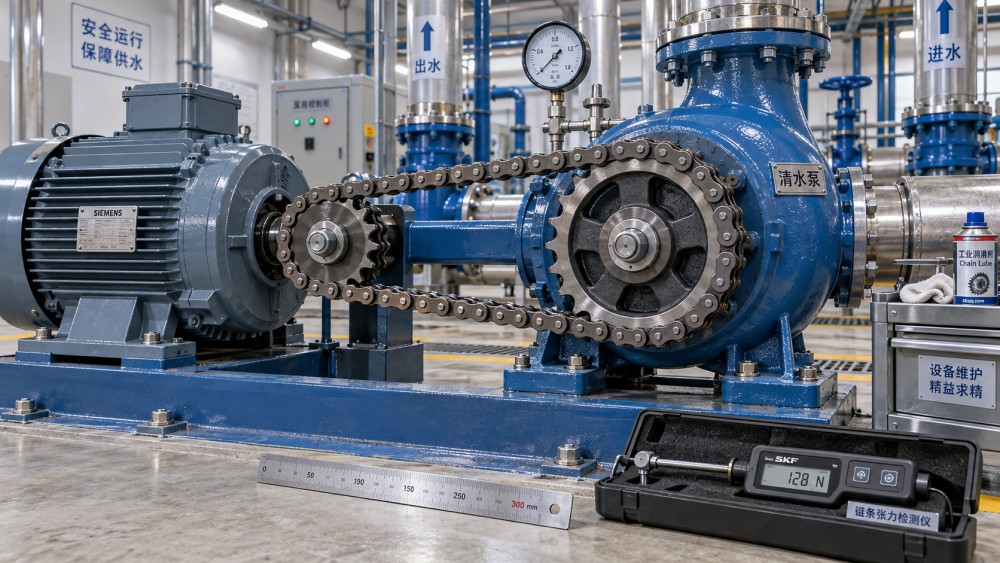
The wear patterns that actually matter
The classic worn sprocket shape is a hooked tooth, sometimes described as a “shark fin.” That sign is useful, but it is not the only one. In practice, severe tooth hooking is often a late-stage condition. Maintenance crews can catch a developing problem earlier by comparing the loaded side and unloaded side of the teeth, checking whether tooth valleys have become widened, and observing how the chain rollers sit in the sprocket pockets.
When rollers ride high rather than settling consistently into the tooth spaces, the drive is no longer sharing load as intended. Uneven contact can point to chain pitch wear, sprocket pitch wear, incorrect chain size, or a mix of parts from different series. Never assume that a chain “fits” simply because it can be installed. Pitch, roller diameter, tooth form, width, and hub arrangement all need to match the drive design.
Pay attention to one-sided tooth wear. If one face of many teeth is bright, sharp, or more deeply worn than the other, misalignment is likely involved. The cause may be a motor base that has shifted, a bent shaft, worn bearing seats, incorrect spacer placement, a distorted guard mount, or a pump frame that has settled. Replacing only the worn sprocket without correcting alignment usually creates the same failure pattern again.
Inspect the drive as an assembly, not as separate spare parts
Before removing guards, isolate the equipment according to the site’s lockout procedure and confirm that the pump cannot start automatically. Water systems often have remote controls, level switches, duty/standby logic, or automatic restart functions. A drive inspection is not worth taking shortcuts around stored energy or unexpected operation.
With the drive safe, begin with the operating context. Ask whether the pump has recently been running more hours, seeing thicker fluid, handling solids, cycling more often, or operating with a partially closed discharge valve. These details help distinguish ordinary wear from a drive that is being overloaded. A chain drive cannot compensate for a pump operating outside its intended duty point.
Then check chain tension. Excessive slack can cause whip, impact loading, and poor tooth engagement. Over-tensioning is equally damaging because it adds load to shafts and bearings while restricting smooth articulation at the chain joints. The correct deflection and tension method should come from the equipment or chain manufacturer’s guidance, since span length, orientation, and drive layout affect the acceptable setting.
Measure alignment rather than judging it only by eye. Straightedges can reveal gross errors, but a more careful check may be needed where repeated one-sided wear is present. Verify that sprockets are in the same plane, shafts are parallel where the arrangement requires it, hubs are seated correctly, and keys, locking elements, and fasteners have not allowed movement. If there is shaft runout or bearing looseness, a perfect new sprocket will not remain perfect for long.
Chain elongation should be checked over a meaningful number of pitches under a consistent measuring method. Comparing one short section can be misleading because wear may not be uniform. Stiff links deserve attention as well. A chain can have acceptable overall length but still articulate poorly at selected joints because of corrosion, contamination, or lubricant that has hardened in service.
When should chain and sprockets be replaced together?
In most planned maintenance situations, replacing the chain and both sprockets together is the safer decision when wear is established on more than one component. The reason is simple: worn parts develop matching but imperfect contact patterns. Installing one new component into that pattern transfers the mismatch to the new part.
That does not mean every chain replacement automatically requires new sprockets. If a chain has been damaged by an isolated event, such as external impact or corrosion during prolonged storage, and the sprockets pass a close inspection for tooth form, pitch condition, runout, and alignment, retaining the sprockets may be reasonable. The reverse can also occur: a localized damaged sprocket may be changed without replacing a relatively new, correctly measured chain. These are exception decisions, not a default maintenance strategy.
For water pump drives, replacement should also consider access and outage risk. A small savings from retaining questionable sprockets may not justify a second shutdown at a remote booster station, a municipal lift station, or a process line with limited bypass capacity. Maintenance planning should weigh the condition of the parts against the consequence of a repeat intervention.
Lubrication is not just a chain issue
The lubricant must reach the chain joints where pins and bushings articulate, but it also affects roller-to-sprocket contact. Applying oil only to the outer plates may make the chain look maintained while leaving the critical interfaces dry. At the same time, excessive or unsuitable lubricant can attract debris in dusty or wet installations.
The right approach depends on speed, load, temperature, exposure, and the equipment manufacturer’s recommendations. Manual lubrication may be adequate for accessible, lightly used pump packages. Continuous or automatic systems can make more sense for high-duty installations, provided they are inspected and not assumed to be working simply because they are fitted. In washdown environments, guard design, drainage, and protection from direct spray can matter as much as the lubricant grade.
Do not lubricate over accumulated grit. Clean the drive first using a method compatible with the chain, surrounding seals, and site safety requirements. Forcing debris deeper into the joints is a familiar way to shorten component life while believing maintenance has been completed.
A practical decision for after-sales maintenance teams
The most reliable answer to whether sprockets need replacement more often than chains in water pump drives is conditional: they may, but recurring sprocket wear is usually a signal to inspect the whole power transmission path. Look beyond the guard at the motor base, pump shaft bearings, coupling arrangement, process load, lubricant condition, and environment. The tooth profile is often reporting a larger mechanical problem.
This systems view is particularly useful across the industrial equipment categories covered by Global Industrial Machining & Piping Equipment Network (IMPE), where pump reliability depends on the relationship between machined shafts, bearings, cast housings, seals, chain drives, hydraulic or mechanical loading, and maintenance practice. A replacement part decision is stronger when material condition, dimensional fit, and operating history are considered together.
Keep inspection notes that record tooth condition, chain measurement method, alignment findings, lubrication state, and any change in pump operation. Over several service intervals, those records reveal whether the drive is wearing normally or repeating the same fault. If the same sprocket position continues to fail early, replacing parts alone is not corrective maintenance; it is only resetting the clock on the next outage.
Related News
- Using Industrial Air Blow Guns to Clear Chips Without Spreading DebrisOct 15, 2026Fluid Power Control Strategist
- Ductile Iron Pipe Valves: Which AWWA Standards Apply to Water Main Projects?Oct 15, 2026Dr. Elias Vance
- Why Vacuum Suction Cups Lose Grip on MDF in Woodworking MachinesOct 15, 2026CNC Kinematics Architect
- Choosing a Variable Displacement Piston Pump Manufacturer: What to VerifyOct 15, 2026Fluid Power Control Strategist
- Parallel vs. Angular Pneumatic Grippers for Confined Assembly StationsOct 15, 2026Fluid Power Control Strategist
- Die Castings vs. Investment Castings: Which Costs Less at Your Production Volume?Oct 14, 2026Foundry Phase-Change Fellow