
Stainless Steel Forged Flanges vs Cast Flanges: Which Performs Better Under Pressure?
It often starts in a familiar way: a flange failure is not dramatic enough to make headlines, but serious enough to stop work, trigger reinspection, or raise uncomfortable questions during design review. Someone notices repeated leakage around a bolted joint, or a project team finds that a part listed simply as “stainless steel flange” does not behave the same way as the one used in an earlier installation. Under moderate service, both options may seem acceptable on paper. Under higher pressure, thermal cycling, vibration, or repeated startup and shutdown, the difference becomes harder to ignore.
In those situations, the real problem is rarely just price or availability. It is uncertainty. If you are evaluating whether a cast flange is sufficient or whether stainless steel forged flanges are the safer choice, you are usually trying to avoid a chain of downstream risk: sealing instability, hidden defects, machining variation, early fatigue, replacement delays, and arguments over whether the original specification was too loose. The better answer does not come from treating “cast” and “forged” as marketing labels. It comes from looking at how each manufacturing route changes structure, pressure behavior, and inspection confidence.
Where the confusion usually begins
A common mistake is to compare flanges only by alloy grade, nominal pressure class, and dimensional standard. Those are important, but they do not tell the whole story. Two flanges can share the same stainless material designation and nominal dimensions while performing differently in service because the internal structure of the metal was formed differently from the start.
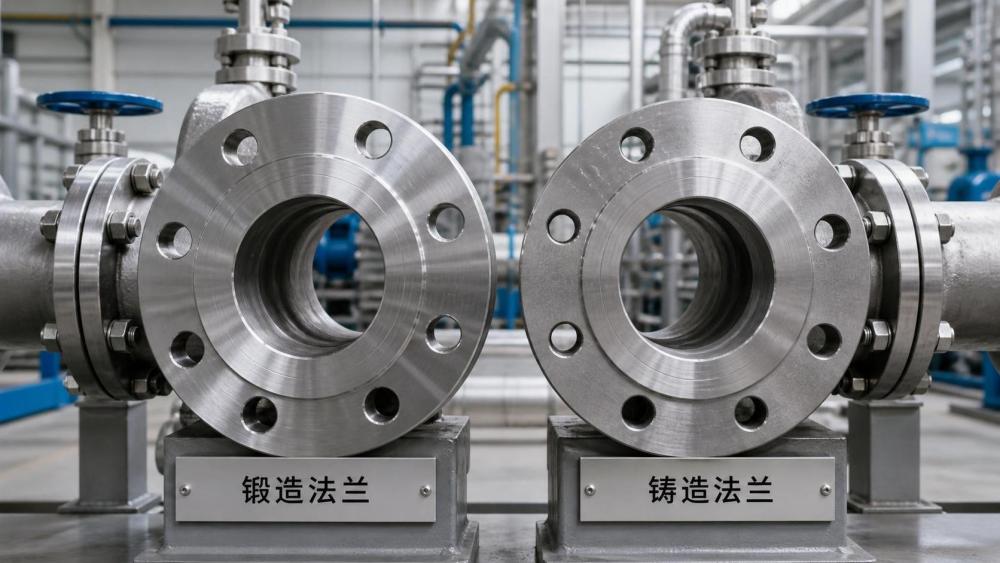
Cast flanges are made by pouring molten metal into a mold. Forged flanges are made by mechanically shaping solid metal under compressive force, then machining to final dimensions. That single process difference affects grain flow, porosity risk, consistency, and the way the part responds when the joint is loaded near its practical limits.
For low-risk applications, this distinction may not change the decision. But when pressure retention is critical, especially where shutdowns are costly or difficult, technical evaluators usually need a more cautious framework than “both meet the drawing.”
Pressure does not act only on the flange rating
When people ask which performs better under pressure, they often mean more than burst strength. In actual piping systems, pressure interacts with bolt load, gasket stress, flange face finish, alignment, bending moments from pipe strain, and sometimes temperature swings. A flange that looks acceptable in catalog comparison can still become the weak point if its structure contains discontinuities or if its mechanical behavior is less uniform across the section.
Forging generally improves structural continuity. The metal is consolidated under force, which tends to reduce internal voids and creates a denser structure. In pressure service, that matters because the flange is not only holding static internal pressure. It is also transmitting bolt preload and resisting local stresses around the hub, bore, and facing surfaces. A more continuous grain structure usually provides better resistance to cracking initiation and better confidence under cyclic loading.
Cast flanges can be suitable in some services, especially where geometry, cost, or manufacturing practicality drives the choice. But casting carries a greater inherent need to control shrinkage defects, porosity, inclusions, and local inconsistency. Even with inspection, the question is often not whether a cast flange can work, but whether the service conditions leave enough margin if small internal imperfections are present.
The practical differences that matter during selection
If the flange is going into a line where pressure excursions, mechanical vibration, or repeated assembly are expected, forged construction usually gains an advantage for reasons that are easier to verify in engineering terms than in sales language.
Material continuity and defect risk
Forged parts usually begin with wrought material that already has a more refined structure than a fresh casting. The forging step further consolidates the metal. This does not mean forged flanges are defect-free, but it does mean the typical defect profile is different. Castings are more vulnerable to volumetric discontinuities formed during solidification. Under pressure, those hidden features can become stress concentrators, especially near critical sections or machined surfaces.
Fatigue behavior
Pressure systems are not always loaded once and left alone. Pumps cycle, valves close quickly, water hammer can occur, and thermal expansion shifts loads into joints. In that environment, fatigue resistance matters as much as headline strength. Stainless steel forged flanges generally perform better where repeated stress cycling is part of normal operation, because the forged structure tends to resist crack initiation more effectively than a casting with less predictable internal integrity.
Machining response and sealing faces
A flange face is a sealing surface, not just a finished edge. During machining, a more uniform substrate often produces more predictable results in flatness, groove formation, and surface finish. With cast material, hardness variation or localized defects may appear during machining, which can complicate final quality even if the overall dimensions remain within tolerance. That is especially relevant for raised face, ring-type joint, or other sealing-critical designs where face condition affects gasket performance directly.
Impact on downstream inspection
Cast components usually require closer attention to non-destructive testing because internal quality is less visually obvious and more dependent on foundry process control. Forged flanges also require inspection, of course, but the manufacturing route often gives evaluators higher baseline confidence for pressure-containing duty. When procurement teams need material traceability and consistent inspection records, this difference can influence not just technical approval but supplier qualification as well.
When cast flanges still make sense
The comparison should stay fair. Cast flanges are not automatically wrong, and treating them that way can lead to over-specification. In some cases, a cast flange may be acceptable where service pressure is moderate, loading is stable, failure consequences are limited, and inspection requirements are clearly defined. Complex shapes can also favor casting in other component types, though standard flange forms often align well with forging.
The problem comes when cast and forged are treated as interchangeable in demanding service simply because both can be made from stainless steel. If the line handles pressure fluctuations, elevated temperature, corrosive media with uncertain maintenance conditions, or duty where bolt retention and sealing reliability are critical, the decision should become more conservative.
A better way to compare them during technical review
When choosing between the two, it helps to stop asking which is “better” in general and ask which is more reliable for the failure mode you are trying to avoid.
If the main concern is pressure integrity over time, forged is usually the safer direction. If the concern is basic dimensional compatibility in a lower-risk system, cast may remain in consideration, provided the quality controls are documented and the application does not rely on high fatigue strength.
Several review points usually clarify the decision:
- Whether the line sees steady internal pressure or frequent pressure cycling
- Whether vibration, pump pulsation, or thermal movement adds external load to the joint
- Whether leakage would create only maintenance inconvenience or a serious operational issue
- Whether inspection records need to support long-term asset management or project handover
- Whether the flange face quality is especially important because of gasket type or service sensitivity
When those questions are answered honestly, the choice often becomes less ambiguous. Many difficult reviews happen because the application is severe but the original specification language is too generic.
Why stainless steel forged flanges are often preferred in higher-pressure service
In many industrial piping decisions, the preference for stainless steel forged flanges is not based on a single strength value. It comes from combined confidence: denser metal structure, lower likelihood of casting-related internal defects, more dependable machining behavior, and better performance under fluctuating stress. For technical evaluators, that combination reduces uncertainty in the places where uncertainty is most expensive.
Stainless steel also brings its own considerations, including corrosion resistance, work hardening behavior during machining, and grade-specific suitability for the medium and temperature range. Forging does not replace material selection. It strengthens the case when the stainless grade is already appropriate and the service demands more trustworthy mechanical behavior from the flange body itself.
Where buyers and reviewers can get misled
One common trap is overreliance on nominal pressure class. A flange class does not erase differences in manufacturing quality. Another is assuming that passing a dimensional inspection proves service suitability. Dimensions confirm fit; they do not fully confirm structural integrity. A third is accepting broad statements such as “stainless is stainless” or “cast is cheaper but equivalent.” Equivalent for what conditions? That question should always be pushed back into the discussion.
It is also easy to focus too narrowly on base component cost. If a flange sits in a location that is difficult to isolate, inspect, or replace, the economic comparison changes quickly. Even without using dramatic failure scenarios, most experienced teams know that the cheapest flange is not necessarily the lowest-cost decision once rework, access, downtime, and verification effort are considered.
A grounded specification approach
If you are revising a specification or reviewing supplier submissions, the more reliable path is to define the application conditions first and then align the flange manufacturing method with those conditions. For pressure-retaining stainless flanges in demanding service, forged construction is often the more defensible baseline. That does not mean every forged flange is acceptable by default. It means the process route is better matched to the mechanical expectations of higher-pressure duty.
From there, it is worth checking the details that often decide whether a good selection stays good through procurement and installation: material traceability, heat treatment condition where relevant, machining quality of the facing surface, bore concentricity, inspection method, and documentation consistency. In environments where industrial buyers compare sources across machining, forging, piping, and fluid systems, structured information around these points matters more than broad product claims.
The useful lesson is simple but easy to miss during routine purchasing: under pressure, flange performance depends on more than stainless grade and catalog class. If the application leaves little room for leakage, fatigue, or quality variation, forged construction usually gives a stronger technical position. Cast flanges still have their place, but that place is narrower once pressure duty becomes less forgiving. For anyone making a specification or approval decision, that distinction is usually the difference between selecting a component and selecting a margin of safety.
Related News
- How to Assess a Rigid Coupling Supplier for Bore Accuracy and Traceable QualityOct 08, 2026Tribology & Kinematics Expert
- Titanium Alloys Compared: Balancing Strength, Corrosion Resistance, and MachinabilityOct 08, 2026CNC Kinematics Architect
- Where Ductile Iron Dismantling Joints Reduce Alignment Risk in Water PipelinesOct 08, 2026Pipeline Metallurgy Scientist
- Selecting a Precision Bearing Sleeve: Fits, Runout, and Material ChoicesOct 08, 2026Tribology & Kinematics Expert
- Face Milling Cutters: How Insert Geometry Affects Finish on Steel and AluminumOct 08, 2026CNC Kinematics Architect
- Single-Acting Cylinders for Clamping: Stroke, Force, and Return Spring ConsiderationsOct 07, 2026Fluid Power Control Strategist