
Precision Ball Screw Assemblies: Key Accuracy Grades and Preload Selection Criteria
Precision Ball Screw Assemblies: Key Accuracy Grades and Preload Selection Criteria
Precision ball screw assemblies determine whether a motion system achieves its drawing tolerance repeatedly, maintains stable cycle times, and preserves accuracy after extended operating hours.
For technical evaluators, the best choice is rarely the highest available grade or the heaviest preload. Selection must reflect the machine’s actual error budget.
A highly accurate screw can still underperform when bearing supports, nut mounting, lubrication, alignment, or thermal control are poorly specified during assembly.
The practical evaluation question is straightforward: what positioning accuracy, repeatability, stiffness, speed, and life are required at the final moving axis?
Answering that question first prevents unnecessary cost in moderate-duty equipment while protecting high-precision systems from backlash, vibration, heat, and premature wear.
Precision ball screw assemblies are commonly evaluated in CNC machine tools, semiconductor equipment, robotics, inspection systems, automation cells, medical machinery, and specialized production equipment.
Although catalogs list nominal diameter, lead, accuracy class, and preload, these values must be reviewed as an interacting system rather than independent features.
This guide explains how technical teams can compare accuracy grades, select practical preload levels, review supporting specifications, and identify common sourcing risks before release.
Start With the Axis Performance Requirement
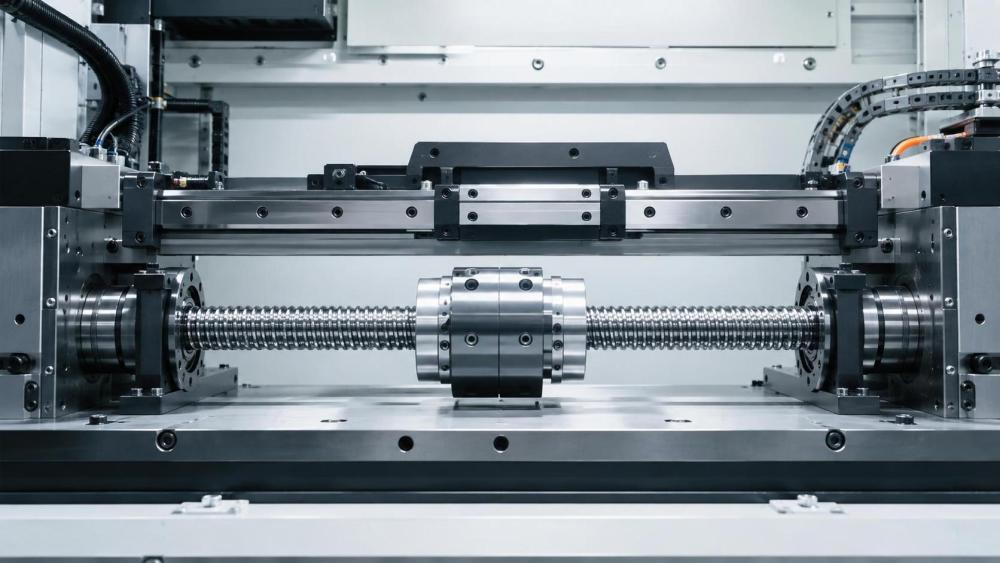
Before comparing suppliers, convert the machine-level requirement into measurable axis targets: positioning accuracy, repeatability, backlash, maximum speed, acceleration, thrust load, and duty cycle.
Positioning accuracy describes how closely the table reaches a commanded location, while repeatability describes whether it returns consistently to that location under comparable conditions.
These values are related but different. A system may repeat well around an offset position while still showing cumulative lead error over its travel.
Backlash matters most when an axis reverses direction under cutting force, inspection load, or servo control. Excessive clearance creates contouring errors and unstable compensation.
Technical evaluators should also distinguish between required part tolerance and required axis accuracy. Machine geometry, scales, thermal drift, and controller compensation consume part of the total tolerance.
For example, a machining center producing precision mold components may need significantly tighter ball screw performance than a transfer unit moving fixtures between stations.
A ball screw should therefore be selected from the permitted error contribution, not from a general assumption that higher catalog precision always produces better equipment.
Document the working travel, usable stroke, mounting arrangement, expected ambient temperature, process heat exposure, and direction changes per minute before requesting quotations.
This application sheet gives suppliers enough context to recommend an accuracy grade, preload method, lubrication system, and support bearing arrangement with defensible assumptions.
How Ball Screw Accuracy Grades Affect Motion Results
Accuracy grades primarily control lead variation, which is the difference between the actual linear travel and the theoretical travel produced by one screw revolution.
Manufacturers may identify grades using different naming systems, but precision ball screw assemblies are generally grouped into rolled, ground, transport, positioning, and high-precision classes.
Rolled screws are economical and suitable for many handling, packaging, welding, and general automation axes where moderate positioning performance is acceptable.
Ground screws normally provide lower lead error, improved surface quality, and stronger consistency for machine tools, measuring equipment, precision assembly, and demanding robotic applications.
Lead accuracy should be reviewed over the effective travel length, not only over a short inspection interval. Cumulative deviation becomes increasingly important on long-stroke axes.
Local lead variation also matters because it can influence smoothness, servo following behavior, and interpolation quality during fine positioning or circular contouring operations.
Do not compare a supplier’s accuracy designation without checking the underlying standard, measurement length, temperature condition, and whether the value represents maximum or average deviation.
Common references include ISO 3408 and JIS-based classifications, but product documentation should state the actual permissible travel deviation and variation values clearly.
For applications using linear encoders, a less accurate screw may be acceptable for absolute positioning, but its smoothness, stiffness, and thermal behavior still require evaluation.
Encoder feedback can correct some lead-related position errors, yet it cannot eliminate backlash, structural deflection, nut compliance, or friction instability within the drive train.
High-accuracy screws also require compatible installation quality. Misaligned supports or distorted nut housings can introduce errors that exceed the supplier’s certified lead tolerance.
Request an inspection certificate for high-value axes, especially when procurement specifications require traceable verification of lead accuracy, axial runout, preload torque, and material identification.
Choose Preload by Balancing Backlash and Heat
Preload is an intentional internal axial force between balls, raceways, and nut tracks. Its main purpose is reducing clearance and increasing axial stiffness.
Higher preload generally improves reversal response and resistance to cutting-force displacement. However, it also increases friction torque, operating temperature, lubrication demand, and drive motor load.
This tradeoff explains why maximum preload is not a universal solution. A heavily preloaded assembly can lose useful life if high speed and inadequate heat removal are ignored.
Light preload is often appropriate for measurement equipment, light automation, moderate loads, and systems where low friction, quiet motion, or high travel speed is important.
Medium preload is common in CNC machining and industrial positioning axes that need low backlash, reasonable rigidity, and balanced thermal performance under variable loads.
Heavy preload is usually reserved for highly rigid, short-stroke, high-force applications where deflection control is critical and thermal conditions can be managed predictably.
Manufacturers may express preload as a percentage of dynamic load rating, a specified axial force, torque range, or an internal grade designation. Clarify the definition before comparison.
Evaluate preload alongside the external axial load. If process thrust approaches or exceeds the internal preload, the nut may partially unload during reversal and reduce effective stiffness.
Conversely, a preload that is excessive relative to the real load causes avoidable heat. Temperature rise changes screw length and can degrade positioning accuracy over time.
In double-nut designs, preload is often generated by a spacer or adjustable arrangement. In single-nut designs, oversized balls or internal geometry create the preload.
Double-nut systems can offer adjustment flexibility, but they require careful assembly control. Single-nut preloaded designs can be compact, although replacement options may be more limited.
Technical teams should request preload force, no-load running torque, permissible temperature range, and recommended lubrication interval rather than accepting a generic “zero-backlash” claim.
Check Stiffness Across the Complete Drive System
The axial stiffness of precision ball screw assemblies is only one part of system stiffness. Screw shaft, support bearings, housings, couplings, and machine structure also deflect.
A preloaded nut cannot compensate for a slender screw operating near its critical speed or for a support housing that shifts under alternating machining loads.
Calculate or obtain the screw’s axial elastic deformation under peak thrust. Long screws with smaller diameters can produce meaningful position loss despite premium nut accuracy.
Support configuration strongly affects performance. Fixed-fixed mounting usually provides higher stiffness and speed capability than fixed-supported or simple-supported arrangements.
However, fixed-fixed assemblies need attention to thermal expansion. If both ends constrain a heated screw without suitable design allowance, internal stress and drag can increase.
Angular-contact support bearings should be matched to the required axial load, speed, preload, lubrication method, and expected installation tolerance. Their performance directly influences axis behavior.
Couplings must transmit torque without introducing misalignment forces. Flexible couplings accommodate small errors, but excessive angular or parallel offset accelerates wear and increases friction.
Review nut mounting interfaces carefully. A distorted flange, uneven bolt tightening pattern, or contaminated mounting face can misalign the nut and damage raceway contact conditions.
For critical applications, include the screw assembly in the full axis stiffness model. This reveals whether a higher preload will create useful benefit or merely shift compliance elsewhere.
Speed, Critical Speed, and Thermal Growth Need Equal Attention
Ball screw lead determines the relationship between motor speed and linear travel. Higher lead supports faster motion but may reduce mechanical advantage and increase rotational speed demand.
At high rotational speeds, technical evaluators must review critical speed, DN value, nut circulation design, vibration behavior, and the maximum speed specified for the selected lubrication method.
Critical speed is influenced by screw diameter, unsupported length, end support configuration, and material properties. Operating too close to it can cause noise, whip, and rapid damage.
Nut speed limits are also important. Ball recirculation components must handle repeated circulation without overheating, impact damage, or unstable return behavior at the intended duty cycle.
Thermal growth follows a simple principle: as the screw heats, it lengthens. On long axes, even a modest temperature rise can create substantial position error.
Heat comes from preload friction, bearing friction, motor operation, cutting environment, inadequate lubrication, and repeated high-speed acceleration cycles. These sources should be assessed together.
Possible thermal strategies include controlled preload, screw cooling, temperature sensing, software compensation, symmetric machine layout, or allowing expansion from an appropriately selected floating support end.
Do not rely solely on controller compensation where temperature changes are rapid or nonuniform. Compensation is most reliable when the thermal model and sensor locations reflect actual operation.
Match Load Ratings and Life Calculations to Real Duty
Dynamic load rating is used to estimate fatigue life under repeated load, while static load rating addresses permanent deformation risk during peak loads, shocks, or stationary clamping forces.
Life calculations should use the real load spectrum rather than a single nominal force. Acceleration, cutting thrust, gravity, counterbalance effects, and emergency stops may differ substantially.
Vertical axes require particular care because the screw can carry sustained gravitational load, frequent reversals, and potential back-driving forces during power loss or braking events.
For machine tool axes, cutting-force direction changes can be more damaging than average thrust values suggest. Review maximum load, duration, frequency, and reversal count.
Environmental contamination shortens practical service life even when calculated fatigue life appears generous. Chips, coolant ingress, abrasive dust, and damaged bellows can compromise the assembly quickly.
Select sealing and lubrication arrangements based on the actual environment. Standard wipers may be inadequate for grinding sludge, cast iron dust, water spray, or aggressive process fluids.
Lubricant selection must match speed, temperature, load, and maintenance practices. Oil systems can support higher-speed duty, while grease may suit simpler or lower-speed equipment designs.
Require suppliers to state the assumptions used for life calculations. Comparing life values is meaningless when one proposal assumes a clean environment and another assumes severe contamination.
Evaluate Supplier Data Beyond the Catalog Table
A reliable technical comparison should include drawing approval, dimensional interfaces, tolerances, certified accuracy values, load ratings, preload definition, material details, and heat treatment information.
Confirm the screw diameter, lead, thread length, overall length, journal geometry, nut envelope, flange dimensions, and mounting features against the released mechanical design.
Special end machining is a frequent source of field problems. Threads, keyways, bearing seats, and retaining features must preserve concentricity and avoid damaging the finished screw raceway.
Ask whether end machining occurs before or after final straightness and accuracy verification. The sequence affects how confidently the supplier can certify the completed assembly.
For OEM programs, evaluate production consistency rather than only prototype capability. Useful evidence includes process control plans, inspection equipment, lot traceability, and documented corrective-action practices.
Review incoming inspection requirements proportionately. High-risk components may justify checks for lead error, runout, torque, axial play, surface condition, and preservation packaging before assembly.
Packaging deserves attention for long screws. Insufficient support during transport can cause bending, corrosion, impact damage, or contamination that is difficult to identify visually.
Supplier communication is also a technical factor. The provider should explain tradeoffs, identify missing load information, and distinguish confirmed values from preliminary selection estimates.
A Practical Selection Process for Technical Evaluators
Begin with the required axis travel, target positioning accuracy, repeatability, backlash limit, maximum velocity, acceleration, process load, orientation, and expected operating temperature.
Next, define the error budget across the entire axis. Allocate permissible error among the screw, bearings, guideways, structure, encoder, assembly process, and thermal variation.
Select the screw lead and diameter based on required linear speed, motor capability, thrust demand, critical speed margin, and available installation envelope.
Choose an accuracy grade using certified lead error requirements over the actual working travel. Avoid specifying a premium grade when other axis errors dominate performance.
Then select preload according to reversal sensitivity and stiffness demand, while checking friction torque, temperature rise, motor sizing, lubrication capacity, and expected maintenance access.
Validate dynamic and static load ratings against the actual duty cycle. Include abnormal loads such as crashes, clamps, tool changes, emergency deceleration, and maintenance handling.
Finally, review the complete assembly drawing and acceptance documentation. A technically sound specification must be manufacturable, inspectable, transportable, and repeatable in production.
Conclusion: Specify the Whole Motion System, Not Just the Screw
The most effective precision ball screw assemblies are selected through application evidence, not generic preference for the tightest accuracy grade or highest preload category.
Accuracy grade should reflect the axis error budget and usable travel. Preload should provide required stiffness and backlash control without creating excessive friction or thermal instability.
Technical evaluators gain better outcomes by reviewing lead accuracy, load spectrum, support arrangement, speed limits, lubrication, contamination protection, and supplier verification as one system.
When these criteria are documented before procurement, teams can compare proposals objectively, avoid overspecification, reduce commissioning risk, and protect long-term positioning performance in demanding equipment.
Related News
- How to Assess a Rigid Coupling Supplier for Bore Accuracy and Traceable QualityOct 08, 2026Tribology & Kinematics Expert
- Titanium Alloys Compared: Balancing Strength, Corrosion Resistance, and MachinabilityOct 08, 2026CNC Kinematics Architect
- Where Ductile Iron Dismantling Joints Reduce Alignment Risk in Water PipelinesOct 08, 2026Pipeline Metallurgy Scientist
- Selecting a Precision Bearing Sleeve: Fits, Runout, and Material ChoicesOct 08, 2026Tribology & Kinematics Expert
- Face Milling Cutters: How Insert Geometry Affects Finish on Steel and AluminumOct 08, 2026CNC Kinematics Architect
- Single-Acting Cylinders for Clamping: Stroke, Force, and Return Spring ConsiderationsOct 07, 2026Fluid Power Control Strategist