
Miniature Ball Screw Assemblies: How Lead and Preload Set Positioning Accuracy
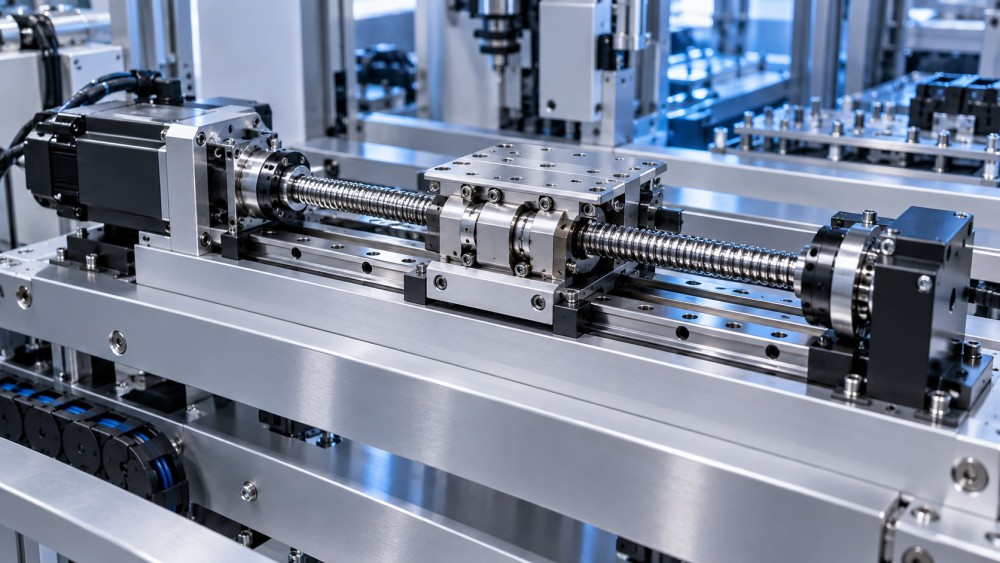
Positioning accuracy in a compact linear axis is set by the entire motion chain, yet two ball screw parameters establish its basic mechanical behavior: lead and preload. Lead converts motor rotation into linear travel. Preload removes internal clearance and raises axial rigidity. Their effects overlap, but they solve different problems. A short-lead screw can provide fine commanded increments while still reversing poorly if clearance remains. A heavily preloaded screw can reverse cleanly but generate excessive friction, heat, and drive torque if its lead, speed, and duty cycle are mismatched.
For miniature ball screw assemblies, these tradeoffs are amplified by the small diameter of the screw, limited nut volume, compact bearing arrangements, and the sensitivity of lightweight stages to friction changes. The correct specification begins with the required positioning behavior at the point of work, rather than with nominal screw accuracy alone.
Lead Determines the Motion Scale
Ball screw lead is the axial distance travelled in one full revolution. With a 1 mm lead, one motor revolution produces 1 mm of linear motion; with a 5 mm lead, the same rotation produces 5 mm. This relationship affects command resolution, available thrust, rotational speed, and the way encoder errors appear at the load.
A lower lead creates a finer mechanical reduction between the motor and the axis. Given the same encoder resolution, the axis receives more countable positions per millimetre. Lower lead also improves the mechanical advantage available for axial thrust, although motor torque, screw efficiency, bearing friction, and acceleration requirements still govern the usable force.
That apparent advantage has a cost. A low-lead screw needs more revolutions to cover a given distance. High travel speed can then require a high screw speed, which raises concerns about critical speed, nut recirculation behavior, vibration, lubricant shear, and motor torque at speed. On a long, slender miniature screw, rotational speed limits may constrain the usable axis velocity before the servo system reaches its intended operating range.
Higher lead reduces the revolutions needed for rapid travel and can support a more responsive long-stroke motion profile. It also reduces the linear distance represented by torsional windup only in a limited sense: the screw still twists under torque, but the relationship between angular twist and linear displacement changes with lead. A high-lead screw demands more motor torque for the same axial force and can expose control-loop limitations when a light carriage is accelerated aggressively.
Resolution should not be confused with accuracy. A servo can command extremely small increments through interpolation, and a fine lead makes those increments smaller in linear units. Neither fact proves that the carriage reaches or repeats every commanded position. Lead error, reversal behavior, structural compliance, thermal expansion, guideway friction, and measurement-system quality all affect the final position.
Preload Changes Reversal Behavior and Stiffness
Preload applies an internal axial load between the balls, raceways, and nut. It is commonly achieved through selected oversize balls, a double-nut arrangement with controlled axial offset, or other manufacturer-specific constructions. The purpose is to eliminate or reduce axial clearance before external load is applied.
Without sufficient preload, a direction reversal first consumes internal clearance. The motor turns, but the table has not yet moved by the corresponding amount. This lost motion is particularly visible in contouring, dispensing, optical alignment, probing, and short bidirectional moves. It may be mistaken for servo tuning error because the position deviation often appears when velocity crosses zero.
A preloaded nut resists this reversal displacement and raises axial stiffness. Under a changing process load, the carriage moves less for a given load change, assuming the screw support bearings, mounting interfaces, guideways, and structural frame are comparably stiff. This condition matters because an accurate screw cannot compensate for a compliant bearing block or a flexing actuator bracket.
Preload also increases drag torque. The motor must overcome nut friction even when no external process load is present. That friction produces heat, and heat changes dimensions. A miniature screw operating continuously at elevated speed can lengthen as its temperature rises, moving the nut position relative to a fixed reference. The resulting shift is not backlash; it is thermal positional drift. Increasing preload to cure a repeatability complaint can therefore create a different accuracy problem when the duty cycle is sustained.
Why Lead and Preload Must Be Evaluated Together
Lead determines the axial motion produced by rotation, while preload determines how firmly the nut transmits that motion under reversal and variable load. Their interaction becomes clear during a short move. A fine-lead screw with low preload may show excellent static resolution but inconsistent settling after a reversal. A coarse-lead screw with substantial preload may reverse reliably, yet its higher reflected inertia and torque demand can make the motion loop difficult to stabilize at the required bandwidth.
The selected lead also affects the practical consequence of drive-train compliance. Torque applied to the screw twists the shaft, coupling, and motor output elements. When direction changes, stored torsional energy must unwind and build in the opposite direction before the load fully responds. Preload removes clearance at the nut, but it does not remove torsional compliance. A system that retains position well during a dwell but overshoots or lags during fast reversals may be limited by torsional stiffness, bearing support, servo tuning, or carriage friction rather than by nut clearance.
A useful distinction is between lost motion, elastic deflection, and positioning deviation. Lost motion is a discontinuity associated with clearance or reversal. Elastic deflection varies with load and recovers when the load is removed. Positioning deviation is the measured difference between commanded and actual position and can include lead error, thermal movement, encoder scale error, and control error. Treating all three as backlash leads to incorrect component selection.
Accuracy Classes Need a Measurement Context
Ball screw accuracy is often specified as lead variation over a defined travel length and as variation within a shorter travel segment. These values describe the screw's geometric transmission quality, not the completed axis accuracy. They should be read with the measurement basis, travel length, temperature condition, mounting state, and compensation method in view.
A screw with predictable cumulative lead error can often be mapped and compensated by a linear encoder or calibrated motion controller. Compensation is less effective against random friction changes, hysteresis, intermittent contamination, or preload variation caused by temperature. For a short-stroke mechanism, local variation over the active working zone can matter more than cumulative error across the full screw length. For a long inspection axis, cumulative positioning deviation and thermal growth may dominate instead.
The nut position also matters. A screw may have a specified accuracy over its full usable length, yet a machine only uses a small central region. Conversely, travel near the end supports can introduce effects from mounting geometry, changing screw temperature, cable forces, or reduced structural stiffness. The specification should identify the actual working stroke rather than relying solely on overall travel.
Load Direction Is Often Underestimated
External axial load can either support or oppose the preload condition. A vertical axis, for example, may experience a constant gravitational load in one direction and a different dynamic load during acceleration. If the nut preload is too low relative to load reversals, the contact condition can shift and repeatability can change between upward and downward approaches. A preload value that appears adequate during a horizontal bench test may not provide the same behavior in the installed orientation.
Radial loading is a separate concern. Ball screws are designed primarily to carry axial load; radial forces from misalignment, belt side load, carriage binding, or an inaccurately machined nut housing can shorten life and raise friction. Linear guideways should carry the moment and radial loads. The screw should transmit axial force along an axis aligned with the nut and support bearings.
Moment loading deserves attention in compact equipment because the nut is often mounted directly to a moving plate. If the plate is pulled off-axis by a cable bundle, pneumatic tube, process head, or uneven guideway loading, the nut housing can distort. The motion may then feel like excessive preload even though the supplied nut is correct. Friction that changes with carriage position is a strong indication to inspect alignment and structure before changing the screw specification.
Thermal Behavior Limits the Value of High Preload
Preload is not fixed in all operating conditions. Differential expansion between the screw, nut, housing, and bearing supports changes internal contact loading. A rigidly fixed screw with a warm shaft can develop additional axial force if the bearing arrangement does not permit controlled expansion. A compact nut inside a heat-retaining carriage can warm faster than the screw, temporarily changing friction and preload distribution.
Lubricant choice influences this behavior. Insufficient lubricant raises metal-to-metal contact risk and friction. Excessive grease fill can create churning losses at high screw speed, especially in small recirculation paths. Lubricant viscosity must match the temperature range and speed regime, while compatibility with seals, nearby optical surfaces, clean-process requirements, and vacuum conditions may further narrow the choice. A clean-looking screw is not necessarily correctly lubricated; a thin, consistent film and a documented relubrication interval are more meaningful than visible grease volume.
For axes requiring tight thermal stability, establish the operating temperature after representative cycling, not only at startup. Position error measured immediately after power-on may conceal a drift that appears after repeated indexing, continuous scanning, or frequent acceleration. A linear encoder mounted near the point of measurement can correct some screw expansion, but it cannot prevent increased torque, altered dynamic response, or lubricant degradation caused by excess preload.
Installation Details Can Override Catalog Performance
The screw and nut should be handled as precision components. Rolling the nut off the screw without a transfer sleeve can release the balls and damage the recirculation circuit. Impact on the screw journal, contamination during assembly, or clamping the thread directly in a vice can produce defects that are difficult to identify after installation.
Support bearing arrangement establishes the axial reference. A fixed bearing set is typically placed at the drive end, with the opposite end arranged to accommodate thermal growth where the design requires it. Bearing locknut torque, shoulder squareness, journal runout, and housing geometry influence axial stiffness and runout. A ball screw installed between supports that are not coaxial can show elevated torque at particular positions even when the screw itself is within specification.
Alignment is best verified through measured behavior rather than visual judgment. Rotate the screw slowly before coupling it to the motor and observe torque consistency through the entire stroke. After coupling, compare motor current or torque demand during equal-speed travel in both directions. A sharp periodic variation may indicate bent screw geometry, coupling eccentricity, or contamination. A gradual increase near one end can point to support misalignment, screw growth, or carriage-induced side load.
Specification Questions That Expose the Real Requirement
A useful technical specification states the target performance at the machine level: travel, maximum and normal speed, acceleration, external axial load, orientation, duty cycle, working temperature, required repeatability, allowable positioning deviation, and the measurement location. These inputs make it possible to determine whether a fine lead is needed for resolution, whether a coarser lead is necessary for speed, and how much preload the axis can tolerate thermally.
- State whether accuracy is required after unidirectional approaches only or after repeated reversals. The latter places greater emphasis on preload, structural stiffness, and control behavior.
- Separate static holding accuracy from dynamic contour accuracy. An axis can settle precisely at a point while still producing path error during continuous motion.
- Define the active travel zone and the allowable warm-up condition. Full-length lead accuracy does not automatically describe short-stroke performance after thermal stabilization.
- Include the intended support bearings, nut housing, guideway layout, and lubrication environment when evaluating friction and stiffness.
Lead and preload are therefore selected as a pair within a complete axis design. Fine lead improves the mechanical scale of motion, but does not remove clearance or structural flex. Preload improves reversal fidelity and axial rigidity, but consumes torque margin and generates heat. When their values are matched to travel speed, load direction, support stiffness, and thermal duty, the ball screw becomes a controlled transmission element rather than an uncertain source of positioning error.
Related News
- How to Assess a Rigid Coupling Supplier for Bore Accuracy and Traceable QualityOct 08, 2026Tribology & Kinematics Expert
- Titanium Alloys Compared: Balancing Strength, Corrosion Resistance, and MachinabilityOct 08, 2026CNC Kinematics Architect
- Where Ductile Iron Dismantling Joints Reduce Alignment Risk in Water PipelinesOct 08, 2026Pipeline Metallurgy Scientist
- Selecting a Precision Bearing Sleeve: Fits, Runout, and Material ChoicesOct 08, 2026Tribology & Kinematics Expert
- Face Milling Cutters: How Insert Geometry Affects Finish on Steel and AluminumOct 08, 2026CNC Kinematics Architect
- Single-Acting Cylinders for Clamping: Stroke, Force, and Return Spring ConsiderationsOct 07, 2026Fluid Power Control Strategist