
Jaw Coupling Supplier Evaluation: Bore Tolerance, Torque Rating, and Lead Time
Start With the Fit at the Shaft, Not the Catalog Size
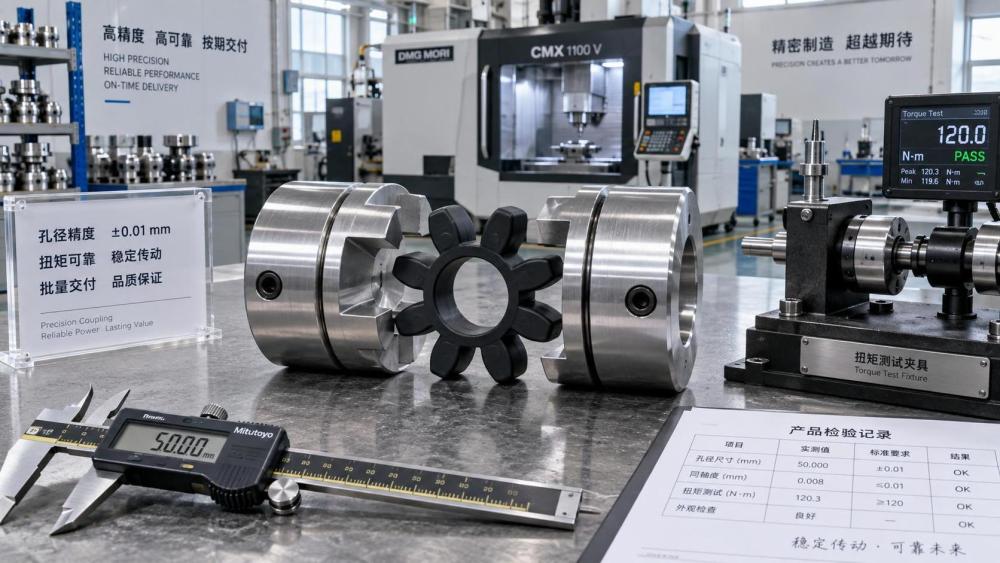
A jaw coupling can look like a simple commodity until it reaches assembly. Then a bore that is a few microns outside the intended fit, an uncommunicated keyway variation, or an incorrect hub configuration can stop a motor, gearbox, or driven machine from being installed on schedule. For a business evaluator, the first question when reviewing a jaw coupling supplier is whether that supplier can repeatedly deliver bores that match the actual shaft-and-hub interface specified on the drawing.
Catalog bore ranges are useful for narrowing options, but they do not prove machining capability. A supplier may list a broad range of finished bores while relying on different production routes for standard, metric, inch-series, stepped, tapered, or custom requirements. Those routes can produce different levels of consistency. The commercial risk is highest when procurement assumes that every listed bore is equally available, equally controlled, and equally fast to deliver.
Request the supplier's bore tolerance convention in writing. This should state whether the bore is supplied as a pilot bore, rough bore, standard finished bore, or customer-specific machined bore. It should also clarify the applicable fit system, any permitted deviation, the inspection method, and whether the stated tolerance applies before or after finishing operations such as broaching a keyway, adding a set-screw hole, or applying surface treatment.
The intended connection method matters just as much as nominal diameter. A keyed shaft, interference fit, taper-lock arrangement, clamp-style hub, and set-screw hub place different demands on bore accuracy and surface finish. A coupling hub intended for a light-duty set-screw connection may not be an appropriate substitute for a keyed, reversing-duty drive simply because both accept the same shaft diameter.
- Confirm the shaft standard: metric and inch dimensions, tolerance designation, and whether the shaft is plain, keyed, splined, or tapered.
- Define the hub requirement: one finished bore, two different bores, pilot bores for local machining, or a fully customized arrangement.
- Review keyway details: width, depth, position, applicable standard, and the relationship between the keyway and any set screw.
- Ask how bores are measured: a declared tolerance has limited value without a repeatable inspection practice and identifiable acceptance criteria.
- Check interchangeability: where replacement inventory is important, hubs from separate production lots should assemble consistently with the intended shafts.
A common purchasing mistake is to treat a finished-bore jaw coupling as a standard stocked part even when it includes an unusual bore/keyway combination. Standard elastomer spiders may be readily available, while the machined hubs still require a separate work order. The supplier should distinguish clearly between stocked assemblies, stocked unbored hubs, and made-to-order bored hubs. This distinction affects both lead time and the likelihood of last-minute substitutions.
For OEM programs, sample approval should reflect the final production condition. Approving an unbored hub or a nominal drawing alone does not establish that the supplier can control the finished bore, keyway, concentricity, and marking requirements at volume. Where coupling performance depends on high rotational speed or low vibration, evaluators should also ask how the supplier controls runout between the bore and the jaw geometry.
Torque Ratings Need Context Before They Can Support a Buying Decision
The torque rating printed beside a coupling size is often the first figure compared, but it is rarely enough to select a supplier. Jaw couplings transfer torque through an elastomeric spider between two metal hubs. The usable capacity depends on hub geometry, spider material, operating temperature, rotational speed, alignment condition, duty cycle, shock loading, and the way the coupling is mounted. A nominal rating cannot be read as a universal guarantee for every motor-driven system.
Supplier evaluation should therefore move from “What torque is this coupling rated for?” to “Under what conditions is this rating established, and what service assumptions apply?” A credible supplier can explain whether a published figure is continuous or intermittent, whether it applies to a particular spider material, and how application factors should be used for starts, stops, reversals, or impact loads.
This is especially important in equipment with variable loads. Conveyor systems, pumps, mixers, crushers, compressors, machine tools, and material-handling equipment can impose very different torsional demands even when their motor nameplate power appears similar. A coupling selected only from motor torque may be undersized when driven inertia, startup frequency, or process upset loads are ignored. Conversely, excessive oversizing can create avoidable costs, packaging constraints, and stiffness that transfers more vibration into adjacent components.
Ask suppliers to provide a rating basis that connects the coupling selection to the operating profile. Useful technical discussion should cover:
- continuous running torque and any stated peak or short-duration allowance;
- maximum speed for the specific coupling configuration and bore size;
- recommended service factors for the machine duty;
- permitted angular, parallel, and axial misalignment, including whether these limits must be reduced when several forms occur together;
- spider material options and their effects on damping, torsional stiffness, chemical resistance, and temperature capability;
- the effect of reversing loads, frequent starts, shock events, and driven-equipment inertia;
- any restrictions related to ambient heat, washdown conditions, dust, oil exposure, or guarding arrangements.
A supplier that offers only a single torque number may still be suitable for straightforward replacement work. It is a weaker fit for engineered assemblies where downtime has a high cost or the machine must perform predictably over a defined operating life. For those applications, procurement should expect a selection statement or technical confirmation that links the proposed coupling size and spider material to the supplied duty information.
The metal hub should also be examined separately from the spider. In a jaw coupling, the elastomeric element is deliberately compliant, but the hub still must retain its jaw profile, bore integrity, and fastening features under the expected load. Material declarations, machining quality, coating choice, and heat-treatment practices can all affect how the hub behaves in service. It is reasonable to request material identification and dimensional documentation when a coupling is part of a critical assembly, particularly where traceability is already required for shafts, gearboxes, or motors.
Do Not Treat Misalignment Capability as Permission to Ignore Alignment
Jaw couplings are often selected because they accommodate a degree of shaft misalignment and absorb some vibration. That benefit can be misunderstood during sourcing. Permitted misalignment figures are limits under defined conditions; they are not a substitute for sound installation practice. If a supplier uses generous figures to imply that alignment is unimportant, the buyer should ask for more detail before accepting the recommendation.
Excessive angular, parallel, or axial offset increases cyclic stress in the spider and can accelerate wear. The effect becomes more severe when the drive also experiences high speed, heat, load fluctuation, or contamination. A coupling may continue to transmit torque while the elastomer degrades, leaving maintenance teams to discover the issue only after vibration rises or a spider fails.
For evaluators, this creates a useful distinction between product capability and system capability. The supplier should be able to support the product side: hub dimensions, spider material, torque limits, speed constraints, and replacement-element availability. The machine builder, installer, or end user remains responsible for shaft alignment, base rigidity, thermal movement, and maintenance access. A sound quotation makes those boundaries visible rather than allowing each party to assume the other has addressed them.
It is also worth asking whether spider replacement can be completed without moving connected equipment. In many installations, the practical value of a jaw coupling lies in its ability to be serviced quickly. Yet hub spacing, guard design, shaft-end clearance, and the chosen coupling style may determine whether this advantage is available in the assembled machine. A low component price offers little benefit if routine replacement requires removal of a motor or driven shaft.
Lead Time Is a Manufacturing and Communication Test
Lead time is more than a delivery-date field on a quotation. It reveals how well a jaw coupling supplier understands its inventory, machining capacity, supplier dependencies, and order-release process. This matters because jaw couplings commonly combine three supply elements: metal hubs, elastomer spiders, and custom machining. A supplier may have one of those elements available while the completed assembly remains weeks away.
Business evaluators should ask for lead time by configuration rather than accepting one general statement. The response should separate standard stock sizes, unusual hub sizes, nonstandard bores, special keyways, alternative spider materials, surface treatments, and orders requiring documentation. A supplier that can state these distinctions early is less likely to create confusion after a purchase order is issued.
Lead-time risk becomes more visible when a buyer compares prototype, production, and aftermarket demand. A supplier may respond quickly to a small prototype order using available parts, then struggle to support a repeated OEM schedule because its machining operation is not planned around forecast demand. Similarly, a manufacturer may supply complete couplings competitively but have no reliable route for replacement spiders in the required hardness or material. For equipment sold into remote or high-uptime environments, the availability of replacement elements may matter as much as the first shipment.
Order changes require similar scrutiny. A late change from a standard bore to a different shaft diameter, or a revision to keyway geometry, can move an item from stock to custom production. Procurement teams should establish which drawing revision governs the order, how changes are acknowledged, and whether the supplier maintains inspection records tied to the final configuration. These controls are modest, but they prevent the familiar dispute in which the delivered coupling matches an earlier email while failing the latest assembly drawing.
Evaluate the Supplier Through a Small, Verifiable Technical Package
A good supplier review does not require an oversized audit for every jaw coupling purchase. It does require evidence proportionate to the consequence of failure. For a routine maintenance replacement, confirmation of dimensions, torque basis, spider type, and delivery status may be enough. For an OEM platform, a pump skid, a gearbox package, or a machine with expensive downtime, the review should become more formal.
The most useful procurement package is usually concise: an approved dimensional drawing, bore and keyway details, a stated coupling and spider designation, rated operating conditions, material information where relevant, inspection expectations, packaging requirements, and an agreed delivery commitment. These documents should identify the exact configuration rather than relying on a generic family brochure.
Price comparisons become more meaningful once this package is aligned. A lower quotation may reflect a pilot-bore hub instead of a finished bore, a different spider compound, a lower documentation level, a different fastening method, or an assumed standard lead time that does not apply to the requested configuration. Those differences are not automatically unacceptable. They simply need to be visible before the commercial decision is made.
For a first order, a controlled sample or first-article process can be appropriate when fit is critical. The purpose is not to burden a straightforward component with unnecessary administration. It is to verify the areas most likely to create assembly failure: bore size, keyway form, hub spacing, spider compatibility, and identification of the supplied configuration. Once those points are stable, repeat orders can be managed more efficiently.
Choose the Supplier That Can Support the Actual Drive, Not Just the Part Number
The strongest jaw coupling supplier is rarely identified by torque rating alone, lowest unit cost, or the broadest catalog. The better choice is the supplier whose technical and commercial answers remain consistent when the conversation moves from nominal size to the actual motor shaft, driven shaft, load pattern, alignment condition, service environment, and required delivery date.
For business evaluators, bore tolerance is the immediate assembly test, torque-rating context is the reliability test, and lead-time clarity is the execution test. When all three are documented against the same configuration, the purchase decision becomes easier to defend and far less likely to create avoidable disruption after the coupling reaches the production floor.
Related News
- Using Industrial Air Blow Guns to Clear Chips Without Spreading DebrisOct 15, 2026Fluid Power Control Strategist
- Ductile Iron Pipe Valves: Which AWWA Standards Apply to Water Main Projects?Oct 15, 2026Dr. Elias Vance
- Why Vacuum Suction Cups Lose Grip on MDF in Woodworking MachinesOct 15, 2026CNC Kinematics Architect
- Choosing a Variable Displacement Piston Pump Manufacturer: What to VerifyOct 15, 2026Fluid Power Control Strategist
- Parallel vs. Angular Pneumatic Grippers for Confined Assembly StationsOct 15, 2026Fluid Power Control Strategist
- Die Castings vs. Investment Castings: Which Costs Less at Your Production Volume?Oct 14, 2026Foundry Phase-Change Fellow