
How to Qualify a Linear Motion Guide Supplier for Accuracy, Lead Time, and Support
Selecting a linear motion guide supplier is not a catalog exercise. Two suppliers may quote rails with the same nominal size, preload class, and load rating, yet deliver very different results once the guides are installed on a machine. The difference usually appears as positioning variation, noise, premature wear, assembly difficulty, missing documentation, or a replacement part that arrives too late.
The practical question is not simply, “Can this supplier make a linear guide?” It is, “Can this supplier repeatedly provide the right guide, in the required condition, with traceable quality and useful support when the machine is under pressure?” A good qualification process looks at accuracy, manufacturing consistency, lead-time control, and technical response together. Ignoring one of these areas can turn a low component price into a costly production interruption.
What a Linear Motion Guide Supplier Must Prove Before Approval
A linear guide rail and carriage system is often treated as a standard purchased part. In many machine designs, it is not. It directly affects straightness, repeatability, rigidity, vibration behavior, and service life. That makes supplier qualification especially important for CNC equipment, automation cells, inspection systems, material-handling units, semiconductor-related equipment, medical machinery, and custom industrial machines.
Before comparing suppliers, define the operating requirement in a form that can be checked. A part number alone is rarely enough. The supplier should receive the rail length, number of blocks, mounting orientation, expected load, moment load, travel speed, duty cycle, required accuracy class, preload requirement, lubrication method, environmental conditions, and any dimensional interchangeability constraints.
For a replacement project, also provide the current rail and block part numbers, mounting-hole pitch, datum arrangement, and installation space. A guide that looks similar may not be functionally interchangeable. Small differences in rail height, carriage width, mounting dimensions, reference surfaces, or block geometry can create alignment problems during assembly.
A capable supplier should ask questions rather than immediately offering the lowest-priced equivalent. If the sales contact never asks about load direction, rail length, contamination, or accuracy needs, that is a warning sign. It may indicate that the quotation is based on a generic match instead of an engineering review.
Accuracy Is More Than a Published Tolerance
Accuracy claims are easy to compare on a datasheet and difficult to validate in real production. Buyers should distinguish between the accuracy of the rail itself and the final motion accuracy of the installed system. A precision linear guide can still perform poorly on a poorly machined mounting surface, with distorted machine frames, incorrect bolt tightening, or rails installed without proper reference to a datum.
Start by asking which characteristics the supplier inspects and how they are measured. Depending on the guide type and accuracy grade, relevant checks may include rail straightness, height variation, width variation, parallelism of datum surfaces, block height matching, running parallelism, and preload or running resistance. The required acceptance criteria should match the application, not a vague description such as “high precision.”
For machines with multiple parallel rails, matched sets matter. Ordering individual rails and blocks from the same product family does not automatically mean they are selected or documented as a matched assembly. A supplier should be able to explain how rails are paired, how block height variation is controlled, and whether the components are marked for traceability.
Do not assume the highest accuracy grade is always the sensible choice. It may add cost and lead time while giving little benefit on a welded frame or a machine base with ordinary machining tolerances. Conversely, choosing a standard commercial grade for a high-speed gantry, optical inspection stage, or grinding machine can introduce problems that are expensive to correct later. The guide specification must follow the performance target of the whole axis.
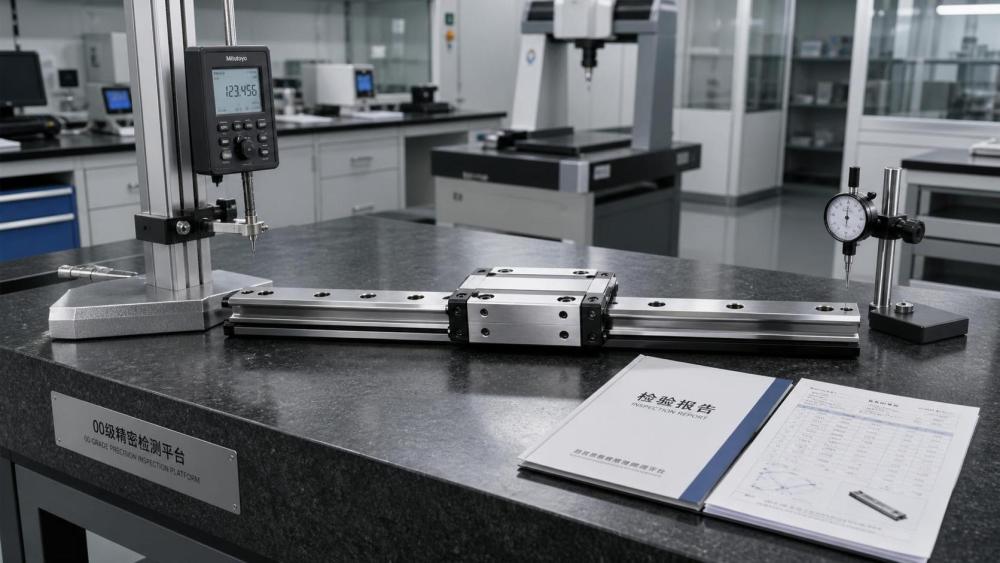
Ask for a sample inspection report before placing a production order. It does not need to reveal proprietary manufacturing data. It should show that the supplier has a defined inspection format, identifies the lot or serial number, states the measuring basis, and records the characteristics that matter to the purchase specification.
Look Past Dynamic Load Rating
A published load rating is useful, but it is not a complete selection rule. Linear guides are commonly exposed to combined forces and moments, especially when a carriage supports an offset tool, cantilevered load, vertical axis, cable carrier, or moving table. A guide that appears oversized in a simple vertical-load calculation may be poorly suited to the actual moment loading.
Ask the supplier to confirm the calculation assumptions. The review should account for the number and spacing of blocks, load distribution, acceleration and deceleration, shock loading, mounting orientation, and expected travel cycle. For vertical applications, ask how the guide works with the drive and brake arrangement. A linear guide supports motion; it is not a substitute for a properly designed holding or safety system.
Contamination is another area where catalog comparisons can mislead. Fine dust, abrasive chips, cutting fluid, washdown water, and poor lubrication can shorten guide life far more quickly than a modest difference in nominal load rating. In a machine tool environment, the correct wipers, scrapers, end seals, lubrication fittings, bellows, and covers may matter more than selecting a slightly larger rail.
A supplier should be able to discuss these practical details. If the application involves food processing, cleanroom assembly, corrosive fluids, outdoor equipment, or high-temperature operation, confirm material, coating, seal, lubricant, and corrosion-resistance requirements early. Standard carbon-steel rails are not appropriate for every environment, and stainless options may involve different capacity, availability, or cost considerations.
Verify Manufacturing Consistency, Not Just the First Sample
Many sourcing failures start with a good first article. The sample fits, the machine runs, and the supplier is approved. Several months later, a repeat shipment has different running resistance, inconsistent block fit, damaged end seals, or rails that do not align as expected. The issue is not necessarily fraud. It can be weak process control, unannounced material substitution, incomplete final inspection, or a supplier purchasing from several factories without a controlled source.
For repeat demand, ask direct questions:
- Is the supplier the manufacturer, an authorized distributor, or an independent trader?
- Will the same manufacturing source be used for future deliveries?
- How are rail batches, carriage batches, and matched sets identified?
- Can the supplier provide certificates of conformity, dimensional reports, or material-related documentation when required?
- What is the process for handling nonconforming goods and replacement claims?
The right level of documentation depends on the machine and the risk. A simple packaging conveyor may need basic incoming inspection and lot identification. A machine used in a tightly controlled manufacturing process may require more formal records, defined change control, and retained inspection data. Buyers should not demand every possible document by default, but they should be clear about what is necessary before issuing the purchase order.
One practical method is to qualify a supplier through a controlled pilot order. Order enough parts to inspect more than one rail and carriage, then check fit, mounting dimensions, motion smoothness, labeling, corrosion protection, packaging, and paperwork. Run the parts under representative conditions where possible. This is more informative than approving a supplier solely from photos or a quotation sheet.
Global Industrial Machining & Piping Equipment Network (IMPE) organizes industrial component information around factors that affect real equipment performance, including tolerances, inspection methods, material control, and long-term operating value. For buyers comparing motion components alongside machined structures, bearings, drive systems, or fluid-power equipment, that broader view is useful: a guide rail is only one part of a motion system, and its performance depends on the quality of the connected assembly.
Lead Time Needs Evidence, Not a Comfortable Promise
Lead time is often evaluated too late, after engineering has selected a guide series. Standard rails may be readily available in common lengths, while cut-to-length rails, higher accuracy classes, special preload, corrosion-resistant variants, or large quantities may require a very different schedule. The same is true for replacement parts: a common carriage may be available, but a matched rail set may not be.
Ask the supplier to separate three dates: order confirmation date, production completion date, and shipment-ready date. For imported parts, also clarify transit method, export documentation, customs responsibility, and delivery point. “Four weeks lead time” has little value if it does not state whether the period ends at factory dispatch or arrival at your facility.
Reliable suppliers can explain their stock position and production route. They do not need to guarantee an unrealistic date, but they should identify what could change it. Common risks include long rails requiring special handling, customized drilling, unavailable blocks, coating requirements, peak factory capacity, and incomplete technical approval from the buyer.
For programs with recurring demand, consider a framework arrangement with defined call-off quantities, agreed safety stock, or a buffer for critical sizes. This is sensible only after the supplier has demonstrated quality consistency. Building inventory around an unproven source simply moves the risk into your warehouse.
Technical Support Is Tested Before the First Problem
Support should be evaluated during the quotation stage, not after a failure. Send a technically specific question and observe the response. Does the supplier reply with a copied catalog paragraph, or does it address the load arrangement, installation condition, and requested performance? Does it provide drawings, mounting guidance, lubrication recommendations, and a clear statement of assumptions?
A responsive sales team is helpful, but technical support requires more than fast email. The supplier should have a process for escalation when a guide is noisy, binding, damaged in transit, incorrectly supplied, or difficult to install. Confirm who will review photos, measurements, and inspection data; what evidence they need; and how replacement decisions are made.
Support becomes especially important when rails are long, guides are installed in parallel, or the design has demanding positioning requirements. In these cases, ask for installation guidance covering mounting-surface preparation, reference edges, bolt sequence, rail alignment, lubrication, and handling. Long rails can be bent or contaminated during shipping and installation even when they left the factory in good condition.
There is also a limit to what supplier support can solve. If the machine frame lacks stiffness, mounting surfaces are not machined to the required condition, or the application has been incorrectly sized, replacing the guide may not fix the problem. A credible supplier will say this plainly and request the information needed to separate component issues from system-level issues.
A Practical Approval Decision
A useful short answer is this: approve a linear motion guide supplier only after it has demonstrated that its product meets the required accuracy and load conditions, its documents identify what was supplied, its delivery commitment is tied to a real supply plan, and its technical contact can answer application-specific questions.
Price should remain part of the decision, but it should be compared against the cost of machine downtime, rework, delayed commissioning, return freight, emergency air shipment, and engineering time. The lowest unit price can be the right choice for a low-risk, standardized application with verified interchangeability. It is rarely the right sole criterion for a critical production axis or a long-term OEM platform.
Before final approval, put the agreed requirements into the purchase specification: guide series and configuration, accuracy grade, preload, rail length and machining, matching requirements, seals, lubrication condition, packaging, required documents, inspection acceptance criteria, delivery terms, and change-notification expectations. This protects both sides. The supplier knows what must be delivered, and the buyer has an objective basis for incoming inspection.
The best supplier relationship is not based on a perfect catalog or a single successful shipment. It is built on repeatable parts, honest lead-time communication, traceable quality, and support that remains useful when the application becomes difficult.
Frequently Asked Questions
Should I buy linear guides directly from a manufacturer or through a distributor?
Either route can work. A manufacturer may offer stronger customization and technical access, while an authorized distributor may provide local stock and faster replacement support. The key point is traceability, confirmed source control, and the supplier’s ability to support your required configuration.
Is a sample order enough to qualify a supplier?
It is a good starting point, not final proof. Use the sample to check dimensions, running quality, documentation, packaging, and communication. For critical or recurring applications, confirm consistency through a pilot batch or staged approval process.
Can a lower-cost guide replace a branded guide rail?
Sometimes, but only after checking mounting dimensions, accuracy class, preload, load and moment capacity, seal design, lubrication arrangement, and expected operating environment. Visual similarity or a matching nominal size is not sufficient.
What documents should I request with an order?
Request only what the application needs, such as a certificate of conformity, lot identification, inspection report, material-related records where relevant, and packing list. For critical projects, agree on the document format before the order is released.
When should lead time become a design decision?
As soon as the guide series is shortlisted. Availability can differ sharply by accuracy grade, rail length, coating, preload, and order quantity. Confirm supply timing before the machine design is frozen.
Image Placeholder List
- : Place after the accuracy and inspection discussion. Suggested image: a technician measuring a linear guide rail on an inspection bench, with rail, carriage block, measuring equipment, and inspection report visible. Alt text: “Inspection of linear motion guide rail accuracy and carriage matching.”
Internal Link Anchor Text Suggestions
- Linear guide rail accuracy grades: Technical guide on accuracy classes, preload, and rail matching.
- How to inspect precision machined mounting surfaces: Guide to mounting-base flatness, straightness, and datum control.
- Industrial bearing supplier qualification checklist: Supplier assessment guidance for related power transmission components.
- Machine tool component traceability requirements: Resource on inspection documents, lot control, and quality records.
- Choosing components for industrial automation axes: Application guide covering guides, drives, bearings, and structural parts.
External Authority Source Suggestions
- Linear motion guide manufacturer official technical catalogs and installation manuals.
- ISO standards documentation relevant to linear-motion bearing accuracy, testing, and industrial quality management.
- Engineering association or machine-tool industry guidance on precision assembly, lubrication, and condition monitoring.
Related News
- Using Industrial Air Blow Guns to Clear Chips Without Spreading DebrisOct 15, 2026Fluid Power Control Strategist
- Ductile Iron Pipe Valves: Which AWWA Standards Apply to Water Main Projects?Oct 15, 2026Dr. Elias Vance
- Why Vacuum Suction Cups Lose Grip on MDF in Woodworking MachinesOct 15, 2026CNC Kinematics Architect
- Choosing a Variable Displacement Piston Pump Manufacturer: What to VerifyOct 15, 2026Fluid Power Control Strategist
- Parallel vs. Angular Pneumatic Grippers for Confined Assembly StationsOct 15, 2026Fluid Power Control Strategist
- Die Castings vs. Investment Castings: Which Costs Less at Your Production Volume?Oct 14, 2026Foundry Phase-Change Fellow