
How Ball Screw Assemblies with Support Bearings Reduce Vibration and Positioning Error
A machine can look mechanically sound and still leave a trail of small problems behind it: chatter on the cut surface, repeatability that drifts over a long shift, a servo that seems to work harder than it should, or a table that never quite returns to the same position under changing load. In many of these cases, the issue is not the screw alone, but the complete motion chain. That is where ball screw assemblies with support bearings matter. In high-precision motion systems, they help control axial movement, maintain shaft alignment, reduce vibration, and limit the kind of positioning error that quietly affects quality, cycle consistency, and component life.
For operators, maintenance teams, and equipment users, this is more than a design detail. It directly affects how a machine feels in daily use: how smoothly an axis accelerates, how stable it stays at speed, and how reliably it holds position when the load changes or the direction reverses.
Why the screw alone is not the full story
When people talk about ball screws, they often focus on lead accuracy, preload, or nut design. Those are important, but the screw does not operate in isolation. A rotating screw or driven shaft needs controlled support at its ends. Without proper support bearings, the assembly can shift axially, flex under load, or vibrate as speed increases. Even a high-quality ball screw can lose practical accuracy if the bearing support is poorly selected, badly installed, or worn.
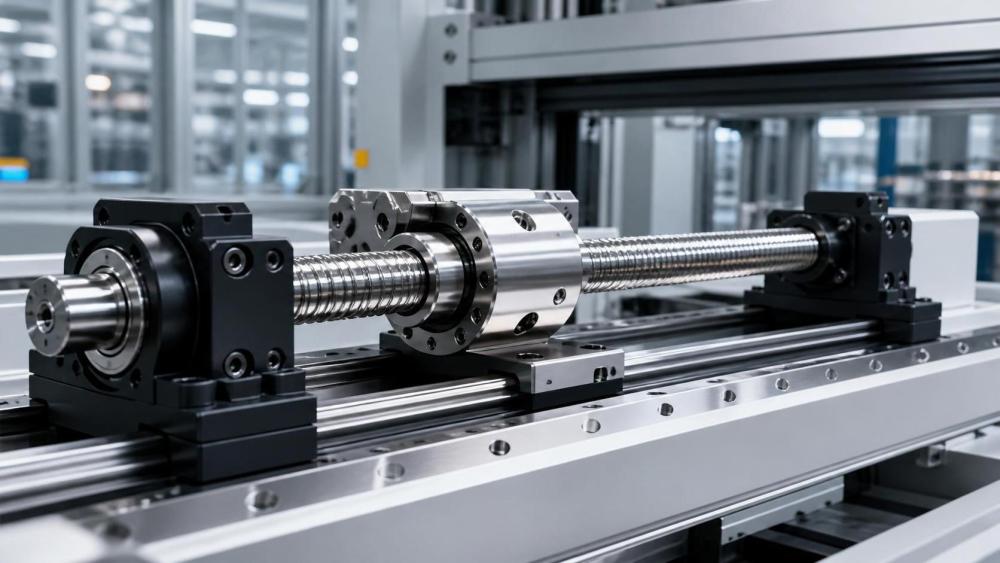
Support bearings are there to manage the real mechanical forces acting on the system. They carry axial loads generated during positioning, absorb radial influences caused by alignment imperfections or machine dynamics, and help keep the screw running on its intended centerline. In effect, they create the stable foundation that allows the ball screw to convert rotary motion into predictable linear movement.
This is especially important in machine tools, automation platforms, packaging lines, robotics, inspection systems, and heavy-duty linear drives where repeated motion happens under speed, load variation, and frequent direction changes.
How vibration starts in a ball screw system
Vibration in linear motion systems rarely comes from a single dramatic failure. More often, it builds from small mechanical conditions that reinforce one another. A screw with insufficient end support may develop slight axial float. A coupling may compensate for minor misalignment, but not enough to prevent side loading. Bearing preload may be too loose, allowing micro-movement, or too tight, creating heat and resistance. Over time, these factors show up as noise, instability, inconsistent surface finish, and premature wear.
At higher speeds, the problem becomes more visible. Rotating elements are sensitive to balance, stiffness, and support conditions. If the screw shaft begins to whip or resonate near its critical speed range, the axis may vibrate even if the motor and control system are functioning correctly. In such cases, ball screw assemblies with support bearings reduce vibration by increasing structural stability at the support points and helping the screw maintain better rotational behavior.
The result is not just a quieter machine. Better support can improve motion smoothness, reduce transmitted vibration into the frame, and make the entire axis easier to tune and operate consistently.
Where positioning error really comes from
Positioning error is often blamed on software compensation, encoder feedback, or the screw’s nominal accuracy grade. Those factors matter, but mechanical support is part of the same equation. If the screw can shift slightly under axial force, the commanded position and the actual position may no longer match perfectly. If bearing stiffness changes as temperature rises, repeatability may drift. If the assembly is not aligned well, friction variation can affect response during reversal and fine positioning.
In practical terms, operators may notice this as:
- Inconsistent stop positions after repeated cycles
- Small dimensional variation across identical parts
- Backlash-like behavior even when the nut appears acceptable
- Higher error during acceleration or deceleration
- Loss of precision after warm-up
Support bearings reduce these risks by limiting unwanted end play and helping the screw react to thrust loads in a controlled way. A properly matched bearing arrangement can keep the axis more stable during start-stop motion, interpolation, and long travel moves.
The role of support bearing arrangement
Not all support configurations perform the same way. In many precision systems, one end of the screw is designed as the fixed side and the other as the supported or floating side. The fixed side usually carries the main axial load and uses bearings arranged to provide high thrust stiffness. The floating side allows for controlled expansion and helps avoid thermal stress building up in the assembly.
This arrangement matters because ball screws experience temperature change during operation. If both ends are constrained without a suitable design approach, thermal growth can create internal stress, increasing friction and shortening bearing life. On the other hand, if the fixed side lacks stiffness, axial displacement can increase and positioning quality suffers.
For users, the takeaway is simple: support bearing performance is not only about load capacity. It is also about stiffness, thermal behavior, preload strategy, and compatibility with the machine’s real duty cycle.
How support bearings improve motion quality in real operation
The benefits are easiest to understand on the shop floor. A well-supported ball screw assembly tends to produce more stable axis behavior across the full stroke, not just at one speed or one position. That shows up in several practical ways.
Smoother acceleration and deceleration
When the screw shaft is firmly supported, the motor does not have to fight as much unintended movement at the ends. The axis responds more cleanly, which is especially useful in systems with frequent indexing, contour motion, or rapid starts and stops.
Better repeatability under changing load
Many industrial applications do not run under a perfectly constant load. Tool pressure, part weight, fixture resistance, or external process forces can all change during operation. Support bearings help the screw handle these variations with less axial displacement, keeping the position more consistent.
Lower vibration transfer into the machine structure
When shaft movement is controlled at the support points, less vibration is transmitted into surrounding components. That can help protect couplings, motor mounts, linear guides, and even part quality in vibration-sensitive processes.
More predictable wear behavior
A stable support system reduces uneven stress. Instead of allowing small alignment errors or oscillation to wear components irregularly, it helps the assembly operate in a more controlled pattern over time.
Common signs that the bearing support may be the hidden problem
Operators do not always have immediate access to design drawings or bearing specifications, but there are clues worth noticing. If your machine shows one or more of the following symptoms, it may be worth checking the support side of the assembly rather than focusing only on the ball nut or servo settings:
- Growing vibration at higher RPM even after lubrication is confirmed
- Unusual heat near the screw support housing
- Noise that changes during direction reversal
- Axis repeatability issues that worsen during long runs
- Surface finish defects that appear rhythmically
- Evidence of coupling stress or frequent coupling replacement
These do not automatically prove bearing failure, but they strongly suggest that the support structure deserves inspection. In many plants, support bearings are overlooked because they are less visible than the screw, motor, or guide rails.
Installation quality is as important as component quality
Even the best ball screw assemblies with support bearings can perform poorly if installation is rushed. Angular misalignment, incorrect locknut tightening, contamination during assembly, and improper preload adjustment can all reduce stiffness or create excess heat. That means a technically good design can still behave badly in service.
For equipment users and maintenance staff, several checks are especially valuable:
- Confirm that the bearing seats and mounting faces are clean and undamaged
- Verify shaft and housing fits against the intended tolerance
- Check that axial locking elements are secured correctly
- Inspect coupling alignment instead of forcing the bearings to absorb misalignment
- Watch for lubrication type and quantity that match the bearing design
- Run the axis through warm-up and monitor temperature, sound, and repeatability
Good installation does not just prevent failure. It protects the positioning accuracy that the rest of the machine depends on.
Selection factors users should understand before replacement
When a support unit needs replacement, many users are tempted to match only the outside dimensions and move on. That can work in some cases, but it may also recreate the same problem. Replacement decisions should consider how the axis actually runs, not only what physically fits.
Useful questions include:
- Is the application driven by high speed, high thrust, or both?
- Does the machine run continuously or in short intermittent cycles?
- Is thermal growth a known issue on long travel axes?
- Does the process require very fine repeatability or mainly robust transport motion?
- Has the machine been modified in a way that changes load or acceleration?
In industrial procurement and equipment support, this is where structured technical information becomes valuable. Platforms such as IMPE help users compare not only component categories but also performance factors like stiffness, load handling, alignment sensitivity, machining quality, and long-term service behavior. For buyers and maintenance planners, that context can prevent a simple parts swap from turning into a repeated reliability problem.
Misunderstandings that often lead to poor results
One common mistake is assuming tighter is always better. Excessive preload can raise friction and temperature, which may shorten bearing life and reduce efficiency. Another is treating vibration as purely an electrical tuning issue. Drive settings can mask symptoms for a while, but they cannot solve mechanical instability at the support points.
There is also a tendency to blame the ball screw whenever positioning error appears. In reality, the support bearings, housing rigidity, coupling condition, lubrication state, and mounting alignment all influence final axis behavior. Looking at only one component can waste time and maintenance budget.
What better support means for daily production
From an operator’s perspective, the value of a stable assembly is not abstract. It means fewer unexplained deviations, less time chasing intermittent accuracy problems, and more confidence that the machine will behave the same on the tenth hour as it did on the first. In precision machining, that may translate to more consistent dimensions and cleaner finishes. In automated handling, it can mean smoother pick-and-place motion and fewer missed positions. In heavy equipment or industrial transfer systems, it can reduce stress on connected components and support longer service intervals.
That is why ball screw assemblies with support bearings deserve attention whenever vibration and positioning error become recurring issues. They are not just passive mounting elements. They are active contributors to stiffness, alignment, motion quality, and overall machine reliability.
A practical way to approach the problem
If you are troubleshooting an axis with vibration or accuracy drift, start by thinking of the system as a whole. Review bearing support condition, mounting integrity, coupling alignment, lubrication, thermal behavior, and operating speed range together. Listen for changes during reversal. Check whether errors increase as the machine warms up. Look for patterns rather than isolated symptoms.
In many cases, the path to better accuracy is not a dramatic redesign. It is a better-supported screw assembly, installed correctly and matched to the real demands of the application. When that foundation is right, the rest of the motion system has a much better chance to perform as intended.
Related News
- Using Industrial Air Blow Guns to Clear Chips Without Spreading DebrisOct 15, 2026Fluid Power Control Strategist
- Ductile Iron Pipe Valves: Which AWWA Standards Apply to Water Main Projects?Oct 15, 2026Dr. Elias Vance
- Why Vacuum Suction Cups Lose Grip on MDF in Woodworking MachinesOct 15, 2026CNC Kinematics Architect
- Choosing a Variable Displacement Piston Pump Manufacturer: What to VerifyOct 15, 2026Fluid Power Control Strategist
- Parallel vs. Angular Pneumatic Grippers for Confined Assembly StationsOct 15, 2026Fluid Power Control Strategist
- Die Castings vs. Investment Castings: Which Costs Less at Your Production Volume?Oct 14, 2026Foundry Phase-Change Fellow