
Flexible Couplings for Pumps: Elastomeric vs. Disc in High-Temperature Service
A pump may run smoothly during a cold alignment check, then develop vibration as the casing, shaft, and baseplate heat up. The coupling can become the visible failure point: an elastomer hardens or cracks, or a metallic disc pack fatigues under movement it was not sized to accommodate. Replacing the damaged element without checking operating temperature and shaft movement can leave the underlying problem unchanged.
Choose an elastomeric coupling when its verified temperature capability covers the actual exposure and torsional damping is valuable. Favor a disc coupling when heat rules out suitable elastomers or the drive requires high torsional stiffness, provided alignment and thermal movement remain within its limits. For flexible couplings for pumps, process-fluid temperature alone is not enough to make that decision.
Establish the temperature at the coupling, not just inside the pump
The pumped liquid, bearing housing, shaft extension, coupling hubs, and flexible element do not necessarily reach the same temperature. Heat reaches the coupling through shaft conduction, radiation from nearby equipment, and hot air trapped around the guard. Ventilation and distance from the casing affect that exposure. An elastomer may also generate heat internally through cyclic deformation.
Start with the operating envelope rather than one normal-duty reading. Include startup, sustained operation, hot standby, shutdown heat soak, and credible upset conditions. A coupling may experience its highest surrounding temperature after the pump stops and cooling airflow disappears.
- Measure representative locations: record accessible hub and nearby housing temperatures using an approved method, and establish how those readings relate to flexible-element temperature.
- Account for measurement uncertainty: infrared readings on reflective metal can be misleading unless emissivity and viewing conditions are controlled.
- Separate continuous from transient exposure: ask how permitted peak temperature changes with duration and frequency.
- Include the environment: oil mist, cleaning agents, steam leakage, and process vapors can change elastomer suitability independently of temperature.
Do not remove guards or approach rotating parts to obtain readings. Plan safe measurement access, and request manufacturer guidance where the critical element temperature cannot be measured directly.
What the two designs change in the drive system
These are design tendencies, not interchangeable catalog specifications. A jaw coupling, tire coupling, and shear-type elastomeric coupling can behave quite differently. Likewise, single-flex and double-flex disc arrangements do not offer the same shaft-displacement capability.
When an elastomeric coupling remains the better choice
Elevated process temperature does not automatically exclude elastomers. Where shaft-end temperatures remain inside a validated operating range, an elastomeric coupling can provide useful damping and straightforward maintenance. That can matter on drives exposed to torque fluctuations or repeated starts.
The selection must identify the actual compound, not simply “rubber” or “polyurethane.” Different elastomers have different resistance to heat, oils, water, and chemicals. Even within one material family, formulation and element geometry affect performance. Substituting a harder or nominally more heat-resistant insert without reviewing the coupling rating can change stiffness, damping, and transmitted loads.
Check derating before increasing coupling size
Ask for allowable continuous torque at the expected element temperature, together with the permitted peak torque and duty assumptions. Do not assume a room-temperature nominal rating remains available at elevated temperature. Heat can alter stiffness, accelerate aging, and reduce fatigue capability before the element shows obvious damage.
A larger coupling may restore torque capacity, but it also changes inertia, bore options, stiffness, and sometimes reaction forces. Oversizing is therefore not a substitute for confirming the compound’s exposure limit. An element operating outside its permitted temperature or chemical environment remains unsuitable even when nominal torque capacity appears generous.
Hardening, cracking, permanent deformation, powdering, and changes in vibration deserve investigation. Their appearance alone does not prove thermal failure: poor alignment, cyclic overload, contamination, and incorrect assembly can produce overlapping symptoms. Compare the damaged element with temperature history and operating duty before specifying a replacement.
Disc couplings remove the elastomer limit—not the alignment problem
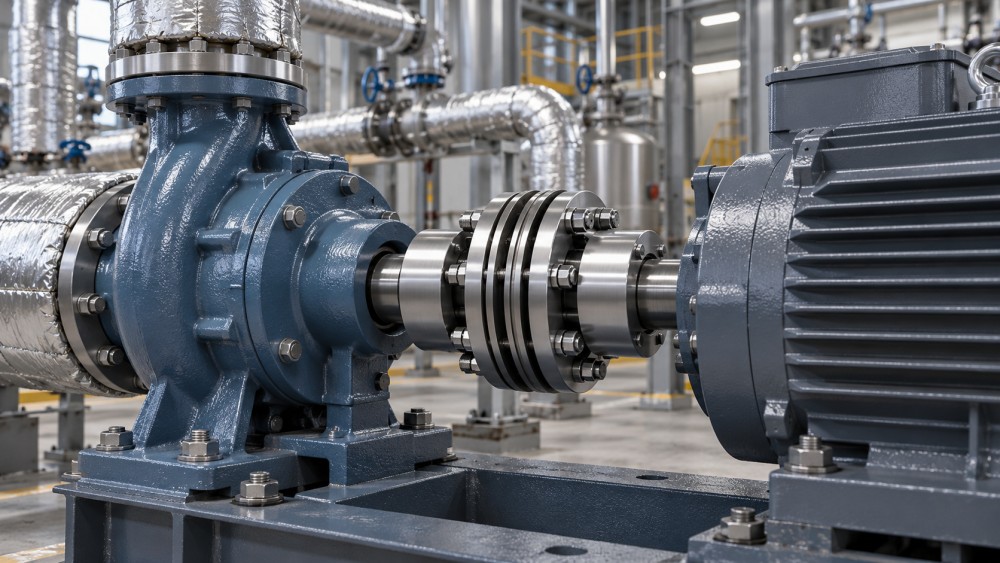
A disc coupling transmits torque through metallic flexible members, avoiding the heat-aging mechanism of an elastomeric element. It is a strong candidate when coupling exposure exceeds available elastomer ratings or when a stiff, lubrication-free flexible connection is required. However, the complete assembly still needs a temperature assessment, including fastener properties, material compatibility, and shaft-to-hub attachment.
A disc pack is flexible in selected directions, not tolerant of unlimited installation error. Misalignment subjects the discs to cyclic bending as they rotate. Persistent angular error, excessive axial displacement, or an unsuitable arrangement for parallel offset can consume fatigue capability even when transmitted torque is modest.
A double-flex spacer arrangement provides two flexing planes to accommodate parallel offset through angular deflection at each pack. Spacer length influences the angle required for a given offset, but increasing length also changes mass distribution and dynamic behavior. Confirm speed capability, balance requirements, and any applicable lateral critical-speed checks rather than choosing spacer length only for maintenance access.
Metallic construction also does not guarantee chemical resistance. Corrosive vapors, deposits, and cleaning chemicals may attack thin discs or fasteners. Material selection should reflect the coupling’s atmosphere, not just the fluid contained inside the pump.
Calculate thermal movement before setting cold alignment
Hot-service pumps and motors rarely grow identically. Different support heights, materials, cooling arrangements, and bearing locations can shift shaft centerlines vertically and horizontally. Axial movement depends on where each rotor is located by its thrust bearing and how the equipment expands from its fixed points.
Establish the expected operating positions of both shaft ends, then determine the cold alignment targets needed to approach those positions. Use equipment-manufacturer thermal-growth data where available. Simple expansion calculations can support an estimate, but uneven temperatures, casing constraints, baseplate distortion, and pipe strain may make a uniform-growth assumption inadequate.
- Establish mechanical condition: correct soft foot, inspect the foundation and baseplate, and evaluate pipe strain before precision alignment.
- Define relative movement: distinguish centerline offset, angular change, and axial displacement between the connected shaft ends.
- Check combined limits: obtain the manufacturer’s allowable operating envelope for torque, speed, temperature, and simultaneous misalignment. Do not assume every published maximum is available at once.
- Verify the hot condition: use an approved thermal-growth or alignment-verification method to compare predicted movement with actual behavior.
Axial accommodation needs particular care. A coupling that accepts axial displacement may still generate restoring force. That force can affect pump or motor thrust bearings, especially when installation spacing leaves the flexible element preloaded. Check the specified hub separation or distance between shaft ends against the expected operating position.
Check torque transients and torsional response separately
Steady torque is only the starting point. For power in kilowatts and speed in revolutions per minute, nominal torque in newton-meters is approximately T = 9550 × P / n. Use the relevant transmitted-power condition, then evaluate startup, acceleration, restart, and upset loads using the coupling manufacturer’s selection method.
Apply service factors and temperature corrections as instructed; adding unrelated factors indiscriminately can produce an oversized but dynamically unsuitable selection. Confirm bore capacity, key or locking-device capability, shaft fit, and maximum speed as well as flexible-element torque capacity.
Elastomeric damping can reduce some torsional oscillations, but it does not make a coupling a cure for resonance. Elastomer stiffness also changes with temperature and loading. Replacing it with a torsionally stiff disc coupling changes the drive system’s natural frequencies and transient response. Variable-speed operation, frequent starts, or known torsional problems justify checking the complete motor–coupling–pump system, not just comparing torque ratings.
Turn the comparison into an approval decision
The decision becomes clearer when each candidate is tested against the same operating envelope. An elastomeric design remains credible where the compound has adequate thermal and chemical capability, derated torque capacity is sufficient, and its damping or maintenance characteristics are useful. A disc design becomes preferable where elastomer exposure is unacceptable and the installation can support its alignment, axial-load, and dynamic requirements.
Neither is ready for approval when actual coupling temperature or relative shaft movement remains unknown. Those gaps should trigger measurement or engineering review rather than a larger service factor.
Request the following evidence with the proposed coupling:
- Exact element or disc material and applicable temperature limits, including permitted transient exposure.
- Continuous and peak torque ratings at the specified duty, speed, and temperature.
- Combined misalignment capability and resulting axial or radial reaction loads.
- Required shaft separation, fits, installation tolerances, fastener procedures, and replacement clearances.
- Inspection criteria and any operating-condition triggers for element or disc-pack replacement.
Maintenance access can break an otherwise close comparison. Some elastomeric elements can be replaced without moving either machine; others cannot. A disc spacer may permit seal access, but disc-pack replacement still demands correct assembly and fastener control. Evaluate the actual arrangement, guard access, spare-part requirements, and restoration procedure rather than relying on “maintenance-free” terminology.
Before returning a modified drive to service, document cold alignment, installed spacing, assembly settings, and baseline vibration. Trend these against operating temperature and load. A coupling change should not conceal unresolved pipe strain, thermal growth, or rotor-dynamic behavior; those conditions can transfer the failure from the flexible element to bearings, seals, or shafts.
Related News
- Why Is Your Heavy-Duty Piston Pump Losing Pressure Under Load?Nov 09, 2026Fluid Power Control Strategist
- Cartridge Valves for Manifold Blocks: Avoiding Cavity Fit ProblemsNov 09, 2026Fluid Power Control Strategist
- Large-Diameter Forged Rings: How Seamless Rolling Affects Grain FlowNov 09, 2026Foundry Phase-Change Fellow
- Sealed Heavy-Duty Roller Bearings: Choosing Seals for Dust and WaterNov 09, 2026Tribology & Kinematics Expert
- Sprockets and Chain Drives: What Determines Replacement Cost?Nov 08, 2026CNC Kinematics Architect
- Monoblock Hydraulic Control Valves: Flow Rating and Spool SelectionNov 08, 2026Fluid Power Control Strategist