
Ball Screws for Automation Equipment: When Precision Beats Belt Drives
In high-speed production lines, the choice between belt drives and ball screws for automation equipment can directly affect positioning accuracy, repeatability, load stability, and long-term maintenance costs. For project managers and engineering leaders, understanding when precision motion matters more than simple speed is essential to selecting automation systems that deliver reliable performance, tighter process control, and better lifecycle value.
That decision is often underestimated at the project stage. Belt-driven linear axes are frequently treated as the default because they are fast, familiar, and usually less expensive upfront. Ball screw systems, by contrast, are often considered only when a machine builder or motion supplier raises a concern about accuracy. In practice, the real question is not whether ball screws are “better” than belts. It is whether the process being automated can tolerate the mechanical behavior of a belt system over time.
For many automation projects, especially where throughput pressure is high, teams focus on cycle time, travel length, and equipment price. Those are valid criteria, but they do not capture the operational impact of lost repeatability, backlash growth, changing belt tension, or inconsistent load response. Once the line is installed, these issues stop being design details and start becoming production problems.
Where the belt-vs-ball-screw decision actually matters
Both technologies convert motor rotation into linear motion, but they behave differently under load, speed, and positional control requirements.
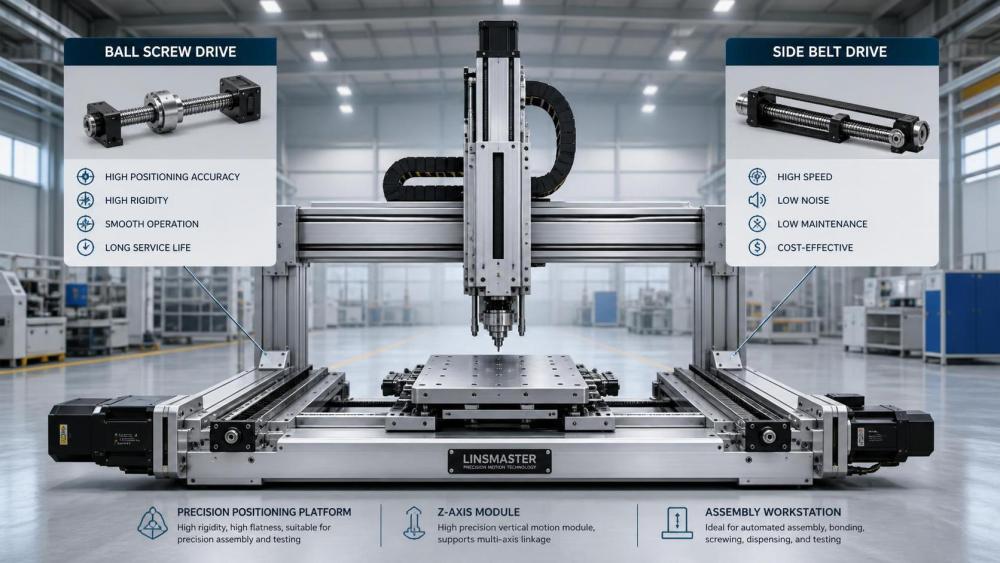
Belt drives are typically preferred for longer strokes and higher traverse speeds. They are common in pick-and-place systems, packaging lines, gantries, pallet movement, and applications where the axis mainly transfers a part from one point to another. They are mechanically simple, lightweight, and often easier to scale across a wide machine envelope.
Ball screws are usually selected when the axis must do more than move quickly. They become more relevant when motion quality directly affects process quality: precise indexing, controlled force application, stable vertical movement, repeatable tool positioning, synchronized assembly steps, or metering operations where small deviation creates scrap or downstream misalignment.
That is why discussions around ball screws for automation equipment are rarely just about components. They are really about process tolerance. If your production outcome depends on micron-level or near-micron-level positioning, repeatable stop points, or stiffness under varying loads, the drive choice becomes a process control decision rather than a mechanical preference.
When precision beats speed in real production environments
Project teams often assume high speed is the main performance indicator. In reality, many automation lines do not fail because they are too slow. They fail because motion inconsistency creates hidden process instability.
Consider a vision-guided inspection station. If the positioning axis drifts slightly or settles inconsistently, image calibration errors accumulate. In an automated dispensing line, small position variation changes bead placement or volume distribution. In electronics assembly, medical device handling, or precision fixture loading, repeatability often matters more than peak axis velocity.
Ball screws are typically stronger in these cases because they offer higher axial stiffness and more predictable positioning behavior. That matters when the axis stops, starts, reverses direction, or holds a load under pressure. A belt system can perform well, but elastic stretch, tension variation, and wear over time may reduce consistency, especially when the load changes frequently.
Vertical axes are another important example. Lifting or holding a payload is not the same as moving horizontally across a conveyor. A ball screw-based actuator generally provides more stable load support and better positional confidence for Z-axis motion, pressing operations, tool approach, and fixture engagement. In such applications, unexpected drift, rebound, or positional compliance can create both quality and safety concerns.
The hidden cost of choosing the wrong drive
At quotation stage, belt drives often look attractive because the initial system price is lower and the mechanical architecture is straightforward. But project managers are rarely judged only on purchase price. They are judged on startup stability, ramp-up performance, output consistency, and how many surprises appear six months after commissioning.
A drive system that is acceptable on paper can become expensive in operation for several reasons.
First, tuning and rework. If the motion platform struggles to hit repeatable positions under real load, controls engineers may spend longer compensating in software for what is fundamentally a mechanical limitation. Extra tuning time extends commissioning and delays handover.
Second, maintenance creep. Belt systems depend on correct tension and condition. Over time, wear, contamination, and thermal variation can affect performance. The issue is not that belts are unreliable by definition; it is that they may need more frequent attention in precision-sensitive environments. If maintenance intervals are not well managed, process drift can emerge before a failure is obvious.
Third, quality loss that does not look like a motion problem. Scrap, inconsistent assembly fit, seal failures, misdrilled holes, poor dispensing patterns, and unstable inspection results are often traced back to tooling, sensors, or operators first. The drive system is not always suspected early. That makes the cost of the wrong choice harder to identify, and therefore easier to underestimate.
Fourth, reduced upgrade flexibility. A line designed around a belt-driven axis may be sufficient for the first product generation. But if future variants require tighter tolerances, more demanding force control, or heavier tooling, the original design can become a bottleneck. Retrofitting later is usually more expensive than sizing correctly from the beginning.
Applications where ball screws usually make stronger sense
Not every automation project needs ball screws. But several application categories consistently justify them.
Precision assembly stations. If components must be inserted, aligned, pressed, or fastened with tight positional control, axis stiffness matters. Ball screws reduce the risk of compliance affecting insertion depth or alignment.
Automated dispensing and dosing. Adhesives, sealants, solder paste, and specialty fluids often require controlled path accuracy and repeatable stop-start motion. Positional deviation can quickly become a process capability problem.
Machine tending with accurate part placement. Loading CNC fixtures, metrology stations, or test nests may require better repeatability than general transfer systems. If the receiving station has limited positional forgiveness, a ball screw axis can reduce correction complexity.
Inspection, measurement, and calibration equipment. Metrology-related motion systems typically value repeatable positioning and low vibration over pure speed. Belt drives can work in some inspection systems, but the tolerance stack should be reviewed carefully.
Short- to medium-stroke axes carrying meaningful load. Ball screws are often particularly effective when travel is not extremely long and the axis must handle thrust, controlled acceleration, or stable holding under changing load conditions.
Vertical motion and pressing tasks. Whenever gravity, compression, or process contact enters the equation, the mechanical stiffness and load-handling behavior of a ball screw becomes a stronger advantage.
Where belt drives still remain the better choice
There is a common mistake in automation planning: assuming precision technology is always the safer option. It is not. Over-specifying motion hardware can raise capital cost, complexity, and maintenance burden without improving process results.
Belt drives still make strong engineering and business sense in several cases:
- Long-travel axes where high speed and moderate positioning accuracy are acceptable
- Simple pick-and-place systems with forgiving part interfaces
- Packaging, sorting, and transfer lines driven primarily by throughput
- Large gantry systems where mass reduction helps dynamic performance
- Applications where the axis does not carry process-critical load at the point of positioning
For project leaders, this is the practical dividing line: if the motion axis is mainly transporting, belts often win. If the axis is part of the process itself, ball screws deserve closer attention.
Key evaluation questions before locking the specification
The best way to avoid a poor choice is to stop comparing drives only by catalog speed and rated load. A more useful review starts with application behavior under actual production conditions.
How much positioning error can the process really tolerate?
Not the theoretical tolerance on the drawing, but the real production window before defects, rework, or instability appear.
Does the axis only move parts, or does it determine process quality?
If motion affects alignment, force engagement, toolpath quality, or sensor accuracy, a more rigid solution may be justified.
What happens when load changes?
An empty gripper and a fully loaded tool head do not behave the same. Systems should be assessed at full dynamic load, not just nominal conditions.
Is the stroke length suitable for a ball screw design?
Ball screws are generally more favorable on short to moderate travel lengths. At longer strokes, critical speed, whip, and structural considerations become more limiting. Exact limits depend on screw diameter, support arrangement, and operating speed, so design validation is essential.
How important is holding stability?
For vertical axes, pressing tasks, and precise dwell positions, holding behavior may matter more than travel speed.
What maintenance capability exists on site?
Some facilities are very disciplined on preventive maintenance; others run lean and respond only after performance drops. Drive choice should reflect the reality of plant support, not the ideal maintenance manual.
Will the process requirements tighten later?
Many lines evolve toward higher precision, smaller parts, more traceability, and tighter quality control. A drive system with no performance margin can limit future upgrades.
Implementation risks that are often missed in project planning
Even when a ball screw is the right technical choice, project outcomes depend on execution details. Problems often come not from the screw itself, but from how the axis is integrated.
Support structure stiffness is one example. A high-precision screw cannot compensate for a flexible machine frame. If the structure deflects, actual process accuracy will still suffer. The same applies to coupling selection, bearing arrangement, lubrication management, alignment, and protection from contamination.
Contamination is especially important in industrial automation. Dust, metal chips, abrasive particles, coolant mist, and poor sealing can shorten ball screw life or degrade smooth motion. In harsher environments, protective covers, proper sealing, and realistic maintenance planning are as important as the screw specification itself.
Motor and control matching also deserve more attention than they often receive. A ball screw can improve mechanical precision, but only if servo tuning, encoder resolution, and motion profile design support the intended performance. In some retrofits, teams install a more precise mechanical drive but keep an inadequate feedback or control architecture, which limits the benefit.
Procurement and supplier evaluation: what matters beyond the component
For engineering leaders working with OEMs, integrators, or overseas suppliers, the risk is not only technical selection but documentation quality and manufacturing consistency.
When evaluating linear motion suppliers or machine builders, it is worth checking:
- Whether repeatability and positional accuracy are specified under realistic load and duty conditions
- How lubrication, sealing, and contamination protection are handled
- Whether lifecycle assumptions are documented clearly
- What inspection records, traceability, and assembly controls are available
- Whether replacement parts and after-sales support are regionally accessible
- How critical components are sourced and whether supply continuity risks exist
For cross-border sourcing, another practical issue is consistency between prototype performance and production batches. A system demonstrated under clean showroom conditions may behave differently in sustained industrial use. Project teams should push for operating-condition evidence, not just nominal specification sheets.
A useful rule for project decisions
If the axis is a conveyor substitute, a belt drive is often enough. If the axis is part of your quality control chain, assembly accuracy, or process repeatability, the argument for ball screws becomes much stronger.
That is the point at which precision beats belt drives—not because ball screws are universally superior, but because the cost of motion variability becomes larger than the savings from a simpler system.
For project managers, the most effective decision is usually not to ask which drive is faster or cheaper in isolation. It is to ask which drive better protects uptime, process capability, and future production requirements. Once the conversation shifts from component price to operational consequence, the selection becomes much clearer.
In automation, the drive system is rarely the most visible part of the line. But when it is underspecified, it often becomes one of the most expensive decisions to correct.
Related News
- How to Assess a Rigid Coupling Supplier for Bore Accuracy and Traceable QualityOct 08, 2026Tribology & Kinematics Expert
- Titanium Alloys Compared: Balancing Strength, Corrosion Resistance, and MachinabilityOct 08, 2026CNC Kinematics Architect
- Where Ductile Iron Dismantling Joints Reduce Alignment Risk in Water PipelinesOct 08, 2026Pipeline Metallurgy Scientist
- Selecting a Precision Bearing Sleeve: Fits, Runout, and Material ChoicesOct 08, 2026Tribology & Kinematics Expert
- Face Milling Cutters: How Insert Geometry Affects Finish on Steel and AluminumOct 08, 2026CNC Kinematics Architect
- Single-Acting Cylinders for Clamping: Stroke, Force, and Return Spring ConsiderationsOct 07, 2026Fluid Power Control Strategist