
Carbide Cutting Tools Explained: Grades, Coatings, and When They Matter
Carbide cutting tools sit at the center of modern machining because they tolerate heat, hold an edge better than high-speed steel in many applications, and make high metal-removal rates possible. But that broad statement hides the real issue: not all carbide performs the same, and the differences that matter on the shop floor rarely come down to marketing labels alone. Grades, coatings, substrate toughness, edge preparation, chip control, coolant strategy, spindle stability, and workpiece material all interact. A tool that performs well in alloy steel roughing can fail quickly in stainless finishing or nickel-based superalloys, even if both tools are sold under the same family name.
That is why engineers and sourcing teams often get confused when comparing inserts, end mills, or drills. The question is not simply “Is carbide better?” It is “Which carbide, under which cutting conditions, and for what process target?” If the goal is better surface finish, the answer may differ from a setup aimed at maximizing tool life or minimizing cycle time.
What “carbide grade” really means in practice
A carbide grade is not just a hardness rating. In most cases, it refers to a cemented carbide substrate made from tungsten carbide particles bound with a metallic binder, commonly cobalt, though actual formulations vary by manufacturer and application. Changing grain size, binder content, and processing route shifts the balance between hardness, wear resistance, and toughness.
A simple way to think about it is this: harder grades usually resist abrasion and crater wear better, while tougher grades better survive interrupted cuts, vibration, and unstable fixturing. The trade-off is real. If a turning insert is too hard and brittle for a scale-covered forging or a flame-cut edge, edge chipping may happen before flank wear becomes the limiting factor. If the grade is too tough and not wear-resistant enough, it may dull quickly in continuous cutting at high speed.
This matters across the industrial sectors IMPE follows. In 5-axis machining of titanium or Inconel, thermal load and notch wear can dominate. In heavy forgings, interrupted engagement and inconsistent skin conditions may punish brittle grades. Even in supporting component industries such as bearings, housings, valve bodies, or fluid-control parts, the right carbide choice often depends less on the catalog headline and more on how the cut behaves second by second.
Why coatings changed carbide from a material into a system
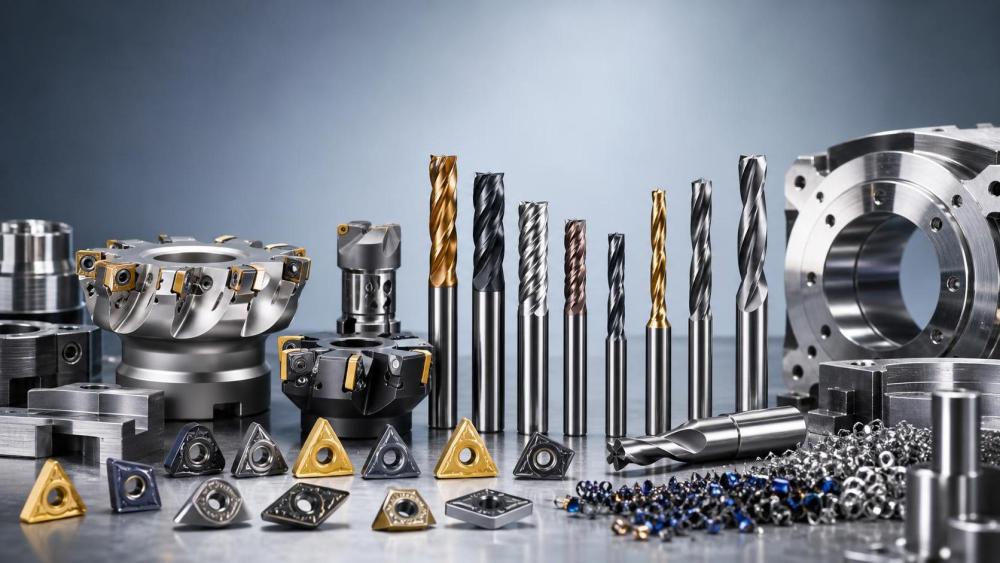
Modern carbide tools are rarely just bare substrates. Coatings became essential because they let toolmakers tailor surface behavior without giving up the core strength of the carbide underneath. In broad terms, coatings help with heat resistance, friction reduction, oxidation resistance, and wear control.
The two big families most buyers hear about are CVD and PVD coatings. CVD coatings are often thicker and commonly used where wear resistance in stable cutting is the priority, such as many turning and cast iron applications. PVD coatings are typically thinner and can preserve sharper cutting edges, which is valuable in milling, drilling, stainless machining, and applications where edge integrity matters. That does not mean one is universally better than the other. It means the tool’s job has to be clear.
A coated tool may last much longer than an uncoated one in the right environment, but coatings are not magic armor. If the machine lacks rigidity, if runout is excessive, or if chip evacuation is poor, coating choice becomes secondary. Many premature failures blamed on “bad carbide” are actually process failures: thermal shock from inconsistent coolant, built-up edge from incorrect speed, or micro-chipping caused by chatter.
When grades matter more than coatings
There are cases where buyers focus too much on the coating color or brand family and miss the substrate behavior underneath. Grade selection often matters more when cutting conditions are severe, unstable, or materially inconsistent.
Take interrupted cuts on forged or cast surfaces. The tool repeatedly sees impact loading. Here, a tougher carbide substrate can be more important than chasing the highest theoretical wear resistance. The same logic applies when machining welded fabrications, hard skin on castings, or parts where fixture rigidity is limited. In these situations, edge chipping, not smooth flank wear, is often the first failure mode.
Another example is aerospace-style machining of heat-resistant alloys. These materials generate heat, resist deformation, and can work-harden. A premium coating helps, but substrate hot hardness and resistance to deformation under load still matter. On a 5-axis machine removing metal from difficult alloys, the grade must survive not only temperature but changing engagement angles, variable chip thickness, and long tool overhangs.
When coatings make the bigger difference
Coatings start to dominate when the process is already reasonably stable and the limiting factor is surface wear, heat, or friction. Stainless steels are a good example. Many shops fight built-up edge, inconsistent finish, and sudden wear jumps. In those cases, a coating designed to lower friction and maintain edge stability may change results more than a small shift in base grade alone.
Aluminum is another special case. Not every carbide tool for aluminum needs a heavy multilayer coating; in some operations, polished flutes and sharp geometries matter more. The wrong coating can even encourage material adhesion if it is not suited to nonferrous cutting. This is where generic thinking causes waste: a tool optimized for hardened steel finishing is not automatically a smart choice for high-speed aluminum milling.
Cast iron often swings the discussion back again. Its abrasiveness can favor wear-resistant solutions, and many successful insert choices in cast iron rely on coating and grade working together rather than separately. That pairing is especially relevant in sectors tied to infrastructure and heavy equipment, where large housings, pump bodies, pipe components, or machine frames need predictable economics over long production runs.
A practical way to judge carbide tooling options
For information researchers comparing suppliers or tooling families, it helps to stop asking which tool is “best” and instead define the failure you most need to avoid.
- If edges chip early, look at toughness, edge prep, entry conditions, and machine stability.
- If wear is gradual but too fast, coating and hot-hardness become more relevant.
- If finish is inconsistent, check built-up edge, runout, chip evacuation, and whether the geometry is too blunt.
- If performance changes wildly between machines, the process window may be narrower than the tool catalog suggests.
This is also why published tool categories should be treated as starting points, not final answers. ISO material groups such as P, M, K, N, S, and H are useful, but they do not capture everything. Austenitic stainless and duplex stainless can behave very differently. A forged steel with interrupted entry is not the same as bar stock. A municipal pumping component, a bearing seat, and an aerospace bracket may all be “steel parts,” yet their tooling priorities are not remotely identical.
Common mistakes that distort tool comparisons
One of the most common mistakes is comparing tool life without normalizing the process. If one trial uses through-coolant, stable workholding, and optimized chip load while another does not, the grade or coating is not the only variable. Another mistake is copying a successful tool from one operation into another with a different radial engagement, overhang, or coolant mode.
There is also a purchasing-side trap: assuming higher initial tool price means lower total cost, or the reverse. Both can be wrong. A premium carbide tool may be justified if it prevents scrap in a high-value part or keeps spindle uptime predictable. But in roughing operations on less critical components, a more forgiving, lower-cost option may produce better economics if edge failure is caused mainly by unstable cutting rather than wear.
IMPE’s coverage of machining, forgings, bearings, and fluid-system hardware tends to reinforce the same lesson across industries: material science and process kinematics have to be read together. Prof. Kaelen Sterling’s emphasis on tool-wear thermal dissipation and high-speed milling physics reflects a reality many plants learn the hard way—tooling decisions cannot be separated from heat flow, chip formation, and machine dynamics.
What to confirm before making a decision
Before choosing among carbide cutting tools, it is worth confirming a few things that catalogs often leave vague: the exact workpiece material condition, whether cutting is continuous or interrupted, the target output metric, coolant method, and the machine’s actual rigidity. For exported machined parts, tolerance expectations matter too. If a supplier is working to tight dimensional control or geometric limits such as ISO 2768-m in a broader production system, tool behavior affects not just edge life but process repeatability and inspection outcomes.
That is where an intelligence-led approach becomes more useful than a brand-led one. IMPE’s work around extreme metal-cutting kinematics, difficult alloys, and compliance-sensitive industrial manufacturing shows that tooling selection is rarely an isolated purchasing event. It sits inside a chain that includes part geometry, tolerance strategy, machine capability, and downstream service expectations.
If you are still at the research stage, the best next step is usually not asking for a generic “recommended grade.” It is narrowing the application: material, operation, spindle limits, failure mode, and acceptable tool-change frequency. Once those are clear, the question of grades and coatings becomes much easier—and much more relevant—than any catalog comparison on its own.
Related News
- How to Assess a Rigid Coupling Supplier for Bore Accuracy and Traceable QualityOct 08, 2026Tribology & Kinematics Expert
- Titanium Alloys Compared: Balancing Strength, Corrosion Resistance, and MachinabilityOct 08, 2026CNC Kinematics Architect
- Where Ductile Iron Dismantling Joints Reduce Alignment Risk in Water PipelinesOct 08, 2026Pipeline Metallurgy Scientist
- Selecting a Precision Bearing Sleeve: Fits, Runout, and Material ChoicesOct 08, 2026Tribology & Kinematics Expert
- Face Milling Cutters: How Insert Geometry Affects Finish on Steel and AluminumOct 08, 2026CNC Kinematics Architect
- Single-Acting Cylinders for Clamping: Stroke, Force, and Return Spring ConsiderationsOct 07, 2026Fluid Power Control Strategist