
Which Ball Valve Material Best Resists Corrosion in Buried Water Mains?
Which Ball Valve Material Best Resists Corrosion in Buried Water Mains?
Which ball valve material resists corrosion best in buried water mains? There is no responsible one-word answer. Soil chemistry, groundwater, stray-current exposure, water quality, pressure class, valve design, coating integrity, and access for future maintenance all influence the outcome.
For most municipal water-main applications, a ductile iron ball valve body with a properly specified external corrosion-protection system is usually the practical long-life choice. The valve should be paired with corrosion-resistant wetted components, commonly a stainless steel ball and stem, suitable resilient seats, and a coating system selected for the actual burial environment. Where soils are unusually aggressive, the decision may shift toward enhanced wrapping, polyethylene encasement, cathodic protection, high-performance coatings, or—in specific cases—stainless steel or duplex stainless steel valve construction.
The key point is easy to miss during procurement: buried-valve durability is rarely determined by the nominal body metal alone. A highly corrosion-resistant alloy can still fail if crevices collect chlorides, dissimilar metals create galvanic effects, stem seals are poorly protected, or damaged coatings are placed directly into aggressive soil. Conversely, a conventional ductile iron valve can provide dependable service when its coating, installation method, and material interfaces are properly matched to the site.
Why buried ball valves corrode differently
A valve installed above ground can be inspected, cleaned, recoated, and repaired. A buried valve is exposed continuously to an environment that may vary over only a few metres of pipeline. One section of trench may contain well-drained, relatively benign soil; another may hold wet clay, fill material, chlorides, sulfates, organic matter, or construction debris. Groundwater can turn a local defect in a coating into a persistent corrosion cell.
External corrosion is only one side of the assessment. On the inside, treated water, disinfectants, dissolved oxygen, pH, sediment, and intermittent flow conditions affect the ball, stem, seat cavity, fasteners, and sealing surfaces. Ball valves also contain moving parts. A body that remains sound is of little value if the stem seizes, the seat is damaged, or trapped water in a cavity creates a localized corrosion problem.
This is why a buried water-main valve should be evaluated as an assembly: body, end connections, ball, stem, seats, stem seals, bolts, gearbox or actuator, coating, wrapping, and valve-box arrangement all matter.
The practical material comparison
Ductile iron remains widely used for buried water infrastructure because it provides mechanical strength, impact resistance, castability, and economical sizing for larger diameters. Its weakness is not structural capability; it is vulnerability to external corrosion when bare or when protective systems are unsuitable for the soil. In a well-engineered system, ductile iron is normally protected by an external epoxy coating, and the project may require additional protection such as polyethylene encasement or site-specific measures for corrosive soils.
Carbon steel ball valves have similar external-corrosion concerns and generally need a robust coating and installation strategy. They may be appropriate for certain fabricated or high-pressure valve designs, but specifying carbon steel without defining coating quality, field repair procedures, and soil conditions leaves too much risk unresolved.
Bronze and brass are often considered naturally corrosion resistant, particularly for smaller water-service valves. Their performance still depends on alloy composition and water chemistry. Some copper alloys can be vulnerable to dezincification or other forms of selective corrosion under unfavorable conditions. They should not be treated as universally superior simply because they are non-ferrous.
Stainless steel offers stronger inherent corrosion resistance than unprotected ferrous materials, but “stainless” is not a complete specification. Type 304 stainless steel may be acceptable in mild conditions yet can be less suitable where chlorides are present. Type 316 generally provides better chloride resistance, although it is not immune to pitting or crevice corrosion. In highly chloride-contaminated, saline, or industrial environments, duplex stainless steels may merit review, but the technical benefit must be weighed against cost, fabrication requirements, availability, and compatibility with the rest of the pipe system.
For large buried municipal valves, an all-stainless-steel body is not automatically the best lifecycle answer. Its purchase cost may be significantly higher, and poor detailing around dissimilar-metal joints, inaccessible crevices, bolting, or actuator components can still undermine the intended benefit. The best material is often the one that works reliably within the complete corrosion-control design.
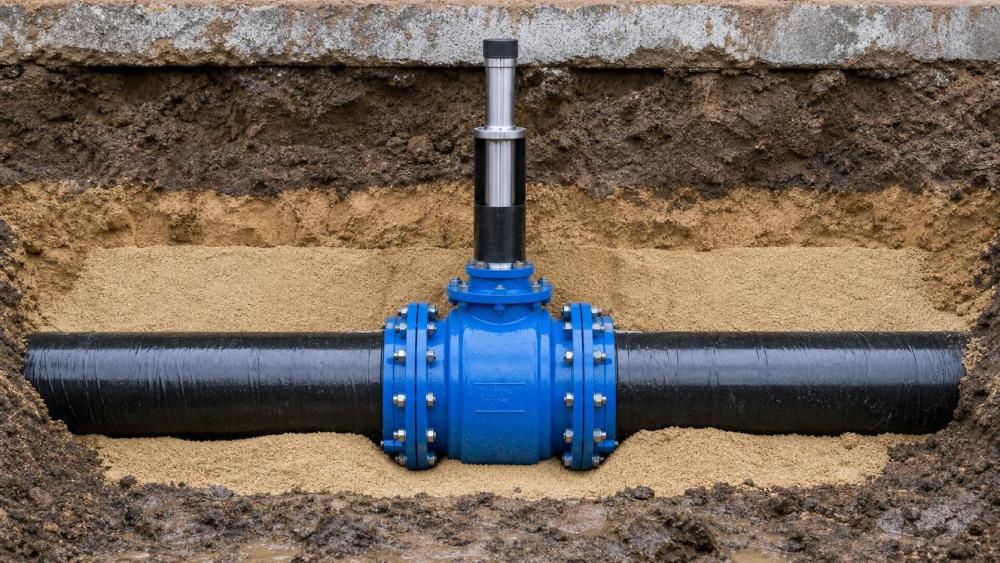
Coating is not an accessory; it is part of the valve material decision
For ductile iron and steel valves, external coating frequently determines whether the valve body is adequately isolated from its surroundings. A factory-applied coating may perform very well, but procurement documents should clarify the coating type, surface preparation, thickness requirements where applicable, adhesion expectations, holiday inspection requirements where applicable, repair methods, and protection of flange faces, fasteners, and stem extensions.
The installation crew also affects the corrosion outcome. Scratches from lifting chains, impact during trench placement, unsupported loading, and unprotected field modifications can compromise a coating before the system is commissioned. Backfill containing rocks, debris, or corrosive imported material creates further exposure. A valve specified for direct burial should be treated as a field-installed corrosion system, not merely a factory-finished component.
Internal linings and wetted coatings deserve separate attention. Their role is to protect the valve body from the conveyed water and to support suitable water-quality performance. Internal and external protection should not be assumed to be identical; they face different service conditions and may require different materials.
The components that often decide real service life
A buried ball valve contains several corrosion-sensitive interfaces. The ball and stem must retain a smooth, functional surface because corrosion or deposits can raise operating torque and damage the seats. Stainless steel is commonly used for these components, but the specified grade should be compatible with the water and external environment. The stem seal arrangement must prevent ingress of soil moisture while allowing reliable operation over time.
Bolts, flange hardware, gear operators, extension spindles, and valve-box components deserve the same scrutiny as the body. A corrosion-resistant valve can become difficult to operate if the extension system corrodes or if the operator is not adequately sealed. For flanged installations, designers should review gasket selection, bolt material, flange protection, and whether the selected metals could create galvanic concerns in wet soil.
Seats are usually selected for sealing performance, operating temperature, pressure, water quality, and expected cycling—not external soil corrosion. Yet they remain central to the valve’s practical life. A material choice that protects the body but does not suit the pressure differential or chemical exposure at the seats may still lead to leakage or difficult operation.
When standard coated ductile iron is enough—and when it is not
A coated ductile iron ball valve is often a sensible selection where soil conditions are ordinary, the utility has an established corrosion-control practice, and the valve is integrated into a compatible ductile iron or steel piping system. It offers a useful balance of structural strength, availability, size range, and lifecycle value. This is particularly relevant for municipal infrastructure, where replacement excavation can cost far more than the original valve.
A more cautious review is justified when the route passes through saline ground, tidal influence, industrial land, landfill areas, contaminated fill, persistently wet soil, or locations affected by nearby electrical infrastructure. Low soil resistivity, elevated chlorides or sulfates, and evidence of stray-current activity can all change the material and protection decision. No material comparison should replace a project-specific soil and corrosion assessment where the consequences of failure are high.
It is also worth separating “aggressive soil” from “aggressive water.” A project may have a relatively benign trench environment but water chemistry that calls for careful selection of stainless components, elastomers, linings, or bronze alloys. The reverse can also be true. Procurement teams should ask suppliers to identify which components are exposed internally, externally, or to both environments.
Questions to settle before the valve is purchased
A useful technical submittal should make the following points clear rather than leaving them buried in catalog language:
- What are the body, ball, stem, seat, seal, bolt, and actuator materials?
- Which surfaces receive internal lining, external coating, or wrapping?
- Is the valve intended for direct burial, vault installation, or above-ground service?
- What soil and groundwater information is available for the route?
- Are there dissimilar-metal connections, insulating requirements, or cathodic-protection interfaces to consider?
- What pressure rating, operating frequency, shutoff requirement, and allowable torque apply?
- Which local utility specifications, potable-water requirements, and project standards govern the installation?
Material certificates, coating records, dimensional drawings, pressure-test documentation, and traceability information may be as important as the headline material grade. This is one area where a low initial price can conceal downstream risk. If a specification only says “corrosion-resistant ball valve,” it does not provide enough direction for a meaningful technical comparison.
A balanced answer for municipal water projects
For the majority of buried water-main projects, the best answer is not simply “stainless steel.” A ductile iron body with a verified external protection system, corrosion-resistant operating components, and a design suitable for direct burial is often the most balanced solution. It combines the structural properties needed for underground infrastructure with protection that can be tailored to the environment.
Where chloride exposure, saline groundwater, contaminated soil, or unusual corrosion risk is confirmed, 316 stainless steel or duplex stainless steel may be justified for selected components or complete valve assemblies. That choice should follow a review of soil data, water chemistry, joining materials, coating strategy, and maintenance access—not an assumption that a higher-alloy metal solves every problem.
For utilities, EPC teams, and distributors comparing buried-valve options, IMPE’s approach to piping equipment evaluation is to connect material selection with casting quality, machining accuracy, coating control, joint design, installation conditions, and long-term serviceability. The most durable valve is the one whose materials and protective measures make sense together in the actual trench, not only on a datasheet.
Related News
- How to Assess a Rigid Coupling Supplier for Bore Accuracy and Traceable QualityOct 08, 2026Tribology & Kinematics Expert
- Titanium Alloys Compared: Balancing Strength, Corrosion Resistance, and MachinabilityOct 08, 2026CNC Kinematics Architect
- Where Ductile Iron Dismantling Joints Reduce Alignment Risk in Water PipelinesOct 08, 2026Pipeline Metallurgy Scientist
- Selecting a Precision Bearing Sleeve: Fits, Runout, and Material ChoicesOct 08, 2026Tribology & Kinematics Expert
- Face Milling Cutters: How Insert Geometry Affects Finish on Steel and AluminumOct 08, 2026CNC Kinematics Architect
- Single-Acting Cylinders for Clamping: Stroke, Force, and Return Spring ConsiderationsOct 07, 2026Fluid Power Control Strategist