
What Specs Matter for Seamless Steel Pipe in High-Pressure Water Lines?
For high-pressure water lines, seamless construction is only one part of the specification. A pipe can be seamless and still be unsuitable if its minimum wall thickness, material strength, end preparation, corrosion system, joint design, or test documentation does not match the actual hydraulic and installation conditions.
The most important distinction is between nominal operating pressure and the pressure the line must safely withstand over its service life. A water line may operate at a stable pressure for most of the day but experience much higher transient loads during pump starts, emergency shutdowns, rapid valve closure, air release events, or changes in flow direction. Pipe selection must be based on the governing design case, not only on the normal pump discharge pressure.
Does seamless pipe automatically provide a higher pressure rating?
No. Seamless steel pipe has no longitudinal weld seam, which can be beneficial where the specification demands uniformity of the pipe body, high material integrity, or a particular manufacturing standard. However, pressure capability is determined primarily by the relationship between outside diameter, effective wall thickness, material strength, design factor, temperature, corrosion allowance, and the applicable code or project standard.
A welded steel pipe manufactured and inspected to the appropriate water-pipeline standard can be fully suitable for high-pressure service. Conversely, a seamless pipe with an insufficient wall or an unsuitable grade is not made acceptable merely because it has no weld seam. In municipal and large-diameter water transmission work, welded steel pipe is common because it is practical for larger sizes and can be fabricated with purpose-designed linings, coatings, and joints. Seamless pipe is more often considered in smaller-diameter, high-pressure, compact, or mechanically demanding sections.
The specification should therefore state why seamless construction is required. Valid reasons may include project code requirements, a conservative integrity policy, compact routing with high pressure, compatibility with forged fittings, or service conditions where the buyer wants to avoid seam-related qualification issues. “Seamless” should not be used as a substitute for a complete pressure design.
Which pressure values should govern the pipe specification?
A technically complete inquiry should identify at least four pressure conditions:
- Normal operating pressure: the expected sustained pressure during ordinary operation.
- Maximum working pressure: the highest expected pressure under defined operating conditions.
- Surge or transient pressure: the additional pressure caused by hydraulic transients, often described as water hammer.
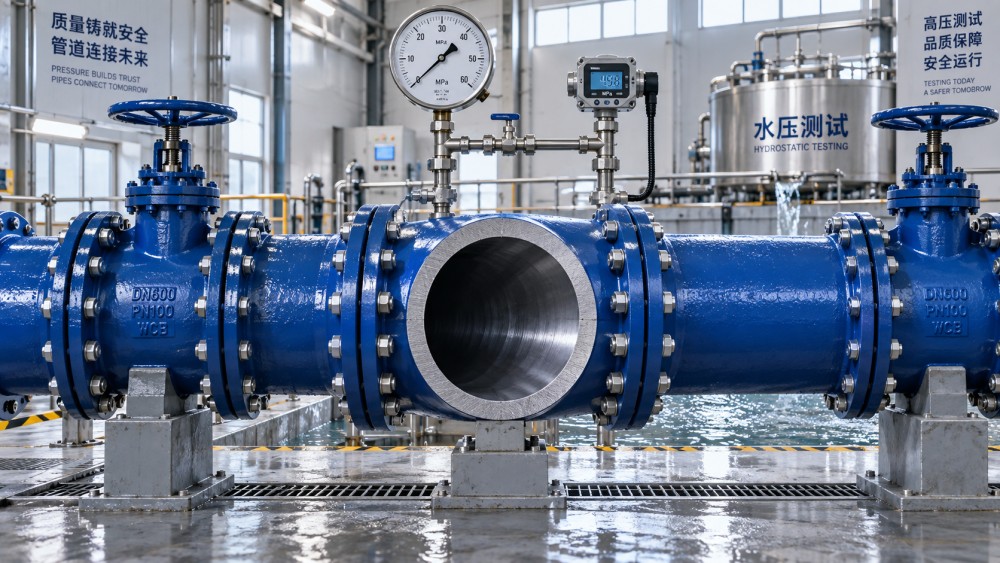
- Hydrostatic test pressure: the pressure applied during factory testing and, where required, field testing after installation.
These values are not interchangeable. A factory hydrostatic test demonstrates that the pipe can withstand a specified proof pressure under controlled conditions; it does not by itself confirm that the installed system is protected against repeated pressure surges, poor restraint design, corrosion, or ground movement.
Transient pressure deserves particular attention. In a long rising main or pumped transmission line, a rapid change in velocity can create a pressure increase that is materially higher than the normal operating condition. The magnitude depends on flow velocity, pipe stiffness, pipe length, valve closure time, pump characteristics, air management, and the system’s surge-control arrangement. The piping designer should define the transient envelope before the pipe wall is finalized. Increasing wall thickness after procurement has started can also affect fitting schedules, welding procedures, weight, transport planning, and support design.
How are diameter and wall thickness evaluated?
Nominal pipe size is not enough. The actual outside diameter, wall thickness, and permitted negative wall-thickness tolerance determine the pressure-bearing section. For seamless steel pipe high pressure water transmission specs, the relevant value is often the minimum available wall thickness, not simply the nominal wall printed in a catalog.
A simplified thin-wall relationship shows the basic design logic:
Hoop stress ≈ pressure × outside diameter ÷ (2 × wall thickness)
This expression is useful for understanding the direction of the variables: higher pressure and larger diameter increase hoop stress, while greater wall thickness reduces it. It is not a substitute for the governing design method. A proper calculation must use the code-prescribed formula, material allowable stress, weld or quality factors where applicable, corrosion allowance, manufacturing tolerance, temperature derating if relevant, and any project-specific load cases.
For the same pressure, a large-diameter pipe may require substantially more wall than a small line. The required wall can also be driven by factors other than internal pressure:
- external loads from soil cover, traffic, or construction equipment;
- vacuum or negative pressure caused by draining, pump trip, or inadequate air admission;
- ovalization risk during handling or installation;
- local stresses at supports, anchors, bends, and branch connections;
- threading, grooving, or machining requirements on smaller pipe sizes;
- future corrosion allowance where coating damage or aggressive soil is credible.
A frequent procurement error is requesting “Schedule XX” without confirming whether that schedule gives the required minimum thickness at the specified diameter. Schedule designations are familiar in some markets, but they are not universal pressure classes and should not replace a project calculation. The purchase specification should state the required dimensions in metric or imperial units, the minimum wall after tolerance, and the acceptable dimensional standard.
Which material grade is appropriate for water service?
The grade should be selected for its specified mechanical properties, weldability where field welding is planned, toughness requirements, chemical composition controls, availability in the required size, and compatibility with the chosen standard. Carbon steel is frequently used for water transmission, but its exact grade must follow the project’s governing code and service conditions.
Standards commonly encountered in international sourcing include ASTM, API, EN, ISO, and national standards. Their titles and intended applications matter. For example, ASTM A106 covers seamless carbon steel pipe for high-temperature service; it may appear in industrial piping specifications, but its presence does not automatically make it the best or only standard for a water line. API 5L and ISO 3183 address line pipe and may be relevant where project documentation adopts pipeline-style requirements. EN 10216 covers seamless steel tubes for pressure purposes, with the specific part and grade determined by the service requirement.
For water transmission systems, the project may instead use a waterworks standard for the pipeline assembly while separately defining the acceptable pipe material and manufacturing requirements. AWWA C200 is widely referenced for steel water pipe in certain markets, although the system design, coating requirements, joint details, and local authority rules must still be reviewed separately.
Material grade should not be specified by yield strength alone. A higher-strength grade can permit a thinner pressure wall in a calculation, but thinner pipe may be less forgiving during transport, handling, external loading, fabrication, or corrosion loss. It may also introduce stricter welding controls. The economically sensible choice is usually the grade-and-wall combination that satisfies the entire pipeline duty, rather than the combination that minimizes steel weight on paper.
What dimensional details should appear on the purchase order?
Ambiguous dimensions are a common source of costly disputes. The order should identify the outside diameter, nominal wall thickness, required minimum wall after permitted tolerance, length range or exact cut lengths, straightness requirements, end condition, and any restrictions on ovality or out-of-roundness.
End preparation is especially important because a high-pressure line is a system, not a collection of pipe lengths. Plain ends, beveled ends for butt welding, threaded ends, grooved ends, flanged ends, or prepared ends for mechanical couplings each create different compatibility and installation requirements. A pipe that passes a body-pressure calculation may still be a poor choice if its connection method has a lower pressure limit than the pipe itself.
For welded field joints, the bevel angle, root face, internal alignment tolerance, and welding procedure requirements need to match the wall thickness and construction method. For flanged or mechanical-joint sections, the flange class, gasket type, bolt material, restraint arrangement, and mating dimensions must be consistent with the maximum system pressure, including surge.
How should corrosion protection be specified?
Unprotected carbon steel is rarely an acceptable long-term assumption for a water line. The external environment and the water chemistry create separate corrosion questions, and the solution for one side of the pipe may not solve the other.
External protection should be selected after reviewing soil resistivity, chlorides, sulfates, moisture conditions, stray-current exposure, burial conditions, and the likelihood of coating damage during installation. Depending on the project, the system may require a protective external coating, field-joint coating, abrasion-resistant protection for difficult installation, cathodic protection, or a combination of these measures.
Internal protection depends on the conveyed water and operating regime. Potable water, raw water, treated process water, brackish water, and water containing abrasive solids create different requirements. Cement mortar linings, epoxy systems, polyurethane linings, and other qualified internal coatings each have limits related to water chemistry, temperature, application method, cure control, impact resistance, and repairability. A lining selected for corrosion resistance may not be suitable for high-velocity abrasive water; a mechanically robust lining may require careful attention to potable-water compliance.
Where the line carries drinking water, the coating and lining system should meet the applicable local health and regulatory requirements. A general statement that a coating is “food grade” is not a substitute for the approval documents recognized by the jurisdiction where the pipeline will be installed.
What tests and records should accompany seamless pipe?
The mill test certificate is a starting point, not the full quality plan. It should identify the heat or lot, chemical composition, mechanical test results, dimensions, applicable standard, and traceability markings. The buyer should ensure that the certificate format and traceability level match the contract requirement before production begins, rather than discovering the gap at shipment.
For high-pressure applications, the inspection plan may also require:
- hydrostatic testing of each length or testing in accordance with the applicable standard;
- non-destructive examination where specified, such as ultrasonic examination;
- dimensional inspection, including wall-thickness verification;
- visual inspection of pipe ends, surface condition, and defects;
- coating and lining inspection, including thickness, continuity, adhesion, and holiday testing where relevant;
- material identification and heat-number traceability maintained through cutting, coating, and shipment.
Testing requirements must be written with precision. “NDT required” is incomplete unless it states the method, coverage, acceptance criteria, standard, and reporting format. The same applies to hydrostatic testing: the required pressure, hold time, test medium, allowable leakage criterion, and record format should be clear.
Why do fittings and appurtenances often control the real pressure limit?
Pipe wall is only one pressure boundary. Elbows, tees, reducers, fabricated branches, valves, dismantling joints, couplings, flange assemblies, gauges, air valves, and restrained joints must all be rated for the same governing pressure condition. In a mixed-material system, the lowest-rated component can define the usable system pressure.
Changes in direction and diameter require particular care because internal pressure creates thrust forces. These forces must be resisted by thrust blocks, restrained joints, anchors, welded restraint assemblies, or a combination suited to the route and soil conditions. A well-specified seamless pipe cannot compensate for an underdesigned restraint system.
Air and vacuum protection also belongs in the pipe specification review. Water lines can see sub-atmospheric pressure during draining or transient events. If vacuum is credible, the pipe must be checked for external-pressure stability and the system must have appropriate air admission and operational controls. Internal-pressure design alone does not address collapse risk.
What should be clarified before requesting quotations?
A quotation request becomes comparable only when it defines the actual service. At minimum, it should state the fluid, operating and transient pressures, design temperature, pipe size and wall requirements, material standard and grade, length requirements, end preparation, corrosion protection, applicable code, inspection scope, documentation level, and destination requirements.
It is also prudent to identify whether field welding is permitted, whether material substitutions require approval, whether third-party inspection is required, and whether the supplier must provide coating repair materials or installation guidance. These details affect both technical compliance and commercial comparability.
The strongest specification is not necessarily the one with the most restrictive language. It is the one that connects pressure design, wall tolerance, corrosion strategy, connection rating, testing, and installation conditions into a consistent system. For high-pressure water transmission, that consistency matters more than the seamless label alone.
Related News
- Using Industrial Air Blow Guns to Clear Chips Without Spreading DebrisOct 15, 2026Fluid Power Control Strategist
- Ductile Iron Pipe Valves: Which AWWA Standards Apply to Water Main Projects?Oct 15, 2026Dr. Elias Vance
- Why Vacuum Suction Cups Lose Grip on MDF in Woodworking MachinesOct 15, 2026CNC Kinematics Architect
- Choosing a Variable Displacement Piston Pump Manufacturer: What to VerifyOct 15, 2026Fluid Power Control Strategist
- Parallel vs. Angular Pneumatic Grippers for Confined Assembly StationsOct 15, 2026Fluid Power Control Strategist
- Die Castings vs. Investment Castings: Which Costs Less at Your Production Volume?Oct 14, 2026Foundry Phase-Change Fellow