
Slip-On Pipe Flanges vs Weld Neck: How to Choose for Pressure and Installation Needs
When engineers compare slip on pipe flanges with weld neck flanges, the real question is rarely “which one is better” in the abstract. It is usually about fit for duty: pressure level, cyclic loading, available welding skill, field conditions, inspection requirements, and how much risk the owner is willing to carry over the life of the line. On paper, both are standard flange types used across industrial piping. In practice, they behave differently enough that the wrong choice can show up later as alignment trouble, weld rework, fatigue cracking, or unnecessary installation cost.
That is why technical evaluators tend to look beyond the catalog description. In water infrastructure, utility piping, plant utility lines, pump skids, process systems, and fabricated equipment, the flange decision sits at the intersection of mechanical design and installation reality. IMPE’s coverage of piping systems, machining capability, fittings, valves, fabrication, and long-term project value reflects that broader context: a flange is not just a component, but part of a system where material control, tolerances, welding practice, and service conditions all matter.
The basic structural difference matters more than it looks
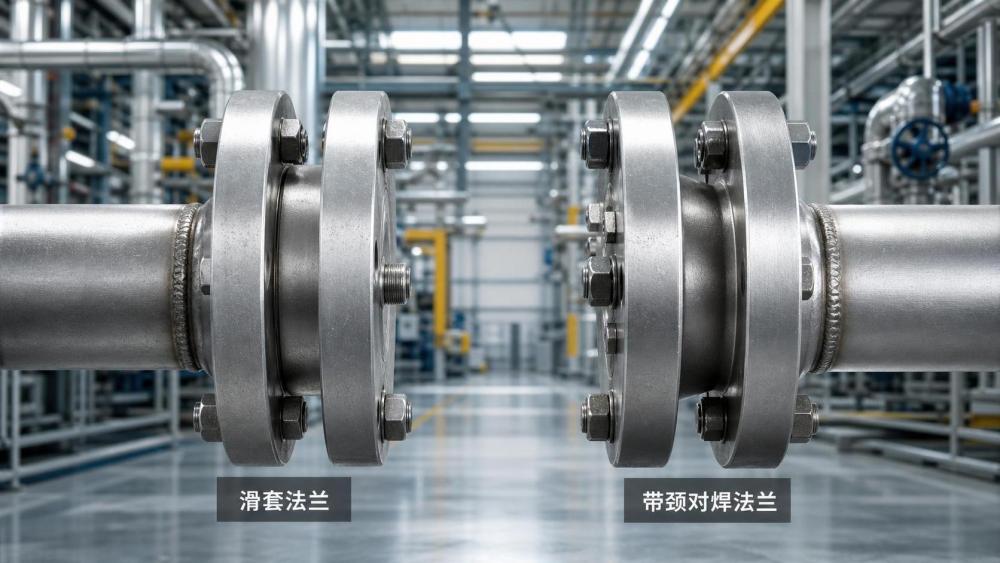
A slip-on flange slides over the pipe and is typically fillet welded, usually at the outside and often also at the inside. A weld neck flange has a tapered hub and is butt welded directly to the pipe. That geometry changes how stress moves through the joint.
With slip on pipe flanges, installation can be more forgiving during fit-up. The pipe can be inserted through the bore and positioned before welding, which helps when alignment in the field is not perfect. That is one reason slip-on designs remain common in lower-to-moderate pressure services, utility piping, and systems where speed of assembly is a practical concern.
A weld neck flange, by contrast, is designed to provide a smoother stress transition from flange to pipe wall. In systems exposed to higher pressure, temperature variation, vibration, or repeated pressure cycling, that transition is not a small detail. It is often the reason design teams prefer weld neck flanges for more demanding service.
Pressure is only one part of the decision
People often simplify the comparison into “slip-on for low pressure, weld neck for high pressure.” There is some truth there, but it is not enough for a proper review. Pressure rating depends on flange class, material, temperature, and the governing standard, not just flange type. A slip-on flange manufactured to the right class is still a pressure-rated component. The limitation is more about joint behavior under real operating conditions than about the flange body alone.
Where slip-on flanges become less attractive is in services where the joint sees frequent starts and stops, pressure surges, thermal cycling, pump vibration, or mechanical loading from misalignment. Municipal pumping stations, industrial water transfer, compressor discharge lines, and skid-mounted process equipment can all create those conditions. A line that is “moderate pressure” on the drawing may still be mechanically aggressive in service.
For steady utility service, clean water lines, non-critical process connections, and many fabricated assemblies, slip-on flanges can still make sense. The key is to distinguish nominal pressure from actual service severity.
Where slip-on flanges usually make practical sense
Slip-on flanges are often chosen because they reduce fabrication difficulty. That is not just a budget issue; sometimes it is also a schedule and access issue.
They are commonly favored when:
- Pipe alignment in the field may require some tolerance during assembly.
- Welding crews are working in less controlled site conditions.
- The line is not highly cyclic or unusually temperature-sensitive.
- Wall thickness and geometry do not justify a full-penetration butt weld approach.
- Fabricators want a simpler fit-up sequence for shop-built spools or support piping.
This is especially relevant in broad industrial supply chains, where buyers may source flanges, valves, pipe, and fabricated spools from different vendors. A component that is easier to align and weld can reduce cumulative field issues. But that benefit only holds if bore dimensions, flange face quality, and weld preparation are consistent. Poor machining or loose dimensional control can cancel out the apparent convenience.
That is one area where technical platforms like IMPE are useful: they help buyers connect flange selection with upstream manufacturing issues such as machining accuracy, material traceability, and inspection capability instead of evaluating parts in isolation.
Why weld neck flanges remain the default for more severe service
Weld neck flanges cost more and usually take more care to install, but they are often chosen because they give fewer surprises over time. The tapered hub and butt weld make them better suited to carrying bending moments and reducing stress concentration at the joint. In systems where failure consequences are high, that matters more than fabrication convenience.
You will typically see weld neck flanges favored in process piping with pressure fluctuations, elevated temperatures, larger diameters where mechanical loads increase, and services where radiographic or volumetric examination of the weld is part of the project requirement. They also tend to be preferred in critical pump and compressor connections, because rotating equipment can introduce vibration and nozzle loading that expose weaker joint designs.
Another practical point: if the piping specification already demands tighter control over weld quality, joint traceability, and NDT, moving to weld neck flanges is often more consistent with the rest of the quality philosophy. It avoids mixing a high-discipline inspection regime with a flange type selected mainly for installation ease.
Installation cost is not as simple as flange price
Slip-on flanges are usually less expensive to buy, and their fit-up can be faster. That is the obvious advantage. But the full installation cost depends on labor hours, weld volume, inspection scope, rework probability, and whether the line will be fabricated in the shop or assembled in the field.
For example, a slip-on flange may save time on alignment but still require two fillet welds. A weld neck flange requires a butt weld, which is more demanding, yet some contractors prefer it when they have qualified procedures, skilled welders, and a strong inspection workflow. In that environment, the “simpler” flange is not always the lower-risk choice.
There is also a supply-chain angle. In global industrial projects, delays are sometimes caused less by flange availability than by document quality, machining consistency, and inspection response time. Technical buyers increasingly look at those factors together. A lower-cost flange that creates clarification rounds on dimensions, weld details, or test records can erode its own savings.
Standards, bore matching, and the details that get missed
Flange selection should always be checked against the applicable standard and piping specification. Depending on the project, that may involve ASME, EN, ISO, AWWA, or owner-specific requirements. The standard will define dimensions, pressure-temperature relationships, facing type, and other critical details. What it will not do is make the engineering judgment for you about service severity.
One common mistake is treating all slip-on pipe flanges as interchangeable with minimal review of pipe schedule and bore relationship. Bore mismatch, excessive internal weld projection, or poor centering can affect flow and create local turbulence. In many utility services that may not be a major problem, but in higher-velocity lines, pump suction conditions, or cleanliness-sensitive systems, it deserves attention.
Another issue is corrosion. The crevice geometry associated with certain flange and weld configurations may matter in corrosive environments or where coating continuity is important. In waterworks and fluid infrastructure, lining systems, external coatings, and long-term corrosion protection are rarely separate from connection design. Evaluators should review the flange not just as a pressure boundary, but as part of the corrosion management approach.
A more useful way to decide
If a project team is undecided, a short review built around five questions usually gets closer to the right answer than a generic preference list:
- Is the line truly low-severity, or does it see cycling, surge, vibration, or thermal movement?
- Will the connection be shop fabricated under controlled conditions or welded in the field with limited access?
- What level of weld examination and documentation is required by the project specification?
- How sensitive is the system to misalignment, bore irregularity, or long-term leakage risk?
- Does the total installed cost still favor the cheaper flange after labor, inspection, and rework are considered?
In many cases, the answer is mixed. Utility water piping, equipment tie-ins, and general industrial services may justify slip-on flanges if the pressure class, welding practice, and maintenance expectations are well understood. Critical process lines, higher-load nozzles, and pressure systems where fatigue or inspection history is a concern usually push the decision toward weld neck flanges.
That is really the point: choose based on operating behavior, not just line item cost or what is familiar in the workshop. The best technical evaluations connect flange geometry, machining quality, welding execution, and service conditions into one decision. If any of those inputs are still uncertain, it is worth pausing to verify the project standard, weld procedure assumptions, and actual duty cycle before releasing the specification.
Related News
- How to Assess a Rigid Coupling Supplier for Bore Accuracy and Traceable QualityOct 08, 2026Tribology & Kinematics Expert
- Titanium Alloys Compared: Balancing Strength, Corrosion Resistance, and MachinabilityOct 08, 2026CNC Kinematics Architect
- Where Ductile Iron Dismantling Joints Reduce Alignment Risk in Water PipelinesOct 08, 2026Pipeline Metallurgy Scientist
- Selecting a Precision Bearing Sleeve: Fits, Runout, and Material ChoicesOct 08, 2026Tribology & Kinematics Expert
- Face Milling Cutters: How Insert Geometry Affects Finish on Steel and AluminumOct 08, 2026CNC Kinematics Architect
- Single-Acting Cylinders for Clamping: Stroke, Force, and Return Spring ConsiderationsOct 07, 2026Fluid Power Control Strategist