
Seamless Steel Pipe Specs for High-Pressure Water Transmission: Ratings and Tests
Choosing seamless steel pipe for a high-pressure water line is rarely a simple matter of selecting a diameter and asking for a pressure rating. For a project manager, the decision sits at the intersection of hydraulic duty, route conditions, installation constraints, public safety, schedule risk, and long-term maintenance. A pipe that appears adequate on a quotation may be unsuitable once pressure surges, corrosion allowance, weld-end preparation, or required test documentation are considered.
This guide to seamless steel pipe high pressure water transmission specs focuses on the questions that matter before material is released for production: how pressure ratings are established, which dimensions and grades must be specified, what tests demonstrate pipe integrity, and where project teams commonly leave avoidable gaps in their purchase documents.
Begin with the actual pressure envelope, not just the nominal operating pressure
In a water transmission project, the stated operating pressure is only one part of the design basis. A main that normally runs at a stable pressure can still experience significant transient loads during pump starts, emergency shutdowns, rapid valve closures, power loss, or changes in reservoir level. These short-duration events are often the reason a seemingly conservative pipe selection later becomes questionable.
The design team should distinguish between several pressure values:
- Normal operating pressure: the expected pressure range during ordinary service.
- Maximum steady-state pressure: the highest pressure expected under continuous operating conditions.
- Surge or water-hammer pressure: the temporary pressure rise caused by changing flow velocity.
- Design pressure: the governing pressure used to determine pipe wall thickness, components, and test requirements.
- Hydrostatic test pressure: the pressure applied during factory or field testing to verify the system’s integrity.
These values must be coordinated with pump curves, valve operating times, pipeline profile, elevation changes, and surge-control equipment. A pressure class selected without a transient analysis may look efficient at tender stage but become expensive when the contractor has to add thicker pipe, restraints, or protection devices after the route is fixed.
It is also important to avoid treating “pressure rating” as a universal label. Different standards use different design formulas, safety factors, allowable stresses, and test multipliers. The purchase specification should identify the governing standard and clearly state whether the quoted rating reflects design pressure, allowable operating pressure, or test pressure.
How wall thickness and steel grade work together
For seamless pipe, pressure capacity is driven mainly by outside diameter, nominal wall thickness, material strength, design factor, corrosion allowance, and the relevant code equation. Larger diameters require disproportionately careful thickness selection because the circumferential, or hoop, stress rises as diameter increases.
A simplified relationship is often expressed as hoop stress being proportional to pressure multiplied by outside diameter and divided by twice the wall thickness. In practice, the applicable piping or waterworks standard governs the final calculation. The formula must also account for permitted wall-thickness tolerance, material allowable stress, temperature where relevant, and any additional code factors.
That means two pipes with the same outside diameter may have very different service suitability. One may use a higher-strength grade with a moderate wall; another may use a lower-strength grade with a heavier wall to improve durability, weldability, or resistance to handling damage. There is no single “best” answer without considering the full installation environment.
Seamless construction is often selected where a project requires a continuous pipe wall with no longitudinal weld seam, particularly for demanding pressure service, compact pipe racks, pump stations, industrial process-water lines, or fabricated spools. However, “seamless” should not be used as a substitute for proper engineering. Material chemistry, heat treatment, dimensional control, inspection, and protective coating remain just as important.
Standards must be named precisely
Project documents frequently cite a general reference to ASTM, EN, API, ISO, or a local water utility standard without identifying the exact edition, grade, testing options, or supplementary requirements. This leaves room for inconsistent interpretation between the pipe mill, coating applicator, fabricator, and site inspection team.
Common steel pipe references may include ASTM specifications for seamless carbon steel pipe, EN standards covering seamless tubes for pressure purposes, or project-specific requirements based on regional water infrastructure practice. The appropriate choice depends on whether the line is classified as waterworks pipeline, pressure piping, process piping, penstock, firewater piping, or another regulated application.
A robust specification identifies at least the material standard, grade, manufacturing condition, dimensions, length range, permitted tolerances, required mechanical tests, hydrostatic test requirement, non-destructive examination scope, coating system, marking, certification level, and inspection rights. If the pipe will be welded in the field, the document should also address weldability-related controls such as chemical composition limits, carbon equivalent where appropriate, bevel geometry, and traceability of heats.
Project managers do not need to perform every metallurgical calculation themselves, but they should insist that the design authority, procurement team, and supplier are working from the same standard hierarchy. When a drawing calls for one grade, a bill of materials cites another, and a coating schedule assumes a third pipe standard, the mismatch usually surfaces at the least convenient moment.
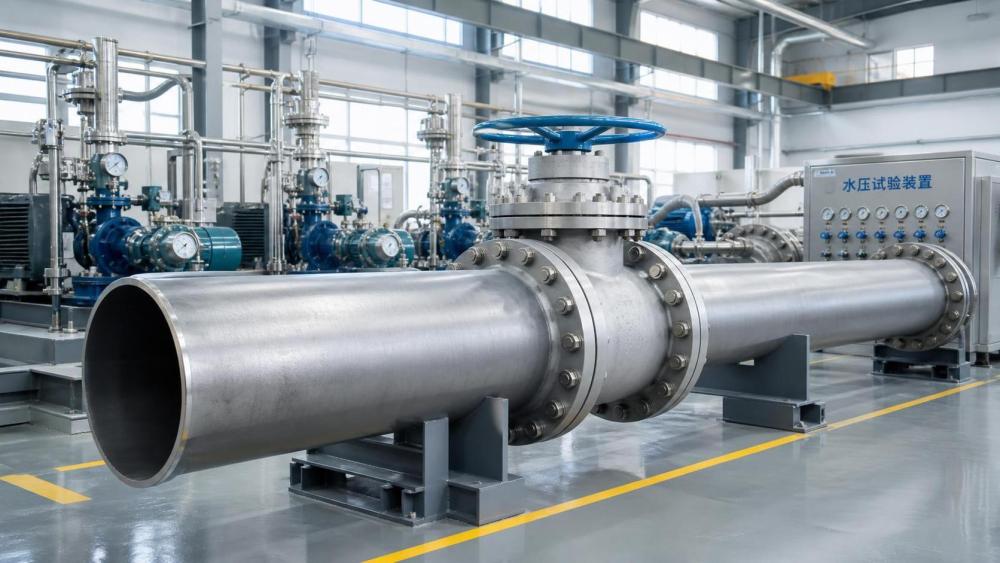
Tests that demonstrate more than a clean-looking pipe surface
High-pressure water transmission pipe should be supported by a test plan that verifies both material properties and manufacturing soundness. The exact scope should follow the governing standard and project risk level, but the following checks are commonly relevant.
Hydrostatic testing
Hydrostatic testing is a central acceptance test for pressure pipe. The pipe is filled with water and pressurized to the specified level for the required hold period. Inspectors look for leakage, sweating, visible deformation, or pressure loss beyond allowable limits. The test confirms that each tested length can sustain the specified pressure, but it does not replace chemical analysis, dimensional inspection, or non-destructive testing.
For procurement purposes, clarify whether testing is required on every pipe length or by an approved sampling method under the applicable standard. Also define whether the test pressure is based on a standard minimum, a project-specific multiplier, or the design pressure of a particular pipeline section.
Non-destructive examination
Ultrasonic testing is widely used to detect laminations, wall-thickness variations, and certain internal discontinuities. Eddy-current testing may be used for surface or near-surface imperfections, depending on product size and specification. Magnetic particle or liquid penetrant testing can be relevant for end areas, repairs where allowed, or fabricated components.
The key question is not simply whether “NDT is included.” It is what method applies, what acceptance criteria are used, how much of the pipe is examined, and whether the procedure is qualified to the project standard. A 100% ultrasonic examination requirement has a different commercial and quality implication from a general statement that pipe will be “inspected.”
Mechanical and chemical verification
Mill test certificates should report the heat chemistry and the required mechanical properties, typically including yield strength, tensile strength, and elongation. Where the service environment demands it, impact testing, hardness limits, or supplementary toughness requirements may also be needed. Positive material identification may be appropriate when multiple grades are stored or fabricated in the same facility.
Review the certificates against the actual pipe markings and heat numbers. A certificate pack that cannot be linked to individual lengths, bundles, or cut pieces creates a traceability gap that becomes harder to repair after coating and installation.
Dimensional inspection
Outside diameter, wall thickness, ovality, straightness, length, end squareness, and bevel dimensions all affect construction. Thin deviations may not seem dramatic in the yard, yet they can cause alignment problems at girth welds, difficulty installing mechanical couplings, or uneven fit-up with flanges and valves. For pipelines with internally applied linings, dimensional checks should be coordinated with lining thickness and allowable bore reduction.
Corrosion protection is part of the pressure specification
Pressure capacity on day one is not the same as reliable pressure capacity after years in wet soil or chemically active service. External corrosion can be influenced by soil resistivity, moisture, chlorides, stray current, dissimilar-metal connections, coating damage, and groundwater conditions. Internal corrosion or erosion may arise from water chemistry, suspended solids, disinfectant residuals, flow velocity, and periods of stagnation.
Depending on the project, the pipe system may require a fusion-bonded epoxy coating, liquid epoxy, polyethylene-based external protection, cement mortar lining, polyurethane lining, or another qualified system. The correct option depends on the water quality, handling method, installation approach, repairability, and applicable drinking-water or environmental requirements.
Specify surface preparation grade, dry film thickness, holiday detection requirements, adhesion testing, repair materials, and coating inspection records. It is not enough to state “epoxy coated.” A coating that performs well in an indoor fabrication shop may fail prematurely if its surface preparation or field-joint repair process is poorly controlled.
Procurement questions that prevent site disputes
Before issuing a purchase order, a project manager should be able to answer a few practical questions without relying on assumptions:
- What pressure governs each pipeline segment after elevation and surge are considered?
- Is the specified wall thickness the nominal value or the required minimum after manufacturing tolerance and corrosion allowance?
- Which exact standard, grade, and edition apply to the seamless pipe?
- Are pipe ends intended for butt welding, flanges, grooved couplings, mechanical joints, or restrained connections?
- Which factory tests are mandatory, and which reports must be submitted before shipment?
- Does the coating system match the actual soil, water, handling, and field-joint conditions?
- How will heat numbers and test records remain traceable after cutting, blasting, coating, and spool fabrication?
These questions are especially important when pipes, fittings, bends, reducers, valves, and fabricated assemblies come from more than one source. The pressure boundary is only as dependable as its least compatible component. A pipe may meet the specified rating while a transition fitting, flange class, gasket, restraint system, or field weld procedure becomes the real limit.
A balanced specification protects both budget and service life
Over-specifying every length of pipe can consume budget that would be better spent on surge control, corrosion investigation, inspection, or installation supervision. Under-specifying may create an even larger liability: restricted operating pressure, repeated repair work, delayed commissioning, or a shortened asset life. The goal is not the thickest wall or the longest test list. It is a coherent system matched to the actual duty.
For high-pressure municipal and industrial water projects, the most dependable approach is to connect hydraulic design, pipe material selection, corrosion engineering, joining method, and quality documentation from the beginning. Clear seamless steel pipe high pressure water transmission specs give suppliers a measurable target and give project teams evidence that the installed pipeline can perform as intended when pressure conditions become demanding rather than merely routine.
Related News
- Using Industrial Air Blow Guns to Clear Chips Without Spreading DebrisOct 15, 2026Fluid Power Control Strategist
- Ductile Iron Pipe Valves: Which AWWA Standards Apply to Water Main Projects?Oct 15, 2026Dr. Elias Vance
- Why Vacuum Suction Cups Lose Grip on MDF in Woodworking MachinesOct 15, 2026CNC Kinematics Architect
- Choosing a Variable Displacement Piston Pump Manufacturer: What to VerifyOct 15, 2026Fluid Power Control Strategist
- Parallel vs. Angular Pneumatic Grippers for Confined Assembly StationsOct 15, 2026Fluid Power Control Strategist
- Die Castings vs. Investment Castings: Which Costs Less at Your Production Volume?Oct 14, 2026Foundry Phase-Change Fellow