
How to Assess an IMPE Piping Equipment Supplier for Municipal Projects
Selecting the right partner for municipal water infrastructure requires more than comparing product catalogs and prices. Assessing IMPE piping equipment supplier reliability for municipal water projects involves reviewing material traceability, pressure ratings, coating performance, quality documentation, production capacity, delivery control, and technical support. A structured supplier evaluation helps project teams reduce lifecycle risk while securing durable piping systems for demanding public infrastructure applications.
Municipal piping procurement is unusual because the equipment is expected to remain in service for decades, often underground and difficult to inspect after installation. A supplier failure may not appear at delivery. It may emerge years later through leakage, premature corrosion, joint separation, incompatible fittings, unavailable replacement parts, or incomplete records during a network repair. For that reason, the most useful assessment is not “Can this supplier make pipe?” but “Can this supplier repeatedly deliver a verified system that fits this project’s technical, commercial, and operating conditions?”
What should be assessed before comparing prices?
Price should be compared only after the technical basis is aligned. A lower quotation may exclude essential items such as restrained joints, special fittings, external protection, flange drilling, field repair materials, testing certificates, or project-specific packaging. It can also be based on a different pipe class, nominal pressure rating, lining thickness, coating system, or inspection scope.
A reliable evaluation begins with a clear project data package. At minimum, this should identify:
- pipe material and diameter range;
- design pressure, surge pressure, and test pressure;
- water, wastewater, irrigation, or industrial fluid application;
- installation method, including open trench, trenchless crossing, bridge installation, or above-ground exposure;
- soil corrosivity, groundwater conditions, and stray-current risk where relevant;
- joint type, restraint requirements, and allowable angular deflection;
- internal lining and external coating requirements;
- applicable national, local, utility, or consultant specifications;
- required documentation, inspection hold points, and delivery schedule.
Without this baseline, quotations cannot be compared fairly. The procurement team may believe it is evaluating competing suppliers while actually comparing different technical solutions.
How can a buyer verify that pipe material is genuinely traceable?
Material traceability is one of the most important indicators of supplier control. For ductile iron pipe, fittings, valves, flanges, fabricated steel spools, and related components, traceability links the delivered product to its production batch, heat, chemical composition, mechanical properties, and inspection record.
Ask the supplier how traceability works in practice, not merely whether it is “available.” A credible answer should explain the identification method used from casting or fabrication through finishing, coating, storage, and shipment. Depending on the product, this may include casting marks, heat numbers, batch codes, durable labels, barcodes, or serialised inspection records.
Material test certificates should be readable, tied to identifiable lots, and consistent with the order quantities. A certificate that states a standard but does not connect to actual production batches provides limited protection. The same concern applies when one generic report is submitted for many different sizes or production dates without a clear batch relationship.
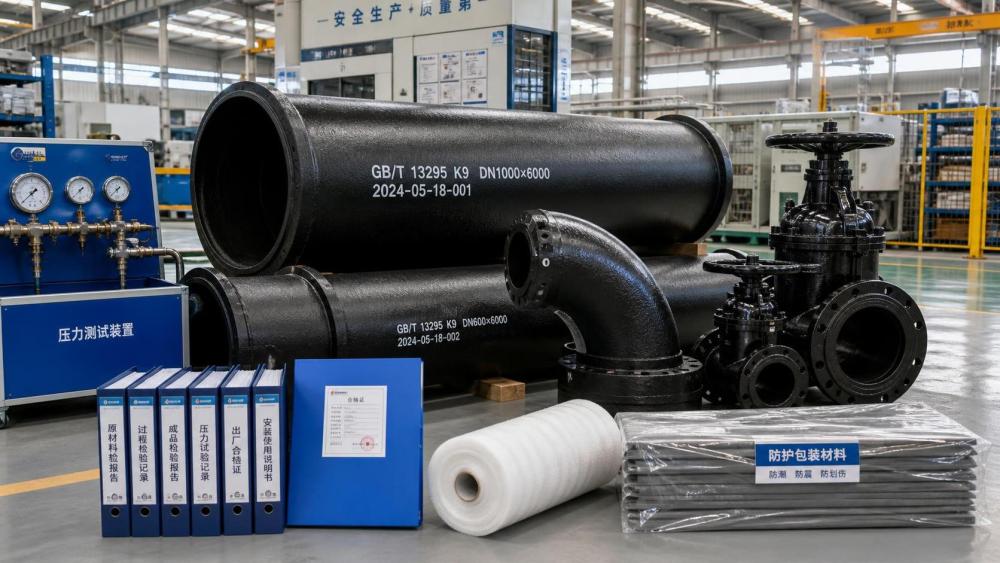
For ductile iron products, buyers normally need evidence relevant to the specified standard and product category, including chemical and mechanical test records where required. For fabricated steel piping, the review may need to extend to plate or coil certificates, welding procedure documentation, welder qualifications, non-destructive examination records, hydrostatic testing, and coating inspection reports. The exact records should follow the contract specification rather than a generic document checklist.
Which standards matter, and why is naming a standard not enough?
Standards establish a common technical language, but compliance claims must be examined carefully. Municipal water projects may refer to AWWA standards, EN standards, ISO standards, national regulations, utility specifications, or a combination of these. For example, ductile iron pipe projects in North America may reference AWWA C151/A21.51 for pipe manufacturing, AWWA C104/A21.4 for cement-mortar lining, and AWWA C116/A21.16 for certain zinc-based external coatings. European and other international projects may instead use EN 545, ISO 2531, or locally adopted equivalents.
These references are not automatically interchangeable. Dimensions, pressure classifications, joint details, test requirements, coating assumptions, and acceptance practices may differ. A supplier familiar with one market may produce technically sound goods that nevertheless do not meet the project’s specified system standard.
Ask for a compliance matrix that maps each contract requirement to supporting evidence: drawings, test methods, certificates, inspection points, and final records. This makes gaps visible early. A simple statement such as “manufactured according to international standard” is not an adequate substitute for a project-specific compliance review.
It is also important to distinguish between a management-system certificate and product compliance. ISO 9001 certification, where valid and applicable, may indicate that a supplier has a documented quality-management system. It does not by itself prove that each pipe, fitting, valve, or coating meets the project specification.
How should pressure rating and surge resistance be evaluated?
Municipal networks do not operate under one constant pressure. Pump starts and stops, valve closures, power interruptions, air release events, and changes in demand can create transient pressure conditions. A pipe selected only against normal operating pressure may not provide an adequate margin against surge events.
The project hydraulic design should define the relevant pressures. The supplier’s responsibility is then to demonstrate that the proposed pipe class, wall thickness, joint system, fittings, valves, and restraint arrangement are appropriate for those conditions. This is especially important at pump stations, transmission mains, elevation changes, pressure zones, dead ends, and locations with rapid control-valve action.
There is a frequent procurement error here: pipe is reviewed in isolation while fittings and joints receive less attention. Yet fittings often experience high local loads, and joint performance can determine whether movement, pressure thrust, settlement, or temperature variation becomes a failure point. A reliable supplier should be able to explain the limits of its joint design, available restraint options, bend radii or deflection allowances, and compatibility with the specified fittings.
Where the design includes thrust blocks, restrained joints, anchors, or special supports, the selected piping system should match the civil and hydraulic design assumptions. Suppliers should not be expected to replace the engineer of record, but they should identify obvious inconsistencies in the requested configuration rather than simply accepting every line item.
Why do lining and coating systems deserve separate scrutiny?
Pipe body strength alone does not determine service life. Internal lining affects hydraulic performance, water quality considerations, abrasion resistance, and protection against corrosion. External coating must be suited to the soil, groundwater, handling method, and installation environment.
Cement-mortar lining remains widely used for many potable-water and raw-water applications, but suitability depends on the water chemistry, operating regime, and governing specification. In wastewater, aggressive industrial effluent, highly abrasive service, or particular chemical environments, alternative linings or more detailed chemical-resistance review may be needed. A supplier that proposes a lining should provide its specification, application controls, curing or inspection approach, and repair procedure for damage found before installation.
External protection should not be selected as a standard catalogue item without understanding field conditions. Soil resistivity, pH, chlorides, sulfates, moisture, contaminated ground, and stray electrical currents can materially affect corrosion risk. Polyethylene encasement, zinc-based coatings, epoxy systems, and other protective methods each have different roles and limitations. The right solution may involve both a suitable factory coating and project-level corrosion-control measures.
Ask a practical question: what happens if the coating is damaged during unloading, cutting, or installation? A credible supplier will have documented repair materials and instructions, and will state who is responsible for inspection and acceptance of repairs in the field.
What documents should be required before shipment?
Documentation should reflect actual project risk. A small, straightforward order does not require the same administrative burden as a large transmission-main package, but major municipal projects should define a formal manufacturing and inspection dossier.
Typical records may include approved drawings, material certificates, dimensional inspection reports, hydrostatic test records where specified, lining and coating inspection reports, batch traceability lists, packing lists, certificates of conformity, and release documentation from the purchaser or third-party inspector where applicable. For valves, the file may also require pressure test records, operating torque information, coating details, and identification of critical components.
The timing matters as much as the document list. If drawings are approved after production begins, or test reports arrive only when goods reach port, the project loses the opportunity to correct problems before shipment. The contract should establish document-submission dates, review periods, hold points, and the consequences of nonconforming goods.
How can production capacity and delivery reliability be tested?
Stated factory capacity is less informative than available capacity during the project’s required production window. A supplier may have impressive annual output but limited ability to deliver the required diameter mix, special fittings, coating system, or packaging format during the needed months.
Request a production and delivery plan that breaks down the order by size, product type, manufacturing stage, inspection stage, packaging, and shipping lot. Review whether high-volume standard pipe is being confused with low-volume special fittings, flange adaptors, restrained couplings, or valves that often determine the real critical path.
For international supply, delivery control also includes export packaging, port handling, container loading limits, break-bulk capability where relevant, shipping documentation, and protection against corrosion or coating damage in transit. Long pipes, heavy fittings, and fragile lining systems require practical loading arrangements. A supplier that regularly ships industrial products but has limited experience with municipal pipe packages may underestimate these risks.
Past delivery performance can be useful, but references should be interpreted carefully. Ask for examples comparable in diameter range, standards, destination, and documentation requirements. A supplier that has delivered small commercial orders is not automatically ready for a phased municipal rehabilitation programme with strict inspection and release procedures.
Is a factory audit necessary for every municipal project?
Not every order justifies a site audit, but high-value, technically complex, or first-time supply relationships usually warrant deeper verification. An audit can be performed by the purchaser, an engineering consultant, or an independent inspection organisation. Its value lies in observing controls that brochures cannot show: raw-material handling, moulding or fabrication practices, testing equipment, calibration records, coating application, nonconformance management, warehouse segregation, and traceability through the production flow.
For smaller projects, a remote assessment may provide a reasonable first screen. This can include live video review of production areas, copies of calibration certificates, sample quality records from completed orders, traceability demonstrations, and interviews with quality and engineering personnel. Remote review is not equivalent to on-site inspection, but it can identify whether the supplier’s systems are substantive or largely presentational.
What are the most common warning signs?
Several warning signs recur in municipal piping procurement:
- the quotation omits a clear standard, pressure class, lining, coating, or joint specification;
- technical questions are answered only by sales staff, with no engineering input;
- certificates are generic, incomplete, difficult to match to product batches, or issued before production dates;
- the supplier cannot explain how fittings, valves, and pipes are made compatible as a system;
- delivery promises are not supported by a production schedule;
- special items are treated as routine despite unusually long manufacturing lead times;
- the supplier resists third-party inspection or refuses to define acceptance criteria;
- coating and lining repair procedures are unavailable;
- commercial terms shift quality risk entirely to the purchaser before inspection and document approval.
None of these issues automatically proves that a supplier is unsuitable. Together, however, they indicate that the buyer may be assuming uncontrolled lifecycle and schedule risk.
How should technical support be judged after the purchase order is issued?
Municipal projects often encounter field conditions that were not fully visible during tendering: an unexpected tie-in dimension, a need for a special adaptor, a damaged coating area, a changed elevation, or an installation question involving joint restraint. The relevant test is whether the supplier can respond with accurate, documented guidance within the project’s decision timeframe.
Assess who will provide that support. Is there an identified technical contact? Can the supplier issue revised drawings under document control? Are installation manuals available in the required language? Can it provide field advice without making unverified design claims? Is there a defined process for nonconformance reports, replacement material, and warranty review?
The strongest suppliers treat documentation, manufacturing, logistics, and field support as connected parts of one delivery system. That is the practical standard behind supplier reliability for municipal water projects. The aim is not to find a supplier with the lowest initial price or the largest catalogue. It is to select a partner whose materials, records, production controls, and technical response can withstand the full life of a public infrastructure project.
Related News
- Using Industrial Air Blow Guns to Clear Chips Without Spreading DebrisOct 15, 2026Fluid Power Control Strategist
- Ductile Iron Pipe Valves: Which AWWA Standards Apply to Water Main Projects?Oct 15, 2026Dr. Elias Vance
- Why Vacuum Suction Cups Lose Grip on MDF in Woodworking MachinesOct 15, 2026CNC Kinematics Architect
- Choosing a Variable Displacement Piston Pump Manufacturer: What to VerifyOct 15, 2026Fluid Power Control Strategist
- Parallel vs. Angular Pneumatic Grippers for Confined Assembly StationsOct 15, 2026Fluid Power Control Strategist
- Die Castings vs. Investment Castings: Which Costs Less at Your Production Volume?Oct 14, 2026Foundry Phase-Change Fellow